
Arizona – where we saw grand sites above and below ground, learnt about how wild the West was and of the man who tamed it with fast food, visited a town full of donkeys, fell in love with Route 66 landmarks, and drove, and drove and drove.
Arizona was the last contiguous state to join the United States in 1912. However, this was many years after it was sold to America by the Mexicans following the end of the Mexican-American War in 1848. It seemed like nobody quite knew what to do with it at first and so the territory was lumped in with New Mexico for a time.
Brigham Young began filling the place up with Mormons in the late 19th Century (including Mitt Romney’s ancestors) and other white settlers followed with the railways. But the white settlers to Arizona didn’t like the idea of being ruled by New Mexico’s largely hispanic politicians and, over time, pushed for independence. As one US Senator put it at the time “This is the cry of a pure-blooded white community against the domination of a mixed-breed aggregation of citizens of New Mexico, who are Spaniards, Indians, Greasers, Mexicans, and everything else.”
One hundred years on, and Arizona still has a reputation for racist laws with the introduction of the controversial anti-immigration Senate Bill 1070 which was widely criticized outside of Arizona for legalising racial profiling.
However, while its politics may be ugly and restrictive, Arizona’s landscapes are beautiful and liberating.
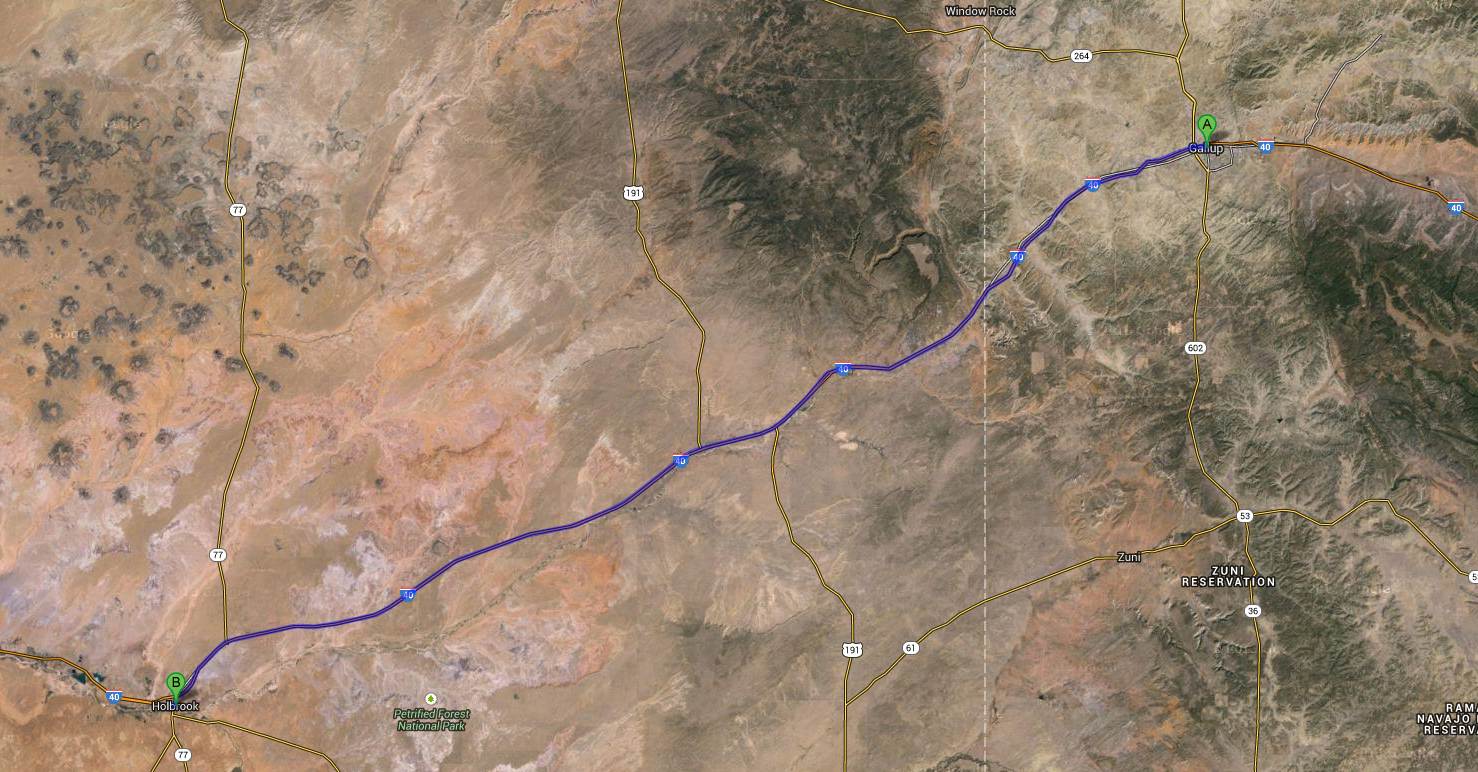
The route from Gallup to The Petrified Forest National Park and Holbrook
Actually seeing what Rickie Lee Jones was on about in The Orb’s Little Fluffy Clouds (this was playing on the car stereo as we drove through Arizona).
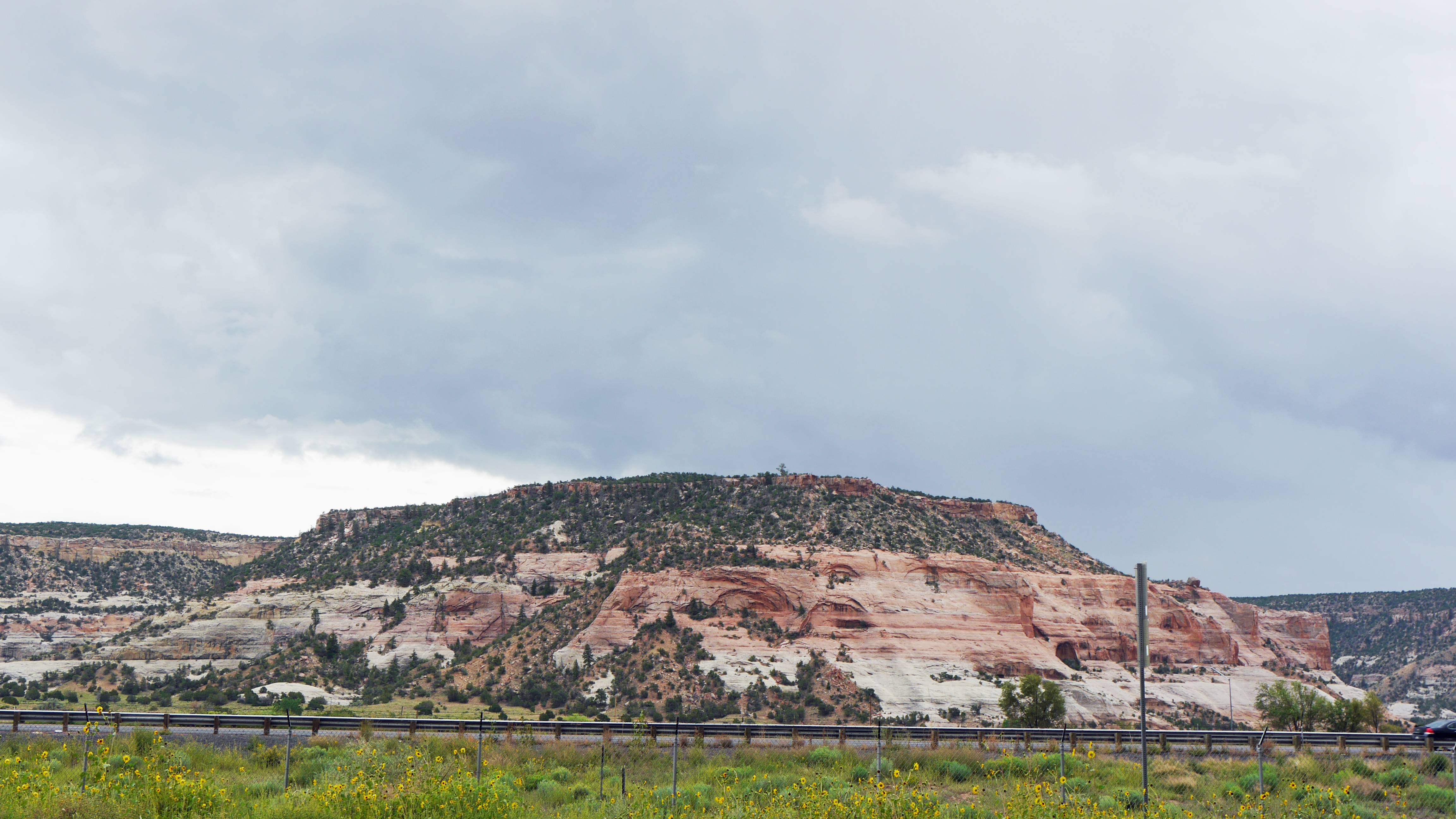
Big Fluffy Clouds
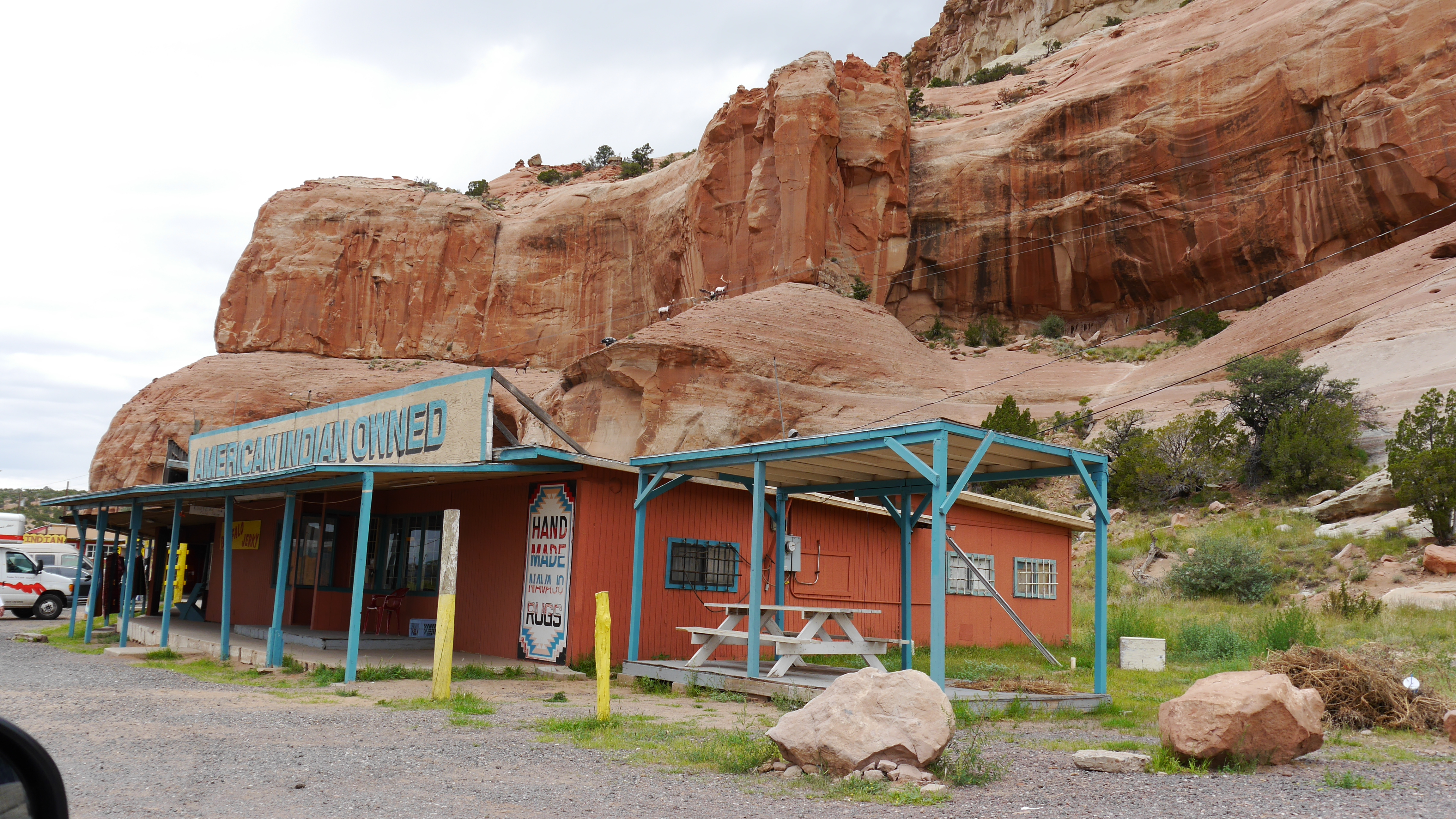
A Navajo trading post as we came over the border
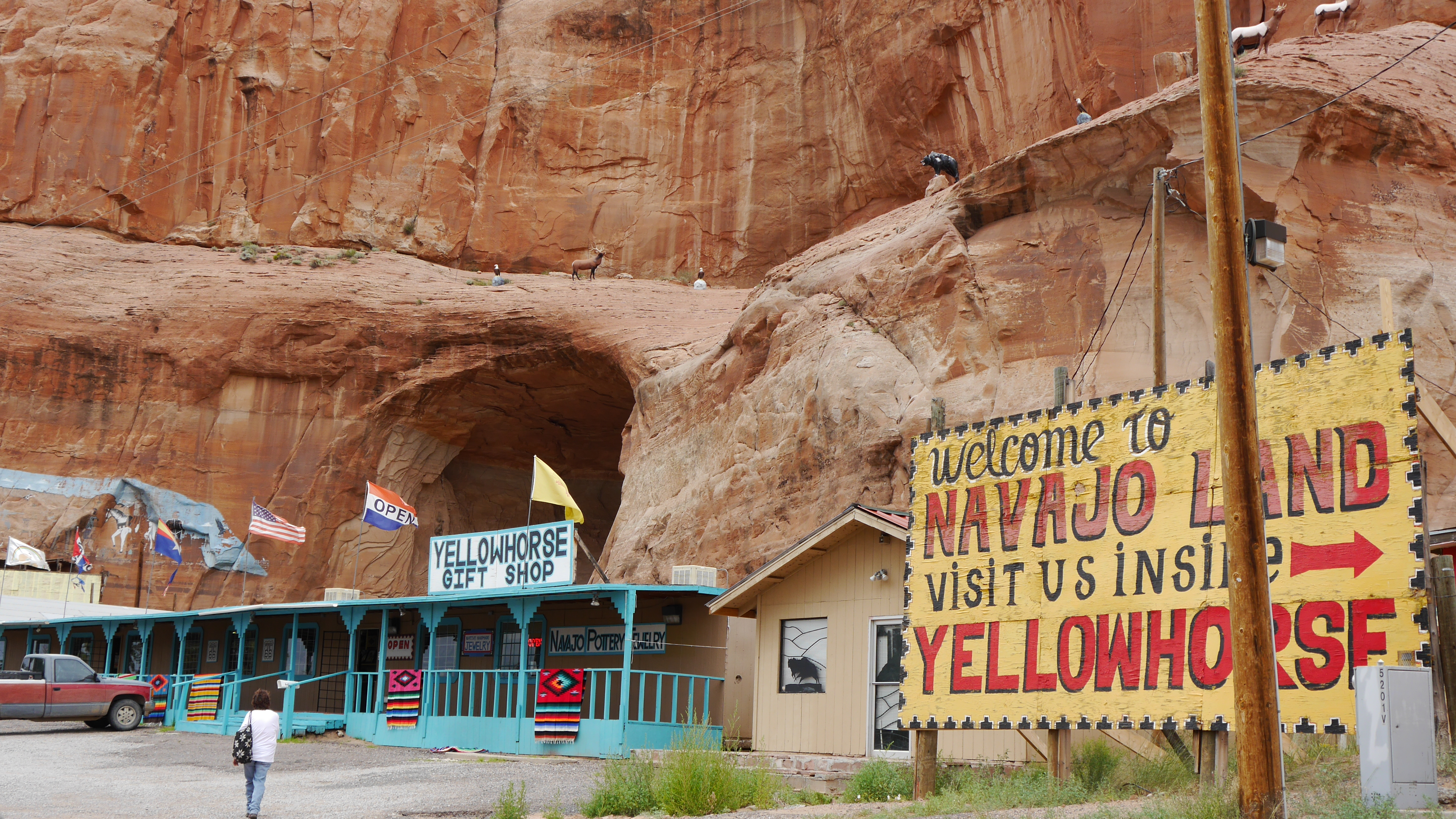
Petrified Forest National Park
August 26 2014, Michelle’s 50th birthday. Given how well-preserved Michelle was for her age, we decided to visit another well preserved beauty – the Petrified Forest National Park.
The park had an amazing array of petrified trees from the late Triassic period (that’s 225 million years ago to all those scratching their heads). The park also hosts the Painted Desert which self-describes a series of rock formations of wildly contrasting colours. We spent half a day exploring the park; driving through the beautiful vistas and stopping to go on a number of walking tracks.
Bizarrely, sitting in the middle of this 380 square kilometre piece of wilderness is a pub (or “inn” as the Americans call them). The Painted Desert Inn was built in 1937 and was designed to provide a rest stop for people travelling on Route 66. However, there was no electricity and all water had to be carted in. Also, because of the distance from supplies, the building was built out of what was handy – petrified wood and stucco. Unfortunately, the inn closed many years ago so we could only drink in the landscape. But it was a fitting place to reflect on the beauty that can be fashioned from the epic passage of time.

The Painted Desert.
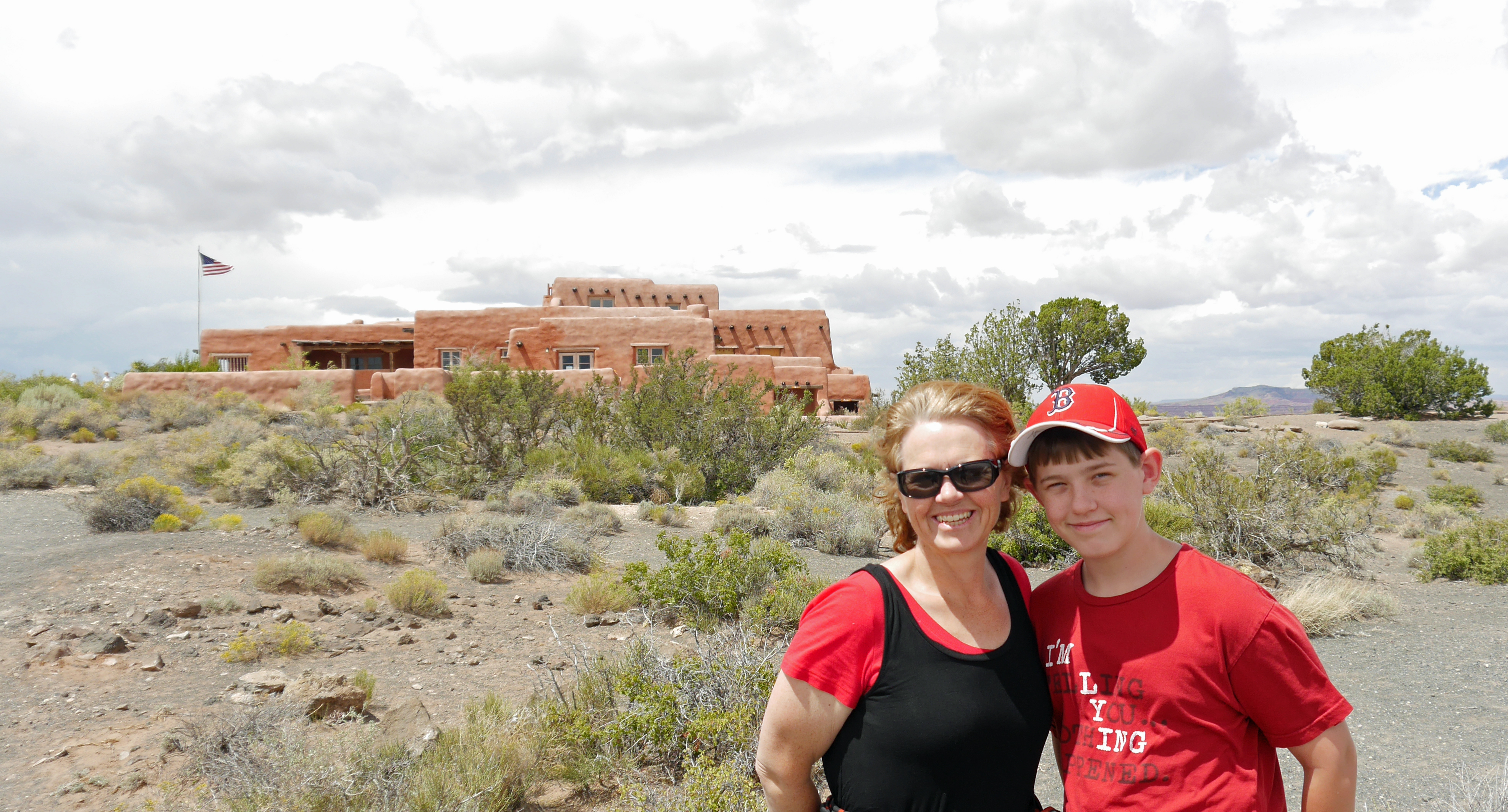
Michelle and Harrie outside the Painted Desert Inn – Arizona’s equivalent of The Pub With No Beer.

Here you can see the petrified wood that makes up the Inn’s walls.
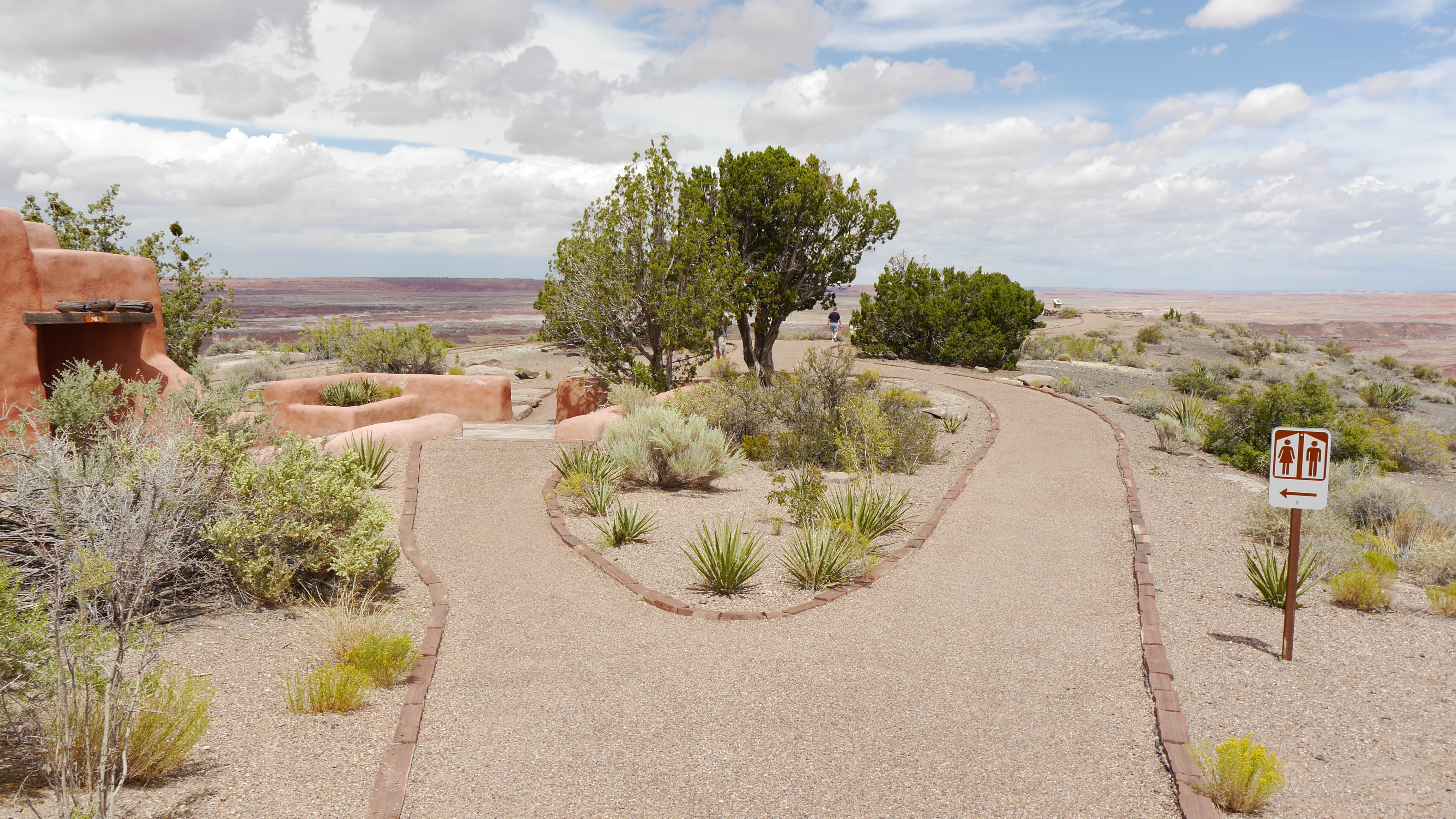
We found America’s national parks to be very well maintained as this pathway next to the Painted Desert Inn shows.

Inside the Painted Desert Inn. Just as colourful as the outside.
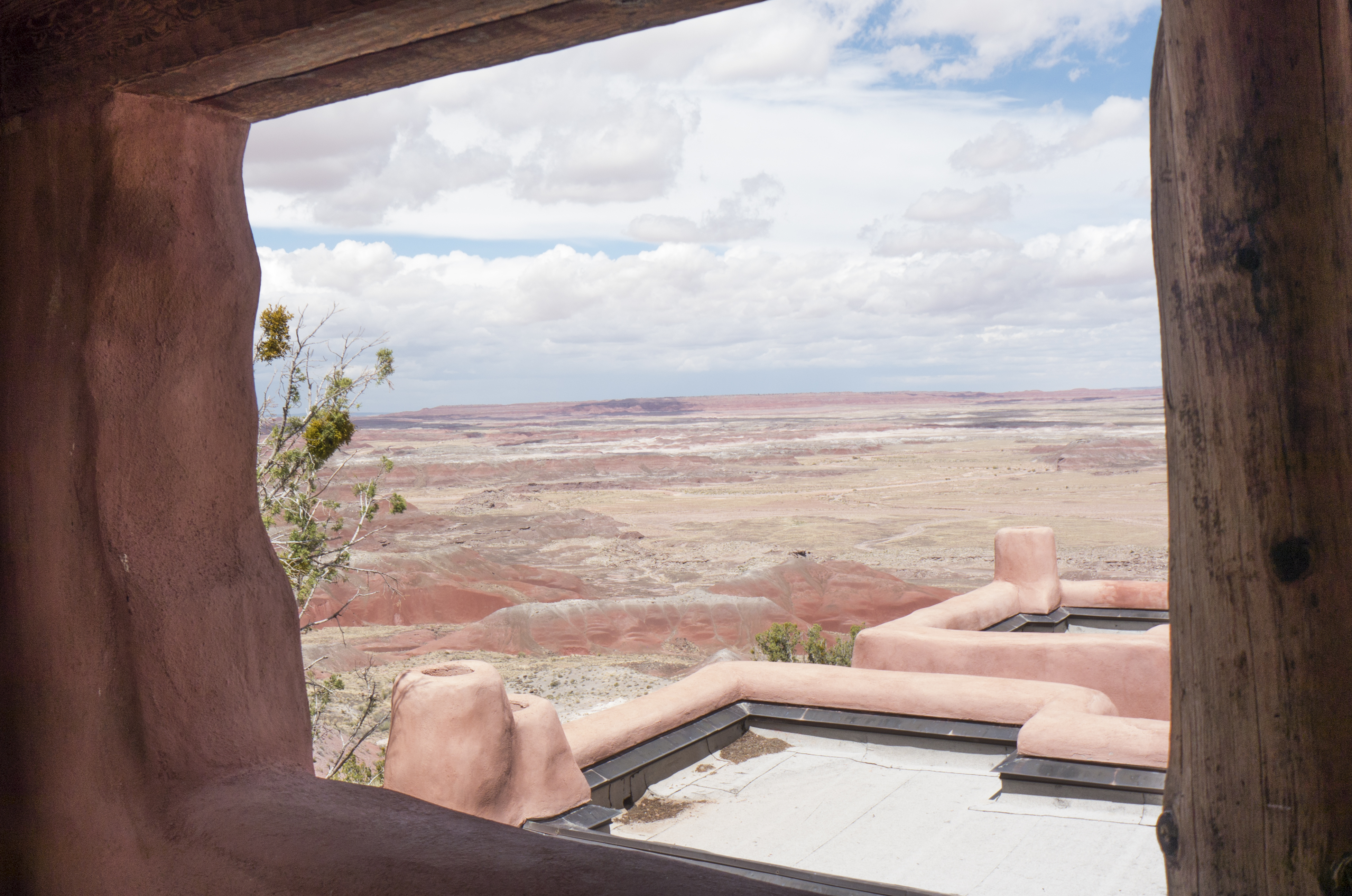
The view from the Inn’s window.
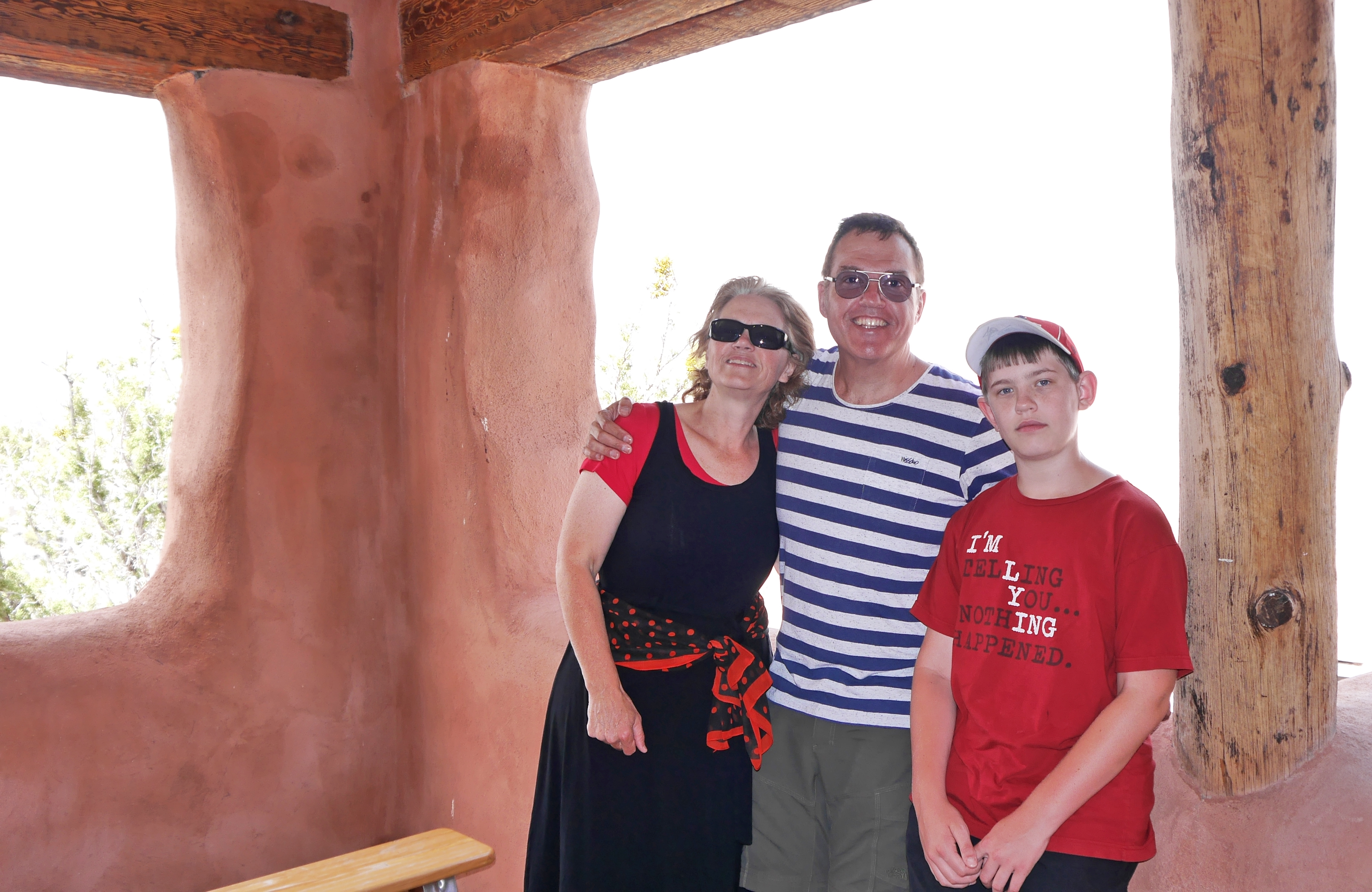
Some desert nomads.
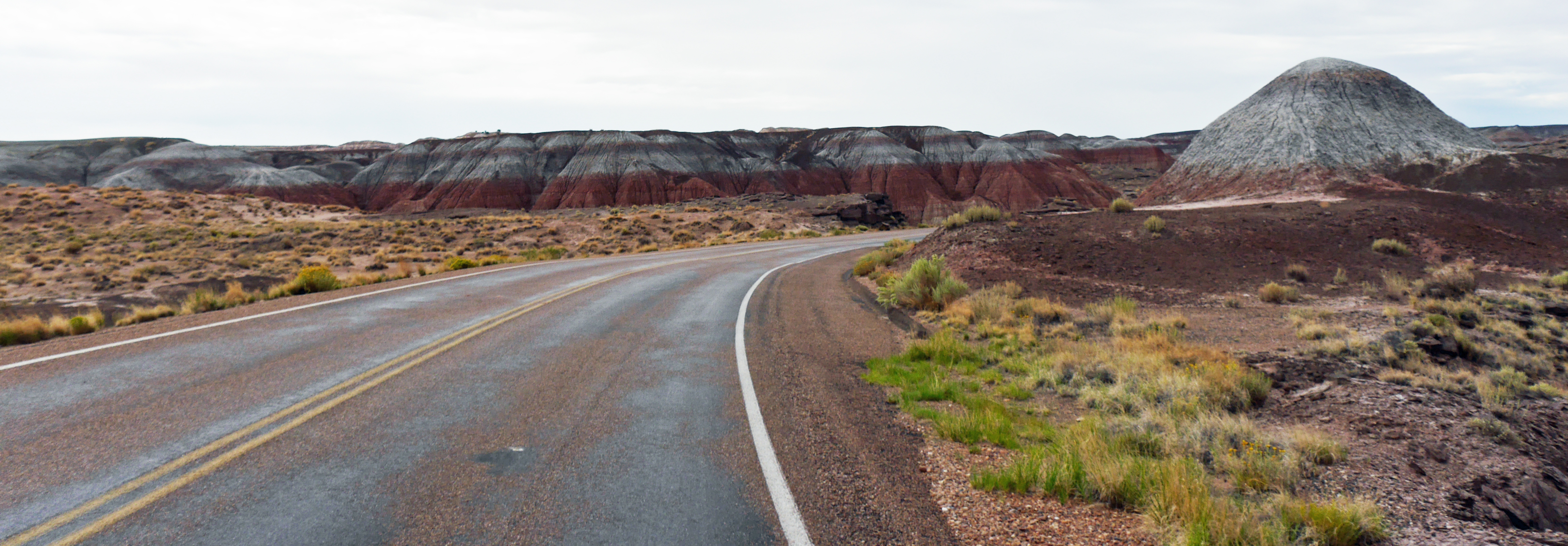
You can’t help but take beautiful photos here.

We found more Indian petroglyphs in the Petrified Forest National Park.
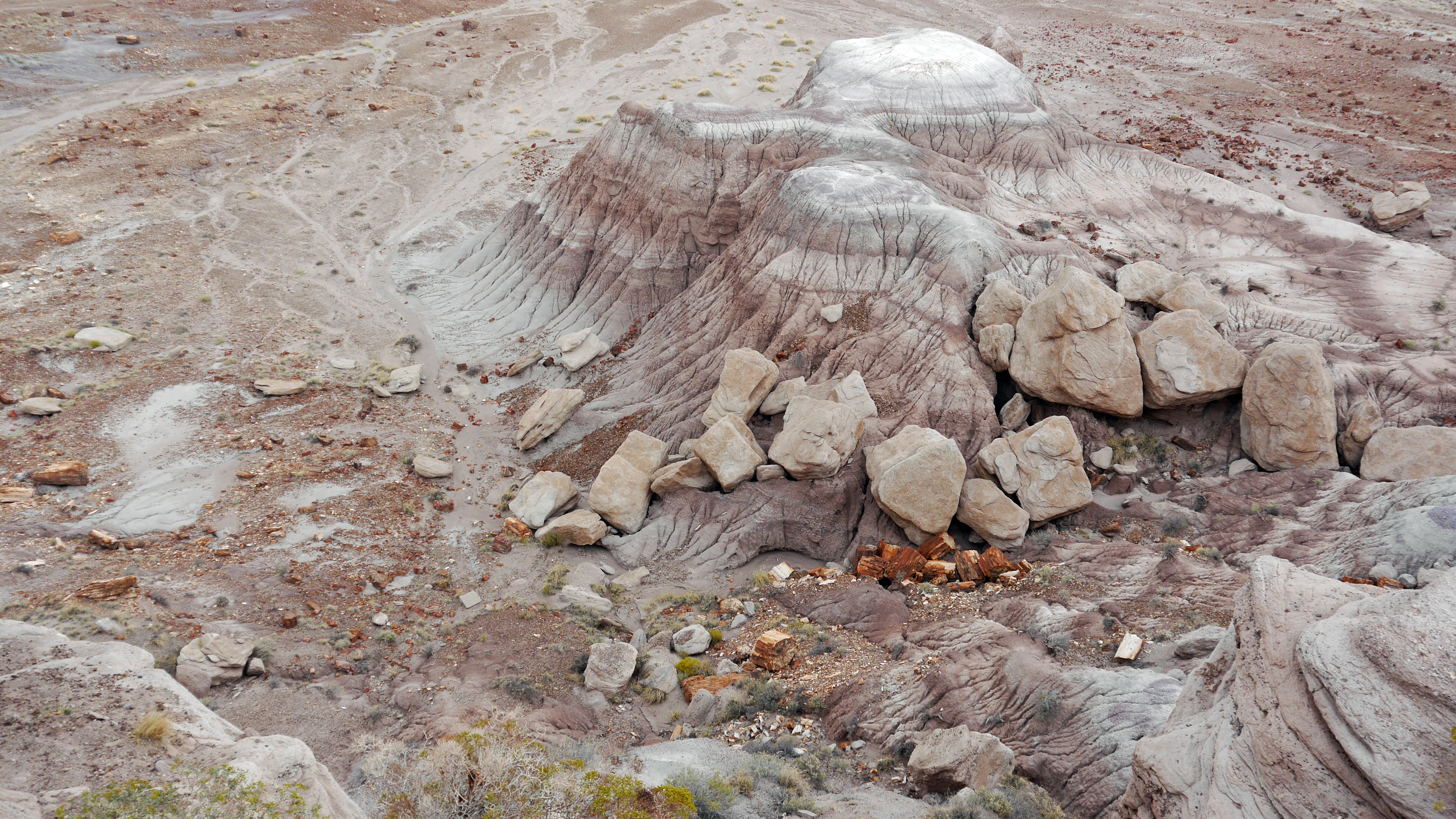
A view from the ridge down into the canyon.
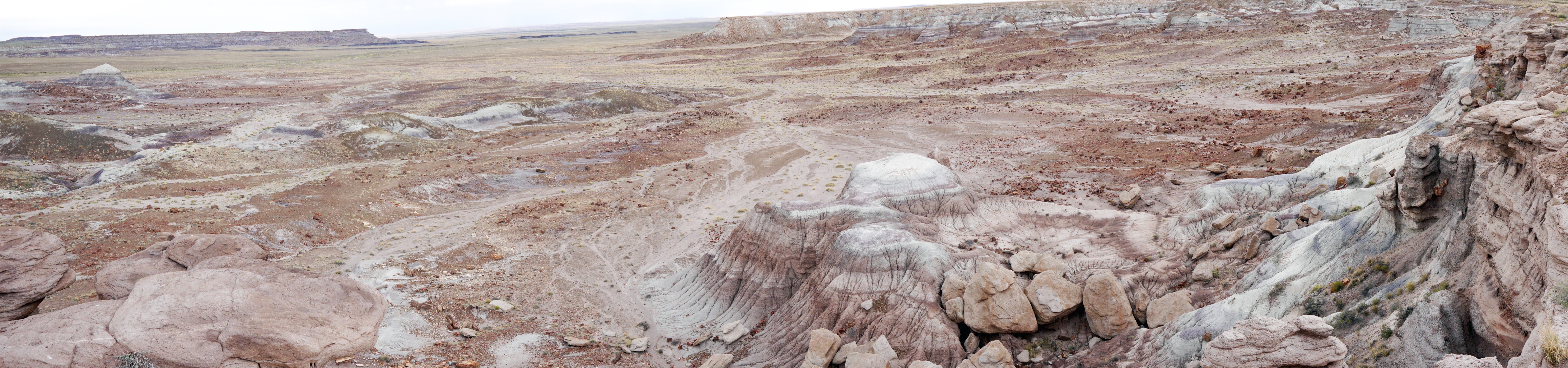
Not Mars but Arizona.
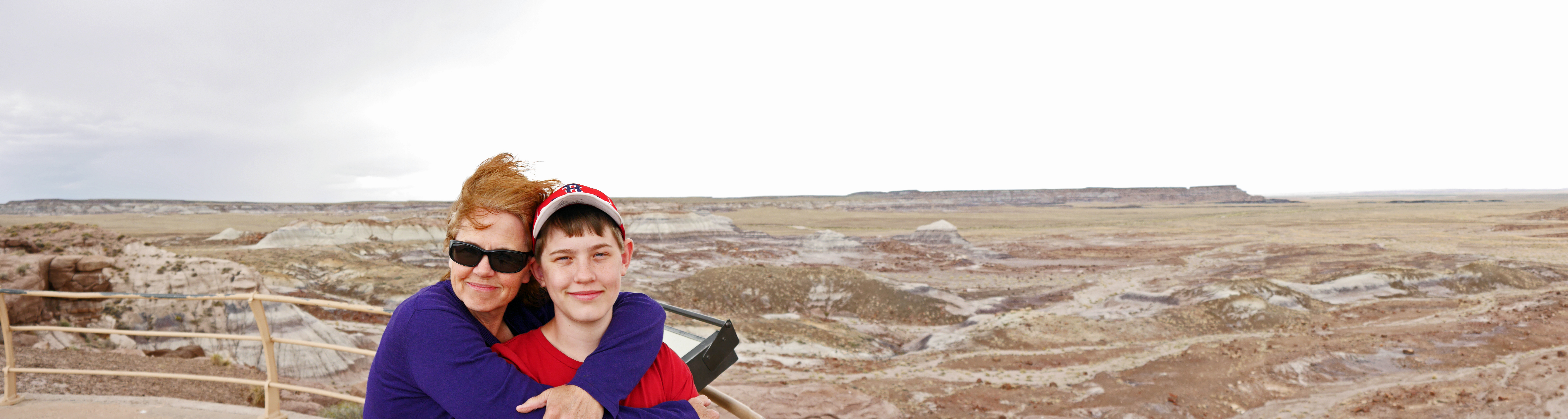
Michelle holds on to Harrie to anchor herself against the strong winds that race around these canyons.

STOP and take in this beautiful view.

250,000,000 year old wood.
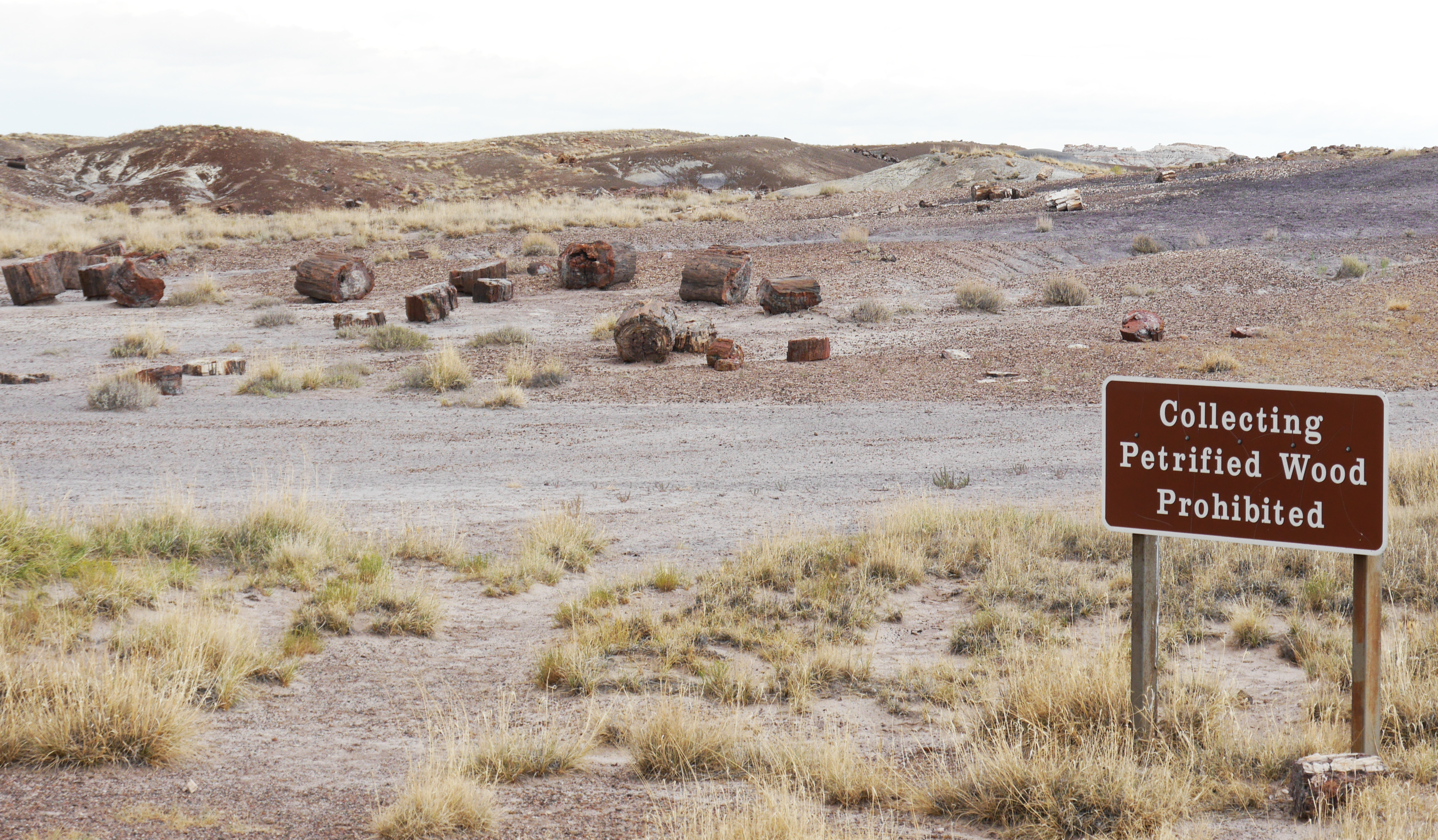
It is illegal to take wood home and every car is weighed going in and out of the park.

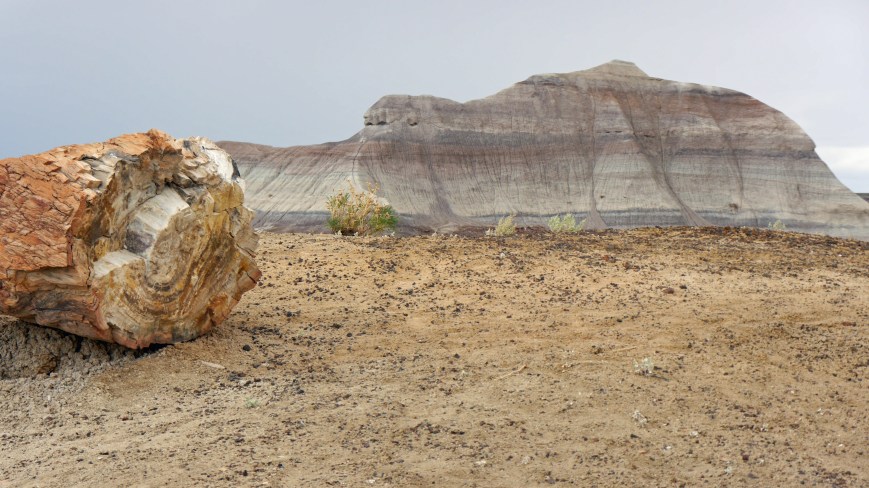
250,000,000 years ago, these trees were washed down a river. Over time, the climate dried and the water-logged trees also dried out. The dried water in the timber left tiny silica crystals that over time hardened to became quartz and fused with the timber to create the petrified timber that you see today. Traces of iron and other metals also seeped into many of the trees giving them their colourful variations.

Well-preserved flora and fauna.
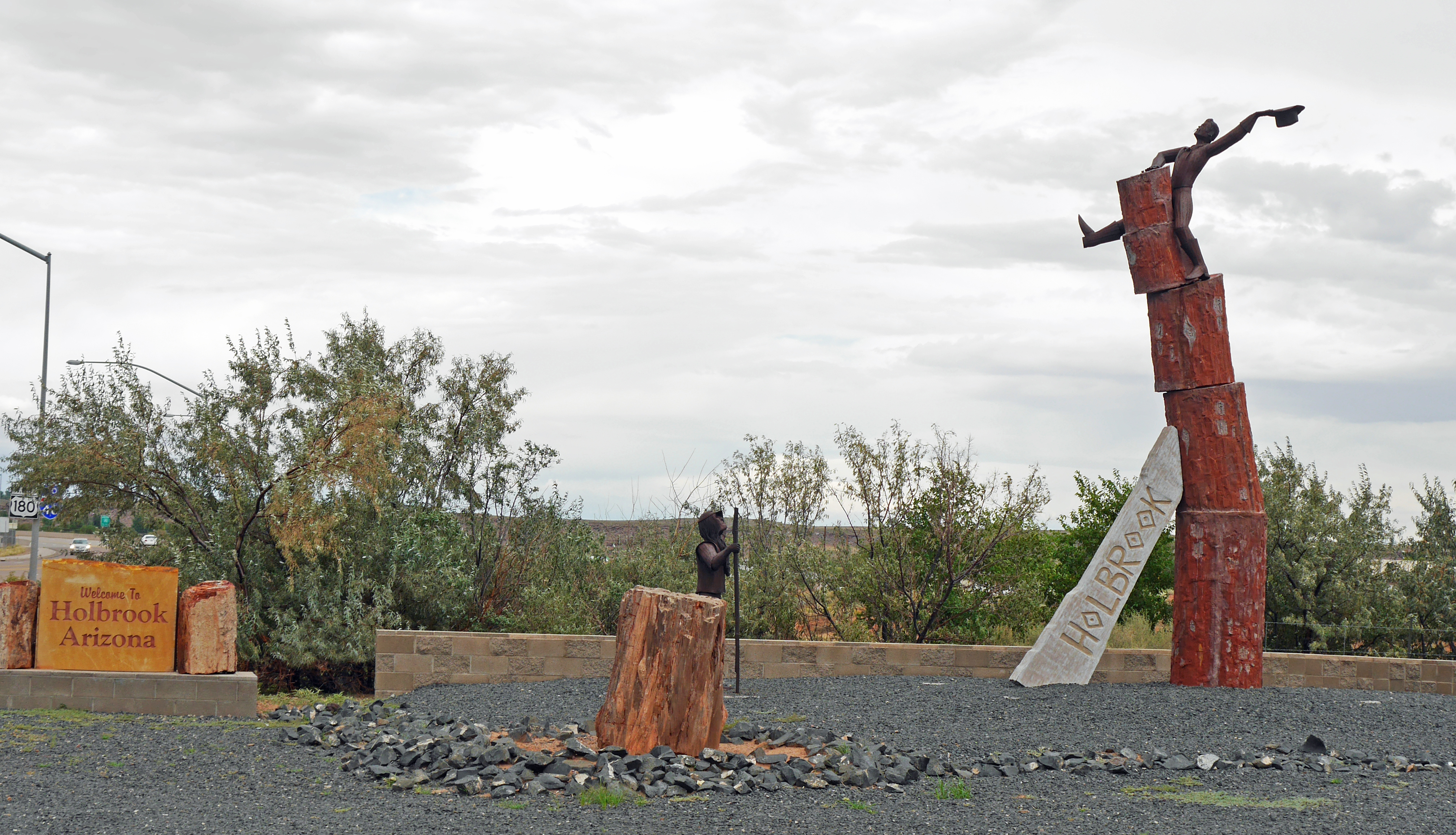
Holbrook. This was the first town we encountered when we left the Petrified Forest National Park. We had lunch in the only place open which was Joe and Aggie’s Cafe. The cafe was like the old cafes you used to see in Australian country towns years ago. No drizzling or infusing things here. Just fried or deep-fried.

It may be illegal to collect rocks from the Petrified Forest National Park but this shop in Holbrook had plenty for sale.
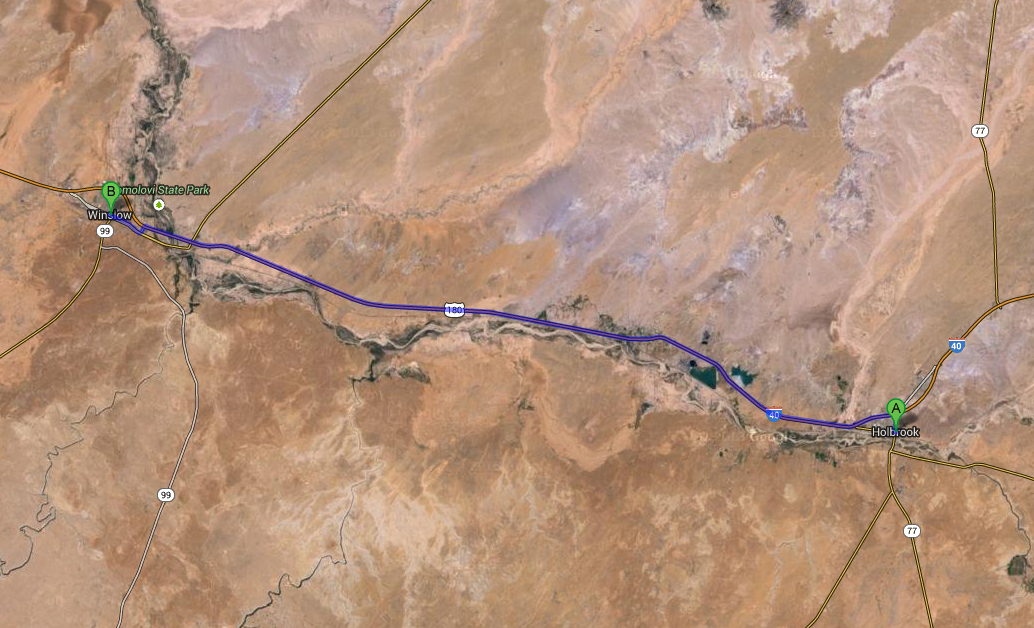
Holbrook to Winslow. Not much greenery here.
Winslow
While we couldn’t stay at the Painted Desert Inn, we did get to stay at another Inn from the same Harvey chain in Winslow. Which made me wonder who this Harvey fellow was? After some research, I found out that, like Clarence Saunders (see my Tennesee post), Fred Harvey is another forgotten genius whose commercial legacy is all around us today. It is claimed that he, more than any other man, tamed the American West.
As we all know from the cowboy movies, guns are a good way to stop a man’s heart but the best way to soften a man’s heart is through his stomach. And this is what Fred Harvey did. He established the first American restaurant chain with the, then unique, concept of a dependable consistency in each restaurant. But his firsts didn’t stop there. He went on to pioneer fast food (ahead of White Castle in the 1920s) and cultural tourism.
Born in England in 1835, Fred Harvey moved to America when he was seventeen to become a pot scrubber in a New York restaurant. From this lowly position, he worked his way up the ranks, learning all aspects of the food business as he went. By the 1850s, Harvey wanted a change and got a job working on the railroads that were winding their way out West.
The first thing Harvey noticed about the West was how disgusting its food was. So in 1876, he started his mission to properly nourish the West through a chain of three restaurants on the Atchison Topeka and Santa Fe Railway lines. The restaurants had similar menus with signature dishes such as Harvey’s legendary 15c ham & cheese sandwich which had three slices of bread and a consistently generous cut of ham. There is an apocryphal story of Harvey’s dying words being “Remember, don’t cut the ham too thin boys”. His other secret ingredient was hiring attractive waitresses who became known as “Harvey girls” and who inspired a 1940s movie starring Judy Garland.
Eighty seven Harvey Houses were built along railway lines and then main roads (such as Route 66) where over 100,000 Harvey girls were employed. It is said that most white families out West can trace their mother back to a Harvey girl because back in the 1800s there were, as the joke went, “no ladies west of Dodge City and no women west of Albuquerque”. Will Rogers also famously wisecracked “Fred Harvey kept the West in food and wives.”
Harvey’s next great innovation was making the food fast. Harvey knew that trains often stopped at some stations to load coal and to give the staff a break. But not long enough a break for someone to order, wait and then eat a full meal. At these stations, Harvey built restaurants where the train passengers could place their orders on the train ahead of their arrival and have it ready when they arrived. This was achieved by having the orders telegraphed to the restaurants to prepare. When the train whistle blew at the station, restaurant staff would know that it was time to plate-up and get drinks ready. When passengers walked in, their ordered meal would be waiting at their table to comfortably eat before the train departed.
Harvey’s last innovation was to tourism. Travelling along the railway, Harvey began to appreciate the many wonderful natural and cultural wonders that the West offered. He thought that if people could have a quick meal while the train stopped, they also might be able to take in a quick visit somewhere. His first and most enduring endeavor was his “Indian Detours” where an attractive Harvey girl would take waiting train passengers on a quick (de)tour of a beautiful natural vista (such as the Painted Desert) where local Indians would act out rituals or tell tribal stories. Such tours now occur everywhere (Lord knows we have done our share of them) but apparently Harvey was the first to pioneer the idea of the short organised-tour that you hadn’t planned but instead took because it was marketed to you. Harvey’s main marketing innovation was leaving attractive postcards of the tours on the train and at his restaurants for people to take.
Helping Harvey design his many Harvey Houses was another remarkable person called Mary Colter. Like Harvey, Colter was also inspired by the natural beauty of the West and wanted to create buildings that blended rather than brawled with the landscape. As an architect, Mary Colter had the rare distinction of being loved by both her architect peers and the scepitcal public.
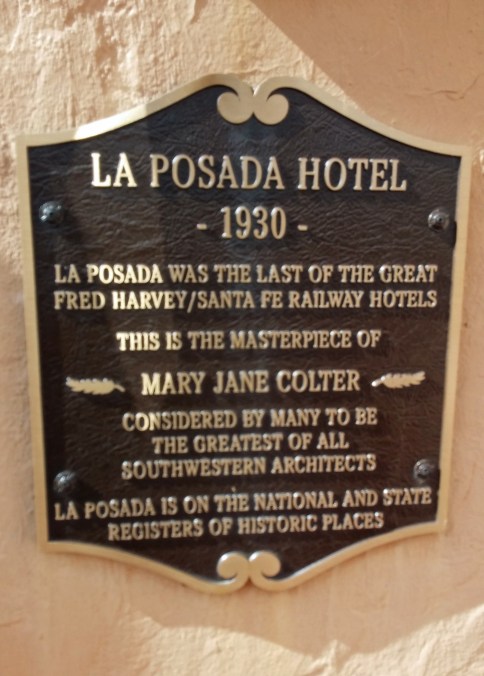
And it was Mary Colter who designed La Posada in Winslow where we pulled in to avoid a violent storm that had been brewing all day. La Posada was built in 1930 and was the last of the great Harvey Houses as well as being considered Mary Colter’s masterwork.
The hotel is literally right on the railway line and 92 trains pass through every day (I reckon I heard about 82 of them during the night). However, the beauty of the place makes you forget the noise. The hotel room was sumptuous with little touches that revealed themselves to us over the stay. A who’s-who of famous people have stayed here but refreshingly the price was reasonable. In fact, Time Out rated it as one of the cheapest luxury places to stay in America. We had Michelle’s birthday dinner at the restaurant and toasted her fifty years as the trains rumbled by.

Frederick Henry Harvey or Fred to his friends.

A great painting of the Harvey girls by another Fred – Arizona artist Fred Calleri. Blue and white was the recognizable colour scheme of both the Harvey Girls and the crockery. Harvey pioneered the Blue Plate Special still used in American restaurants today where a special of the day would be advertised on the counter on a blue plate.
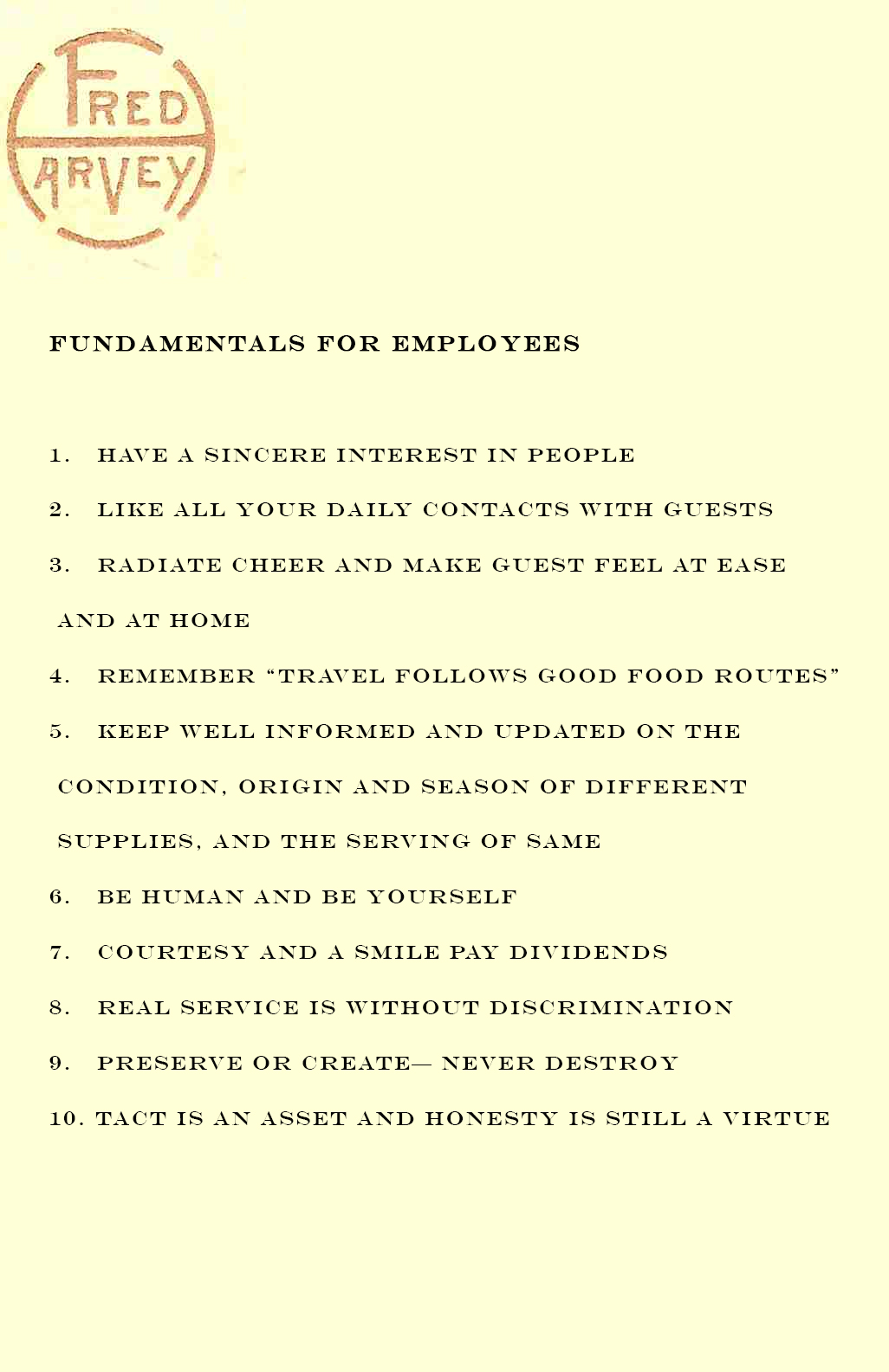
This is a replica of the guidance sheet that would be given to all Harvey House employees. This was Fred’s Ten Commandments. To illustrate Fundamental Eight, there is the great story about Fred Harvey overhearing a cranky customer complaining about the service he was getting. Harvey asked, “What is all the trouble?” The waitress answered, “Oh, that man is a crank. No one can please him.” Harvey replied “Of course he is a crank, but we must please him. It is our business to please cranks as anyone can please a gentleman.”

One of Fred Harvey’s marketing postcards for The Painted Desert.
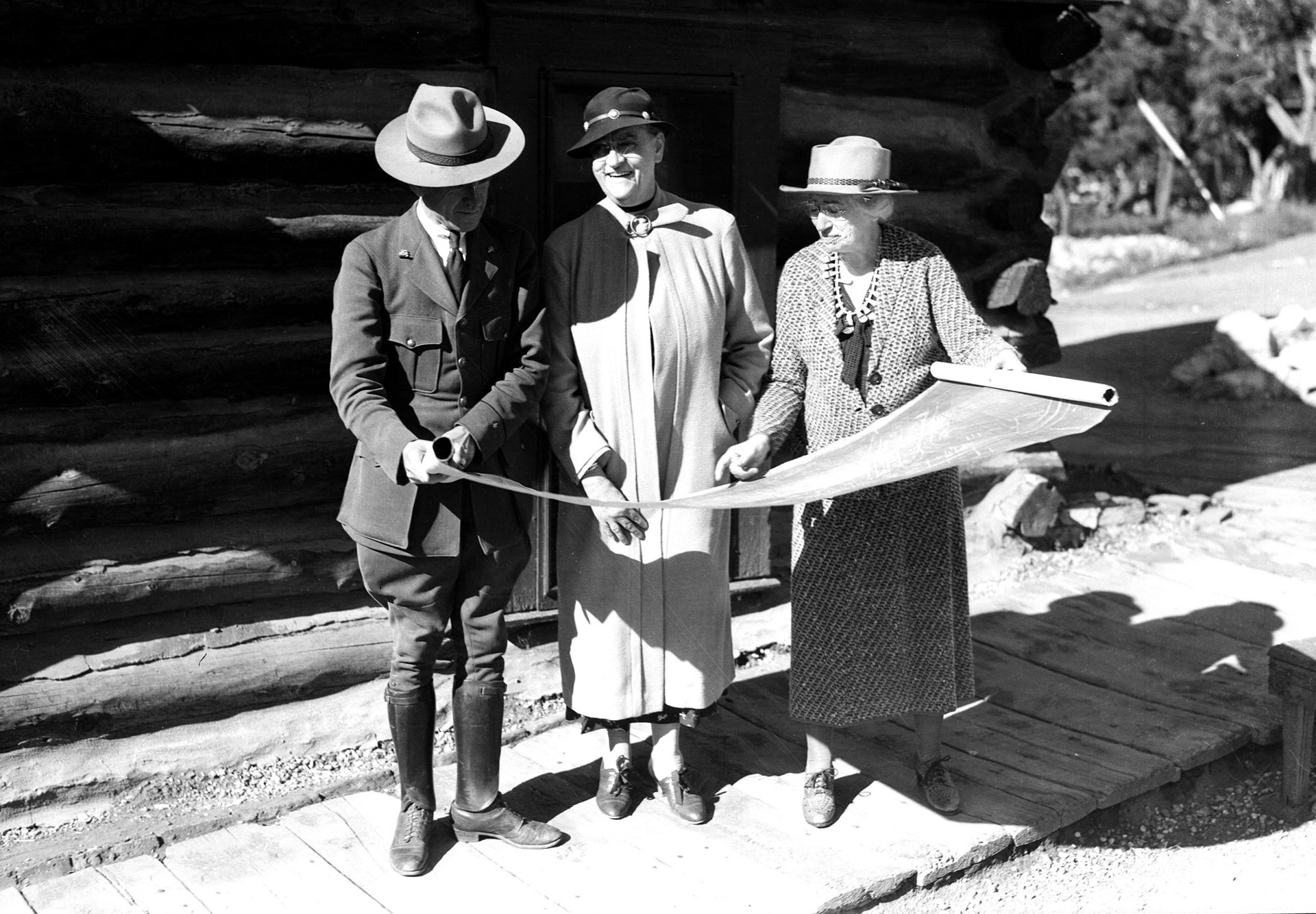
Mary Colter meets with National Park officials to show her plans for the Bright Angel Lodge at the Grand Canyon. Mary is the one on the far right.

La Posada Harvey House in Winslow.

The front courtyards of La Posada which are full of quirky sculptures.

The back of La Posada shows you how close the hotel is to the train tracks.

Another courtyard with real and fake fish.
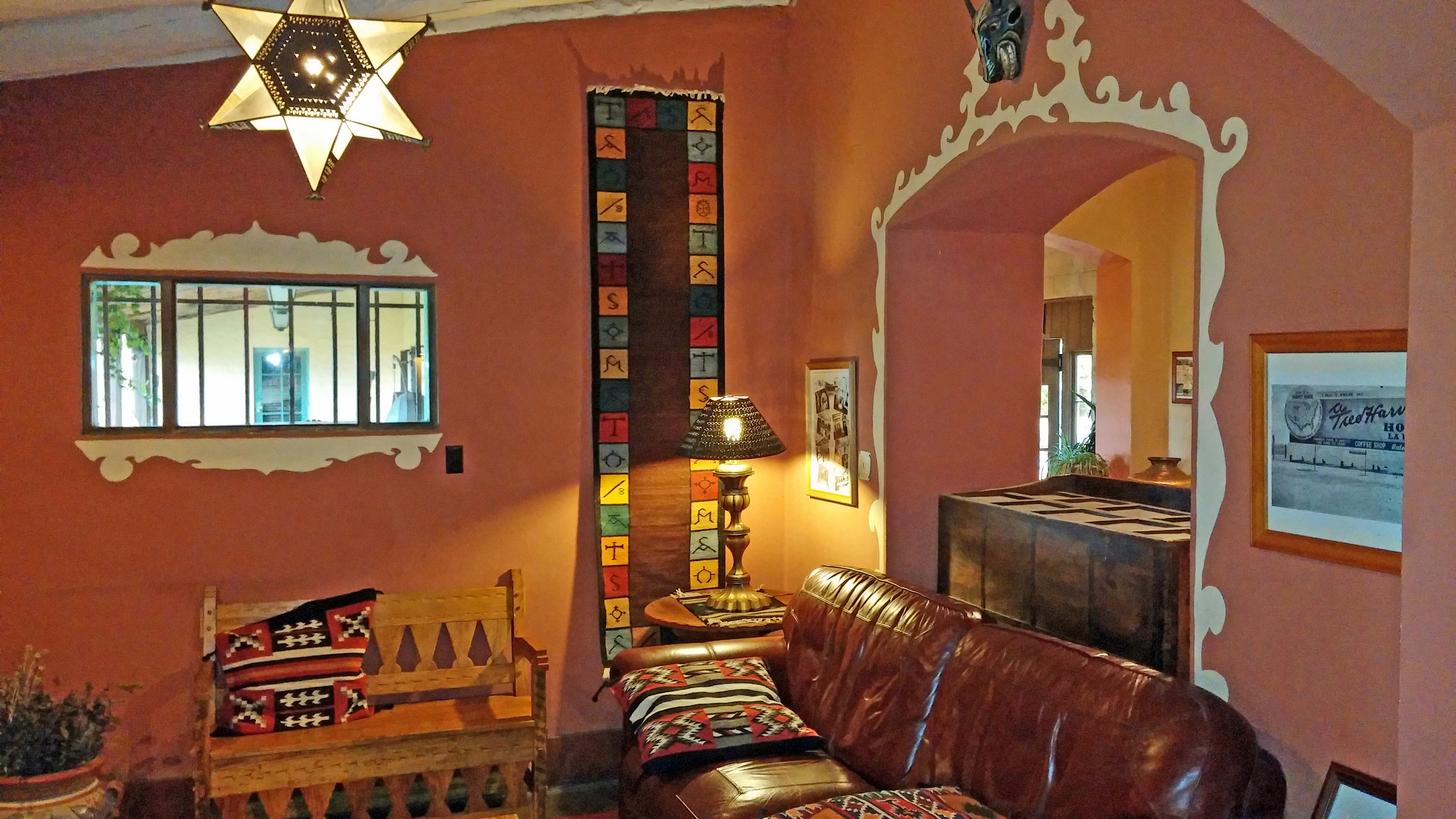
One of the many beautiful alcoves inside La Posada for guests to socialise.

Standing on a Corner in Winslow Arizona
Standin’ on a corner in Winslow, Arizona and such a fine sight to see. Being a Seventies chick from way back, Michelle had a driving ambition to stand on a corner in Winslow in honour of the Jackson Browne/Glenn Frey song Take it Easy which was The Eagles’ first single.
But what corner? The song just said “a” corner. We were looking at points of interest on our car’s GPS when, to our great surprise, up popped Standin’ On The Corner Park.
A whole corner block had been set aside to honour the song’s passing reference to Winslow, including an old flatbed Ford which was also fleetingly referenced in the song. People are able to buy a brick in the pavement and have messages engraved. Most of the ones we saw had messages like “keep on rockin'” and “best song ever”. This is either awesome or sad depending on your age and disposition.
Strangely though, there was no reference at all to The Eagles or Jackson Browne. The woman in the shop opposite said that it was to avoid copyright issues and that was also why the park is called Standin’ On THE Corner rather than Standin’ On A Corner. If this is true, it is pretty crummy that The Eagles or their legals won’t let Winslow cash in on the song. Whoa like totally uncool Eagle-heads; don’t you guys dig that your song is like called Take It Easy.

Standin’ On A Corner Park.
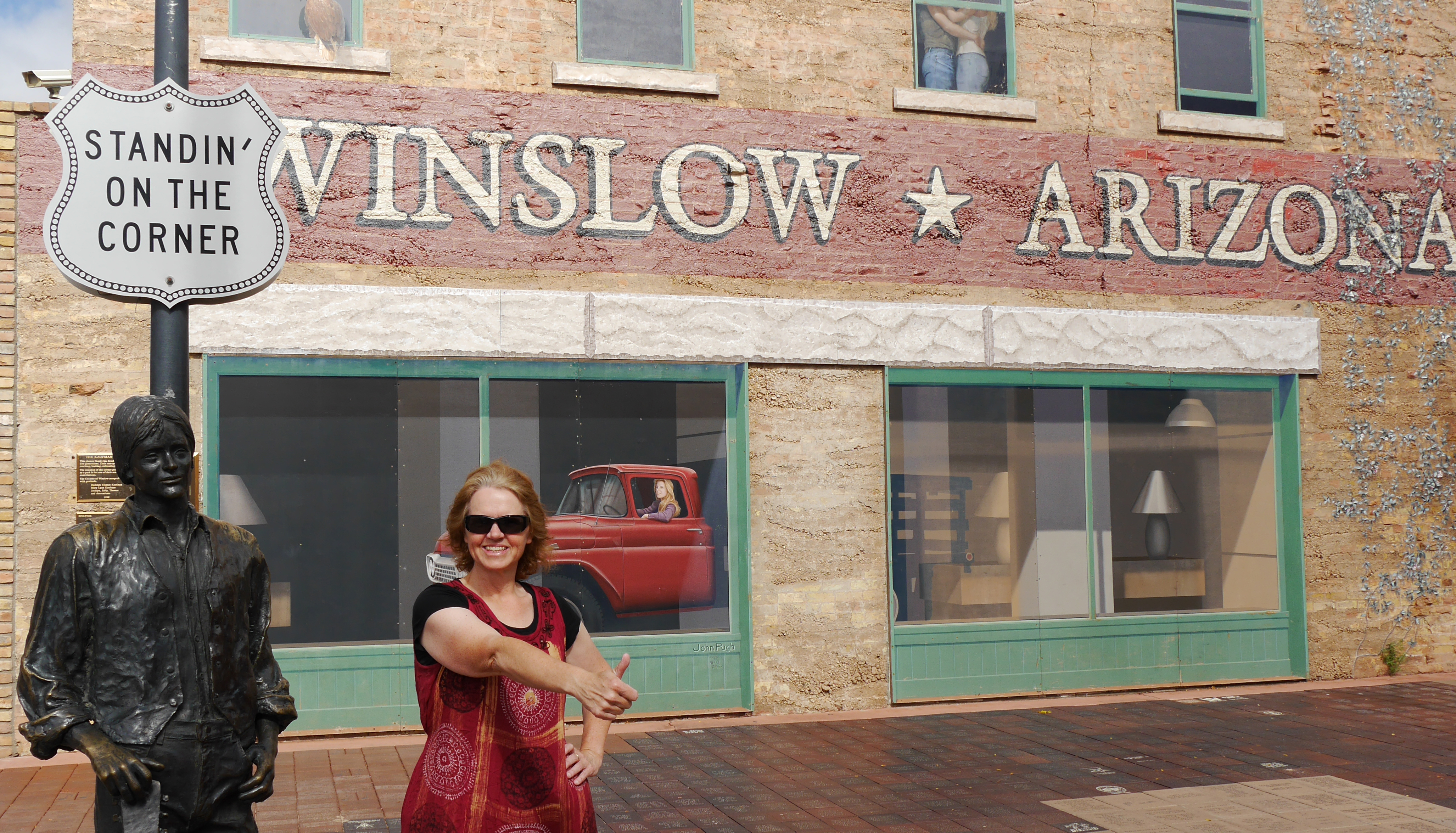
Seventies-chick Michelle Takin’ It Easy ©™All Rights Reserved.

Standin’ on a corner next to some rocker dude (any likeness to Glenn Frey or Jackson Browne is unintended and purely coincidental).
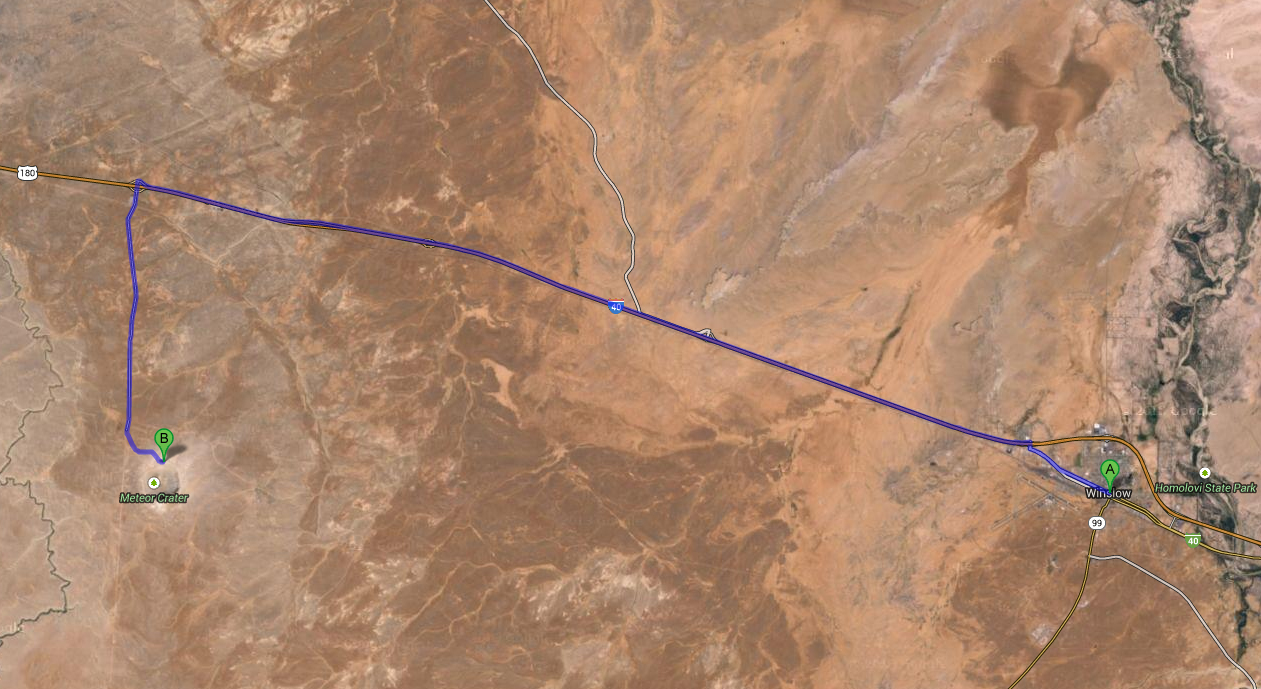
From Winslow to Meteor Crater.
Meteor Crater
Driving from Winslow to Flagstaff, we took a detour off to see Meteor Crater which is the best preserved meteor crater in the world. It has been studied by scientists since the 1800s and it is where scientist Eugene Shoemaker first proved that Earth had been impacted by meteors in the past.
However, Shoemaker’s theory wasn’t without controversy as in 1891, the US Government’s chief geologist had looked at the same crater and concluded that it was caused by a volcanic eruption and was not of any further scientific significance. In 1903, a mining engineer called Daniel Barringer visited the crater and was the first person to question the Government’s conclusions. Barringer had seen similar smaller craters before and they usually resulted in a large chunk of iron (in other words, a meteor) being found underneath. Barringer figured that with a crater of this size (over a mile long) there must be a pretty big chunk of iron underneath and appealed to businessmen in New York to bankroll him to buy the land in order to dig up the iron and make a fortune.
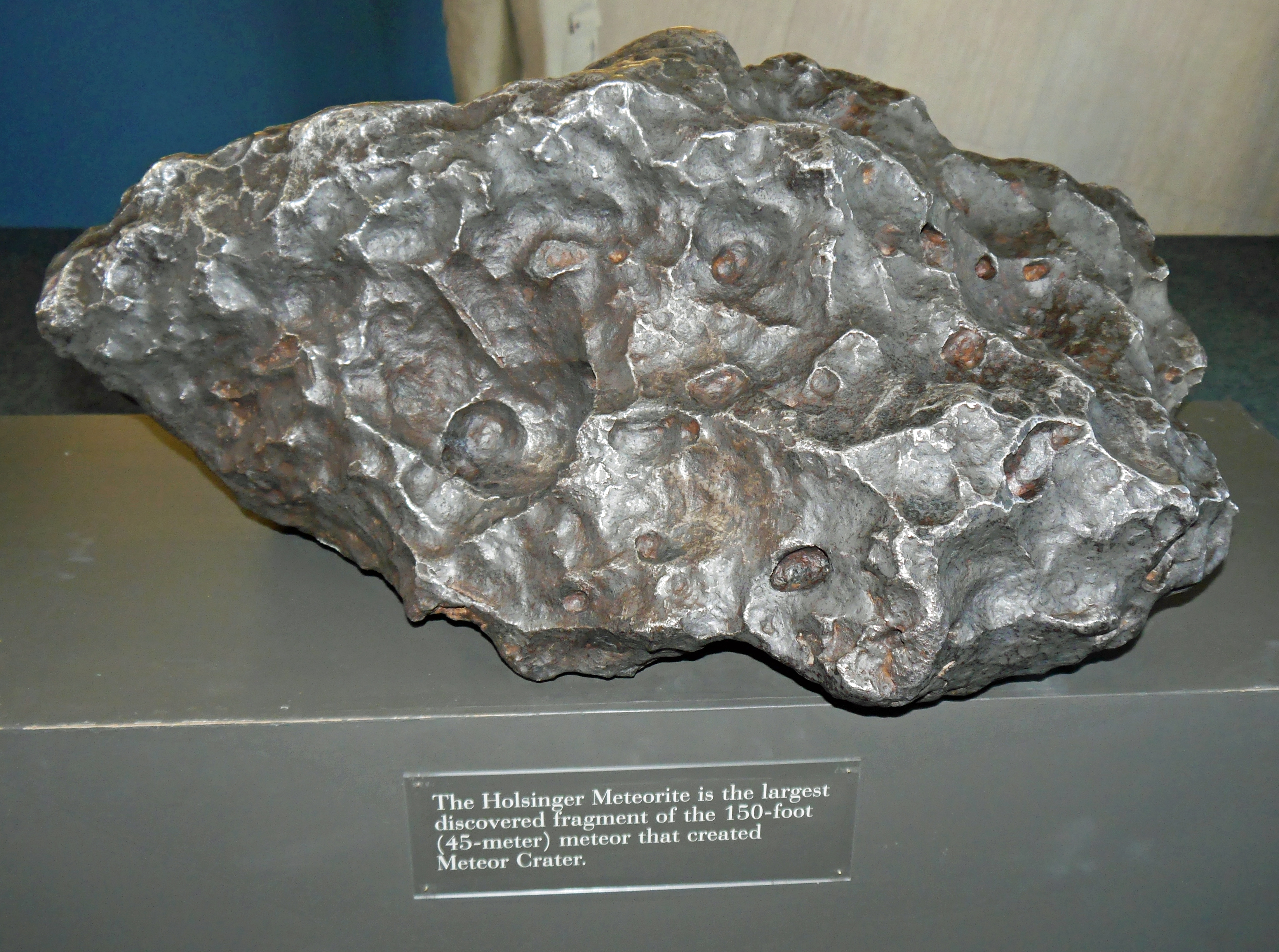
Unfortunately for Barringer, while his theory was correct, the meteor itself had broken up and then disintegrated on impact and so Barringer never realised his iron fortune. However, the scientists that accompanied him on his dig were fascinated by the site and made significant breakthroughs in the understanding of meteors that quickly led to Shoemaker’s important conclusions.
Interestingly, Berringer’s heirs still own the land and still seem to have a bit of a grudge with the Government according to our tour guide. As a result, the site is not a National Park but a private tourist park. Back in the 1960s, NASA had to beg the owners to let astronauts spend time at the site as part of the Apollo Program. The Apollo team wanted to understand the type of craters that they may encounter on the moon. Neil Armstrong and Buzz Aldrin tested their spacesuits on the rocky terrain here which thankfully led to significant improvements as one of the suits ended up being torn on a rock (a windy breeze for the wearer on Earth but instant death in space).
It was awesome to see the crater up close. Michelle said she had goosebumps as she had learnt about the crater as a student in high school.
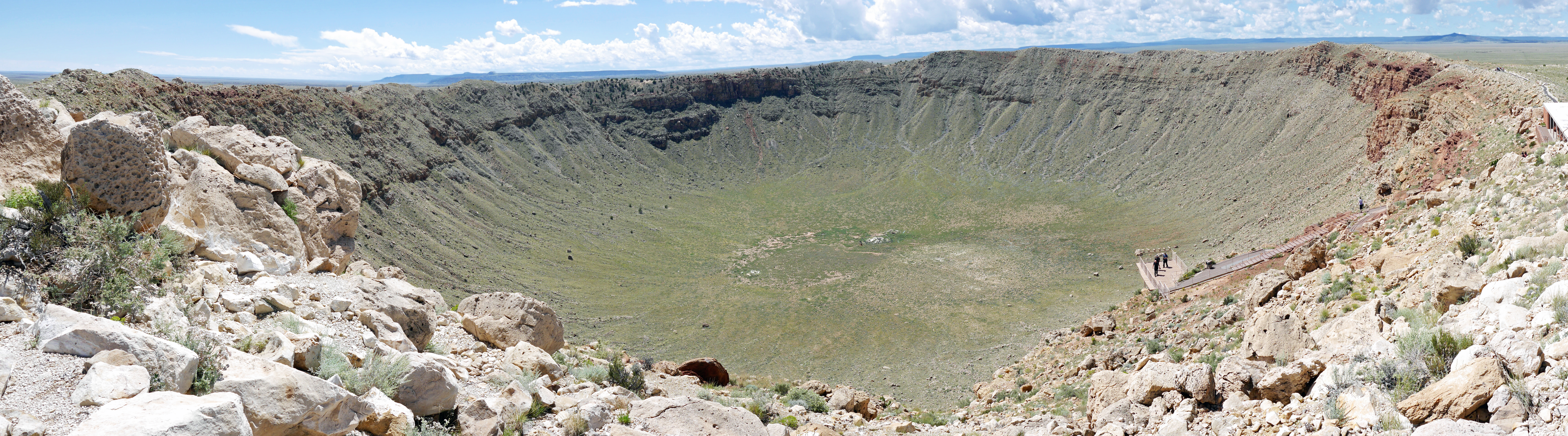
This is what happens when a 45 metre meteor travelling 27,500 km per hour hits the Earth.

Meteor Crater to 2 Guns.
Two Guns
Driving out from Meteor Crater, we had an experience not unlike the movie Duel. I started to notice a swerving semitrailer getting closer and closer to us. I pulled over to the right lane and it barrelled past us veering dangerously close to our car. It continued down the road swerving in and out of lanes alternatively going fast and then slow as if the driver was either nodding off to sleep or coming in and out of focus from drugs.
We wisely decided to get off the road and took a turn-off to an intriguingly-named place called Two Guns. Two Guns turned out to be a decaying ghost town in the middle of nowhere. Almost the minute we got in to Two Guns, it started raining and then, soon after, hailing. It was like the ghosts were telling us to leave, which is what we eventually did.
Five minutes out of Two Guns, the rain stopped and the dry Arizona Summer returned. Not believing in the supernatural, this was nonetheless spooky.
More shocking though was what awaited us a few miles further down the road. The traffic had come to a halt and police lights were flashing. As we crawled closer we saw that a motorhome’s contents were strewn all over the road. The motorhome itself looked like someone had taken an old-fashioned tin opener and cut the thing open. A man was standing next to the police looking battered and distraught. As we went a bit further, we saw the semitrailer that had almost hit us, overturned in a ditch on the opposite side of the road.
Could it get any more haunting? Well yes. What is even more incredible (and I use that word in its truest sense meaning so extraordinary as to seem impossible ) than our own experiences is the amazing cursed history of Two Guns that we were to discover later.
The town was built in an area known as Canyon Diablo (the Devil’s Canyon) where an entire tribe of Apache Indians was burnt to death in a cave by their Navajo enemies. Indians refused to live there afterwards as they considered the place to be haunted by dead Apaches.
A railway town eventually sprang up in the late 1800s and it had the reputation of being one of the deadliest places in America. While most American cities have a “Main Street”, the citizens of Canyon Diablo officially named their main st, “Hell Street.” To give you an idea of the commercial imperatives in Canyon Diablo at the time, Hell St housed fourteen saloons, ten gambling houses, four brothels, two dance halls and one grocery store.
For a long time, the town didn’t have a Marshall on the basis of don’t need ’em and don’t want ’em. Canyon Diablo’s first Marshall was sworn in at 3pm and was buried at 8pm later the same day. The second Marshall was killed after two weeks. The third lasted almost three weeks before being shot while the fourth lasted six days (even after apparently doing a cowardly deal with the town that he would go easy on everyone). For the fifth Marshall, an ex-preacher-turned-con-man was recruited who called himself Bill Duckin after his trademark striped ducking pants. Bill Duckin wisely chose to chat with the criminal elite of the town and said that he could be of service in helping them combat visiting bandits. A month later, Duckin was killed; not by the townfolk, but by a marauding bandit.
By now, the word had spread to the New Mexican Government that Diablo Canyon was a bad town that desperately needed order (of the law variety). So they recruited Joseph “Fighting Joe” Fowler, one of New Mexico’s toughest gunfighters. Fighting Joe arrived ready to clean up the town but, after a near-death scrape, got out while the going was good.
Desperation had now set in amongst Government officials. So in 1882, the Governor of New Mexico called on the US Government to send in the army to clean up the place. However, by the time the army eventually arrived, the town itself had died. Those not under the ground, had left the place.
More death followed in 1905, when two cowboys went to a saloon in nearby Winslow. After ordering their drinks, they spotted a pile of silver dollars on the dice table. Forgetting about their drinks, they quickly grabbed the money and ran. They fled to Diablo Canyon where they were confronted by the Winslow Sheriff and his deputy. The long gunfight that ensued saw one of the cowboys shot dead and the other seriously injured. The Sheriff buried the dead cowboy in Diablo Canyon and took the other back to Winslow. That’s when things got strange. When the word of the gunfight got back to the Winslow Saloon, the drinkers there were less concerned about two men being brought to justice and more concerned about the injustice that the two cowboys had endured in not getting the drinks they had ordered. So they left the saloon and set off to Diablo Canyon armed with a bottle of whiskey and a spade to make amends. The saloon-goers exhumed the cowboy from his grave and plied a bottle of whiskey down his throat. Justice was served, albeit not in a shot glass at a saloon.
When the highways opened in the 1920s, Earle and Louise Cundiff opened a trading post and campground in Canyon Diablo hoping to attract new visitors and maybe even residents (they also built a few modest cottages). However, the Diablo smell of death lingered over their business plans until a crazy guy called Harry “Two Gun” Miller arrived in town. Miller claimed to be an Apache Indian (he wasn’t) and said he felt an affinity with the place. What the place needed according to Miller was fake Apache cave dwellings, a fort and a zoo. He eventually convinced the Cundiff’s to help him build them. The zoo housed mountain lions, gila monsters, snakes and eagles. When his work was done, Miller insisted that the new settlement be named “Two Guns” after him.
Two Guns was going great guns until the mid-twenties, when two drifters came to town and stole all of Cundiff’s belongings. In 1926, Miller, with only one of his two guns, shot dead Earle Cundiff for reasons that were never really known. Stranger still, Miller was acquitted of the crime. Many thought that bribery was a likely alibi. With Cundiff out of the way, Miller was now king of Two Guns. Here he resided by himself with his animal menagerie who he treated cruelly. They also treated him cruelly in kind. He was severely mauled by the mountain lion on two occasions, had his arm seriously injured from a Gila monster bite and was almost disemboweled by a lynx. Miller left town in 1930 in order to avoid prosecution for a series of crimes that were never properly established publicly and were believed to be hushed-up by authorities (possibly because they revealed the same decision-making that led to Miller’s acquittal for murdering Cundiff).
In 1971, what remained of the town was destroyed in a massive freak fire. The town was never rebuilt.
More recently, Two Guns was the filming location of the disturbing film Jesus of Malibu also known (by the filmmakers themselves) as The Film That Changed The World. The film was made by husband and wife hippies Bill and Anais Yeager whose form of hippiedom mostly closely resembles Charles Manson’s unique version. The trailer for the film has been banned from You Tube for disturbing and offensive content but is available through the filmmakers’ web site but I must warn you that it is not for the faint of heart. More kookier than these two though, is the guy who now lives in Two Guns who calls himself Jesus and who shoots at strangers who wont pay him twenty dollars for one of his tours. His web site explains less and should be viewed by the authorities.
The final chapter of Two Guns’ fascinating history bizarrely involves actor Russell Crowe. While not officially confirmed by Crowe, many stories sprang up in 2011, reporting that Rusty had bought Two Guns for US$3 million in order to film a remake of Westworld. Not surprisingly, given the curse of Diablo Canyon, the film was never made.
Most of my information about Two Guns was drawn from Wikipedia but also from the fascinating 1968 history book, Two Guns by Gladwell Richardson. This has now been republished as an e-book which you can view online here.
I look forward to reading about what happens next to this place. It is sure to be both bizarre and sad.

The colourful and cursed Two Guns, Arizona.

Hell Street in Canyon Diablo back in 1890. These guys put the “wild” in Wild West.

Joseph “Fighting Joe” Fowler. Even a tough cigar-chompin’ hombre like Fowler was scared of the place.
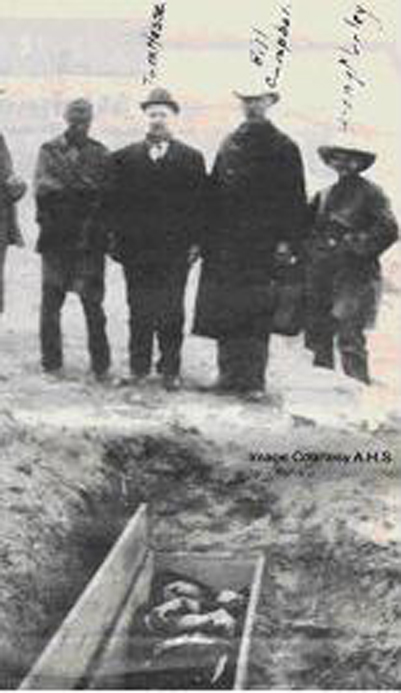
Winslow Saloon patrons exhume the body of cowboy robber John Shaw to give him the drink he was owed.

Trying to open Shaw’s mouth to give him some whiskey.

Apparently this photo was proudly displayed in the Winslow Saloon for many years afterwards to prove that no one gets gypped at the Winslow Saloon.

A rare photo of Harry “Two Gun” Miller. Note the poisonous Gila monster sitting on his lap whose deadly bite ended up immobilizing his arm for six months.

Here is Miller’s menagerie.

The crazy who made the disturbing film Jesus Of Malibu on location in Two Guns.
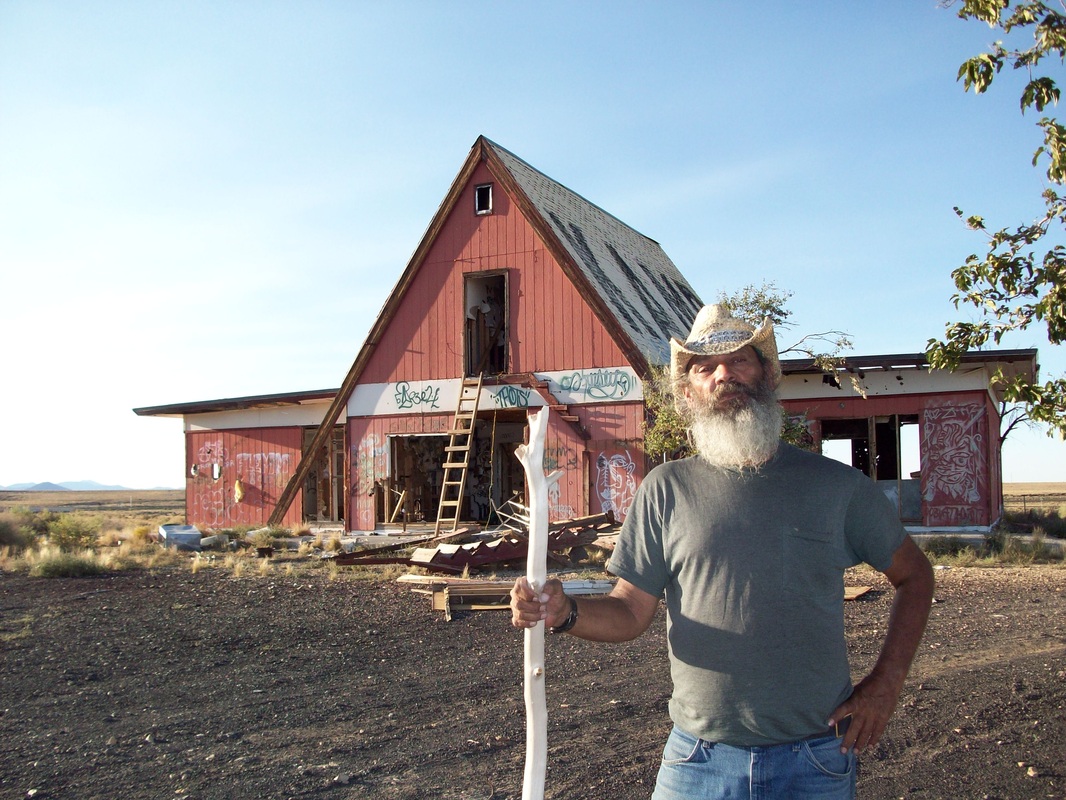
The crazy who was inspired by the crazy who made Jesus of Malibu. He calls himself Jesus of Malibu after the film and lives in Two Guns. Here he charges $20 for “a tour” which, if you don’t pay , to quote his web site, he will “blow your god damm head off.” Our Lord moves in mysteriously violent ways. Mind you, he does have his romantic side as he says in his web site (typos and all): “Also I enjoy meeting nice women who ike to raom about and camp out I got plenty of room but I AINT INTERSTED IN YOUR CHILDREN, someone older about 45 or 50 is ok even if your overwight dont care, if you like a great view and like rocks and looking at trafiic going by from long away I got binooculers too.”

The crazy who apparently owns the place – Russell ‘Two Guns” Crowe (no relation to Arthur “Two Sheds” Jackson).

2 Guns to Sedona. The contrast between the two towns couldn’t be starker.
Sedona
Named by USA Today as the “the most beautiful city in America”, Sedona is certainly a beautiful place to visit. As well as nature lovers, Sedona also attracts heaps of New Agers because of its supposed spiritual energy. According to those who shun science, Sedona is at the epicentre of spiritual energy vortexes (the Sedonan spelling) that are meant to heal and enhance psychic abilities. And, like just dig it man, this has to be true because Sedona spelt backwards is “anodes” which is an electrical term for the electrodes through which electrical current flows.
We drove in and stopped at Oak Creek Canyon where there was a Visitor Information Officer waiting to help us. Well, that is until we found out that he was really just flogging time-share in exchange for jeep tours. Maybe it was our lower selves talking to our higher selves or maybe we were under the spell of one of Sedona’s vortexes, but inexplicably we agreed to share our time.
After two and half hours of maddening teasing about the wonders of time-share, the cost was revealed – $25,000 plus an annual fee. But only if you sign up today. Within the next fifteen minutes, that price had dropped to $4,500. When we said we wanted to show it to our Australian lawyer, the sales grip was relaxed for the first time and shortly after, we were freed from our time-share prison. Was being sales-tortured for almost half a day worth a free jeep ride. Yes, but only just.
The jeep ride itself was great. We rumbled along rocky tracks that took us into the rugged hills of the Verde Valley. The jeep driver was very confident behind the wheel and powered around tight bends that most of us would have taken slowly or not at all. At one point she drew up to a sharp halt on the edge of a huge cliff face so that we could get a better look. This scared the bejesus out of a guy from New York who said in a kind, but wavering, voice “thanks and its not that we don’t appreciate it but you really don’t have to go that close for our benefit.” A second later, he thought better of his first approach and said more emphatically “actually, just don’t go near the edge again would you please.”
On our second night, we drove up a narrow windy road to the top of a large plateau. Here we sat and watched the hot desert sun set over the sprawling city and give way to a cool blanket of twinkling stars. Harrie and I went for a relaxing walk along the perimeter of the plateau and encountered people from all walks of life trying to bathe in vortex energies. When we re-joined Michelle, an Australian hippie guy was sitting cross-legged on a rock playing a pan pipe. This soon got a crowd humming and swaying as though in a trance. Just when I was wondering whether he was going to get up and lead them all off the cliff like a modern-day Pied Piper, a woman jumped up and said “I got a willy.” This is apparently what you say when you feel the bogus energy of the vortex take hold. Others soon nodded and said that they were feeling it too. Sadly, the only thing we felt was an updraft of scepticism.
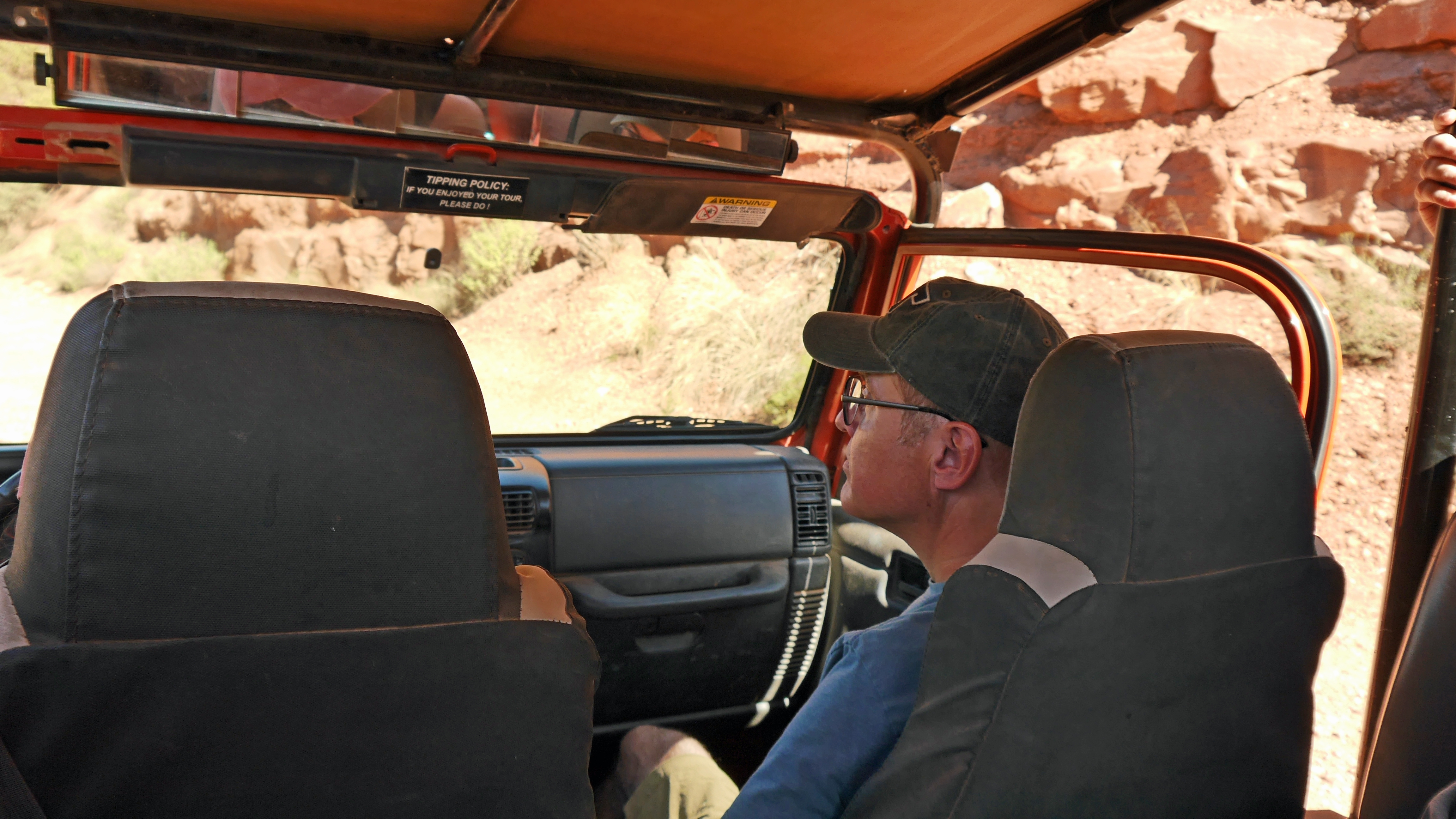
Up front in the Jeep. Everyone else sat opposite each other in the back military-transport style.
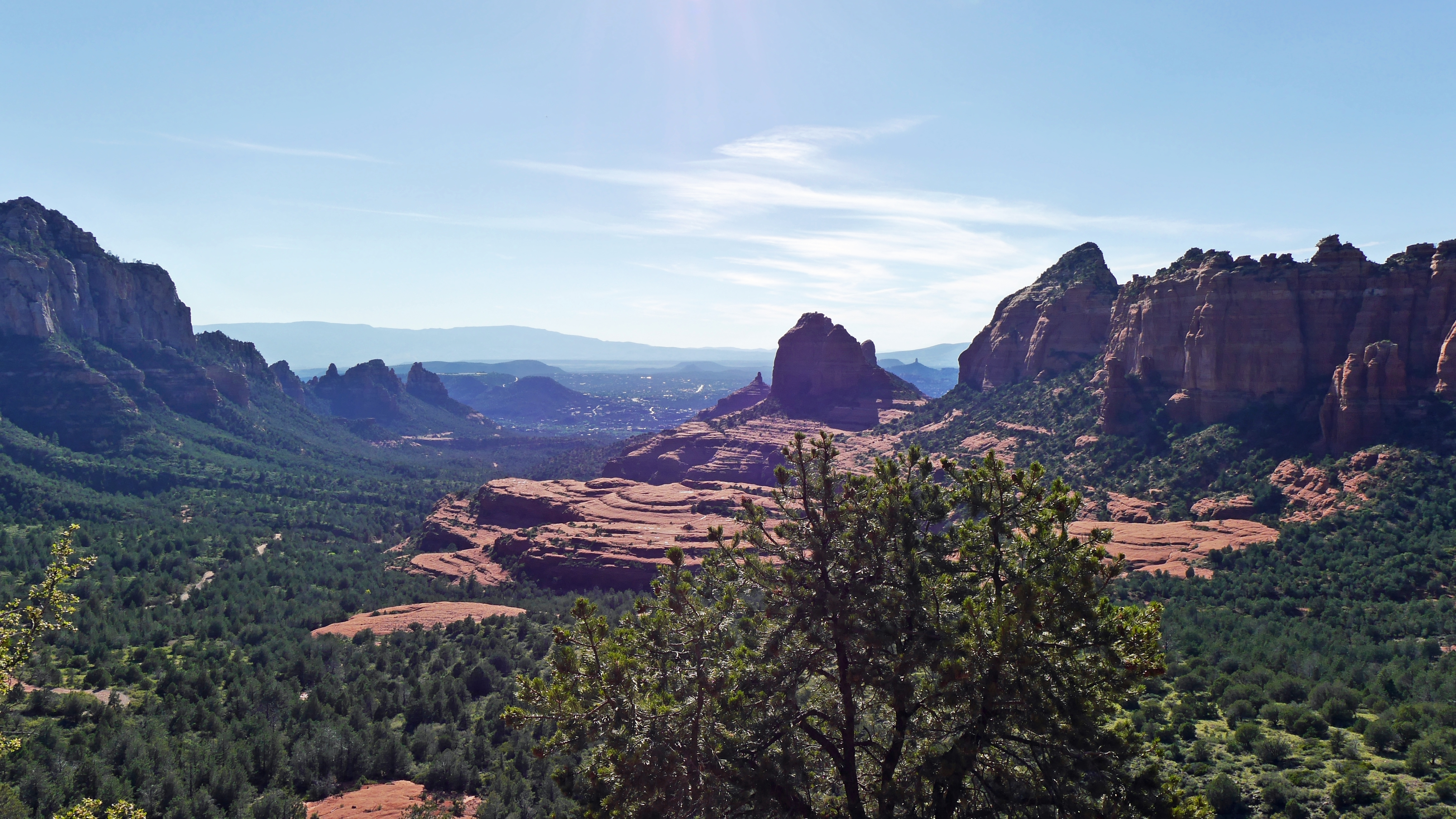
The red rocks of Sedona.
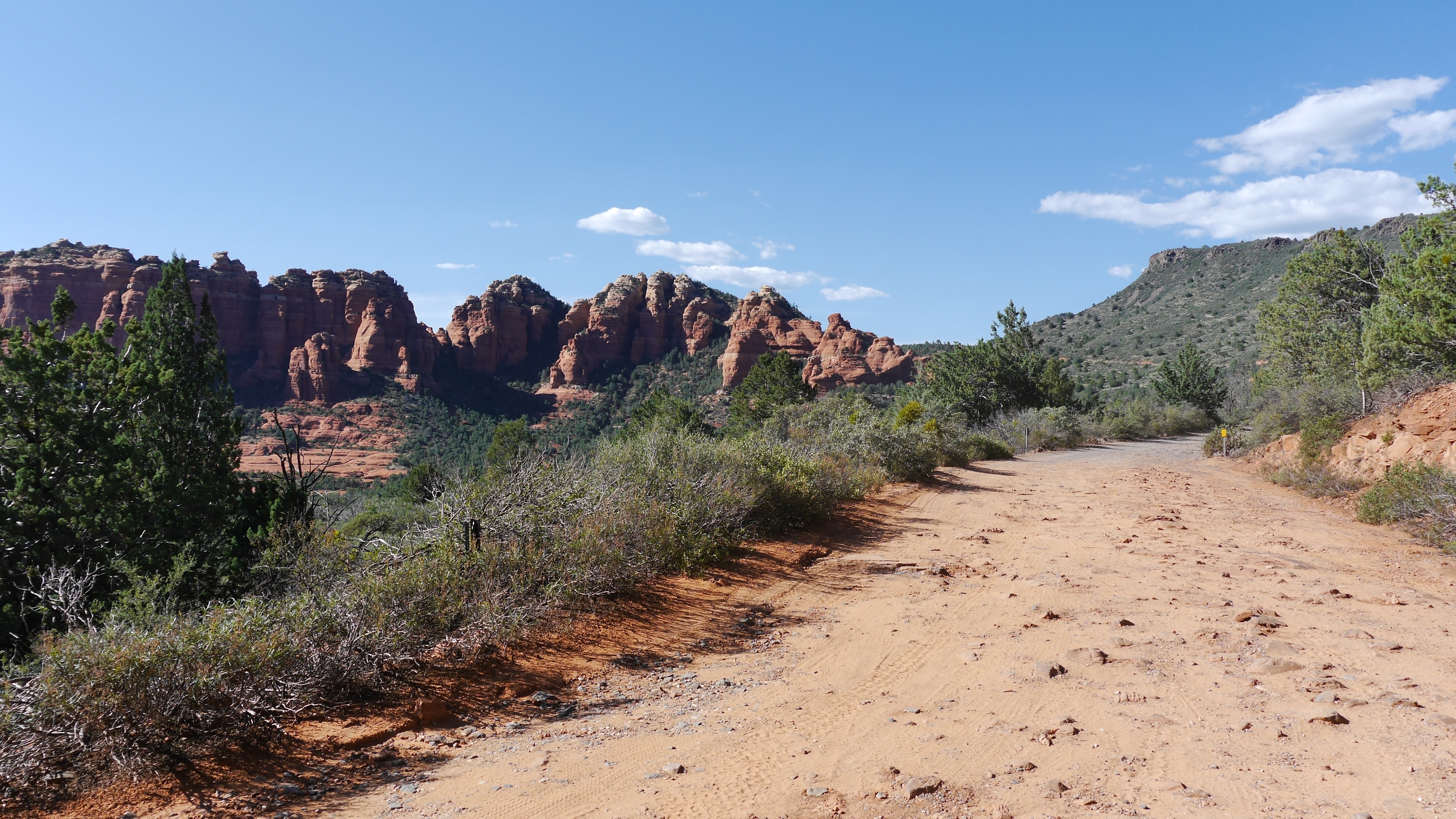
This the start of the dirt trail we took up the hills of the Verde Valley.
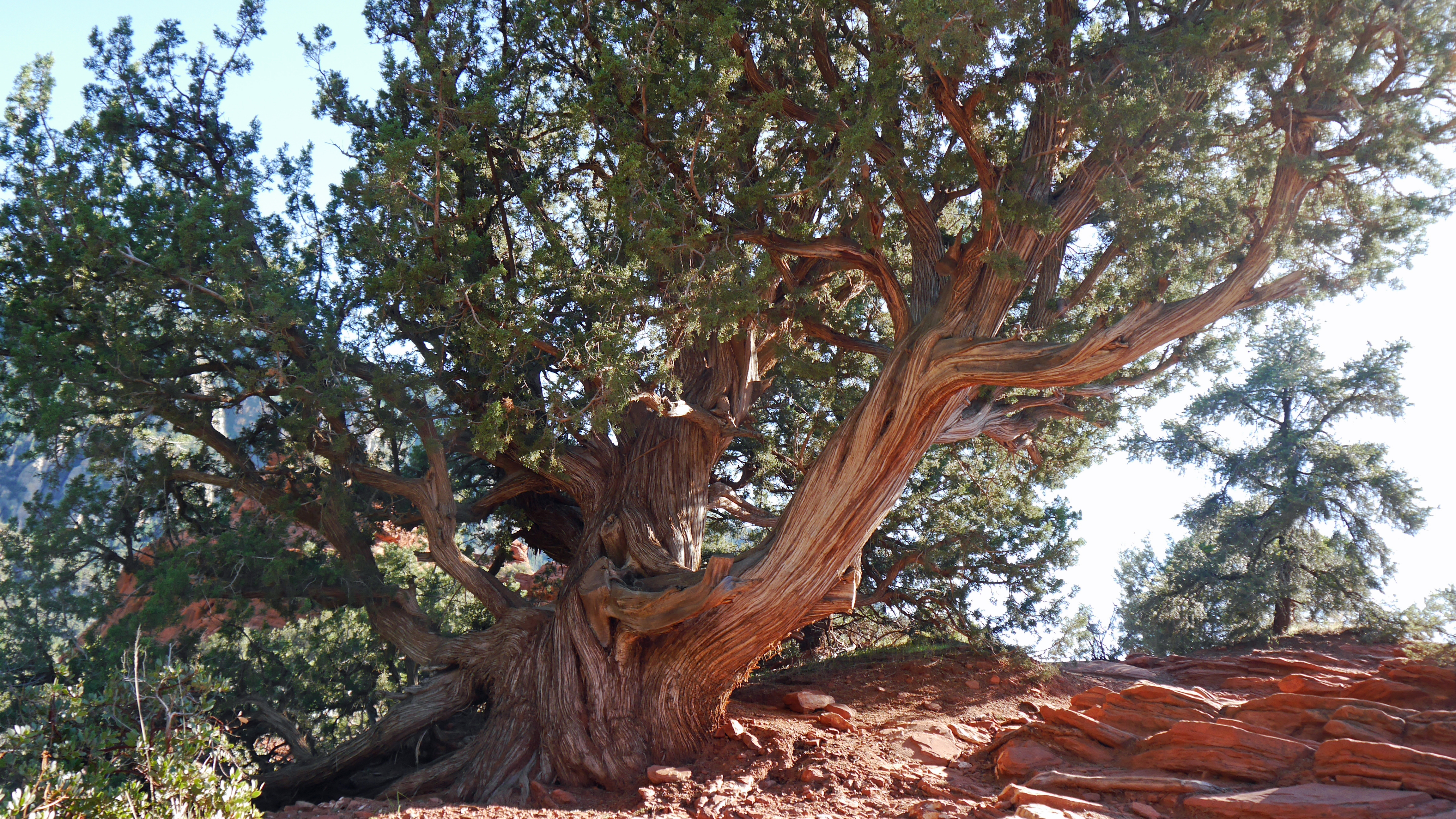
One of the many twisted juniper trees that line the hillside.

The intrepid explorers. Also used Photoshop to give it this Albert Namatijra effect.
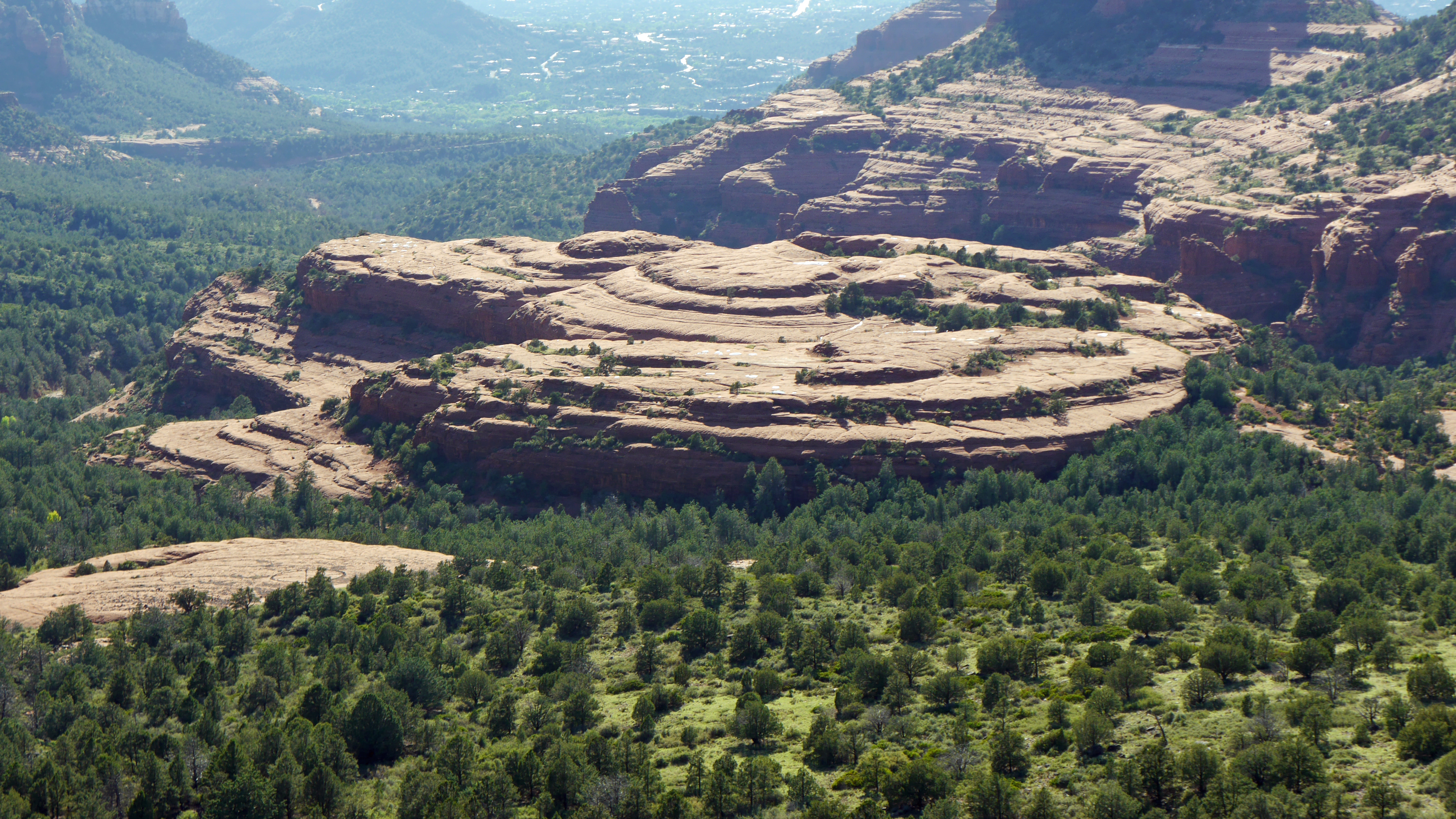
Broad plateaux like this can be found throughout the hills surrounding Sedona.
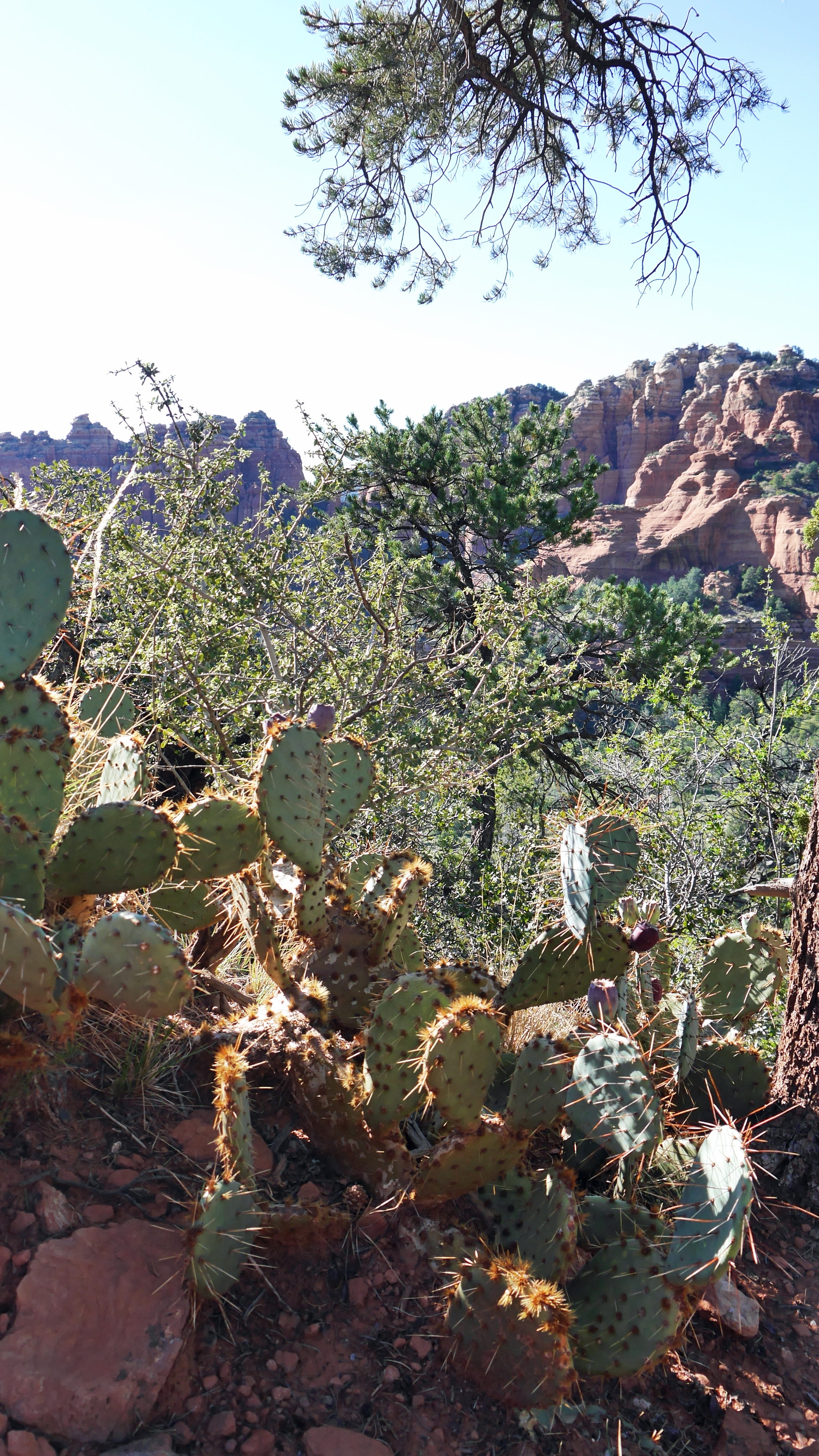
I spy cacti.

A rock formation that looked like a giant human head.
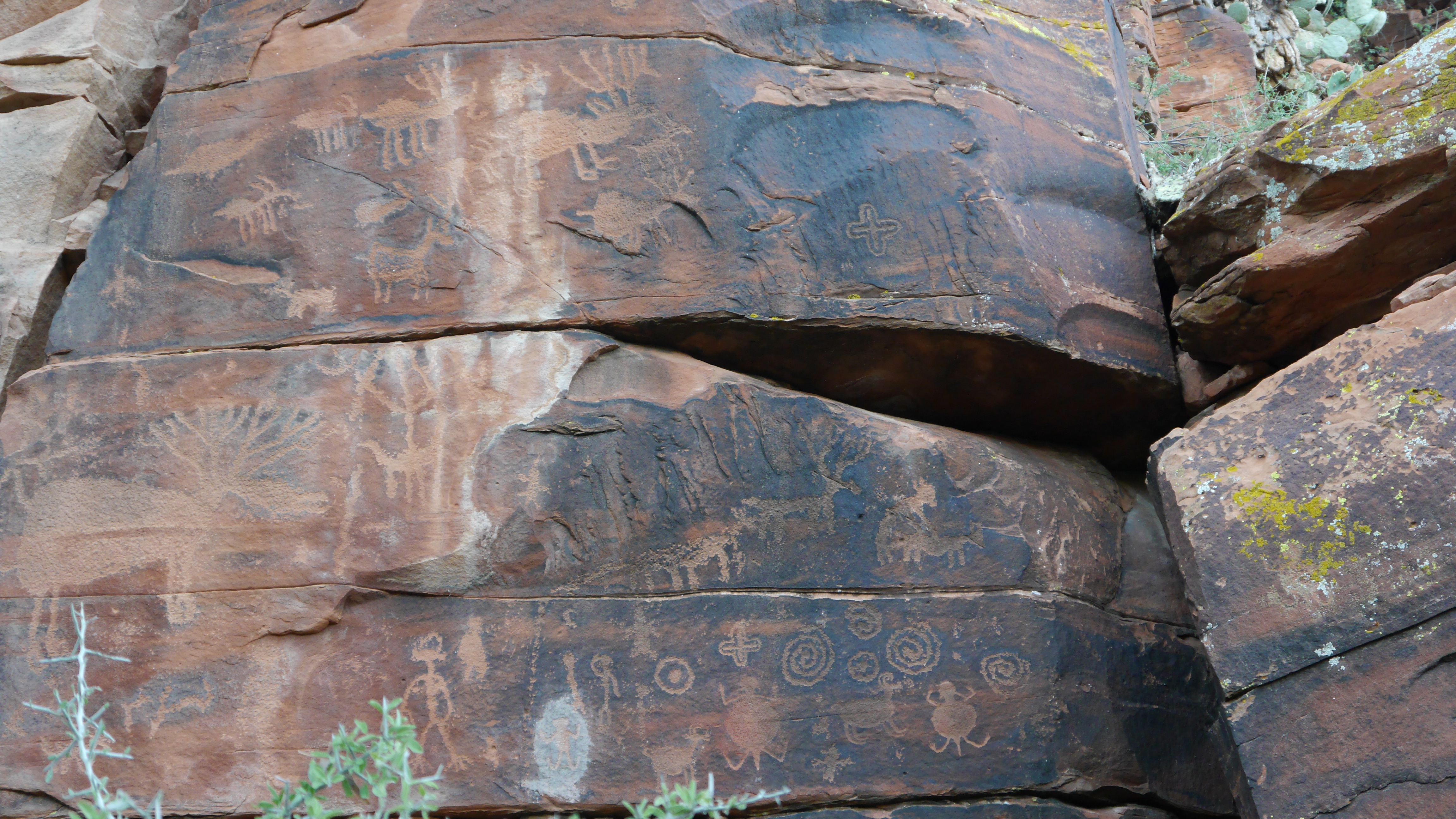
More Indian petroglyphs.
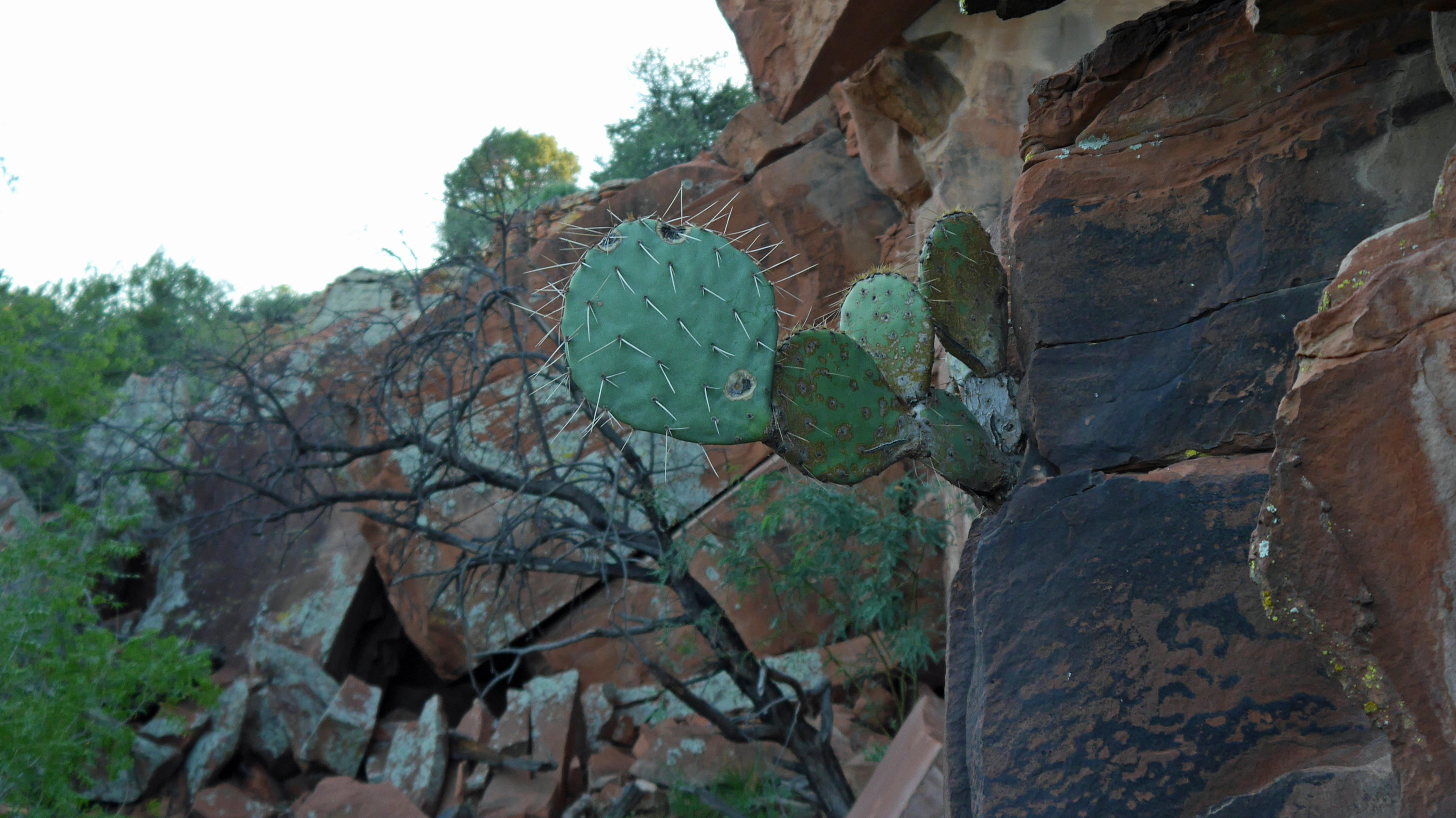
A enterprising cactus sprouts forth from a rocky crevice.
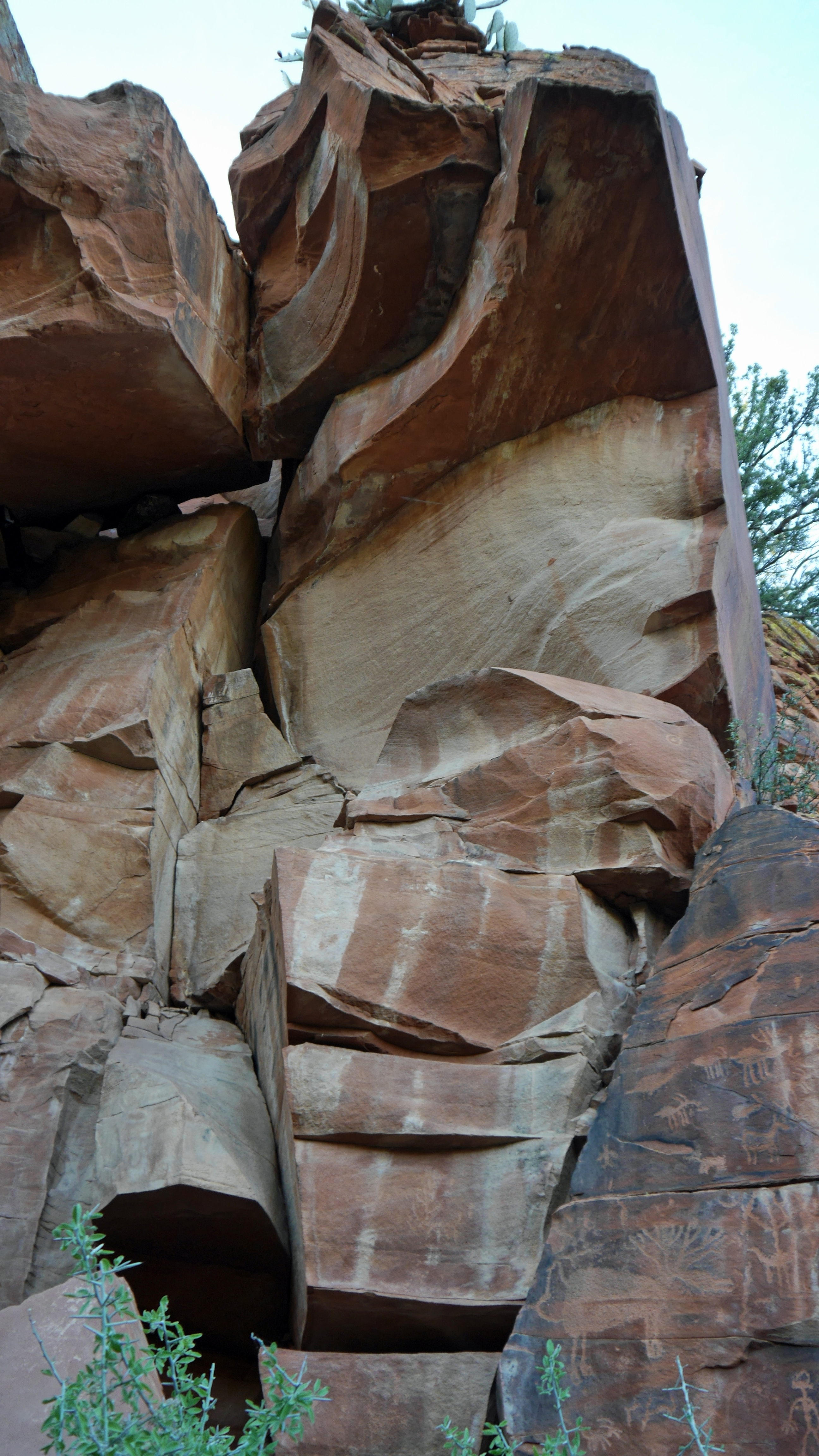
Towering Jenga-like rocks.
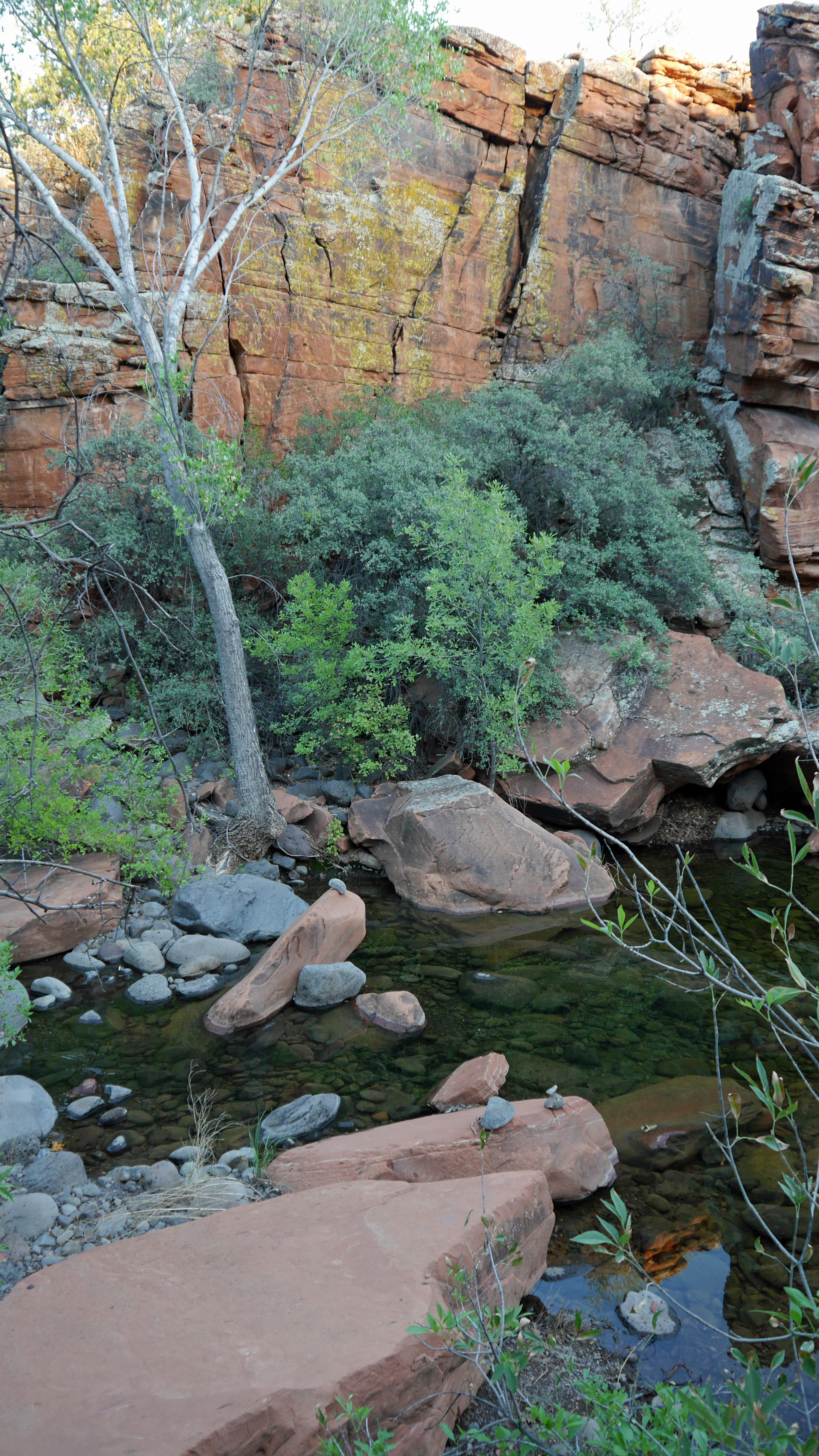
A mountain stream where we went for a walk.

Harrie takes in the scenery.

Sedona’s rugged beauty.

The Jeepsters. From the left: A New York family venturing out of their safety-zone, two very funny girlfriends from Chicago and three Aussies. I think Michelle is proudly singing Advance Australia Fair.
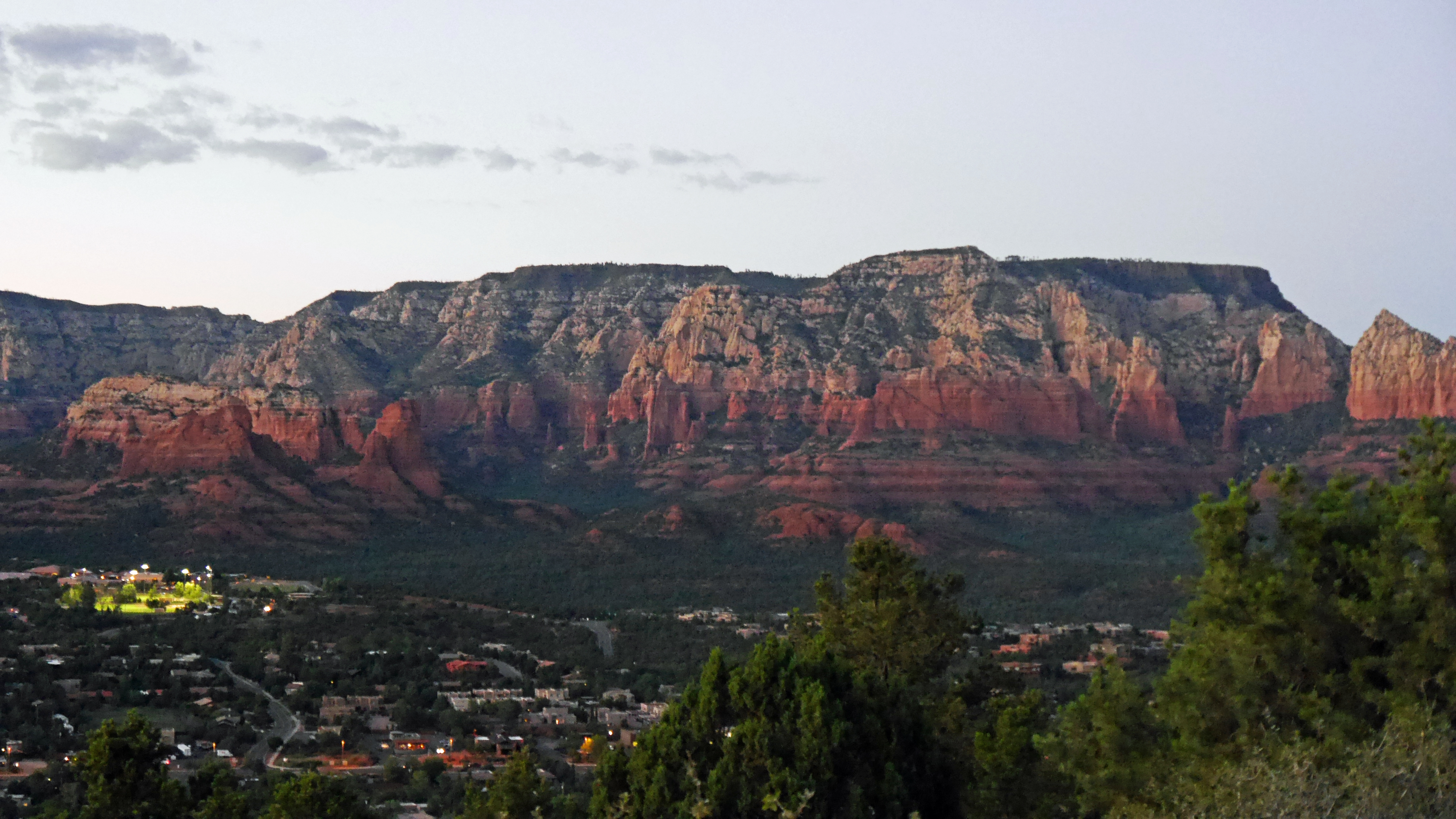
Looking out from a high plateau as the sun sets on Sedona.

A Sedona sunset.
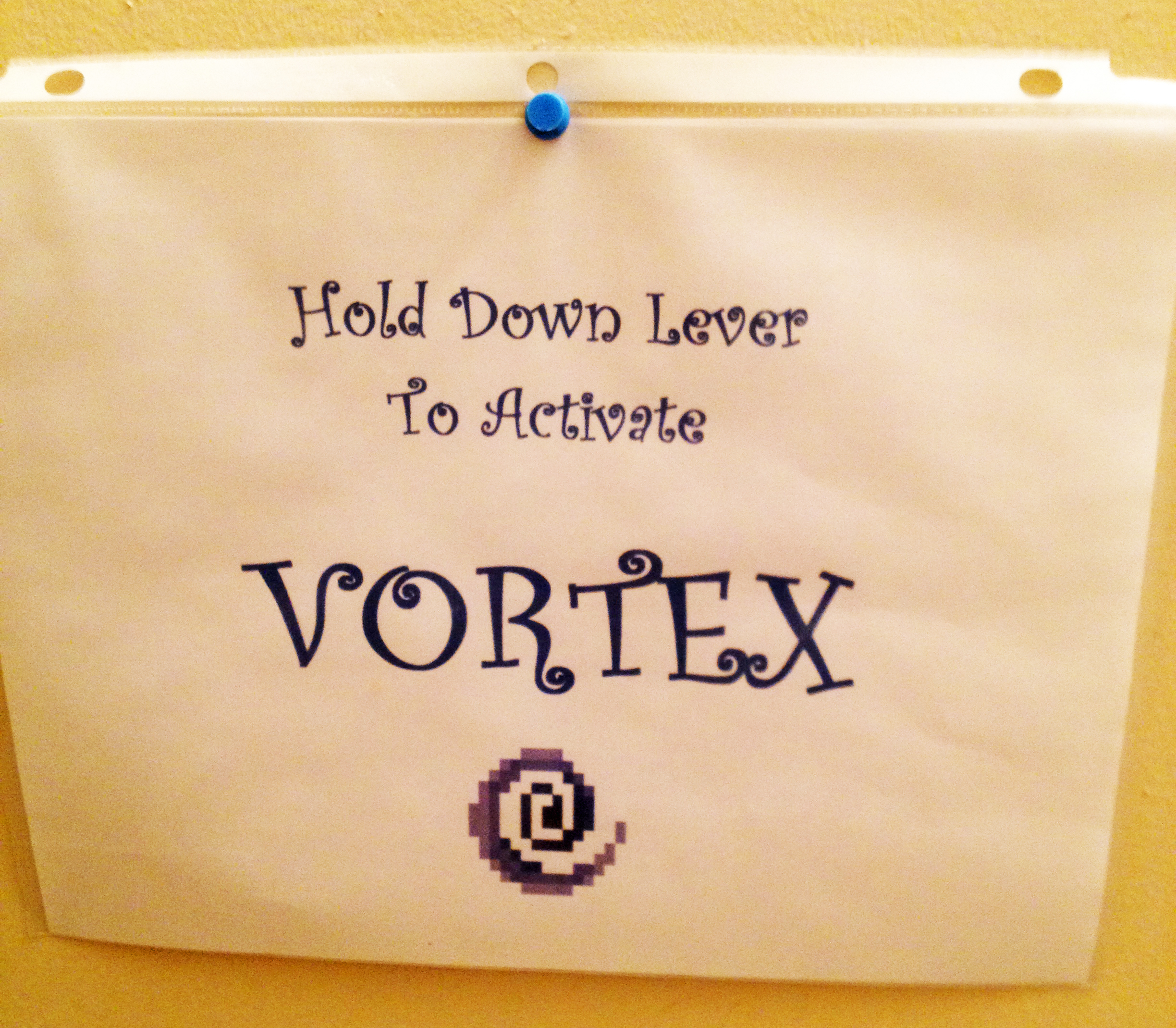
We spotted this in a toilet. A good sign that not all Sedona residents take the vortexes seriously.

Sedona is the only place in the world where you won’t find the Golden Arches of McDonalds. Instead you will find the Turquoise Arches of McDonalds. Sedona has very strict colour-code regulations to ensure buildings are harmonious with the landscape.

Sedona to Flagstaff.
Flagstaff
I found Flagstaff to be a great town. It reminded me a bit of Cooma in NSW in being the big-smoke hub for surrounding rural communities. It has everything you need without being an urban behemoth. It also has that grounded country-town atmosphere that you don’t get in either big cities or touristy towns.
Flagstaff is home to the Lowell Observatory where Pluto was first spotted in 1930. Of course, the folks at the Lowell Observatory are kind of pissed that Pluto was recently downgraded from a planet to “an object” in the Kuiper belt. They have a commemorative plaque in their foyer that reads “Pluto 1930-2006 Revolve In Peace.”
We visited the Lowell Observatory on a balmy Summer evening and strolled around the different observation stations where we viewed craters on the moon and distant galaxies. We listened to a talk on the solar system by one of the geeky volunteers who also told us all about the history of the Observatory.
The Lowell Observatory was set up in 1894 by a wealthy Boston businessman called Percival Lowell. Lowell was a self-taught astronomer who was convinced that there was life on Mars. He chose Flagstaff to build an observatory as it had all the ideal conditions for astronomy (an elevated position, no city lights, mainly cloud-free skies) which was the first time in the world that a remote site was chosen to build an observatory. And it paid off. The observations from Lowell were considered to be amongst the best in the world at the time.
At first, Lowell studied Mars almost exclusively; publishing a book in 1905 called Mars As The Abode of Life which captured the public imagination with its theories about a Martian society living underground in the so-called canals of Mars. In 1906, Lowell had another notion that there was a mysterious planet lurking beyond Neptune that he called “Planet X.” He spent the remainder of his life searching for Planet X but never found it. After his death in 1916, his young protege Clyde Tombaugh continued the search and, in 1930, finally found Planet X.
The news of the discovery traveled all around the world including to Oxford where an eleven year old schoolgirl called Venetia Burney thought that the new planet should be called Pluto after the Roman god of the Underworld who could make himself become invisible. She was fortunate in having a well-connected grandfather, Falconer Madan, who rant the Bodleian Library at Oxford University. He thought her suggestion should be passed on to the Lowell Observatory where it was enthusiastically received. This is chiefly because they realised that the first two letters of PLuto where also the initials of Percival Lowell. Planet X was now Pluto.
Lowell Observatory, Flagstaff Arizona
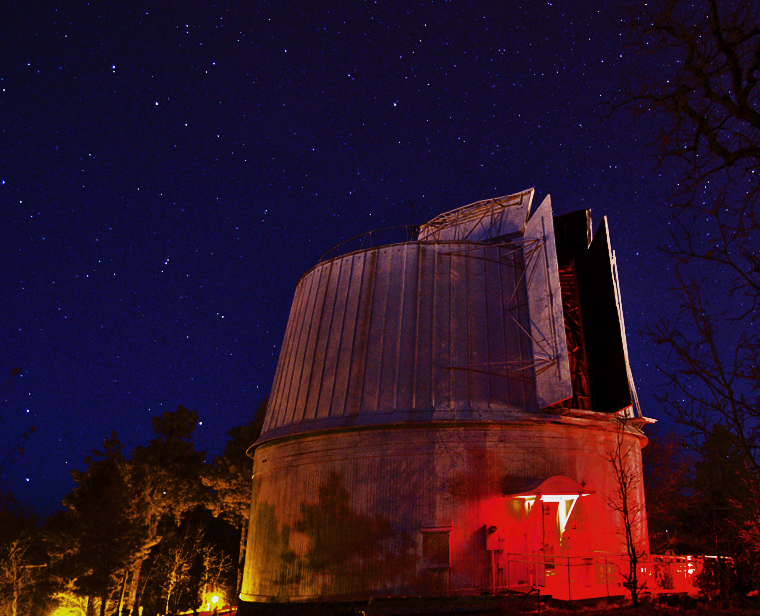
One of the observation stations where we looked through a giant telescope to see the night sky.
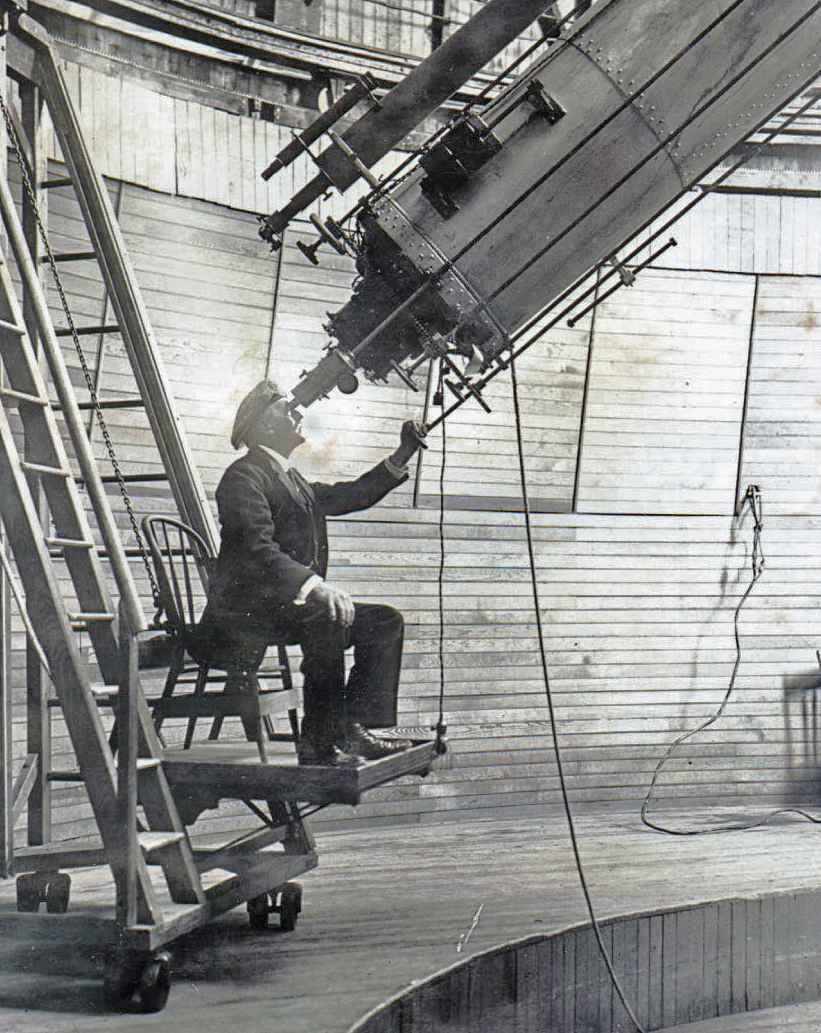
Percival Lowell observing Mars in 1914.

Lowell believed he had proof that there was life on Mars. The proof was the sighting of canals on Mars that he believed could have only been built by intelligent Martians. Unfortunately, the canals turned out to be an optical illusion when observing the planet from Earth. You can read the full article here.
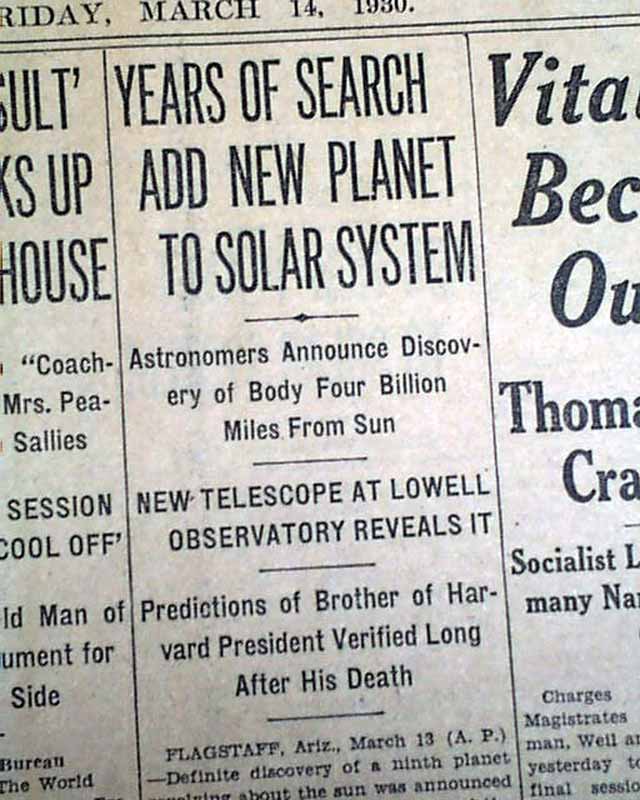
Pluto is discovered.
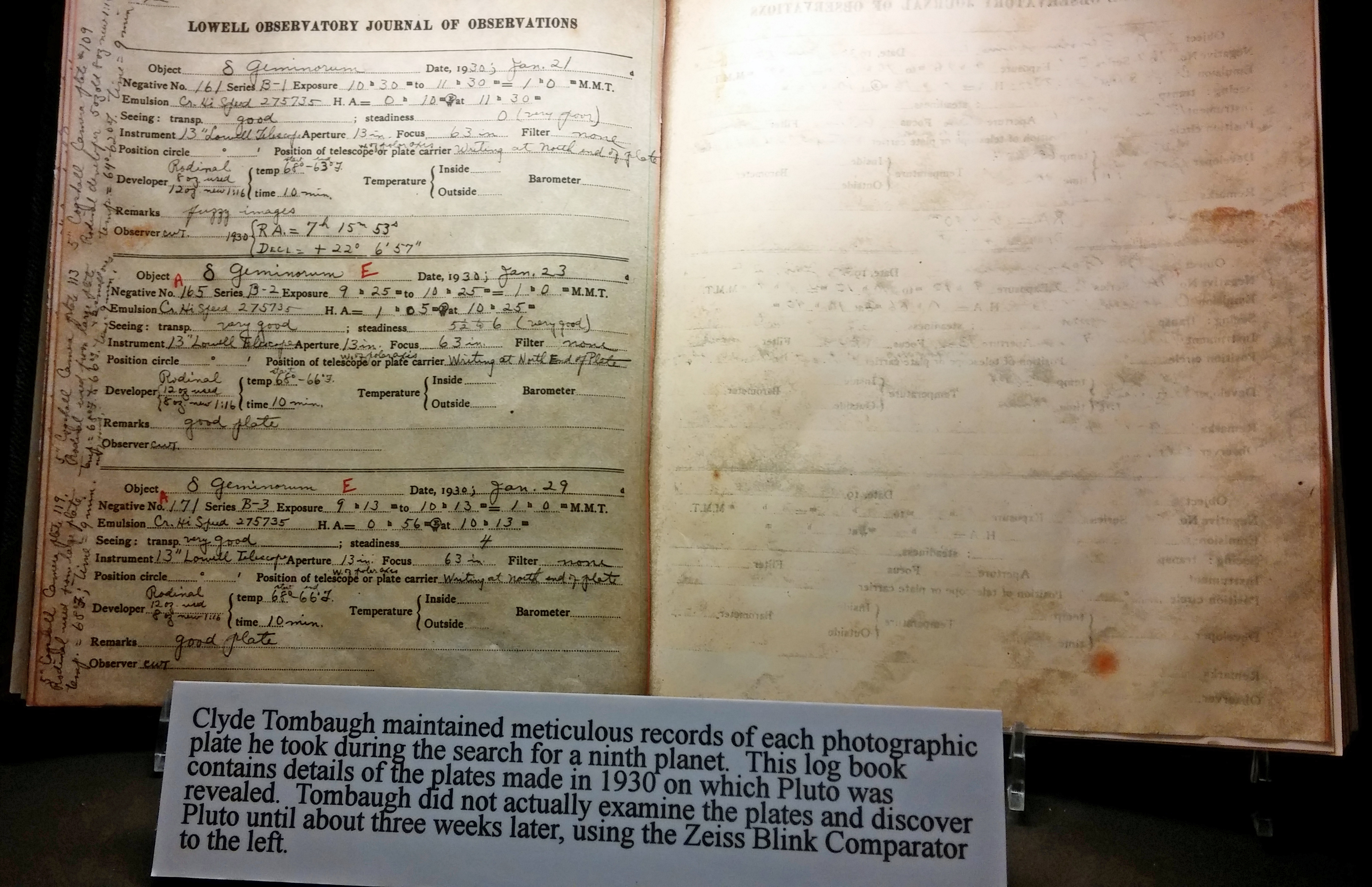
Clyde Tombaugh’s notebooks where he first recorded the discovery of Planet X or Pluto.
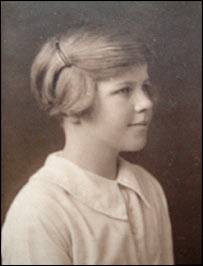
Venetia Burney, the eleven year old who named Planet X Pluto.
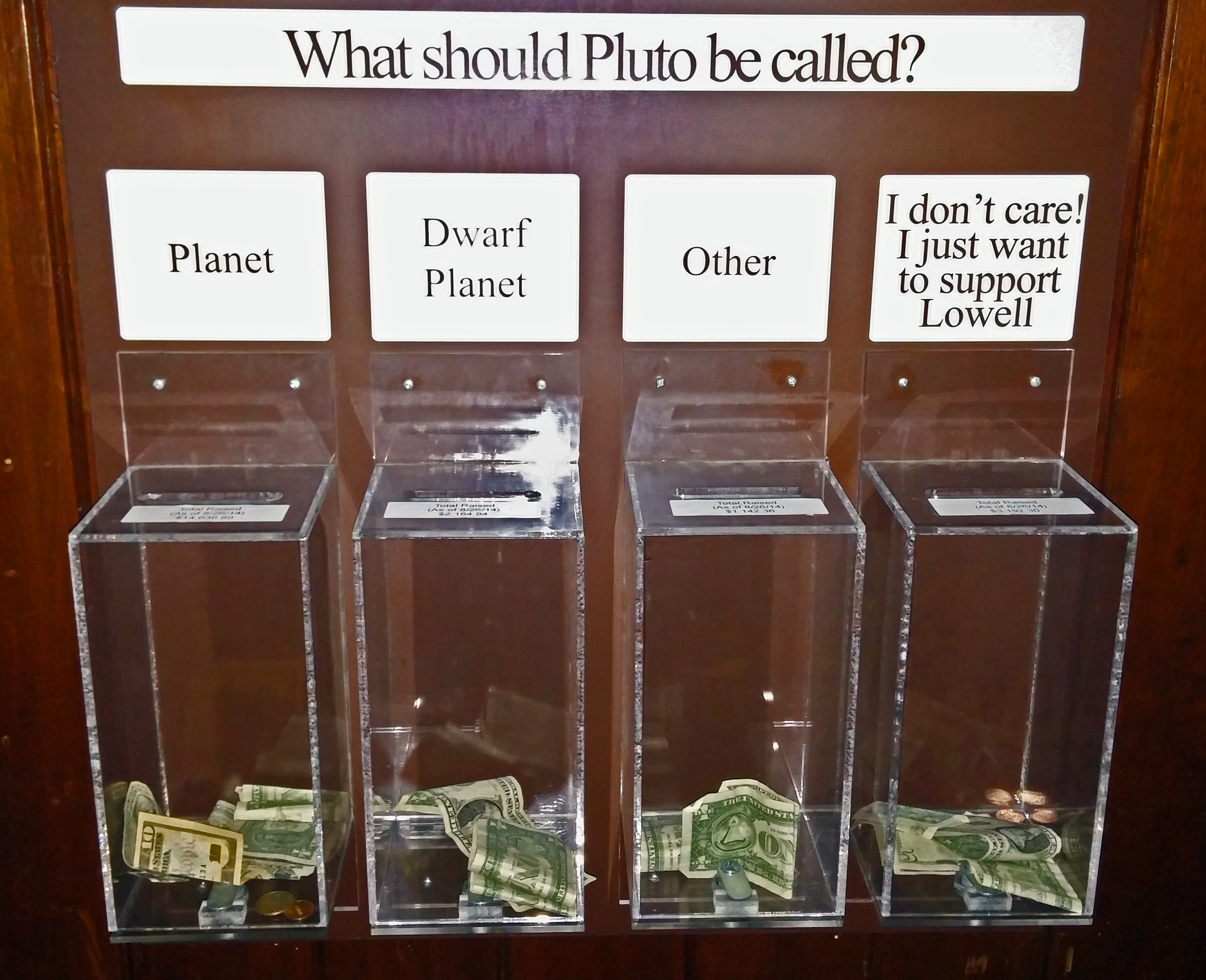
The donations box at Lowell Observatory.
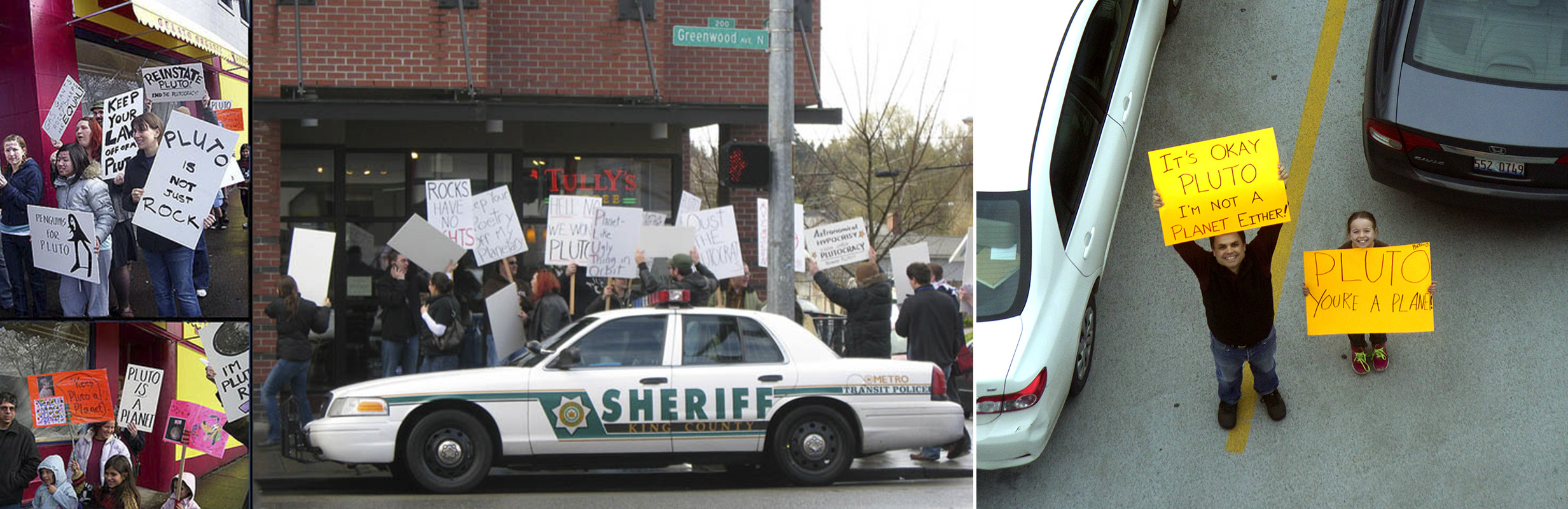
The demotion of Pluto as a planet caused protest demonstrations in some US cities. Here is one in Seattle (click on the photo to get a better view of the protest signs).
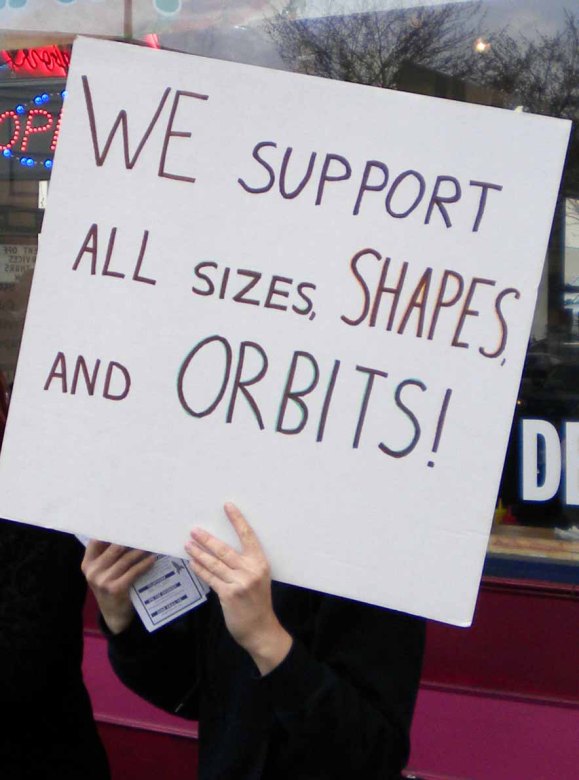

One protester taking the opposite view.
A Brief History of Pluto
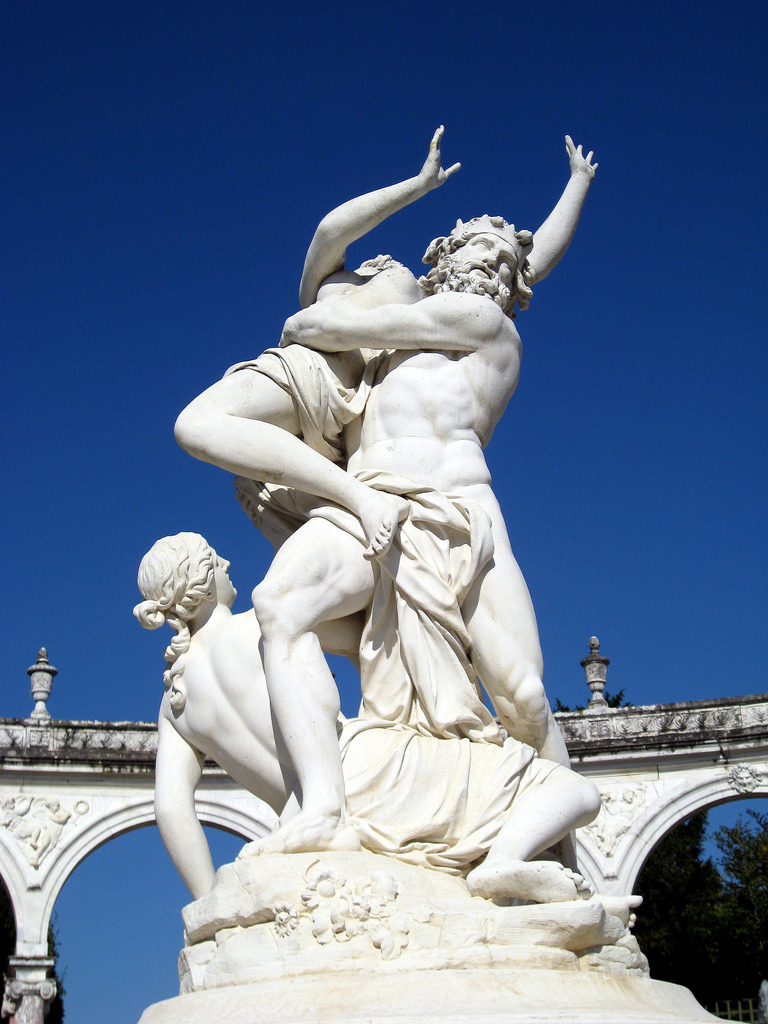
Of course, Pluto started as the Roman god of the Underworld. The statue above is by French sculptor Francois Giraudon and depicts the Rape of Proserpine by Pluto. The desperately lonely Pluto (the Roman version of Hades) abducts Proserpina (the Roman version of Persephone) to be his wife in the Underworld. The lonely god has a lot in common with the distant dwarf planet. Pluto’s crown also enabled him to turn invisible which was also a hallmark of the planet when viewed by astronomers.
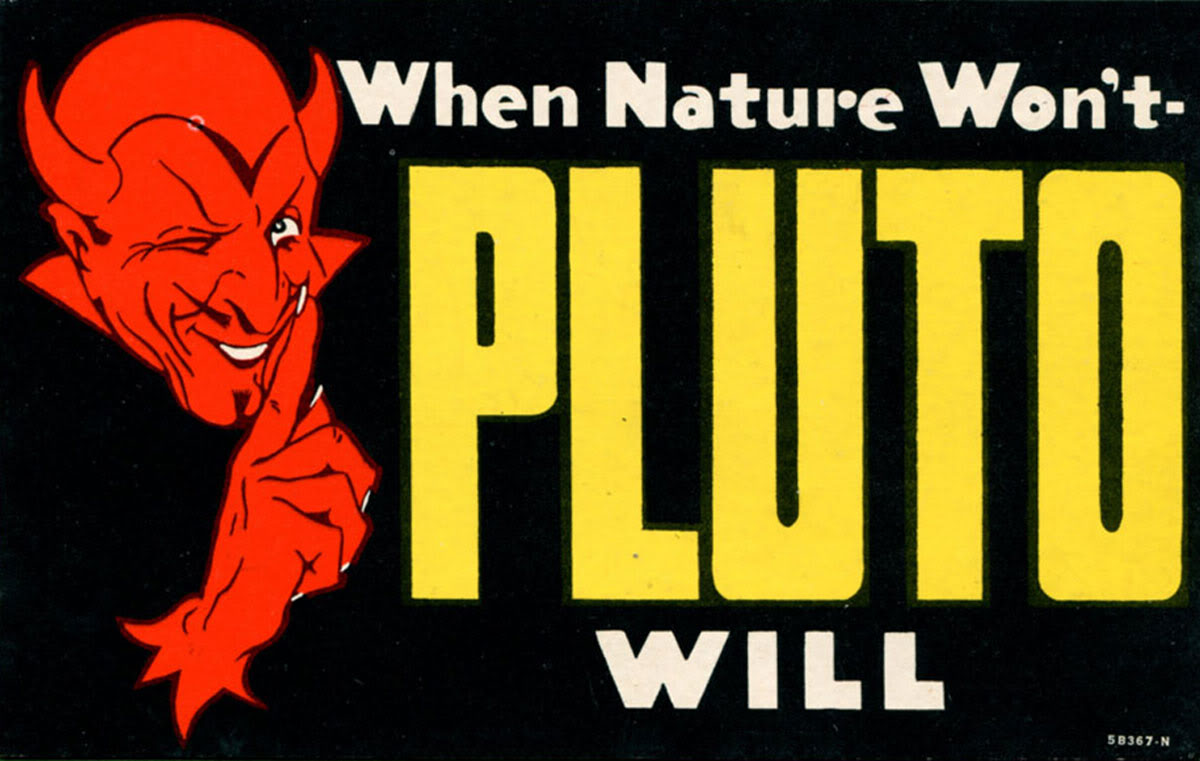
Before the planet was discovered, Pluto was most well-known as a laxative. Pluto Water was one of America’s most popular medicines in the early twentieth century before it was banned for its use of lithium.
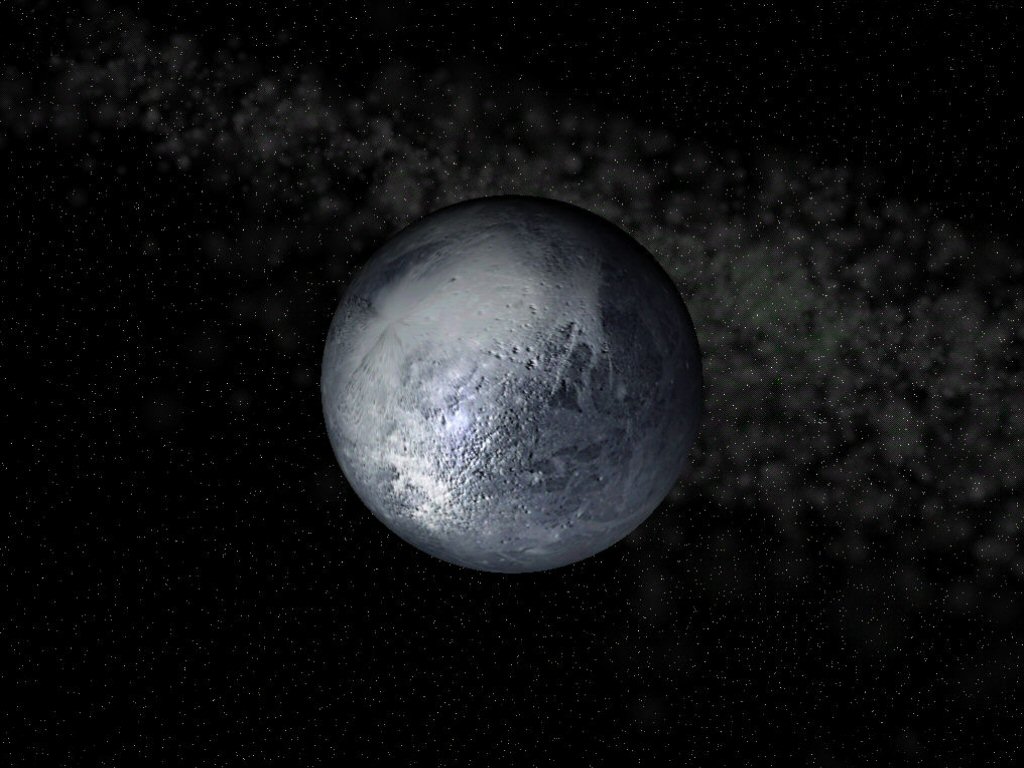
In 1930, Pluto became a planet. Many at Lowell Observatory didn’t like the name because of its association with Pluto Water. Constance Lowell (Percival Lowell’s strange wife who pretended she was blind even while pointing out things that a blind woman couldn’t possibly see) wanted it to be named Percival after her late husband. This is an artists impression of what the dwarf planet looks like. We will get better pictures in July 2015 when NASA’s New Horizons probe flies past Pluto.
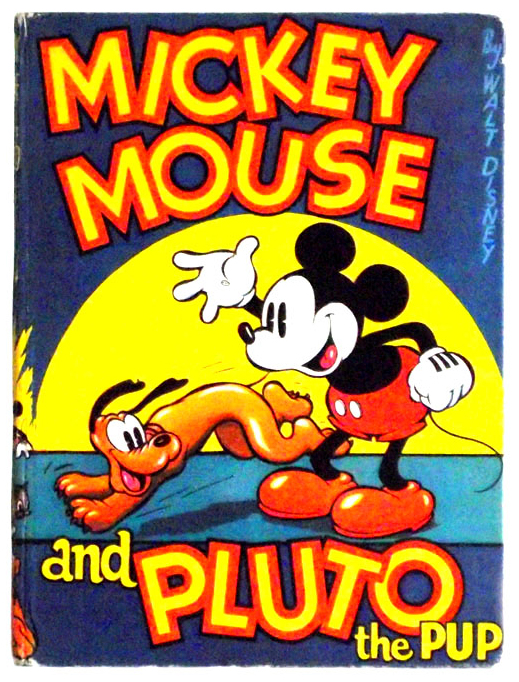
Walt Disney was said to have been amazed at the public interest in the newly-discovered planet and cashed in by changing the name of Mickey’s pet dog from Rover to Pluto in the 1931 Mickey Mouse short, Moose Hunt. The dwarf planet should have sued.
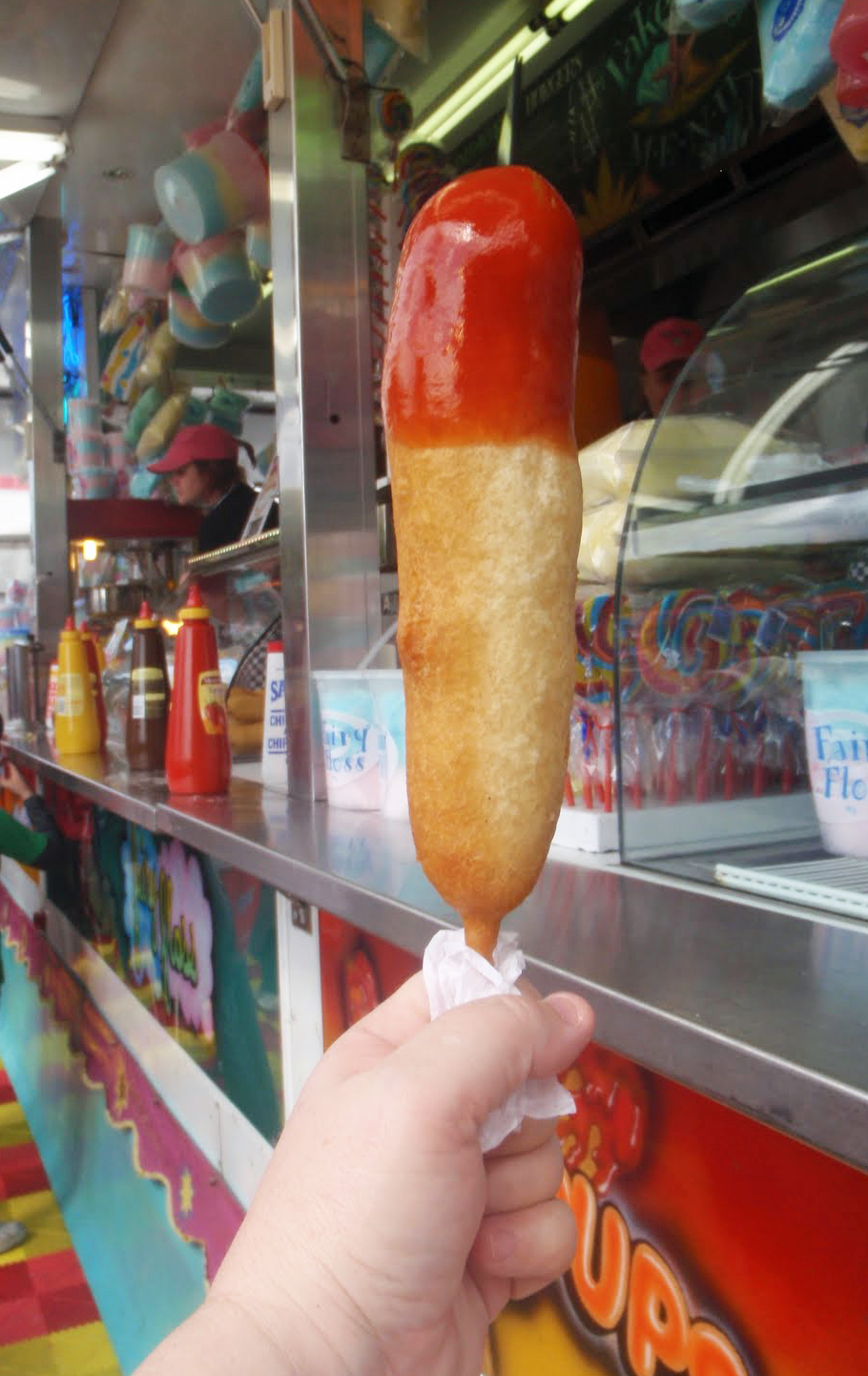
Australia’s own contribution to the god of the underworld – the devilish Pluto Pup. Also known as the Dagwood Dog, the Battered Sav or the Dippy Dog. It was invented in America in 1927 by German immigrants who patented a “Combined Dipping, Cooking, and Article Holding Apparatus” or, in other words, an American Corn dog.

Moving on from the Lowell Observatory, here we are having lunch at a cafe near the railway station in Flagstaff.

The route from Flagstaff to the Lava River Caves.
Lava River Caves
When we were in Sedona, we got in touch with the local scout troop to enquire if Harrie could attend a meeting. Unfortunately, we missed the meeting, but we were encouraged to attend a hike the troop had planned through the Lava River Cave north of Flagstaff. We were advised to wear warm clothing which we didn’t have in the middle of Summer. So off we went to buy the cheapest sloppy joes and trackie-daks that the Flagstaff branch of Target would sell.
In our two-wheel drive Camry, we gingerly headed down a torturous four-wheel drive track to the Lava River Cave taking every pothole and rocky incline in a measured clamber; all the time thinking if one spare tyre was enough.
The cave was formed 700,000 years ago when lava erupted from a nearby volcano and flowed through the rocks to carve out an extensive network of caves. Today, it is a popular destination for underground hikers. Harrie and I joined the Sedona scout troop at the entrance to the cave and got down on our hands and knees to crawl down the jumble of rocks to the cave floor. With only head torches for light, we cautiously made our way through the icy cold caves.
The caves were beautiful and unexpectedly big. At some points they were like giant underground railway tunnels that almost looked man made. At other points though, you had to get down on your hands and knees to crawl through confined spaces. It was at one such point that I hit my head on the cave roof and had a nasty gash that didn’t heal until well after we got back home to Australia.
The caves split off in different directions at some points and sure enough, half the troop got separated after about an hour. Eventually we decided to head back to the entrance way and wait. Here we had a number of interesting and varied chats with the scouts that had stuck with us. They were very intrigued about Australia. One scout wanted to know if we had pizza in Australia adding that he didn’t think he could possibly live in a country that didn’t have pizza. Another scout wanted to know if we had caves. Maybe he was under the assumption that America had an exclusive geological right on the concept. These were nice kids though and Harrie had a great time hanging out with them.

The brochure we picked up on the Lava River Cave. It’s funny how national park brochures look the same the world over. Slightly dated and very wordy.

The Sedona scout troop at the entrance to the Lava River Cave.

Inside the cave (as taken on my phone).

This gives you a better sense of scale.
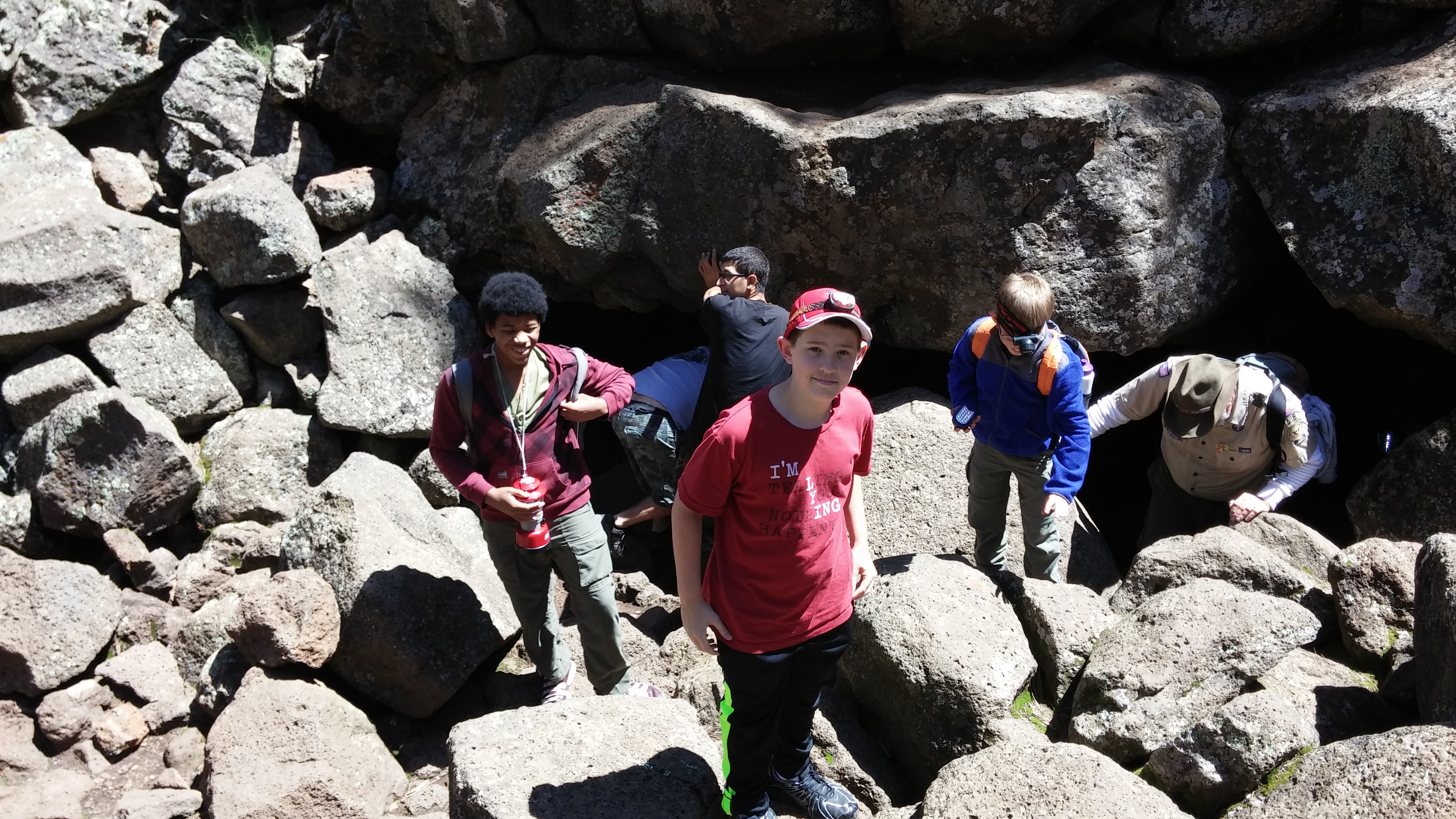
Clambering out of the cave.

Driving from the Lava River Caves to the Grand Canyon. Cameron isn’t shown on this map but is just prior to the Y junction where the purple and yellow lines meet.
Cameron
From the Lava River Cave we headed north to the Grand Canyon. We stopped at a one-horse town called Cameron which was mainly a Navajo settlement. We were told that their were lots of road runners around these parts and I was quite keen to see one in the wild. Unfortunately, we didn’t spot any which was a great disappointment.

The post office in Cameron

Bizarrely, there was an upmarket Indian concept home on display in Cameron. This is the kitchen with its unique branch-slatted cupboards. and Indian-motif tiles.
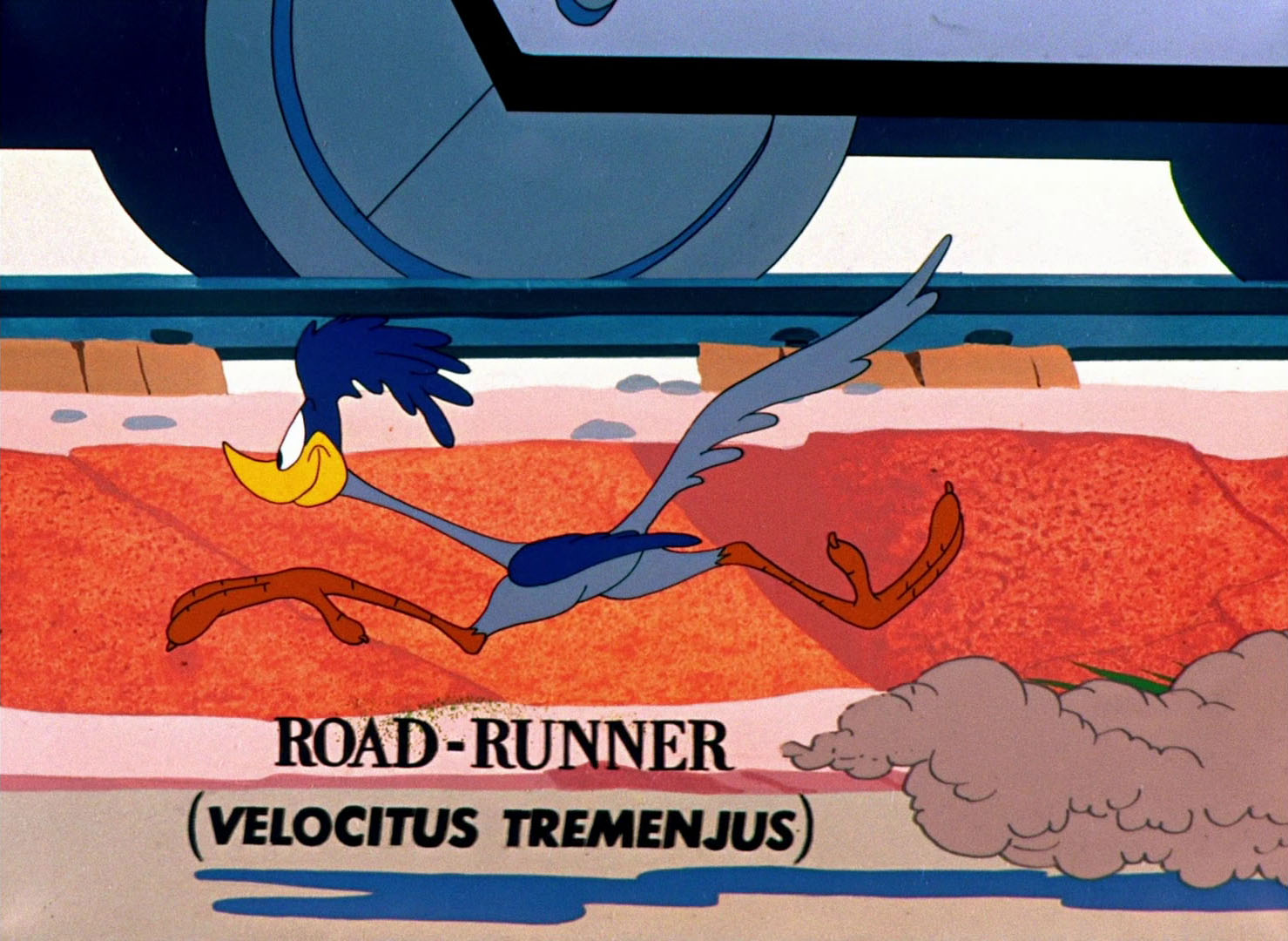
The Road Runner of my youth. I still know all the lyrics from the theme song by heart. Coincidentally, the Road Runner tune was written by Barbara Cameron who didn’t live in Cameron though.
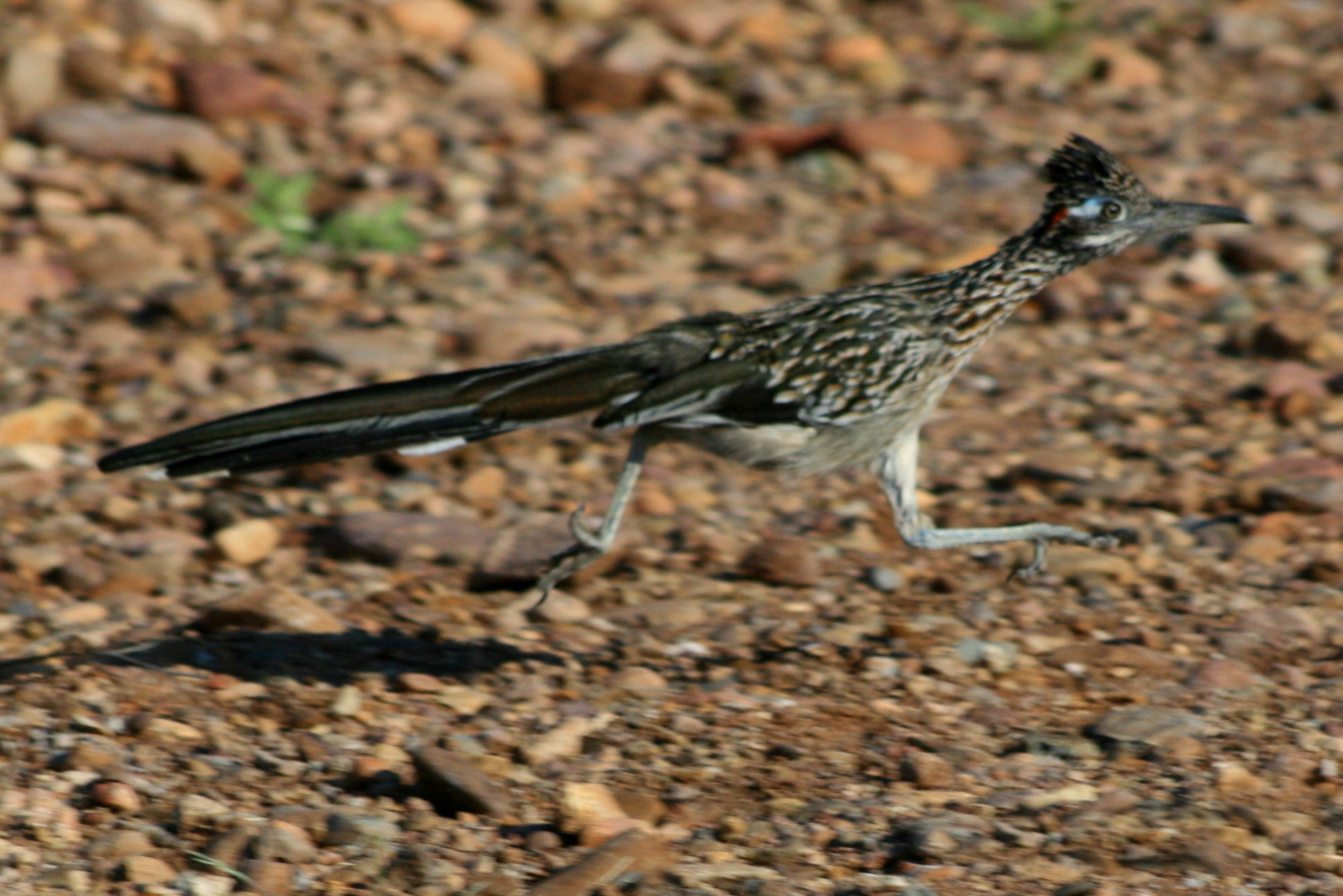
The real road runner. Related to the cuckoo family, this road runner doesn’t go, as Jonathan Richman put it, at “faster miles an hour.” It only travels at a maximum of seventeen miles per hour (27 kilometres per hour). It can be easily caught by a coyote without the help of the Acme company.
The Grand Canyon
We drove into the Grand Canyon National Park and made our way up towards the South Rim. At one point a family of giant elk decided to cross the road in front of us. Thankfully we were going slow and didn’t collect them. Our first opportunity to see how grand a canyon can be was at the Desert View Watchtower.
It was a pleasant surprise to find that our old friend Mary Coulter (see above) had designed the Desert View Watchtower back in the twenties. She had it built in the style of an ancient Pueblo watchtower and it was quite beautiful both inside and out.
However, it still didn’t match the beauty of the vista it looked out on. The Grand Canyon can not be experienced through a camera lens or even a stationary pair of eyes. You need to move your head around to take in the massive scenery that confronts you and sprawls in all directions like a constantly unfurling canvas. It simply takes your breath away. And to think that it is only the third biggest canyon in the world.
The second sensation you get is one of deja vu. The Grand Canyon is so iconic that there is a strange sense of familiarity when you see it for real. For some reason all I could think about was The Brady Bunch and Evel Knievel. But it turned out that I got it wrong. I always thought that Evel Knievel had tried to jump the Grand Canyon when he instead tried to jump the Snake River Canyon. When checking this, I came across this absolute gem.
We stayed at the Thunderbird lodge which, regrettably, wasn’t designed by Mary Coulter. However, it did prompt me to question what the heck a thunderbird was? I grew up with Thunderbirds being “GO” and knew of the Ford Thunderbird car, but was there an actual bird called a thunderbird? It turns out that a thunderbird is a mythical bird from Indian legends. You often see it depicted on the top of Indian totem poles. As legend has it, the Thunderbird would cause booming blasts of thunder with every beat of its wings. It was symbol of great power. The Thunderbird Lodge wasn’t quite that but it was comfy enough.
We went for a long sunset walk around the rim of the canyon and watched the sinking sun cast long shadows across the gorgeous gorge. Much like our evening on the plateau in Sedona, clusters of people had gathered on different ledges around the canyon to “do their thing.” This included everything from New Age rituals, painting pictures, striking yoga poses to a group of backpackers knocking back beer while they ate a communal pizza.
We wanted to take a mule ride down to the floor of the Canyon but were put off by the exorbitant prices being charged. Instead, we spent the morning exploring more of the top of the Canyon.
Driving off, we had that wistful feeling that we could have stayed longer and would have benefited from being further nurtured by the Canyon’s beautiful nature. But we had to get to Las Vegas and there was still quite a distance to travel.
We were five minutes down the road when Harrie had a mild panic attack. He realised that he didn’t have his beloved Boston cap. We drove back to the Thunderbird Lodge and spent over an hour retracing our steps in order to find it. It turned out that he had left it at the Arizona Room restaurant where we had eaten the night before. With hat in hand, we set off towards Seligman.

The view from the Desert View Watchtower. Remember, clicking on any picture will bring up a high resolution version.
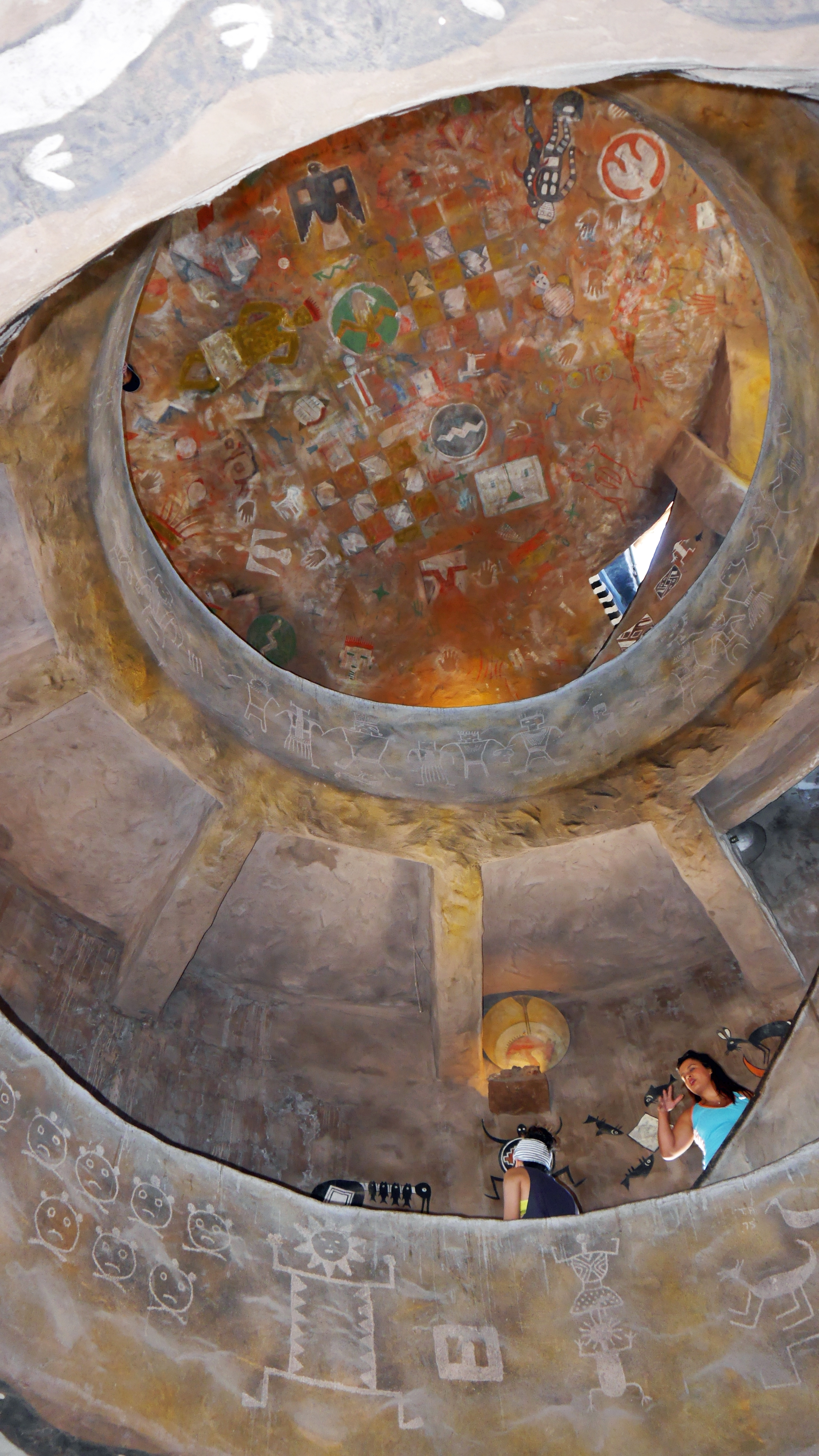
The beautiful (but fake) Pueblo interior to the Desert View Watchtower.
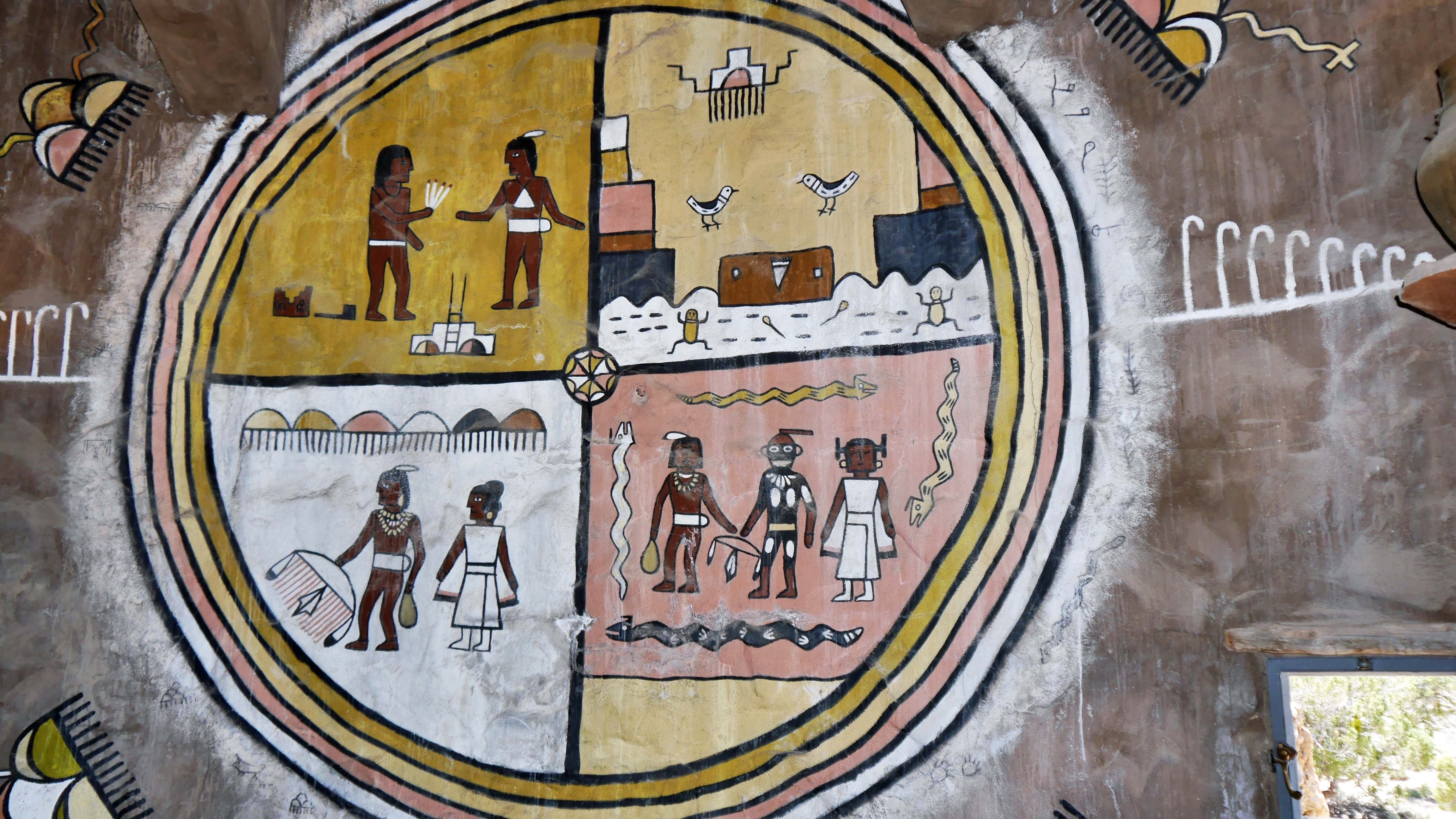
A pseudo-Pueblo mural inside the Desert View Watchtower.
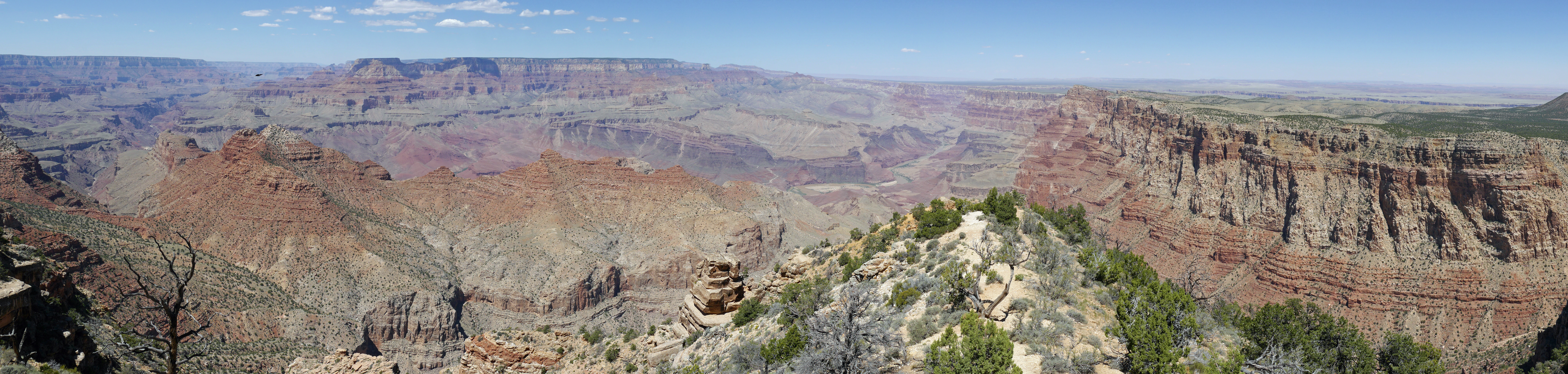
Another gorgeous vista of the much-visited gorge.
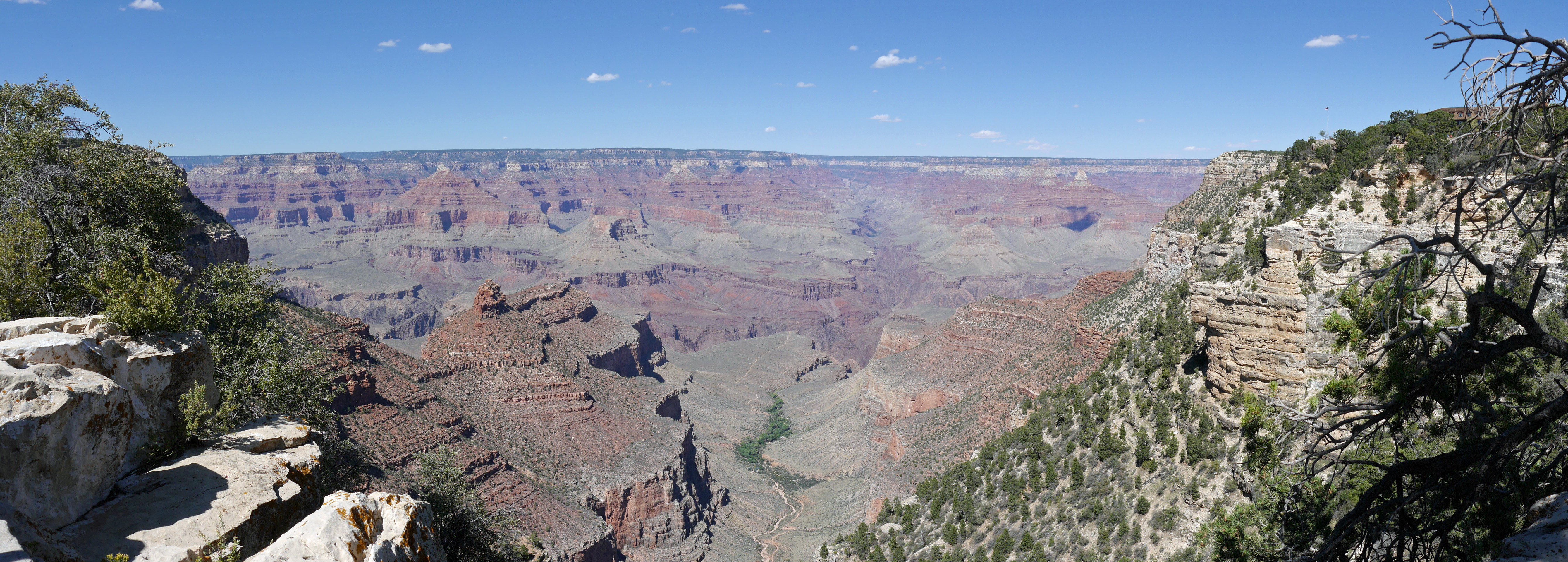
Yet another angle, with more rock formations to view.

The Thunderbird lodge where we stayed. It is not as charming as the older Mary Coulter lodges but it does face the Canyon.
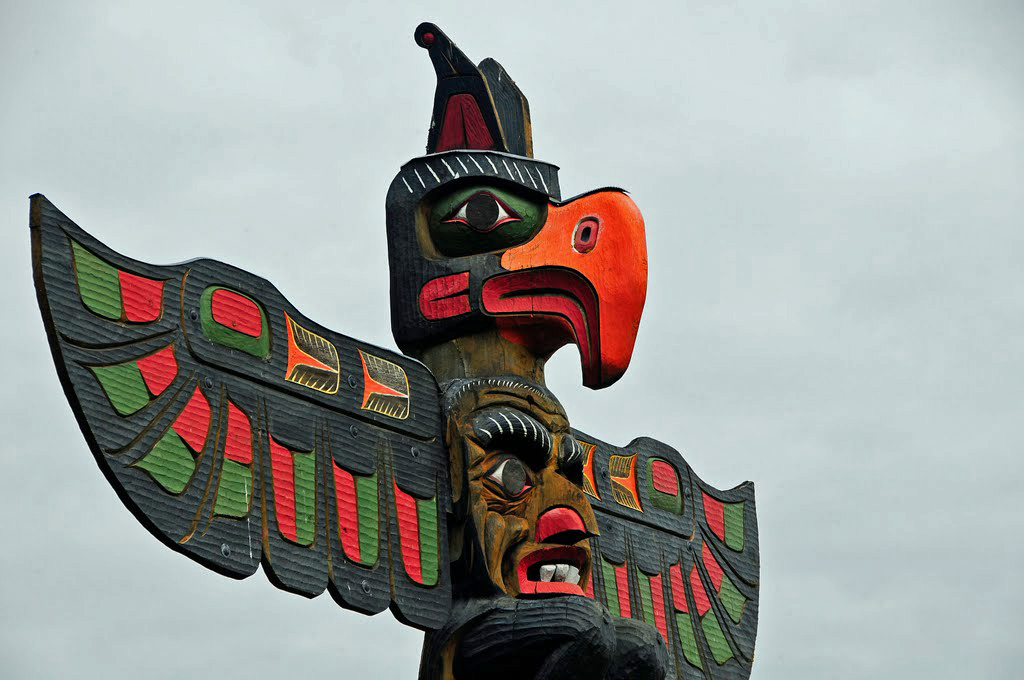
A thunderbird atop an Indian totem pole. Many crazy cryptozoologists believe that the thunderbird was a real bird and point to the account given to the The Tombstone Epitaph in 1890 by two cowboys who reckoned they shot one.
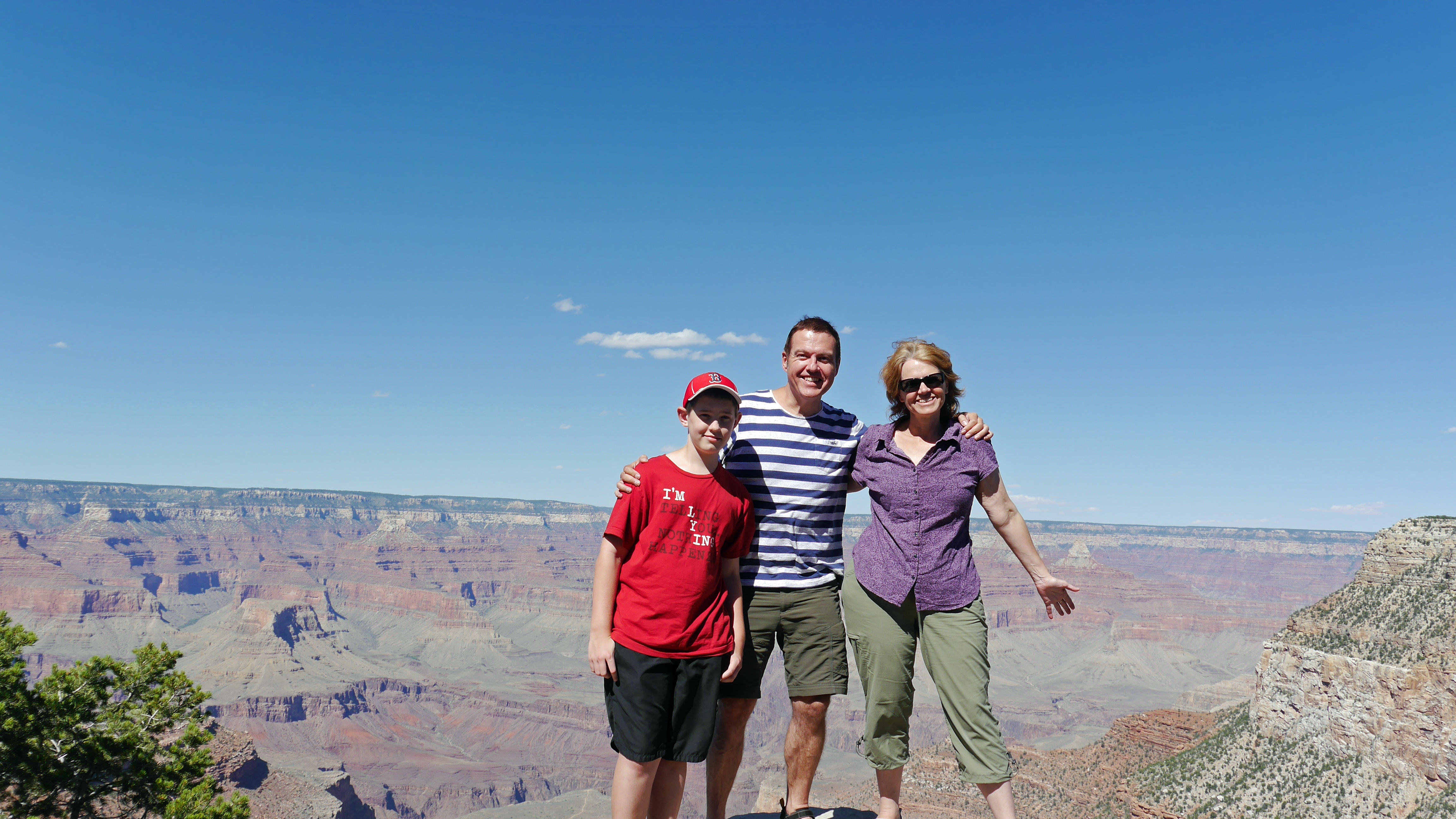
Conquering our fear as we stand on the precipice of the grandest canyon. Also the photo used as the banner of this blog.
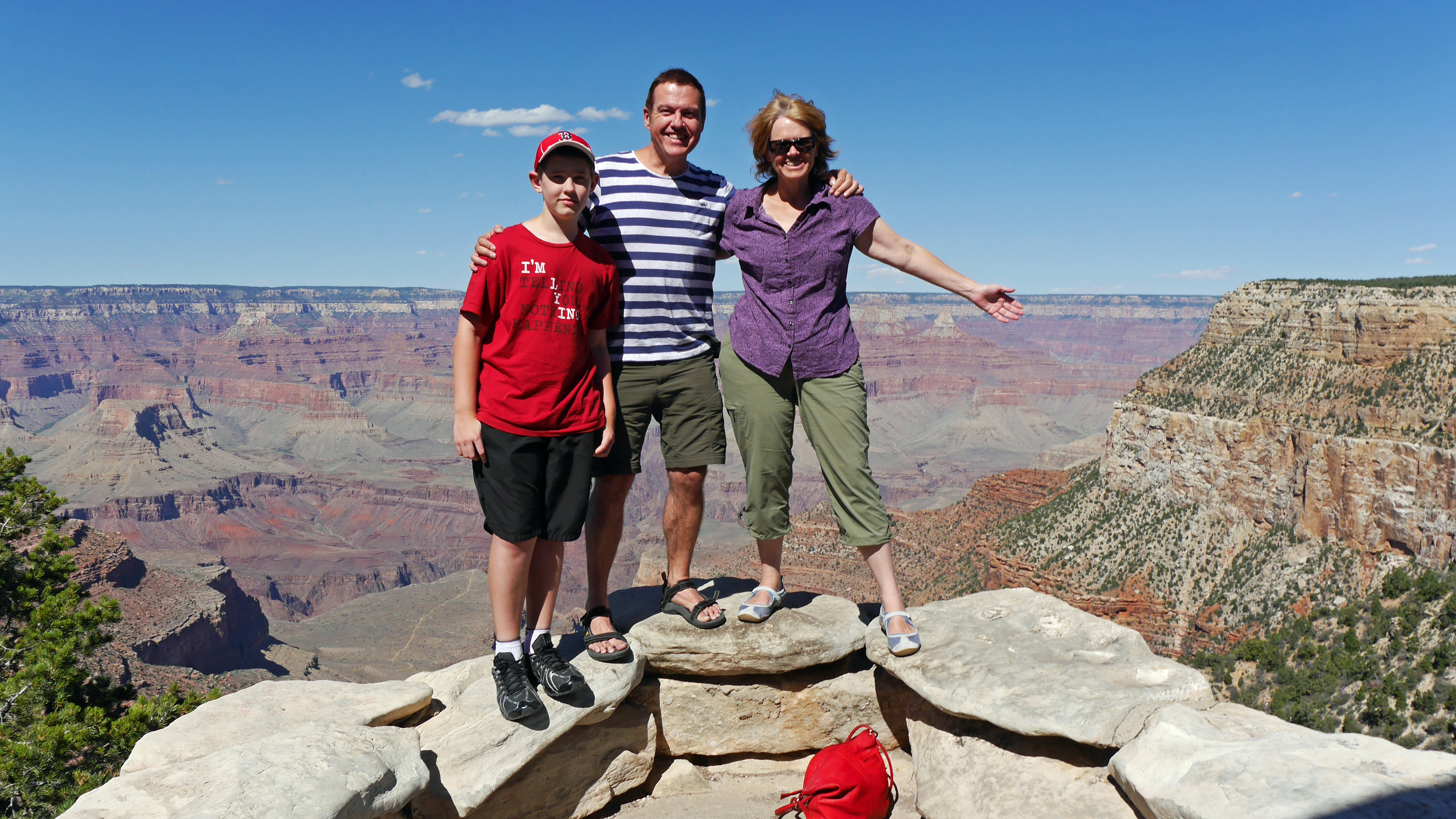
Living dangerously on the edge.

Michelle enjoying the Grand Canyon.
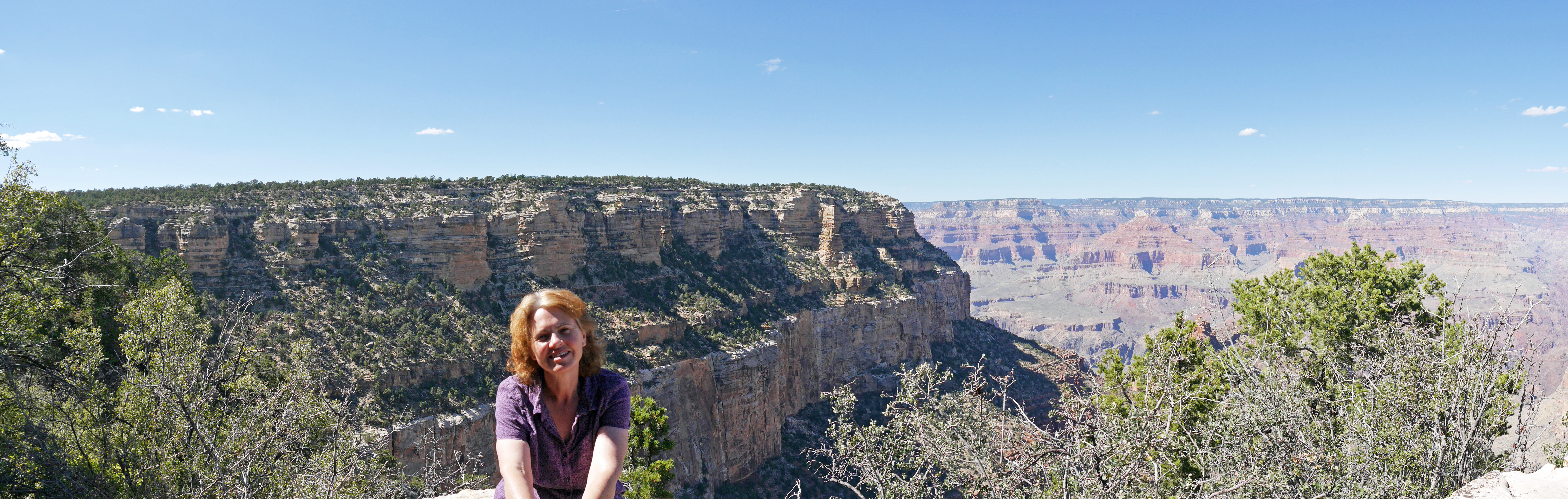
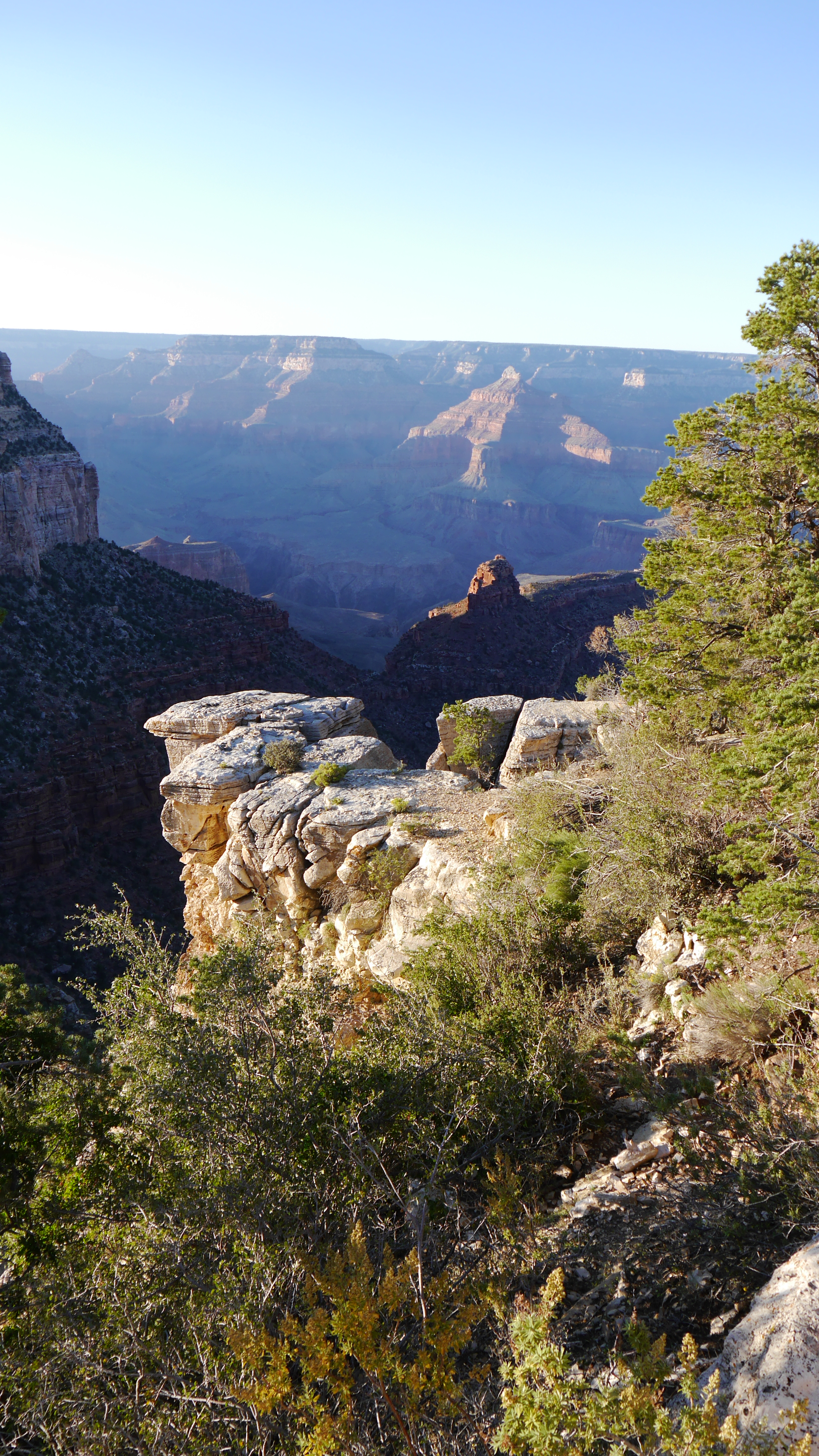
Raising Arizona. 541 million years ago, these rocks were raised by volcanic activity to form the Colorado plateau. The Canyon itself is the result of millions of years of water and wind erosion.

As the sun set, the light created dramatic highlights on the ridges and jutting ledges.
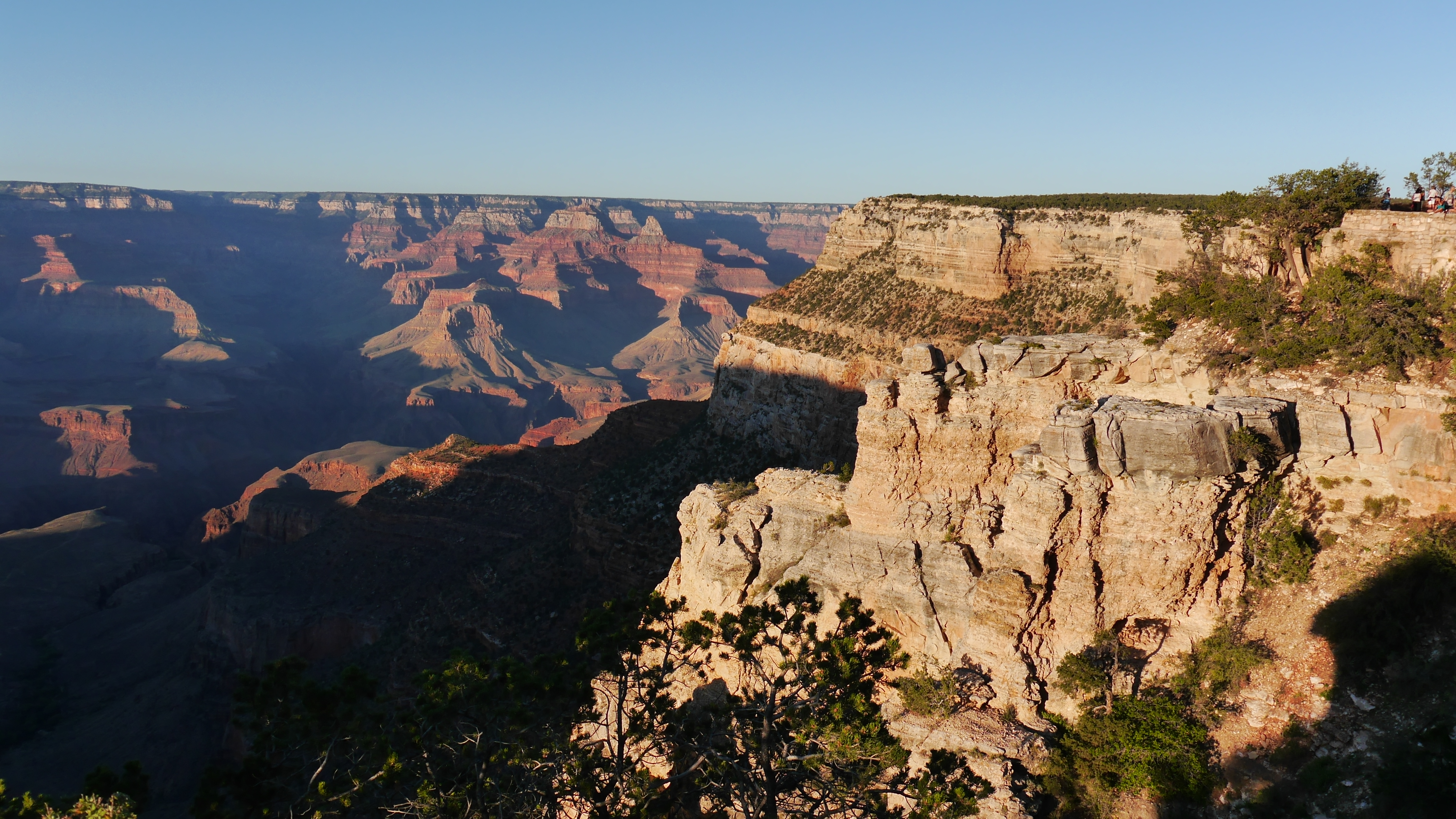

I loved the way the light caught this hole in the rock as well as how it foreshortened the canyons in the background making them look like they were standing next to each other for a group photo.

As we walked around the Canyon the last rays of sunlight would hit the higher ledges and bathe them in bright light.

Just like in Hot Springs, free spring water was available on tap at various points.

Harrie and other humans take in the dying light.

This looks like a massive nuclear explosion but is simply a solar flare on the camera lens. I liked the effect though.
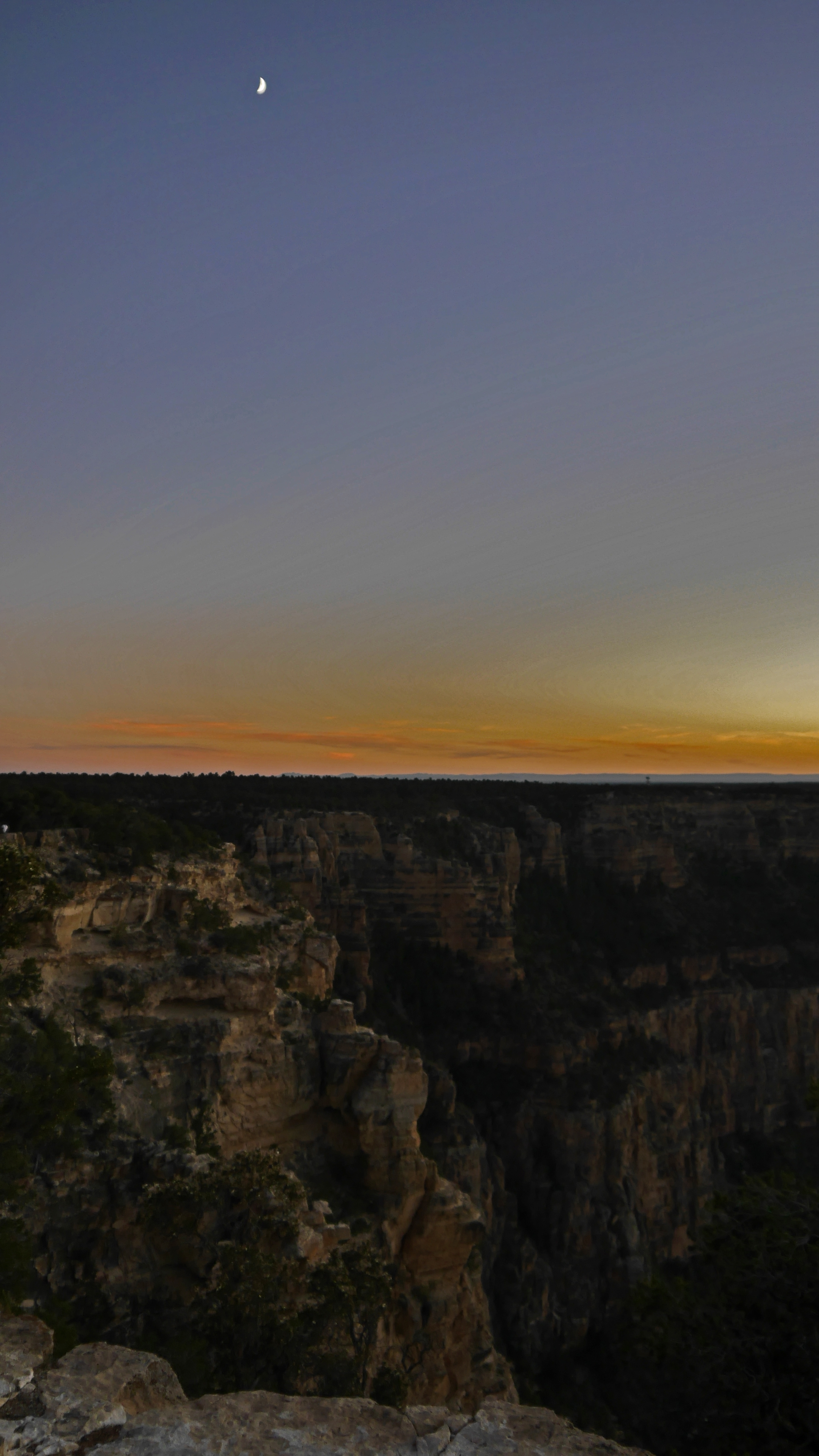
A crescent moon appears to signal the coming of night.

Now only a flash can illuminate the landscape.
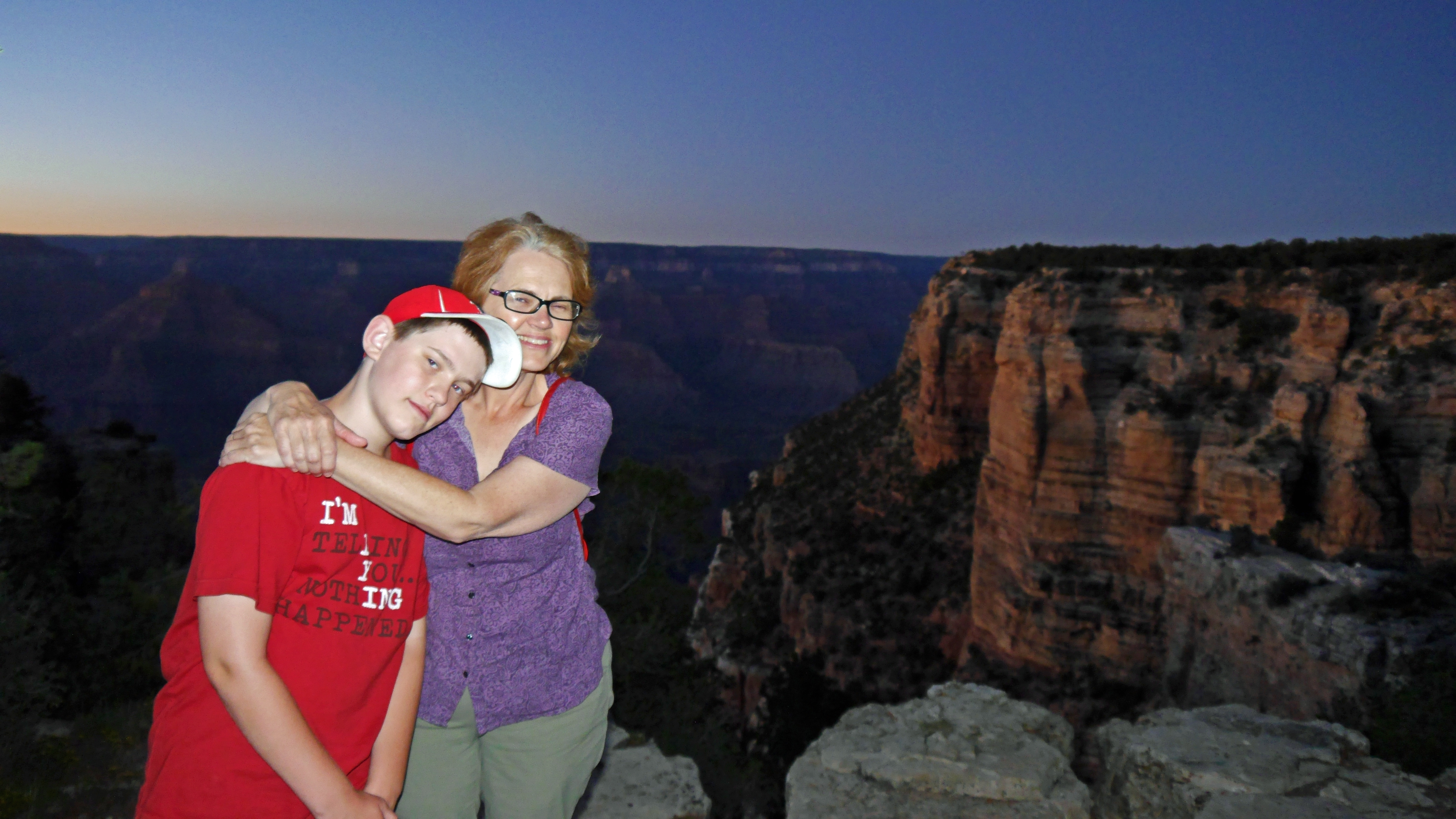
The Mother and child re:Canyon (sorry for the bad Paul Simon pun but it’s not easy writing all of these captions).

A photo before returning to have dinner where, funnily enough, I had a Grand Canyon Sunset Amber Ale. Its colour kind of resembled the sunset we had just seen.

The next morning we walked around to the Mary Coulter designed Lookout Studio and Hopi House.
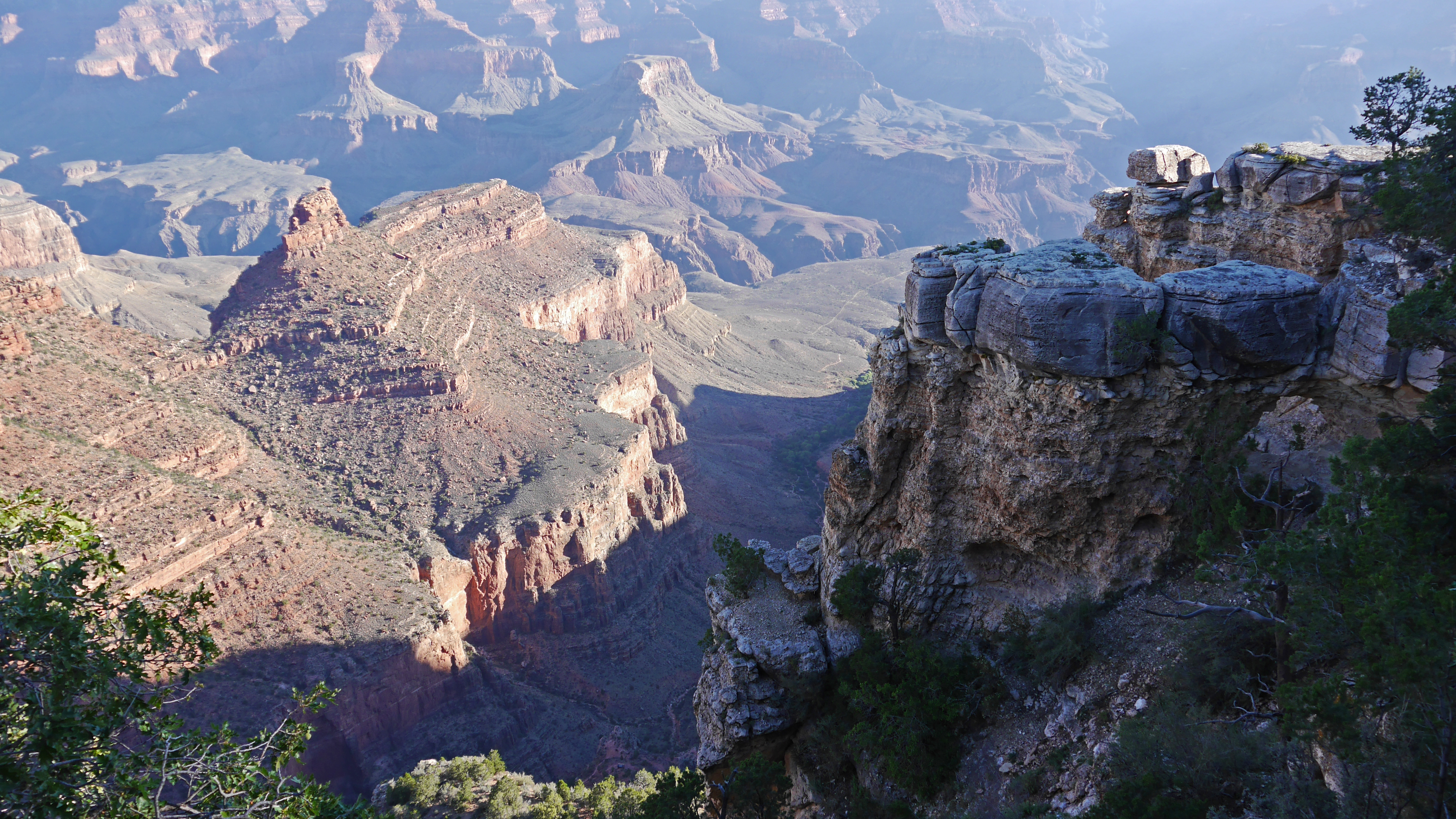
These views never get tired.
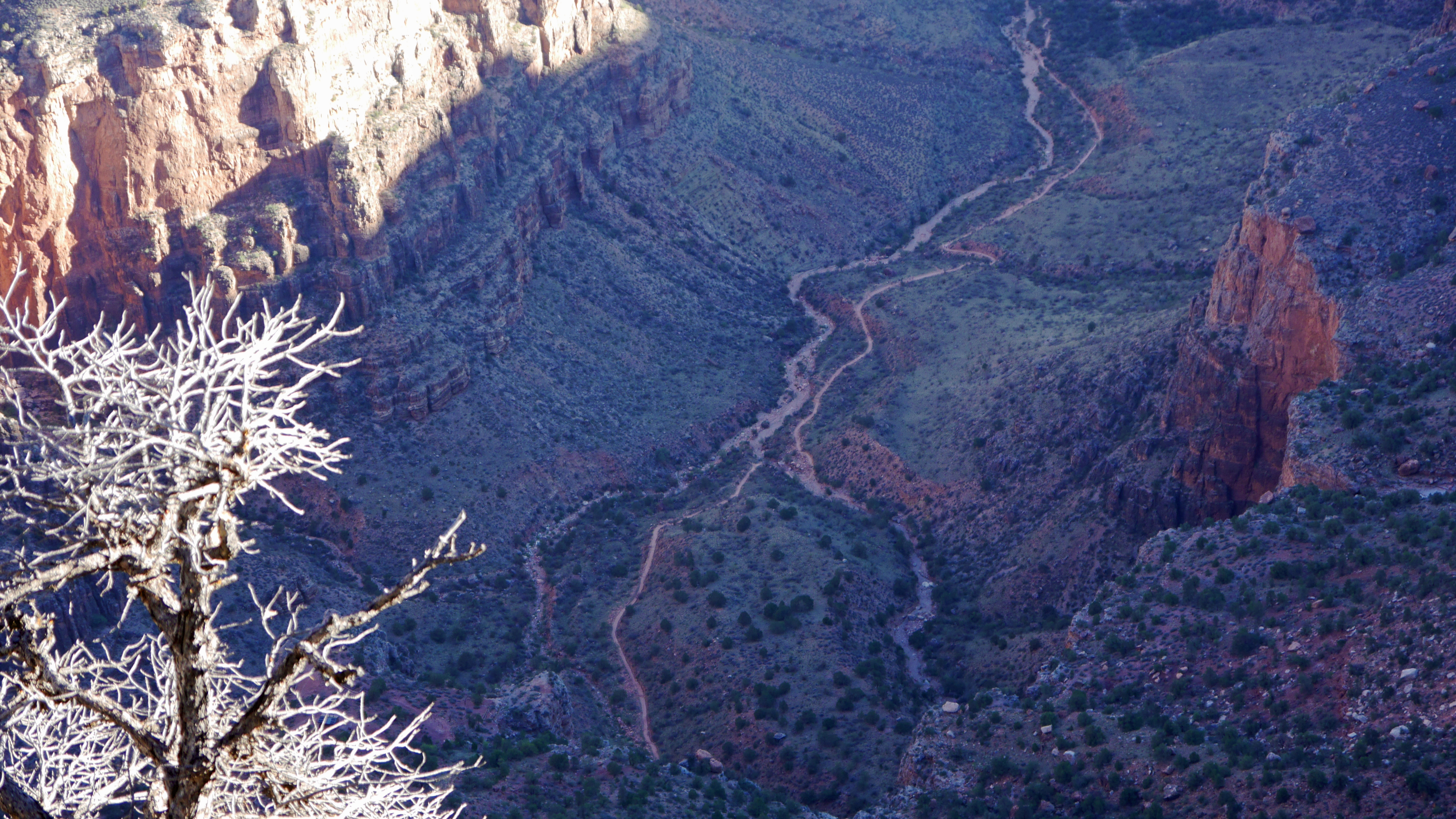
A tributary of the Colorado river on the Canyon floor.
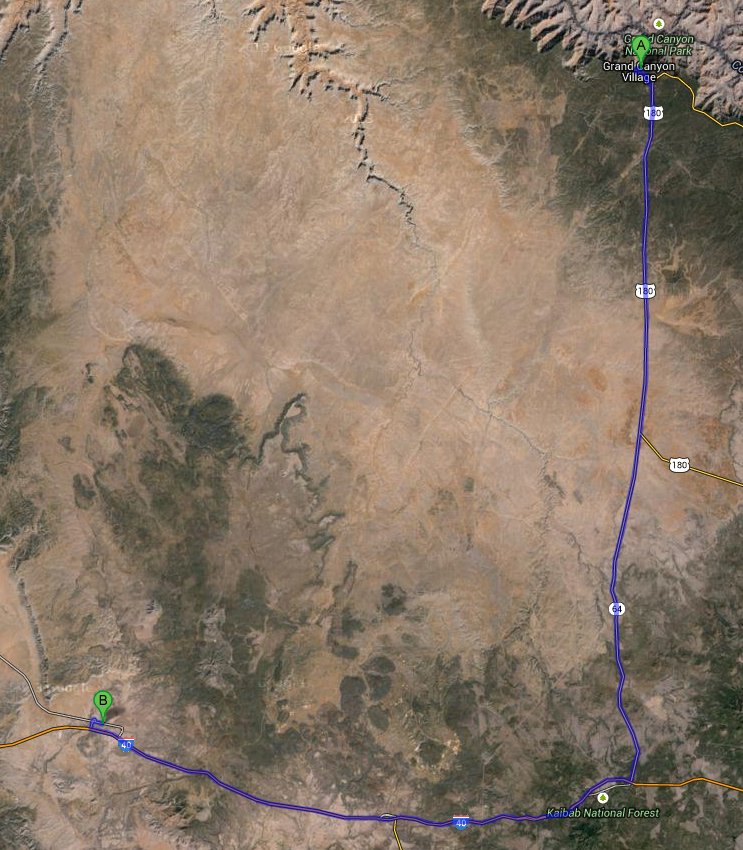
The Grand Canyon to Seligman.
Seligman
We rejoined Route 66 from the Grand Canyon and stopped at the small town of Seligman. While Shamrock may have inspired some of the buildings in the Pixar movie Cars, Seligman was where Pixar director John Lasseter formed the plot for Cars. This is because Seligman is home to Angel Delgadiillo, the guardian angel of Route 66, who met with Lasseter and inspired him to turn a movie he wanted to make about cars into a homage to Route 66.
In 1987, Angel Delgadillo set up the Route 66 Association as an attempt to both preserve and revive the historic landmarks of Route 66. He firstly started resurrecting the then-dying myth of Route 66 as the Mother Road and as a rite of passage where people could get their kicks. He successfully lobbied the Government to put up signs to indicate to drivers where “Historic Route 66” turn-offs existed. He was persistent. Over time, he alternately agitated and allured the road back to life.
We visited his shop in Seligman as well as the wacky Snow Cap that used to be run by his brother Juan (now deceased).
You immediately get a sense of what sort of place the Snow Cap is when you walk to the door which has a sign saying “Sorry, We’re Open.” as well as handles on both sides of the door. Being a hot day, we ordered some ice creams. Michelle insisted that she get a small size having sampled large American-sized ice creams before. The women behind the counter (who turned out to be Juan Delgadillo’s daughter Cecilia) smiled and came back with a cone the size of her thumb with a tiny smudge of ice cream on top. She then asked me if I wanted mustard on my ice cream and grabbed a mustard bottle to squirt. I recoiled in horror as a large thread of mustard sprayed towards me. However, it was just a thread. A mustard-coloured yarn in a trick bottle. We all laughed at the Snow Cap’s unique form of customer service slapstick.

Juan and Angel Delgadillo sit on Route 66 just out of Seligman.

Angel’s shop in Seligman. He is a barber by trade who then set up a Route 66 tourist shop.

Here is Mater from Cars.
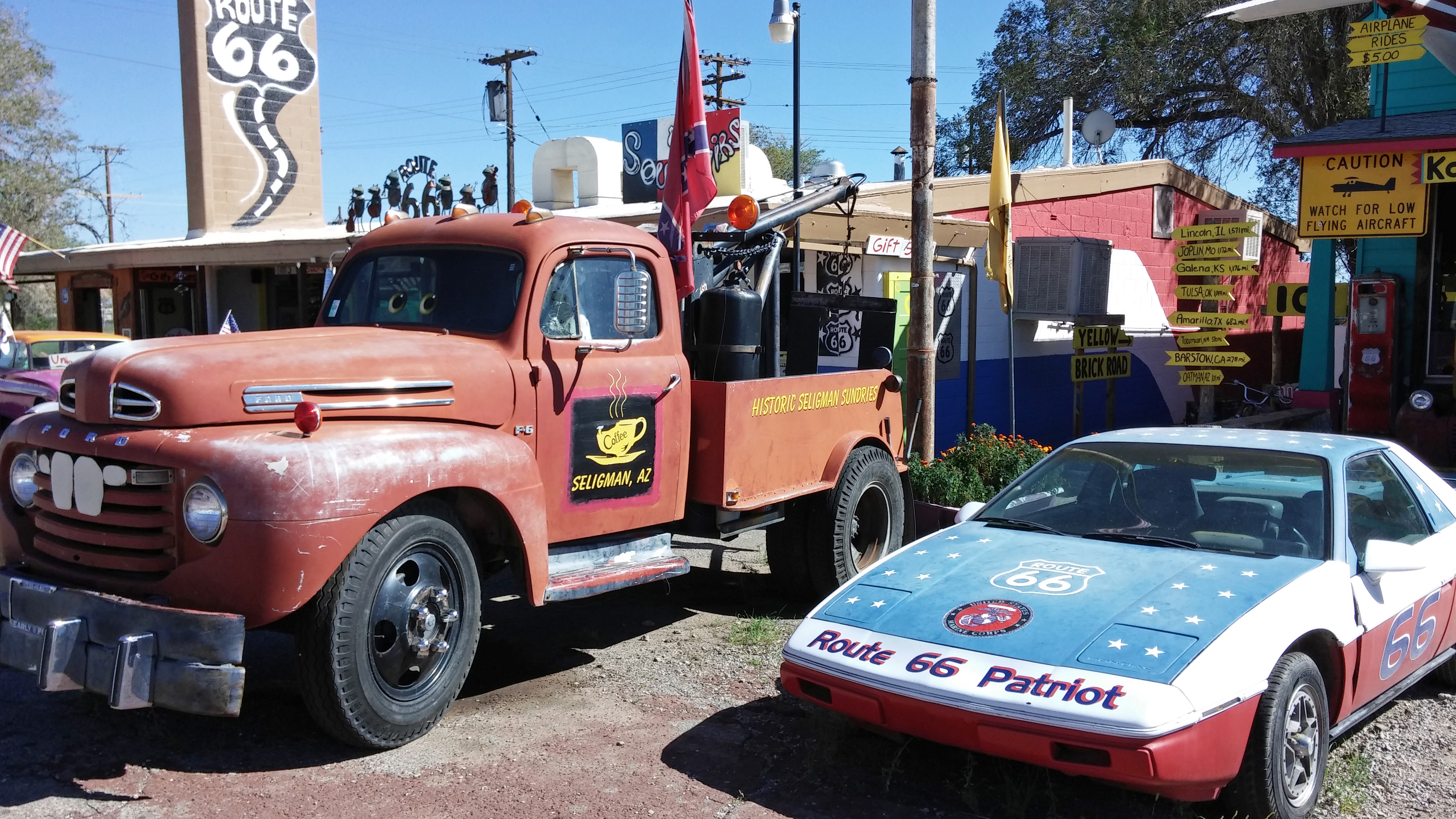
Mater next to a Patriot muscle car. Patriot cars used to be hand-built in a small factory in Texas. Their power was only equaled by their shoddy design.
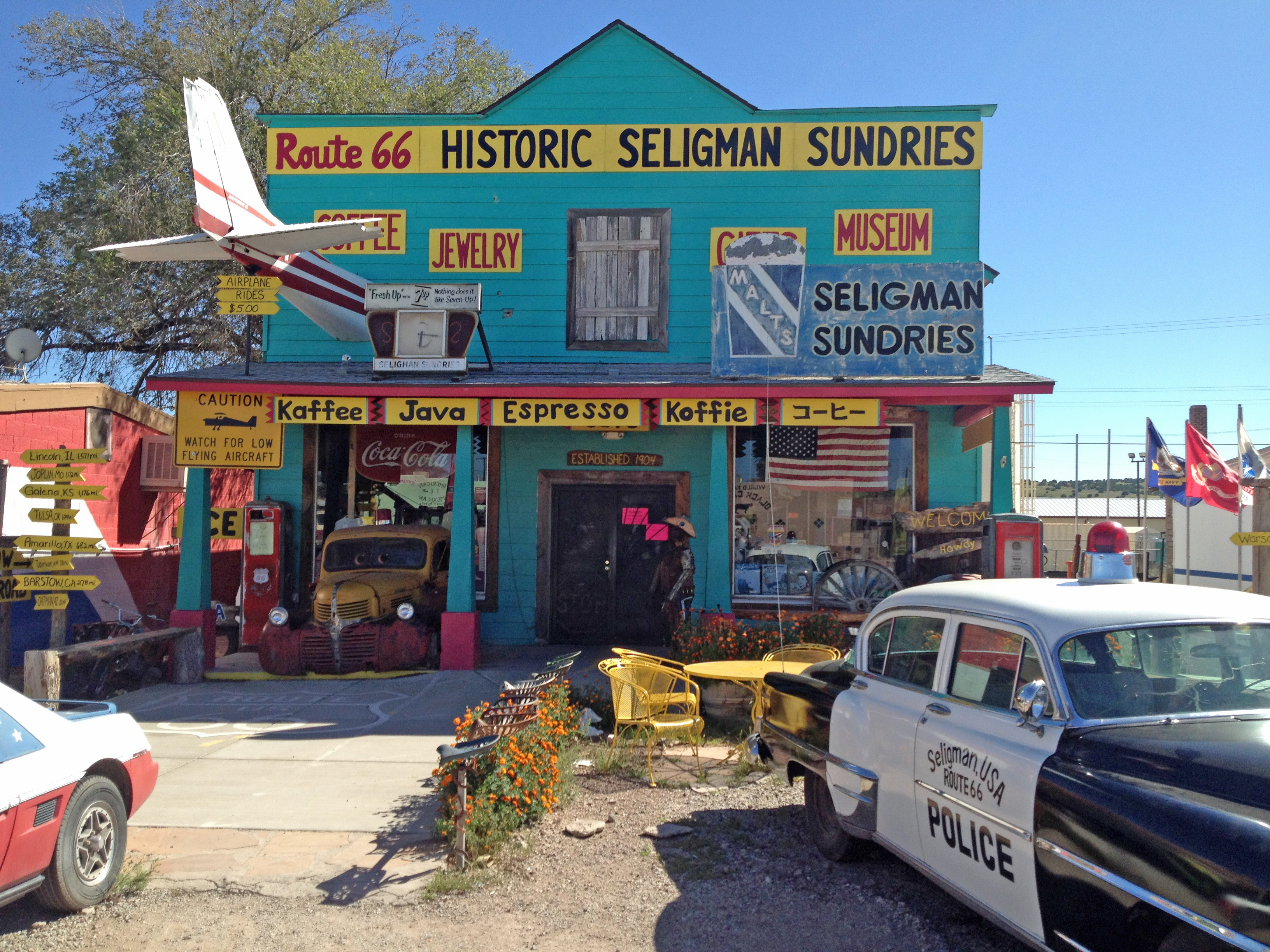
Everyone tries to out-kook each other in Seligman.
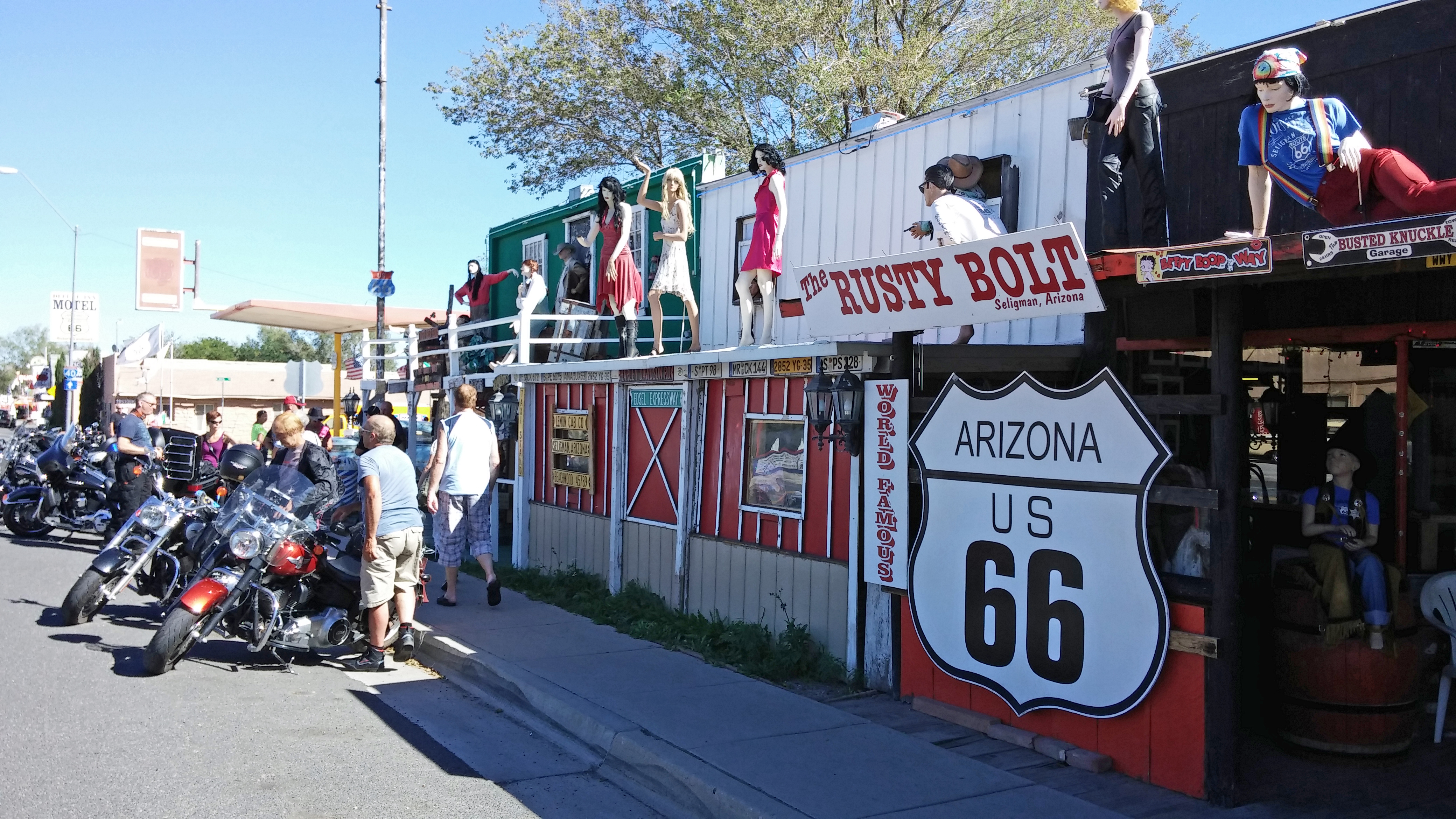
Lots of bikers checking out “the ladies” at the Rusty Bolt.
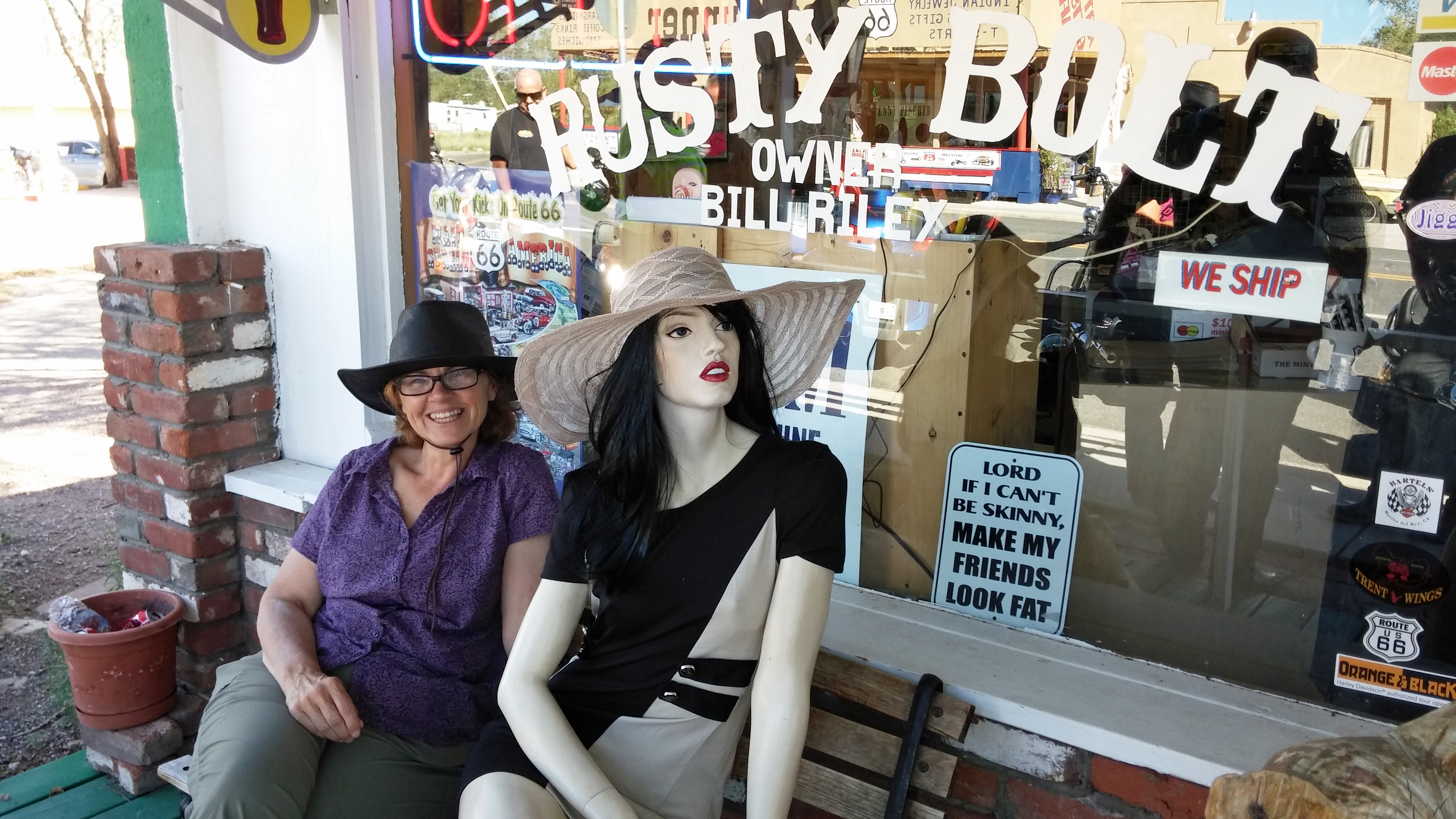
Which one is the doll and which one is the living doll?
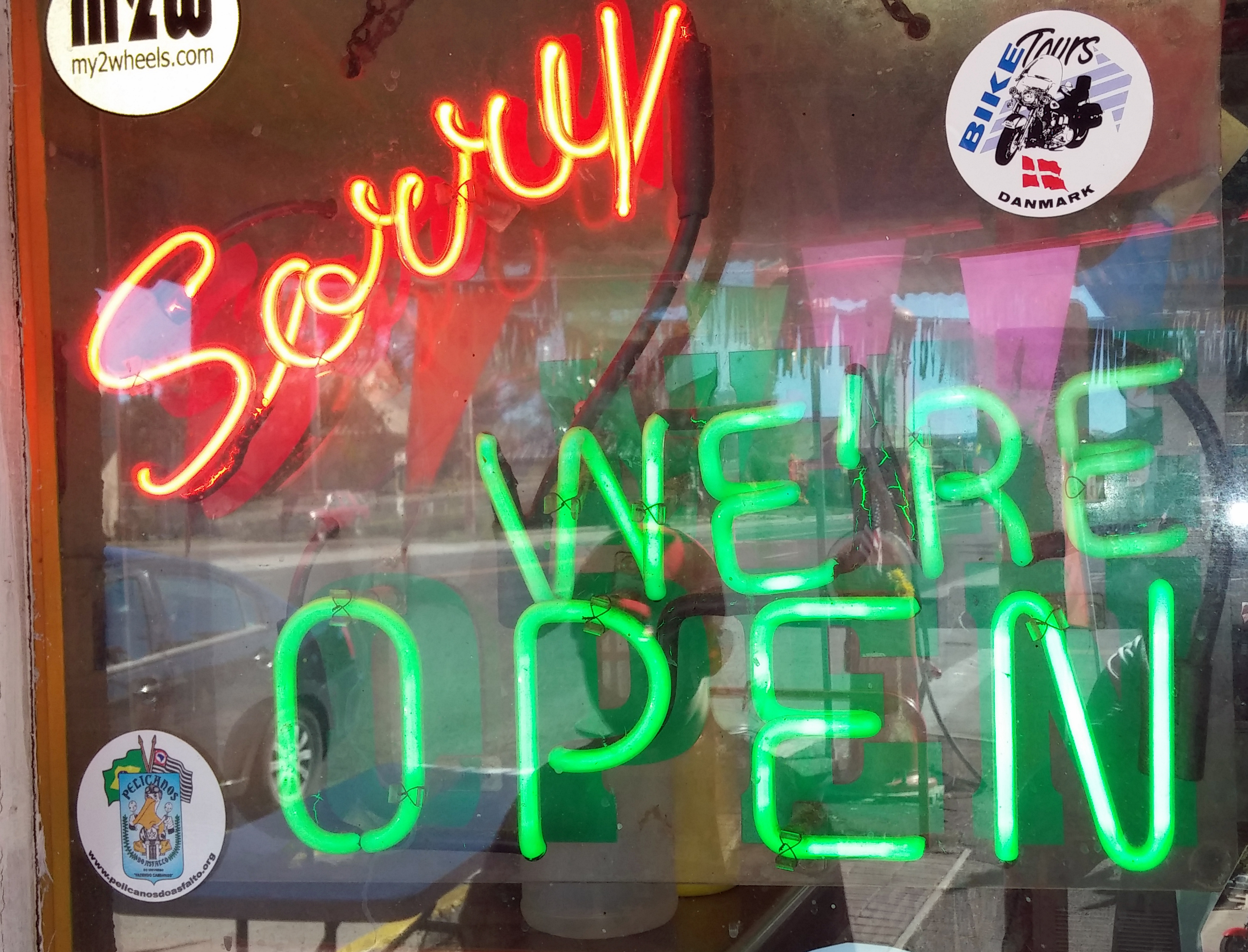
The sign on the door of the Snow Cap.
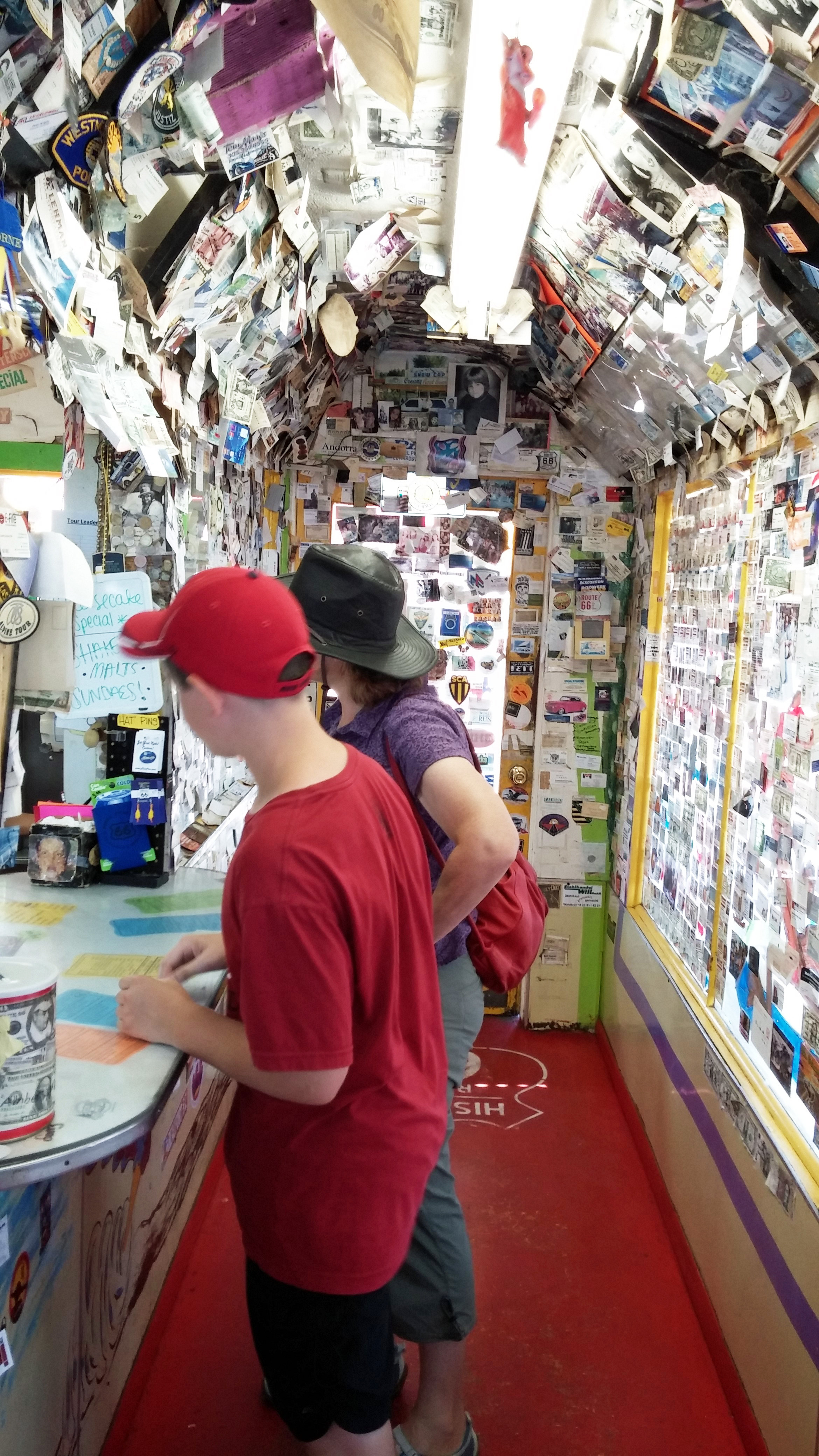
The cramped interior of the Snow Cap. Apart from our fake-mustard joke, other Delgadillo pranks include asking if you want cheese on your cheeseburger, asking a woman if the hot tea is for the hot-tee (the hotty), and giving you a piece of hay when you ask for a straw. The business cards and postcards on the wall come from all over the world and include many famous celebrities.

Those Delgadillo yuksters.
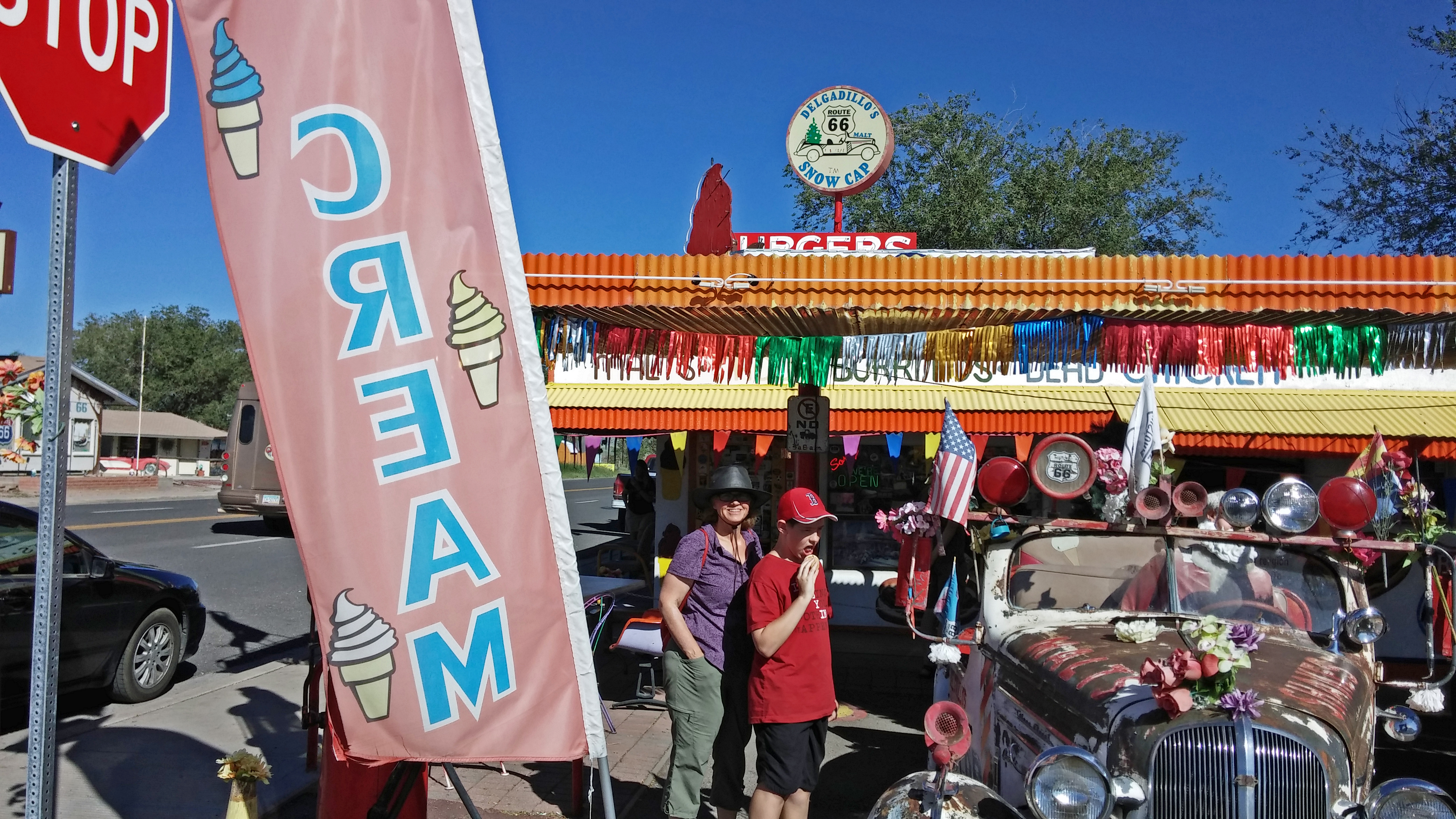
Outside the Snow Cap is just as interesting with all sorts of painted cars and statues.
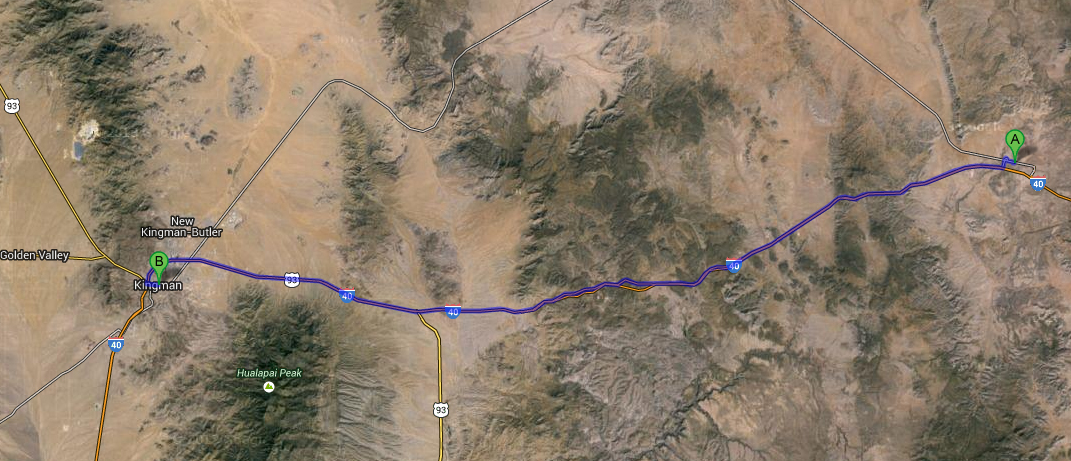
From Seligman to Kingman. Lot of “man” towns out West.
Kingman
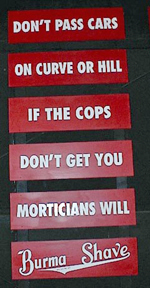
Leaving Seligman, we saw an intriguing set of signs along the highway as follows:

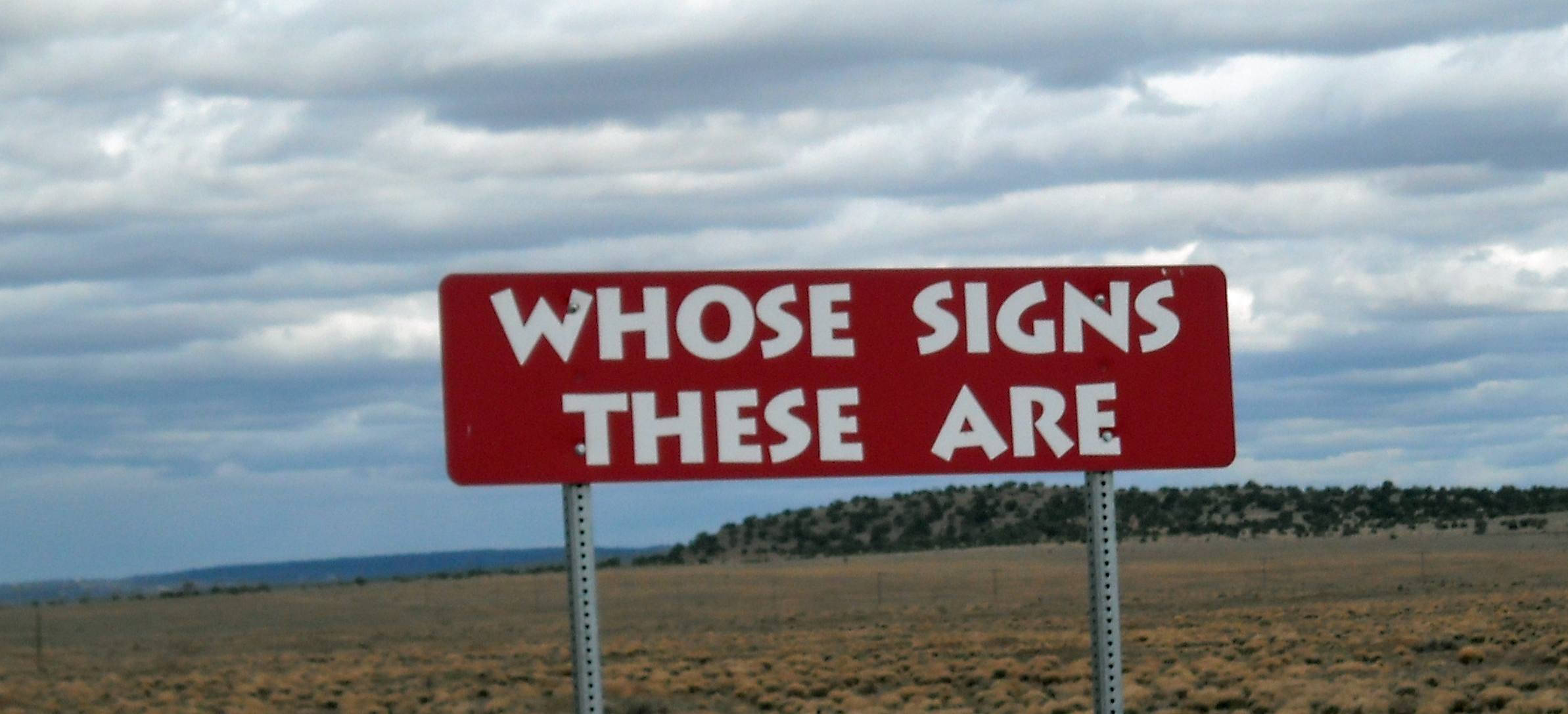
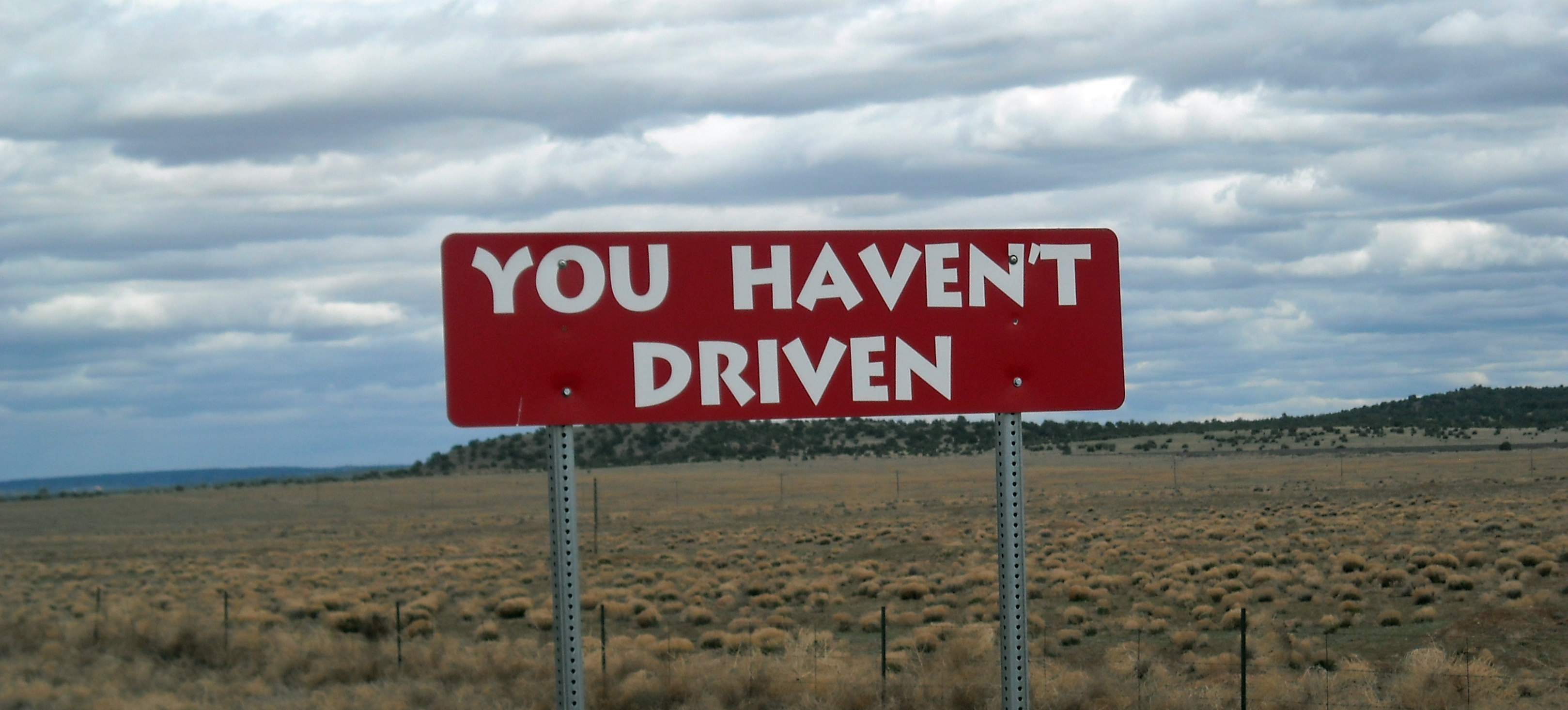
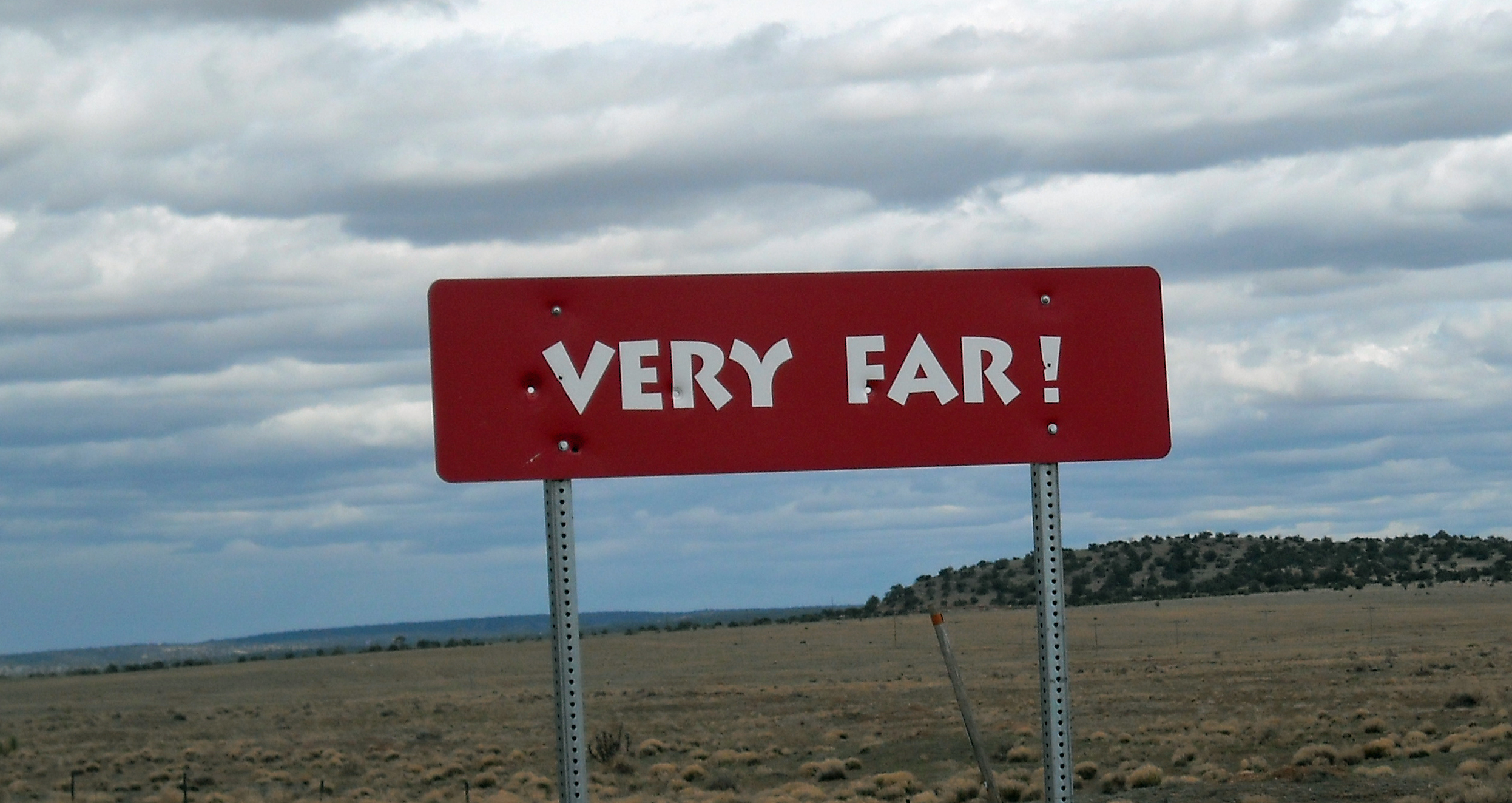
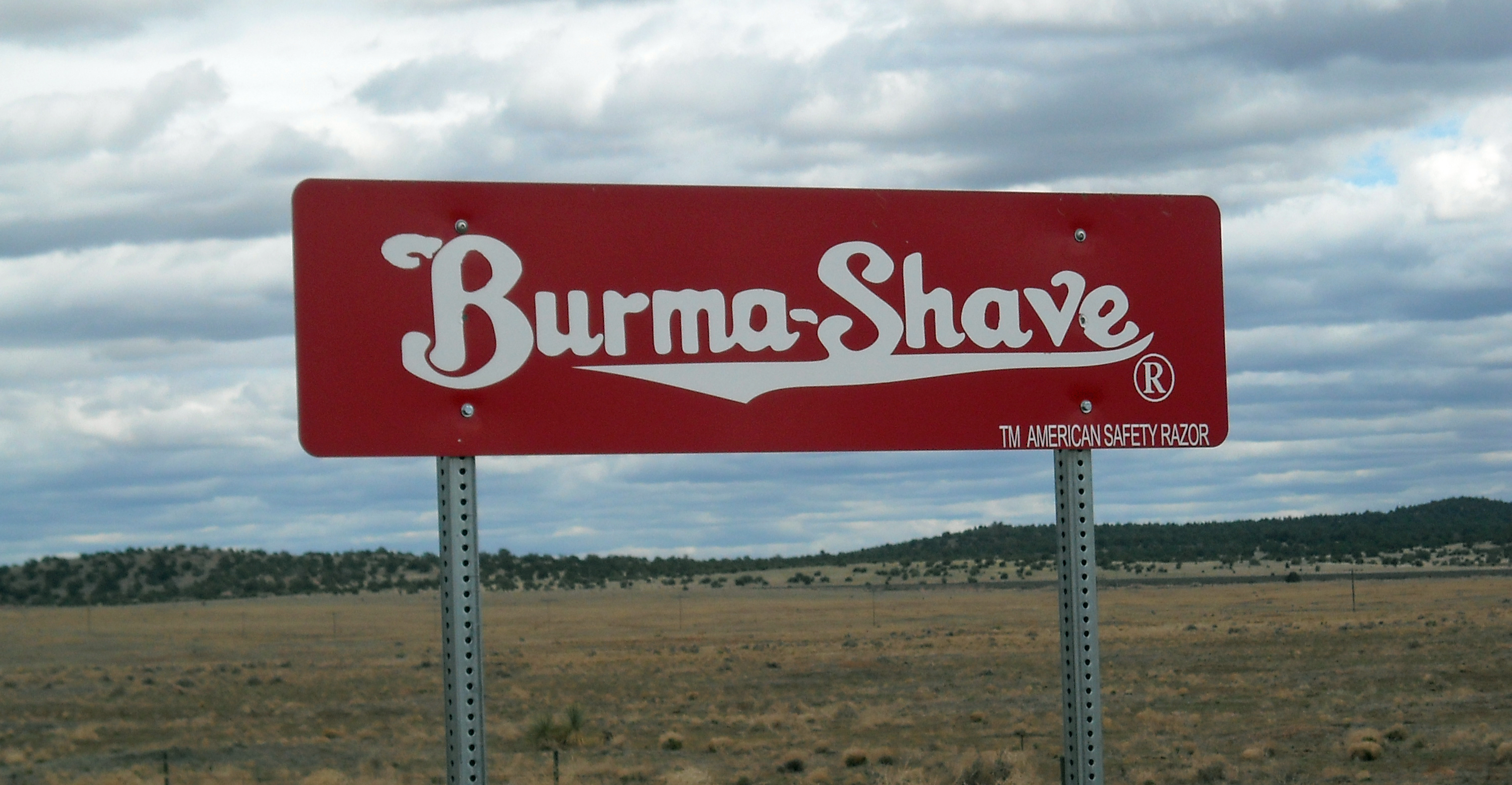
The Burma-Shave road signs first appeared in 1925 and became an enduring marketing campaign for the company. Over 600 spaced sayings were developed by the Minneapolis shaving cream company. They are a much-loved Route 66 icon and have inspired books and two songs by Roger Miller and Tom Waits. There is even a web site that has captured all the signs and ordered them by year of creation. Here are a few of my favourites:

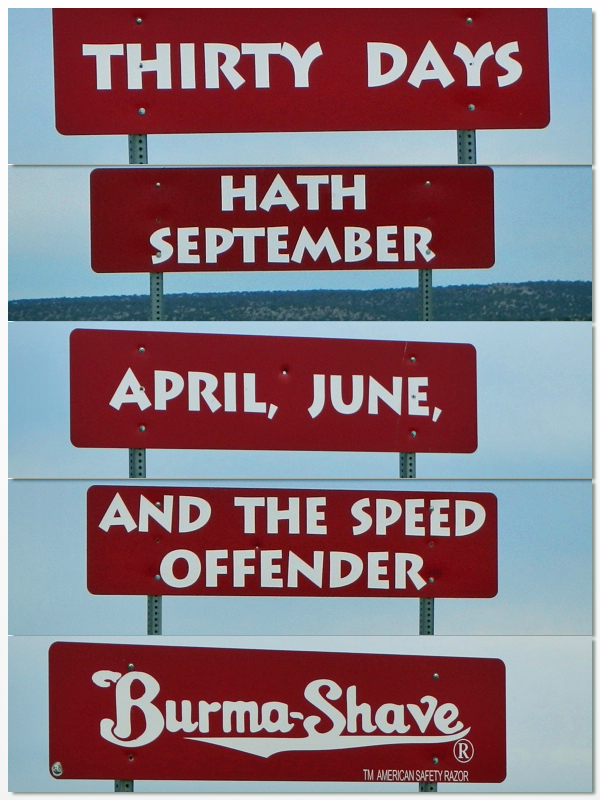
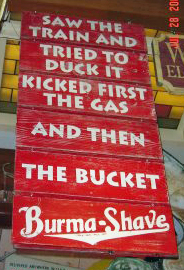


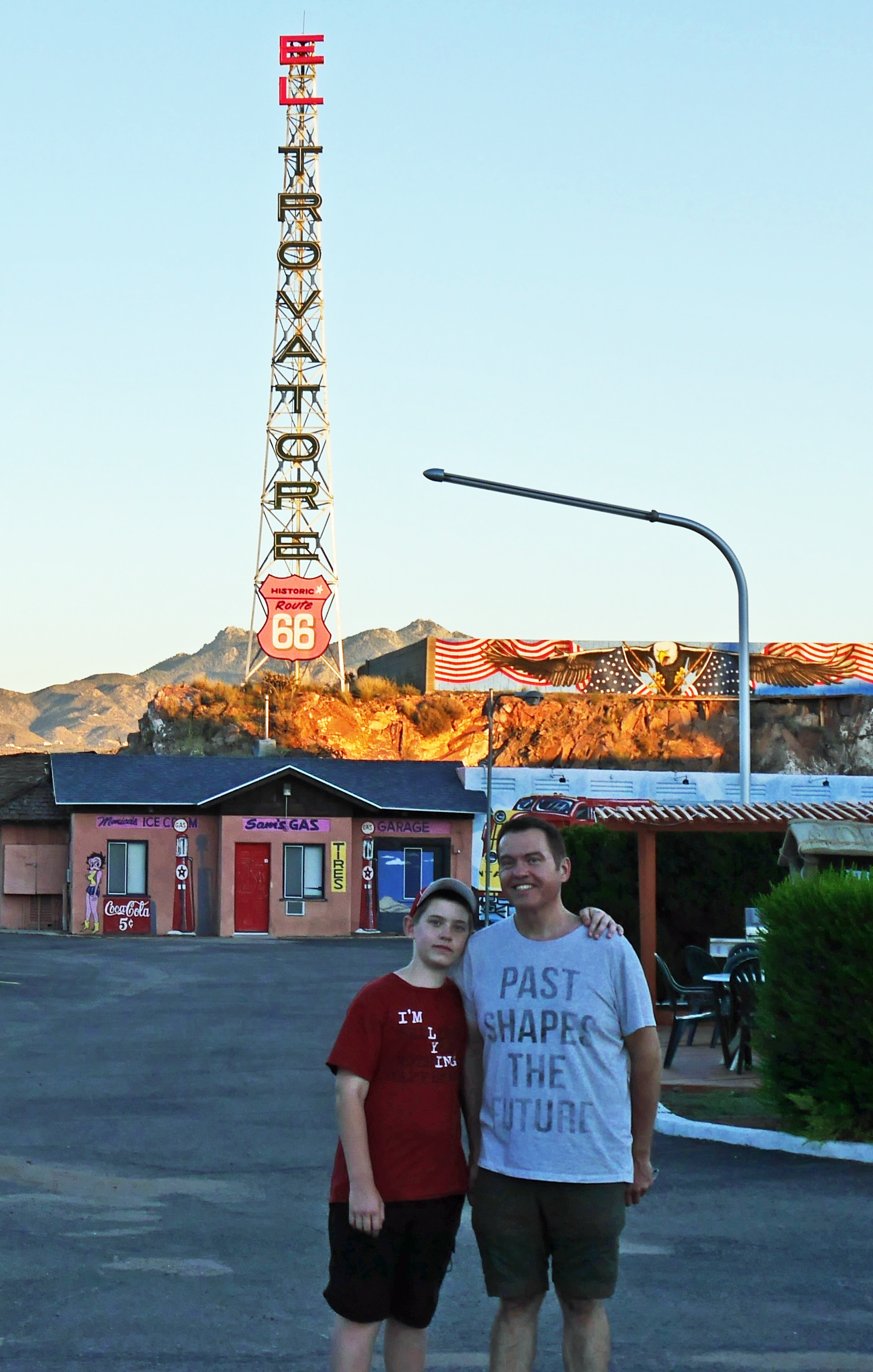
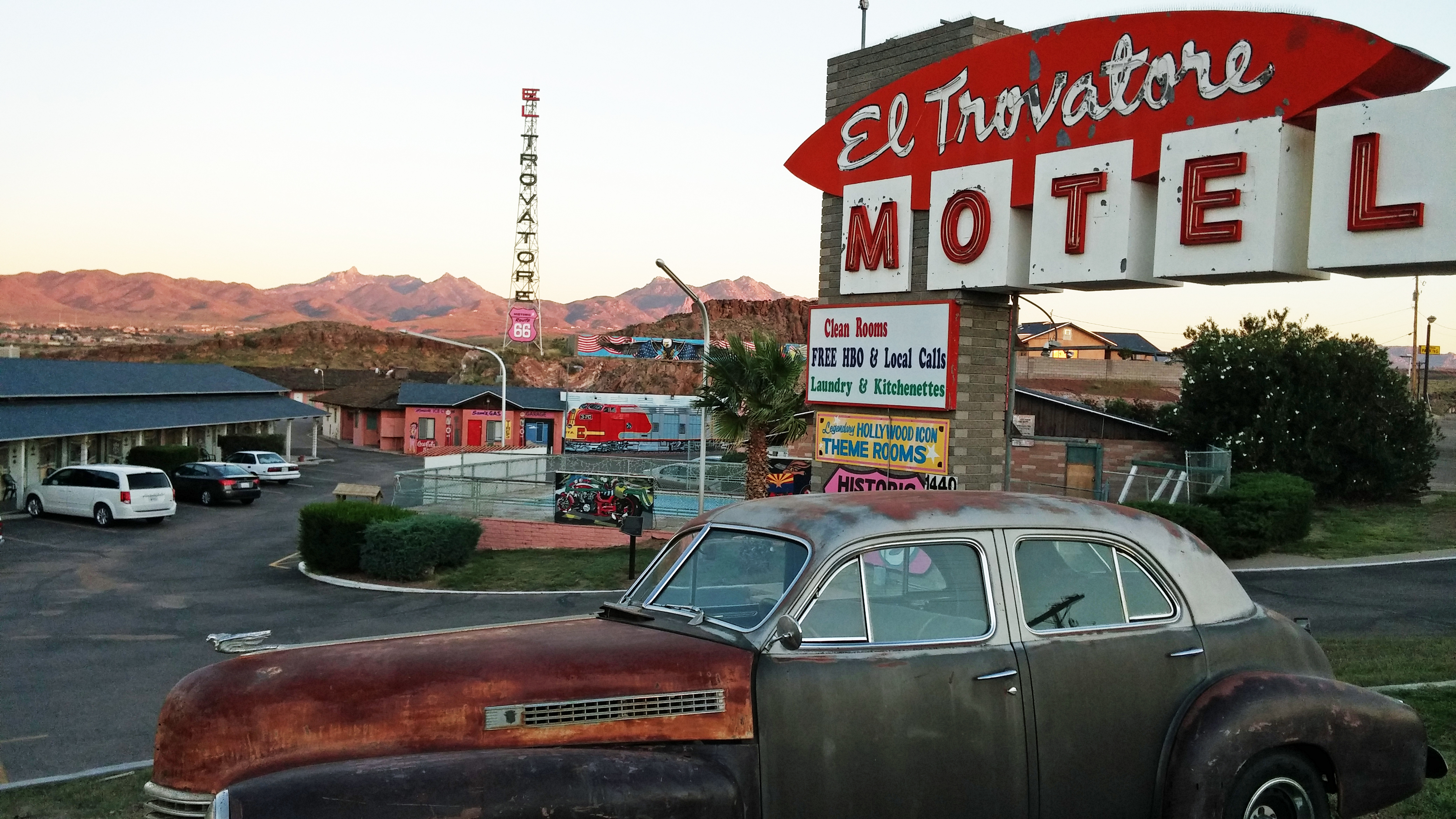
We drove from Seligman to Kingman where we spent the night in a strange motel called the El Travatore. Firstly, how many motels can you name that have their own theme song. Sure, there are songs written about memorable stays in Hotels such as Hotel California or Chelsea Hotel but I don’t know many hotels that commission their own official theme song.
We went in to the reception where we seemed to wait a lifetime to be served, as the owner, Sam Frisher, casually chatted away to a group of German tourists. While we waited, Harrie played with a dog that looked like a cross between a chihuahua and a dachshund who we later found out was Sam’s much-loved dog Taco.
When we eventually got to talk to Sam, he wanted to know all about us and also told his his life story in the process. Sam had immigrated from Israel and thought the USA was the greatest country in the world. He had bought the El Travatore a few years ago when it was condemned. It was originally built in the thirties by John F Miller who also built the first hotel in Las Vegas. In its heyday from the thirties to the fifities, it was the most luxurious place to stay in the mid-west region. This was primarily due to its electric air-conditioned rooms and stellar service.
It’s fair to say that Sam’s restoration of the place is still very much a work in progress. Half the hotel is out of action due to it being unfit to stay in. The other half is still being done up, one repair at a time.
But Sam and his wife Monica have revived the stellar service. They personally showed us around the available rooms; all themed after famous movie stars who had stayed there. We ended up choosing the Marilyn Monroe suite which was fantastic in the parts that were renovated and frightening in the parts that weren’t. The most frightening unrenovated part was the 1930’s shower which was housed in a dark enclave with a dim light bulb providing the only illumination. What the light did reveal was great swathes of mould that could well have been around since the days Marilyn Monroe stayed in the room. They could have even grown from detritus left behind by Marilyn herself. Not only were we sleeping in the room where Marilyn Munroe once slept we could have also been infected with some of her sixty year old fungi..
As the sun set, we went for a walk into town and had dinner at the Kingman Chophouse which was recommended by Sam. It reminded us quite a bit of Jordo’s Steakhouse in Texas. Not a place for vegetarians. The next morning, we spent some time chatting to Sam who wanted to know where we were going next. When we said Las Vegas, he casually confessed that he had lost over $30,000 dollars in Las Vegas on his last trip. He looked solemnly at me and said “My friend, the ‘lady luck’ can be very good to you when she likes you” before changing his tone to say “but sometimes she just don’t like you and you are going to lose big time.” This was good advice.
We bid farewell to Sam, Monica and Taco but not before Sam plied us with marked-up road maps and brochures of places we should visit. He even gave a free Route 66 souvenir to Harrie. After more talking, we finally headed off on our last leg of Route 66.

The slowly-reviving El Travatore with its great theme song. “Sweet dreams are welcomed when you spend the night… or maybe many more, at the El Travatore”

From Kingman to Oatman. You can clearly see the Black Mountains on the map.
The Black Mountains
The road from Kingman to Oatman is probably one of the worst stretches of road along Route 66. It is also one of the most picturesque. The old narrow road has been battered by the desert elements who still battle against its attempt to cut through the Black Mountains of Western Arizona. We drove cautiously as we wound our way up the rocky terrain. We saw old cars that had fallen over the edge of the road which had no guard rails to hinder their descent.
At one point we saw a massive truck coming in the other direction and really weren’t sure how the both of us were going to pass on the tiny road. The truck driver certainly didn’t seem to think he was going to be the loser in any scrape as he thundered down on the inside lane away from the cliff edge. Slightly scared, I slowed to a crawl and inched over towards the edge lest we be swiped by the truck. The truck driver cheerily rolled past us and the wind blast from the micro-millimeters of space between us violently shook our car but thankfully not enough to send us over the edge.
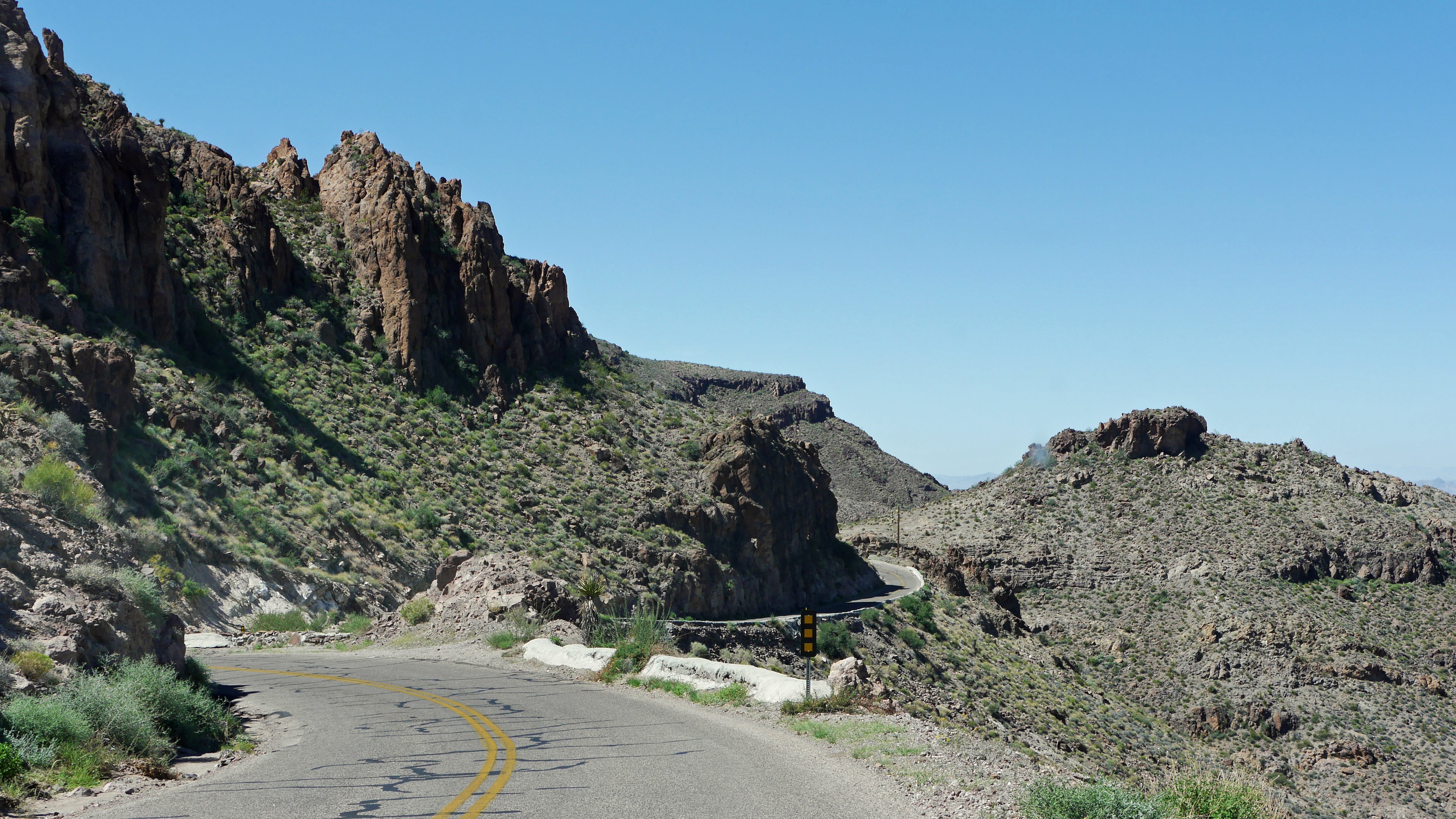
The windy narrow roads of the Black Mountains.
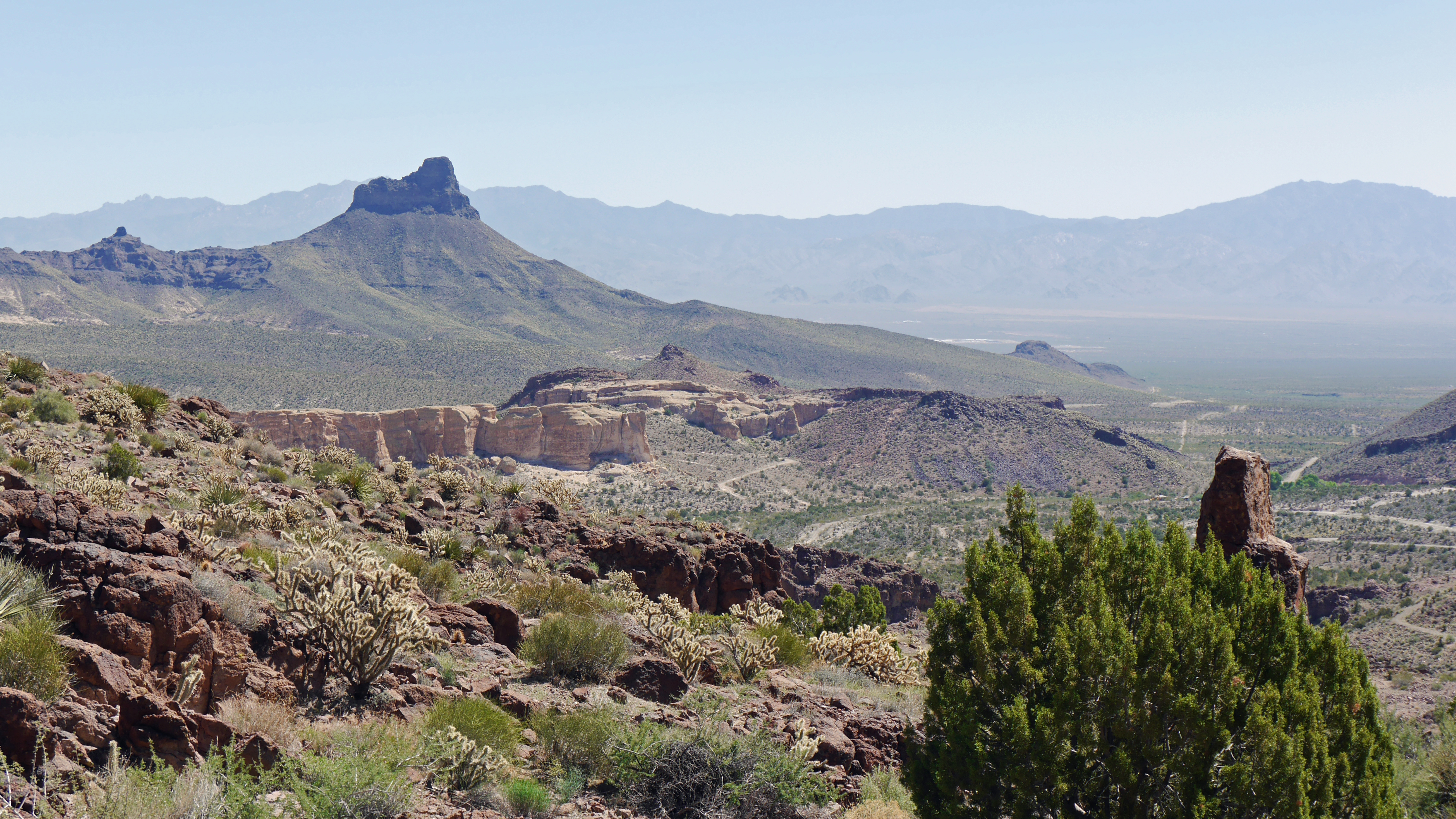
While the roads may be poor, the scenery is rich.

An abandoned trading post from the heyday of Route 66.

A small mine in the Black Mountains.

One of the many gorgeous vistas on the road.
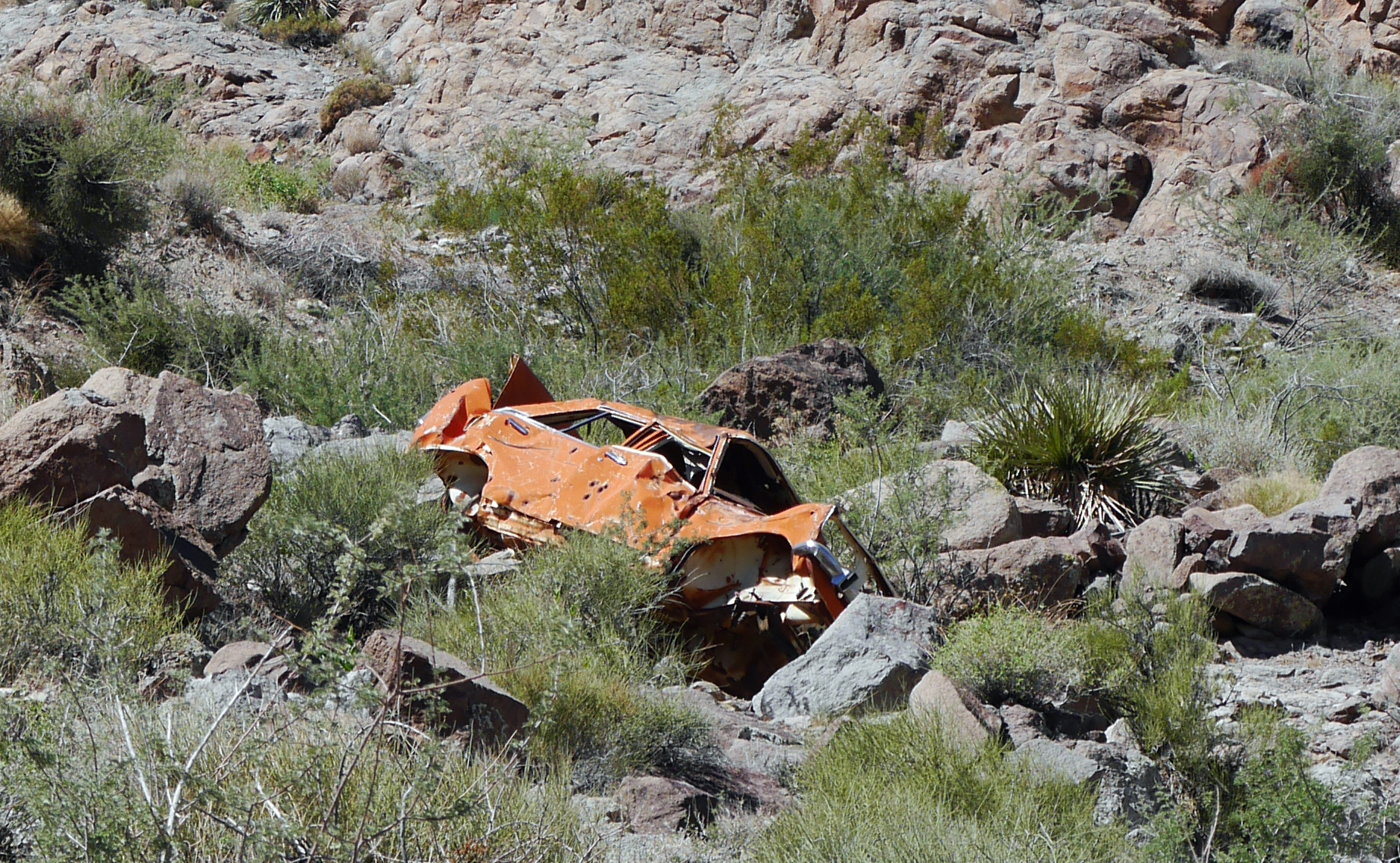
I wish I knew the stories behind the wrecked cars that have fallen down the Black Mountains. Were they travelling too fast, under the influence or side-swiped by a truck?
Oatman
Descending from the Black Mountains we encountered the old Wild West town of Oatman. As we entered the main street we were immediately greeted by strolling donkeys who meandered across the road looking for food. The donkeys or “burros” (Spanish for donkeys) are what now sustains Oatman since the decline of nearby mining operations. The burros were first introduced in the late 1800’s by Spanish miners who had flocked to the town following the discovery of gold in the nearby hills. When the gold rush died out, the burros were abandoned and left to fend for themselves in the harsh Arizona desert. In search of food, they would wander in to town where they scavenge for scraps or be feed by the locals before returning to the hillside to spend the night. Over 100 years later, the descendants of these burros are still eking out an existence in town; this time being fed by the many Route 66 travellers that pass through Oatman.
The minute we got out of the car, the burros descended on us. They were smelly and pushy but very lovable.
We were told that a gunfight would occur in the main street at high noon and headed up the street to get a good view. As we settled on a porch overlooking the main street, a Kris Kristofferson-looking guy with a cowboy hat came out of the Oatman Hotel brandishing a shotgun. He walked purposefully up the street with the look of a badass getting down to business. He then walked less purposefully back down the street and asked a nearby man something before throwing up his arms. At one point, he walked over to us and was asked by a nearby woman whether he was supposed to be catching a bank robber to which he replied with indignation “I was supposed to be robbing a bank.” He then went on to complain how he was stood up by the other guy that was meant to stop him and how generally hopeless the people he was meant to be working with were. So the gunfight never eventuated. Mightily pissed, the would-be bank robber trudged back to the Oatman Hotel. This is where we met him again later. Although, this time he was singing country ballads on the hotel’s small makeshift stage.
The Oatman Hotel is fabulous place that dates back to the old mining settlement. It is covered in dollar bills that used to serve as a tab for the miners (they would fix one to the wall with their name on it and the barman would put a mark on it every time they had a drink). The hotel also hosts the honeymoon suite enjoyed by Clark Gable and Carole Lombard who had their honeymoon there in 1939. Apparently, Clark Gable loved the place as the local miners weren’t pretentious Hollywood-types. Gable would return to Oatman regularly to play poker, drink with the locals and just unwind. I know how he must of felt. We had a very relaxing time listening to our friend, the failed bank robber, sing moving country songs while we quenched our dusty mouths with refreshing local beer and ate Burro Ears (locally-made chips shaped like donkey ears).
It was hard to get back on the road really. But we had to reach Vegas by nightfall and still had a lot of miles to make up.
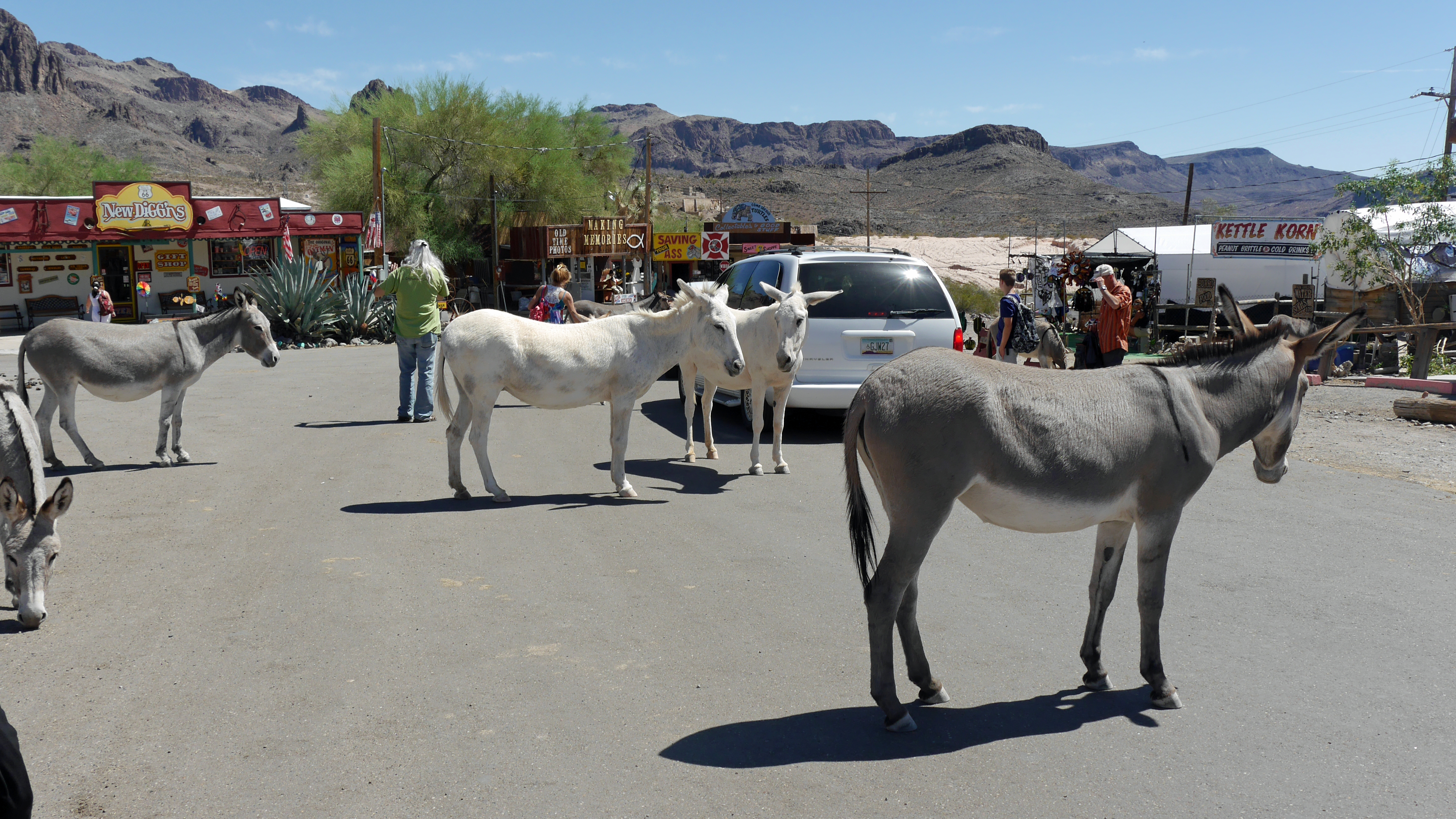
The burros that blocked our entry into Oatman. Get these jack asses off the road.

Oatman, Arizona. There is really only the main street in Oatman. This is a good shot of what lies beyond the main street – the desert.
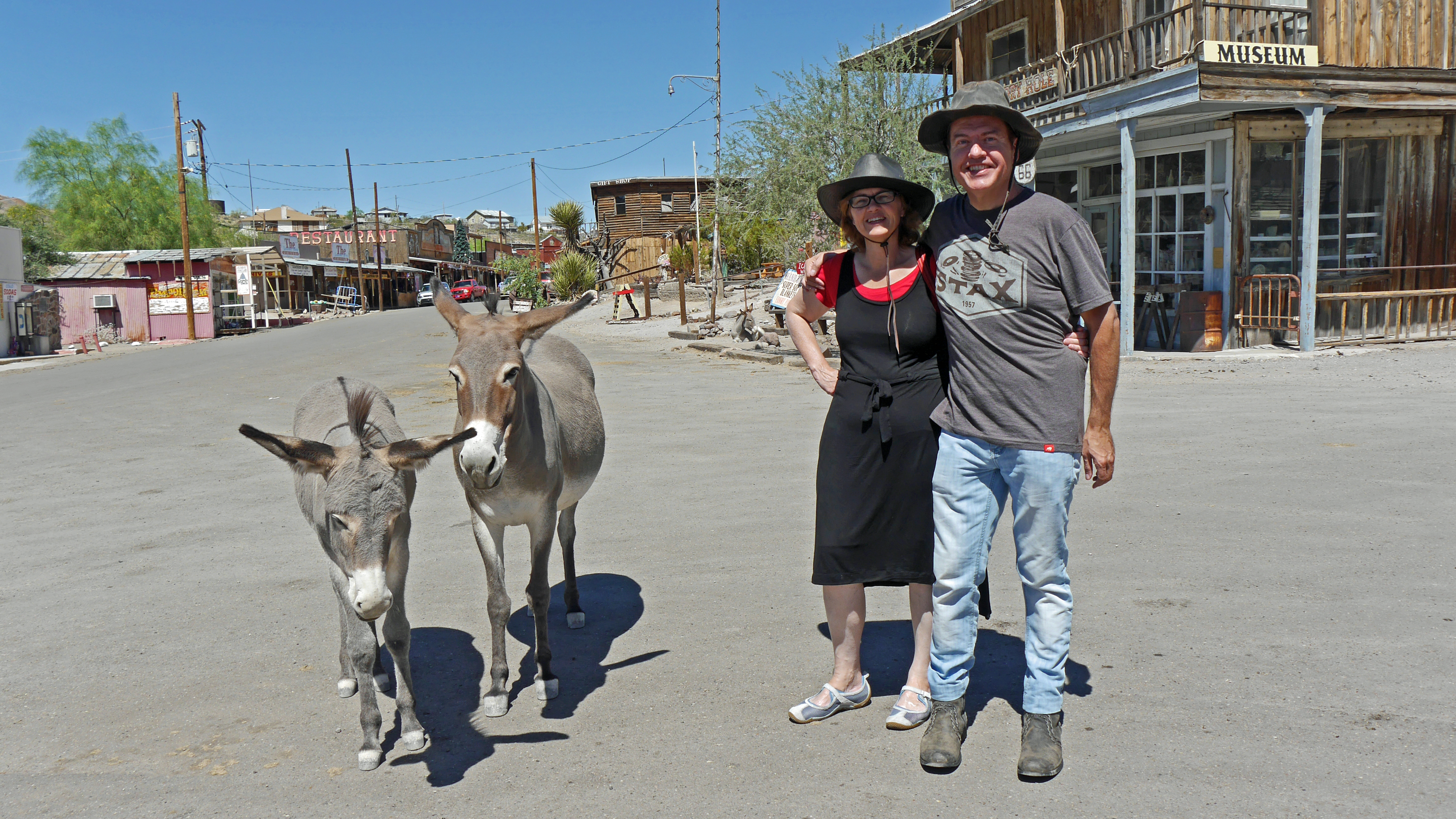
Two silly asses and two burros.
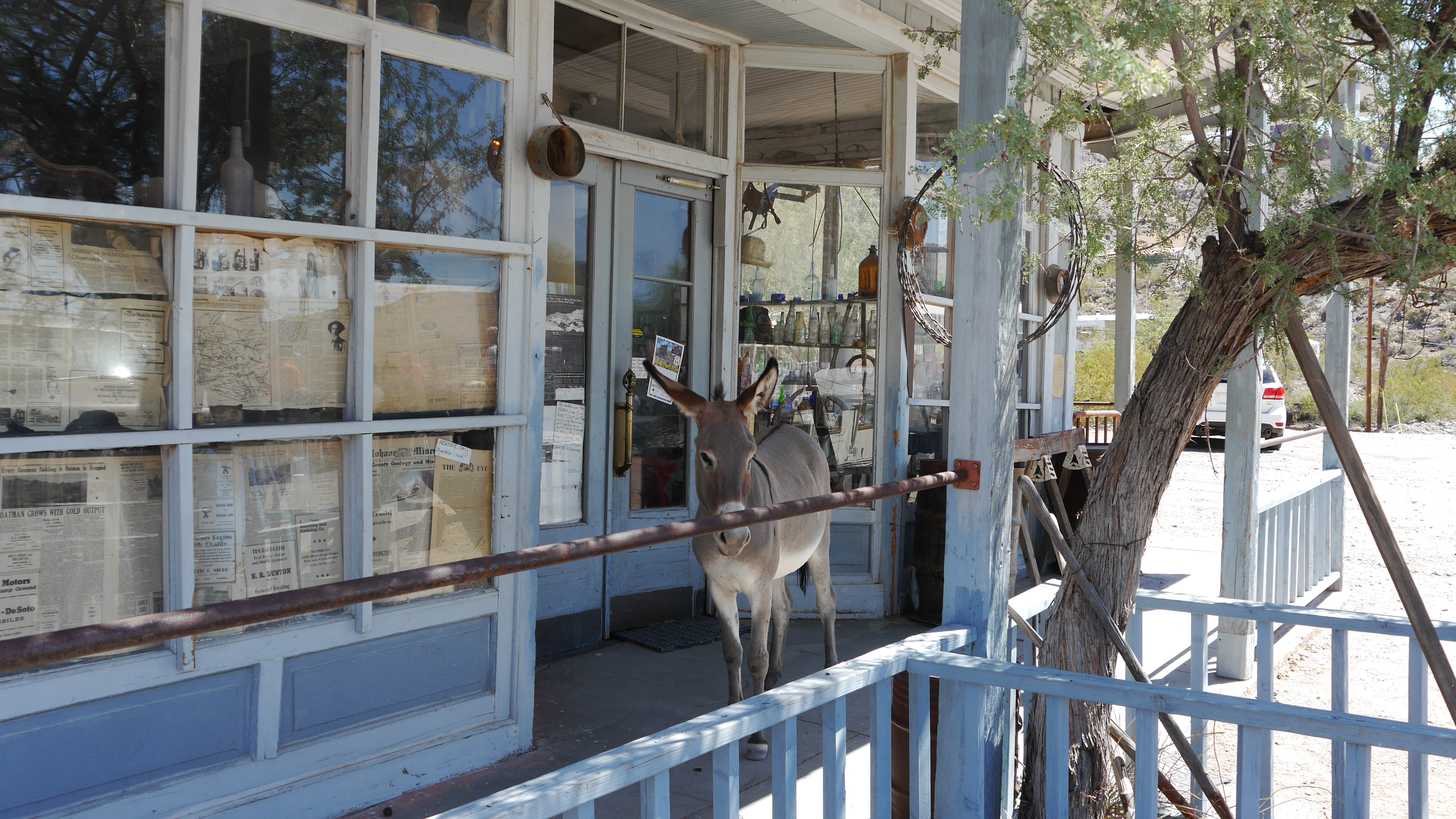
The burros go everywhere. Many tried to enter the buildings as well. Some shop-owners had rigged up burro-proof entrance ways.
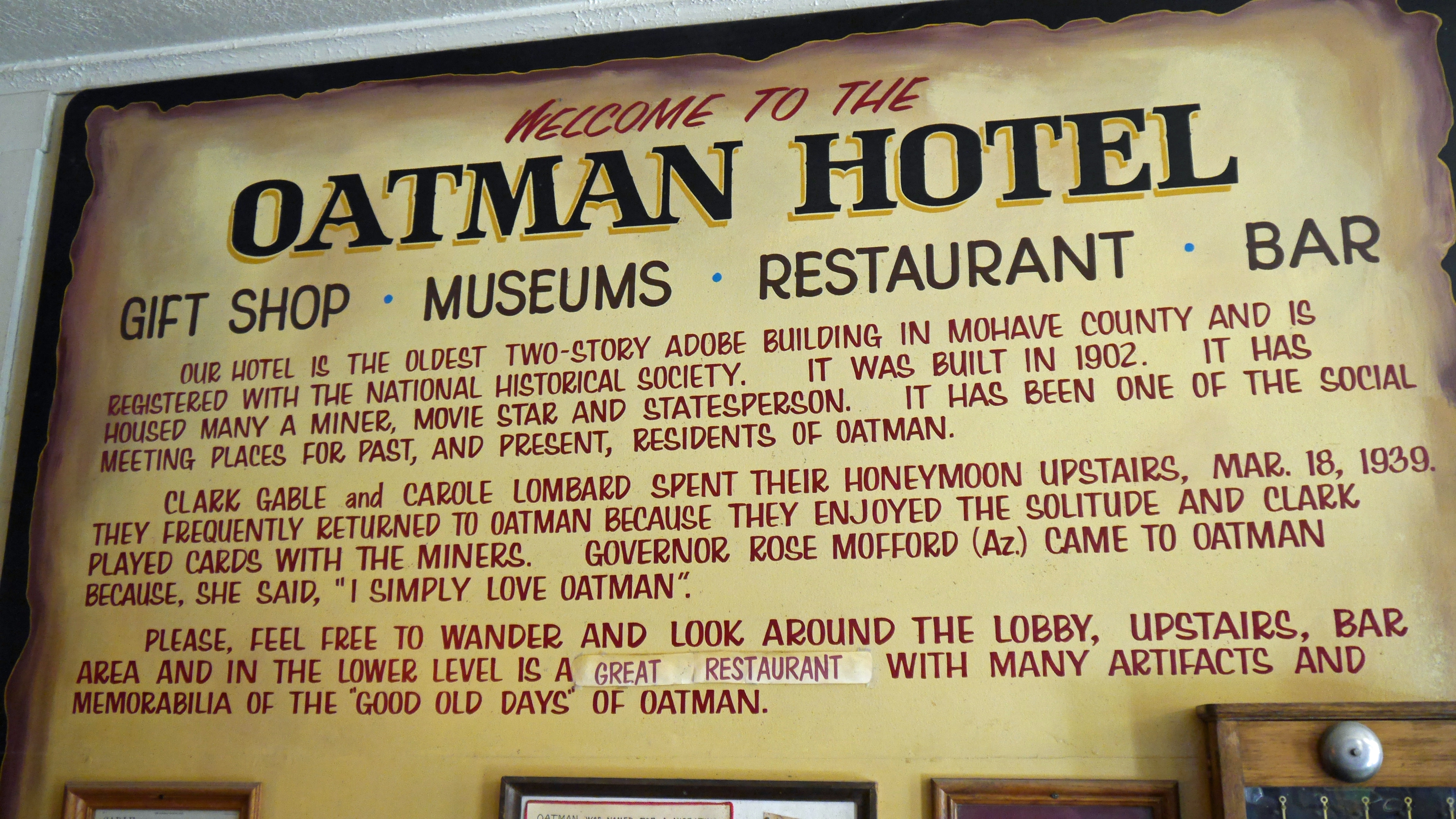
Not sure what the addition of “GREAT RESTAURANT” replaces? “NOT-SO-GREAT RESTAURANT” maybe?
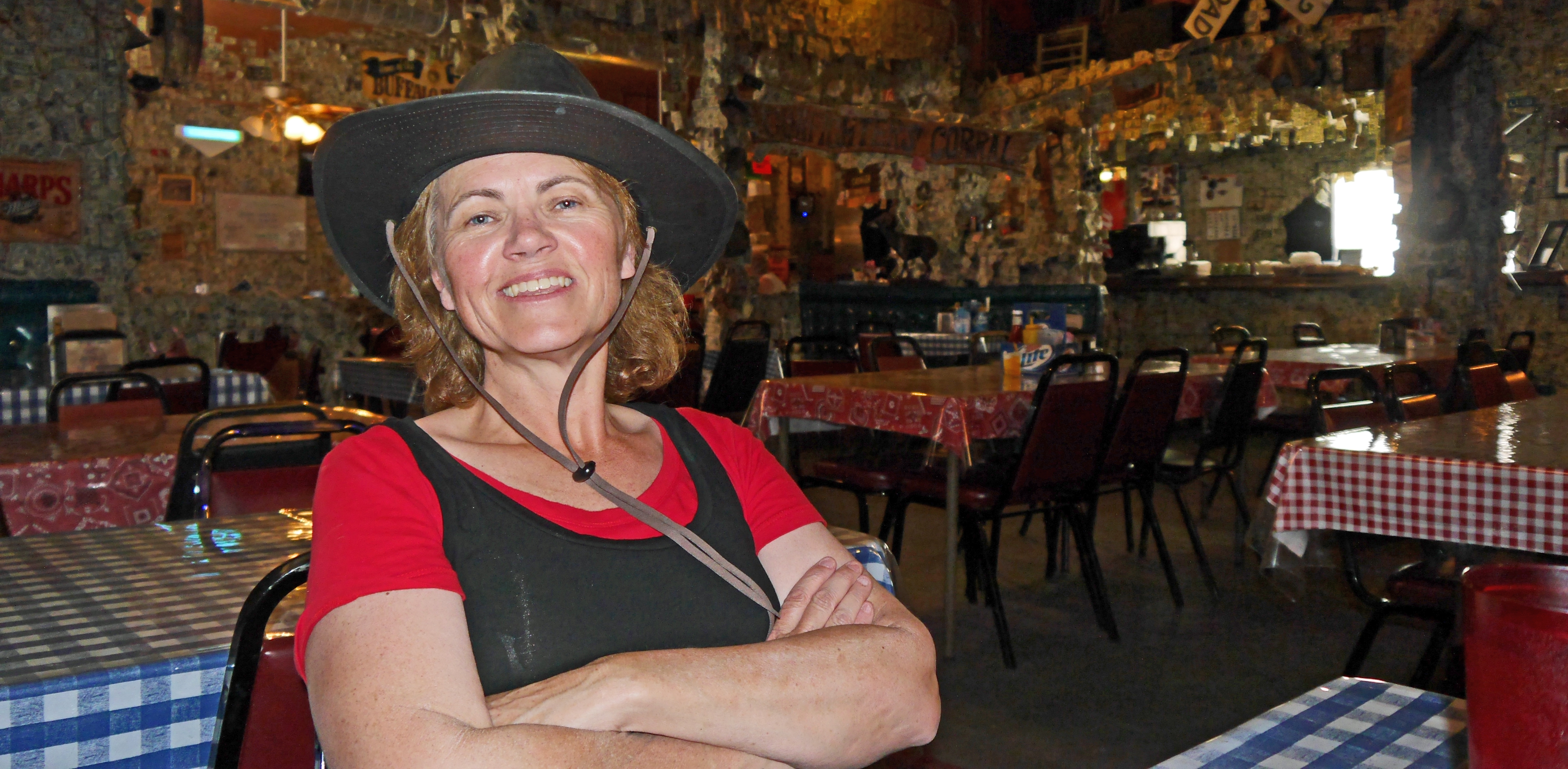
Lunch at the Oatman Hotel.

Me making an ass of myself with the Burro Ears. Okay, I’ll stop the ass jokes now.
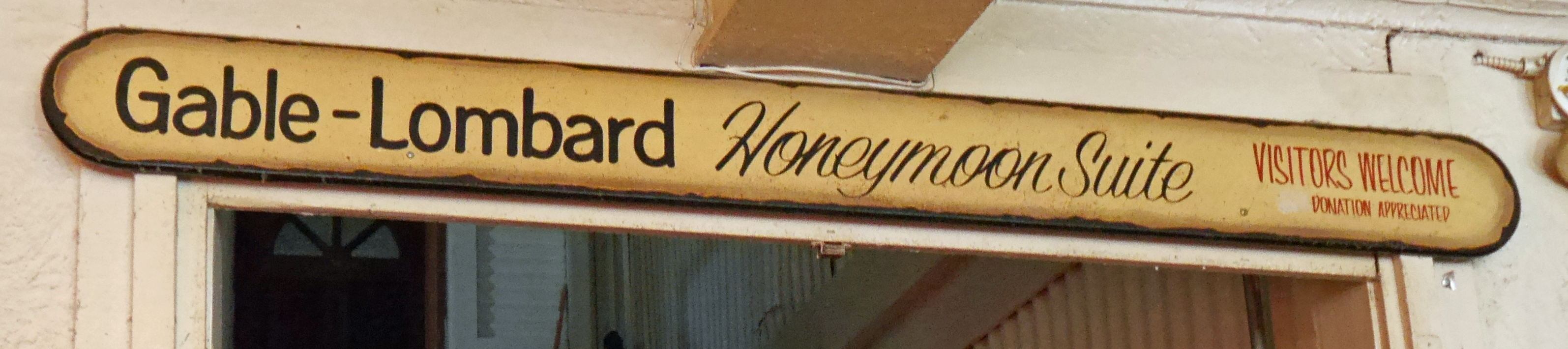
The sign to the honeymoon suite where Clark Gable and Carole Lombard stayed for their honeymoon after getting married in Kingman.

Michelle feeds the burros. This ended up like a burro version of Alfred Hitchcock The Birds. As the burro word spread that food was in the offing, they hungrily descended on Michelle and Harrie who scrambled into the car for safety. Even there, the burros tried to put their heads through the window to find food.
Next stop Nevada – the Silver State that also attracts a lot of silly donkeys.
 ourtripyall.com