
California – where we got hip and beat in San Francisco, toured the tech giants of Silicon Valley, walked through the mansion of Citizen Hearst, broke bread with my Hollywood cousin and sat down with the cast of The Simpsons.
More people live in California than any other U.S. state. In fact, one out of every eight people in America is a Californian and is also statistically more likely to be a woman. The Beach Boys wished they all could be Californian girls and they are well on their way to becoming so.
The first thing that kicked off the Californian population boom was the 1849 Gold Rush. Before the Gold Rush, California had a population of only 8,000 non-native Americans. A year after the Gold Rush, the population had grown to almost 300,000 requiring a state constitution to be hastily cobbled together along with a governor and legislature. The new government had an action-packed first year building roads and infrastructure to cope with the new towns that had sprung up out of nowhere across the state.
The second Gold Rush that attracted settlers was more of a Nitrocellulose Rush as the motion picture business moved shop from New York to Hollywood in order to flout Thomas Edison’s restrictive intellectual property restrictions on motion picture production.
The third and latest Gold Rush was the Silicon Rush that bought tech gold-diggers to the industrial wastelands of San Jose to strike it rich in ones and zeroes.
All of the Californian Gold Rushes shared a sense of creative ingenuity mixed with mercenary greed that still define the state and its people.
We partook in our own rush as we rushed around California trying to pack in as much fun, history and mileage in the thirteen days we had available.

The flight from Las Vegas to San Francisco.
San Francisco
We arrived in San Francisco and hailed a taxi. The taxi driver recognised us straight away as Australians and groaned about how many Australians were visiting San Francisco lately. He said that he had been to Sydney and didn’t like the place.
“So did you go anywhere else” I asked. I really wasn’t expecting his answer. “Yes” he said “I also went to Newcastle.” Even Harrie looked up from his iPod at that point.
“Why Newcastle of all places? I asked amazed.
“I said to the concierge that I wanted to meet some real Australians and he just suggested that I go to Newcastle” he replied; slightly irritated that he had to explain himself.
“Did you like Newcastle” I asked hesitantly also telling him that I had lived there for four years. He just shrugged indifferently and said “just as bad as Sydney really.”
“So, I guess you won’t be returning to Australia then?” I said. “Nup” he said in a bored voice as he concentrated on the road.
There was silence for the remainder of the trip.
We exited the taxi feeling a bit downbeat that our country hadn’t so much been dissed but had been considered so disinteresting. After unloading our bags, we went to cheer ourselves up with a bite to eat at Fisherman’s Wharf.
Fisherman’s Wharf
Fisherman’s Wharf was bustling with food vendors and tourists. The smell of both fresh and rotten seafood permeated the air as gigantic seagulls hustled for scraps. I say they were gigantic because I had never seen seagulls quite as big. They looked closer to albatrosses than seagulls. While our Australian Silver Gulls can grow up to 45cm in length, the Californian Western Gull can grow up to 68cm.
We ate fresh dungeness crab and clam chowder from a local crab shack and sat on a park bench to look out at the ocean. With our long trip across the dry country, it seemed like ages since we had seen the ocean. While others stayed away from the edge, we put our faces into the wind to receive the salty sea spray that blew fiercely from the bay.

Fisherman’s Wharf, San Francisco.
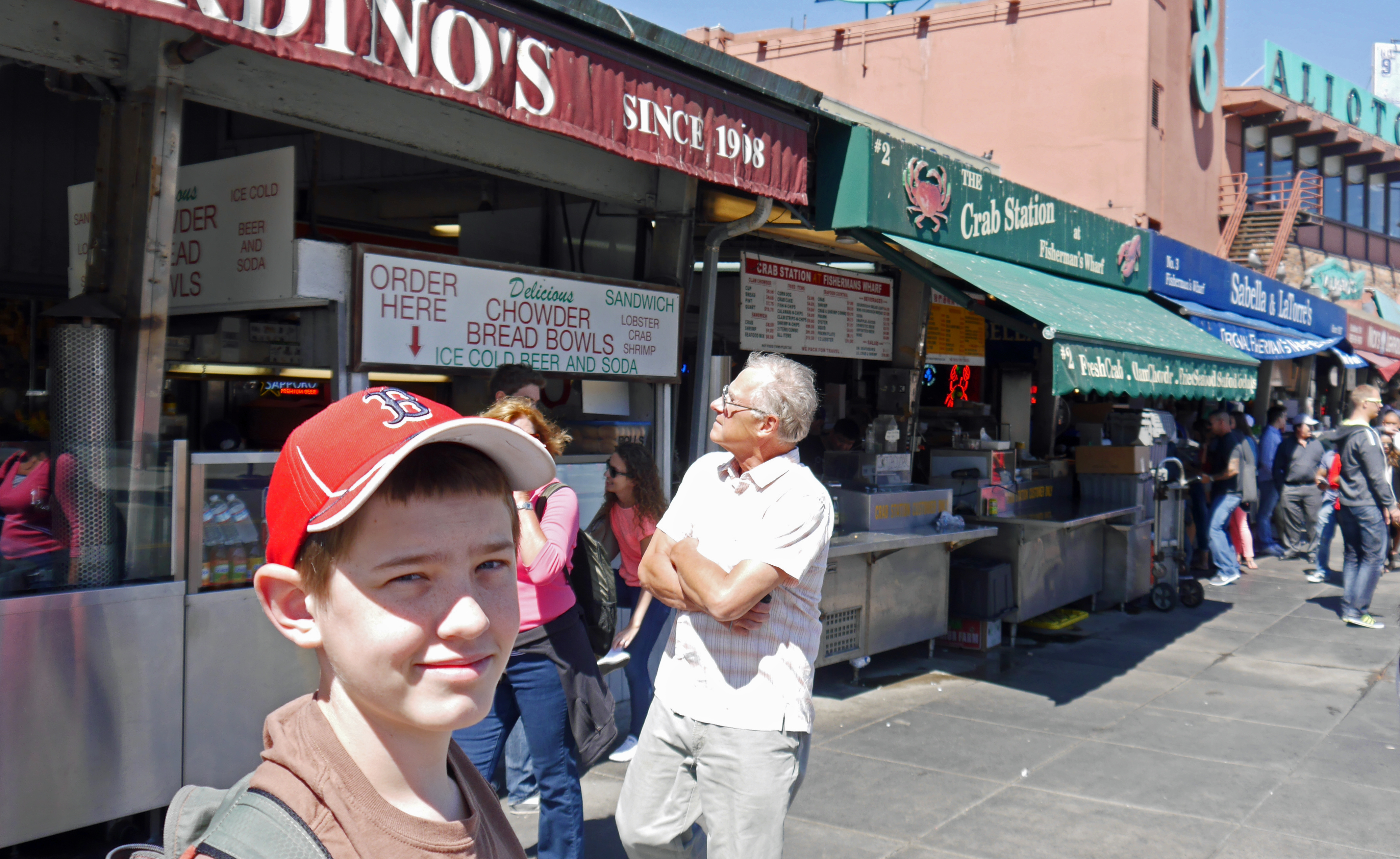
Harrie squinting in the sun at the many fine food vendors who almost certainly had crab on the menu.

A vendor cooking up some dungeness crabs. The crabs are said to have the sweetest meat of any crab in the world. I haven’t tasted all the different species of crabs in the world to verify, but they did taste very good.
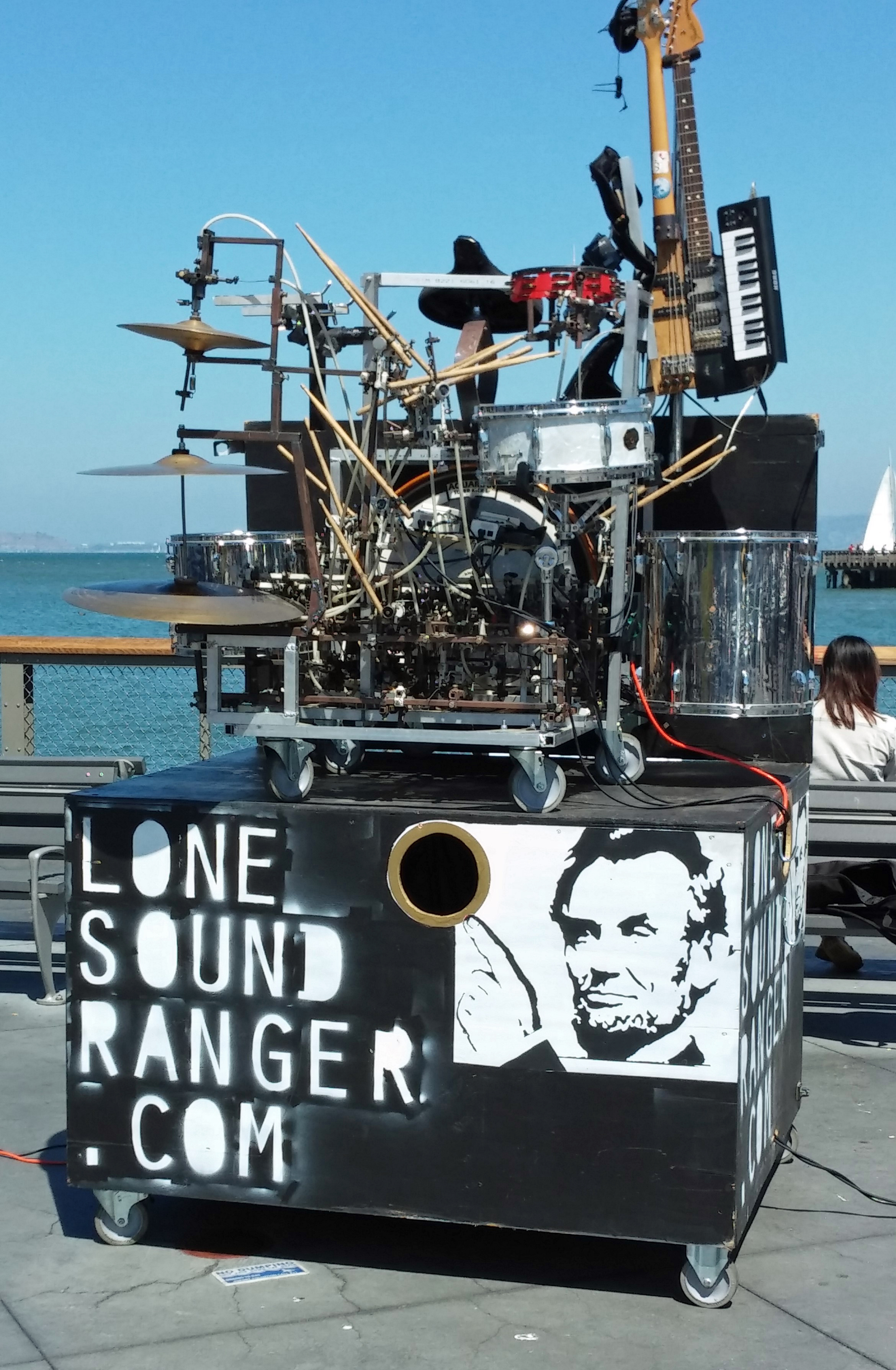
The Lone Sound Ranger – A rock and roll Heath Robinson. We saw the Lone Sound Ranger’s amazing one-man-band as we were waiting for food one day at Fisherman’s Wharf. Unfortunately, by the time we got our food and went to take a video, he had stopped and packed up. However, you can check him out here.
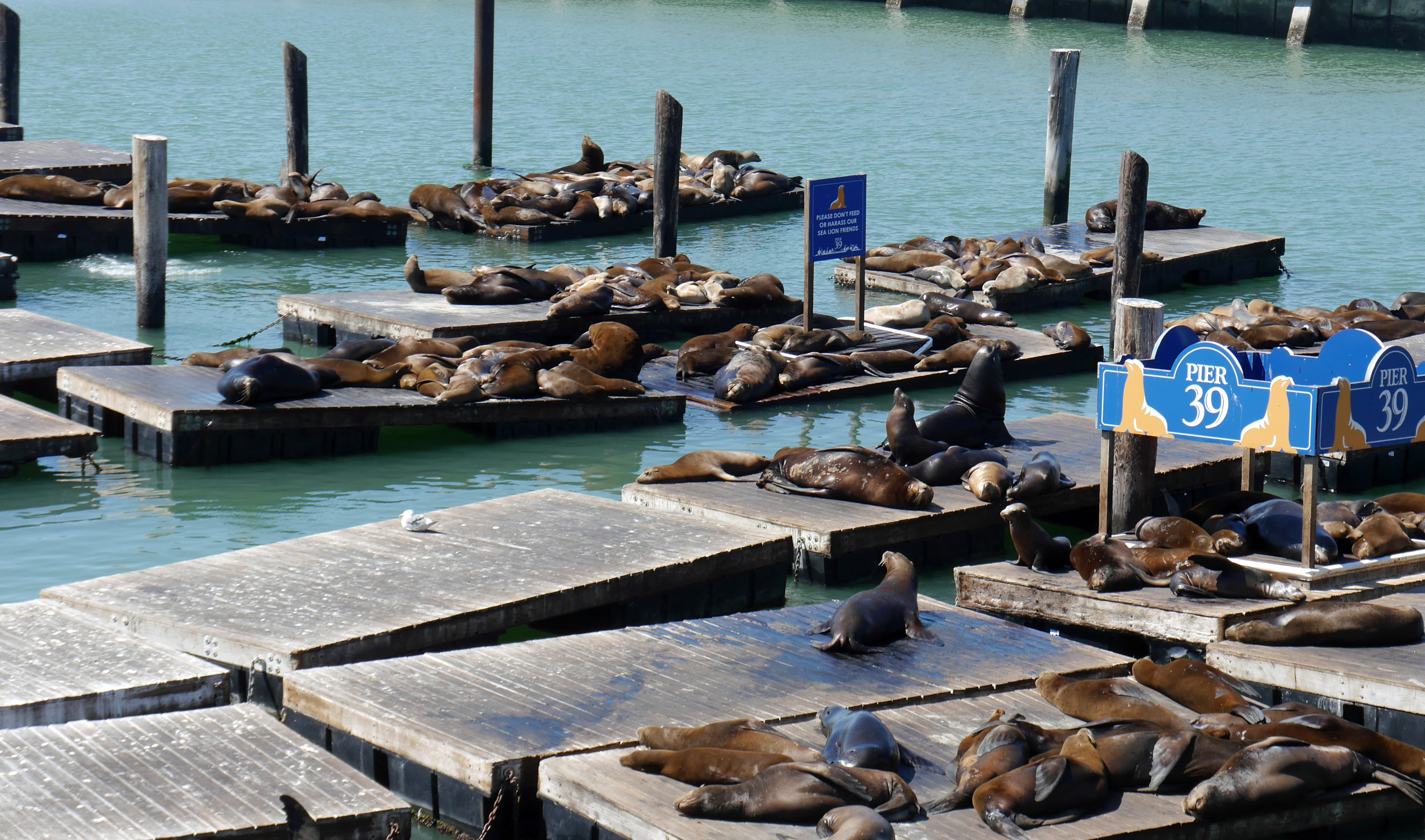
Sea Lion city on Pier 39 at Fisherman’s Wharf. This photo doesn’t convey the loud honking noises that these beasts made all day. The video below does though.
Sea Lions Roaring.
Musée Mécanique
Situated at Fisherman’s Wharf, the Musée Mécanique is the world’s largest privately-owned collection of penny arcade machines with over 300 operational machines.
We had a ball discovering the cheap, and often politically-incorrect, thrills of a bygone era. With machines dating back to the 1880s, these really were old-school arcade games.

The Musée Mécanique at Fisherman’s Wharf.
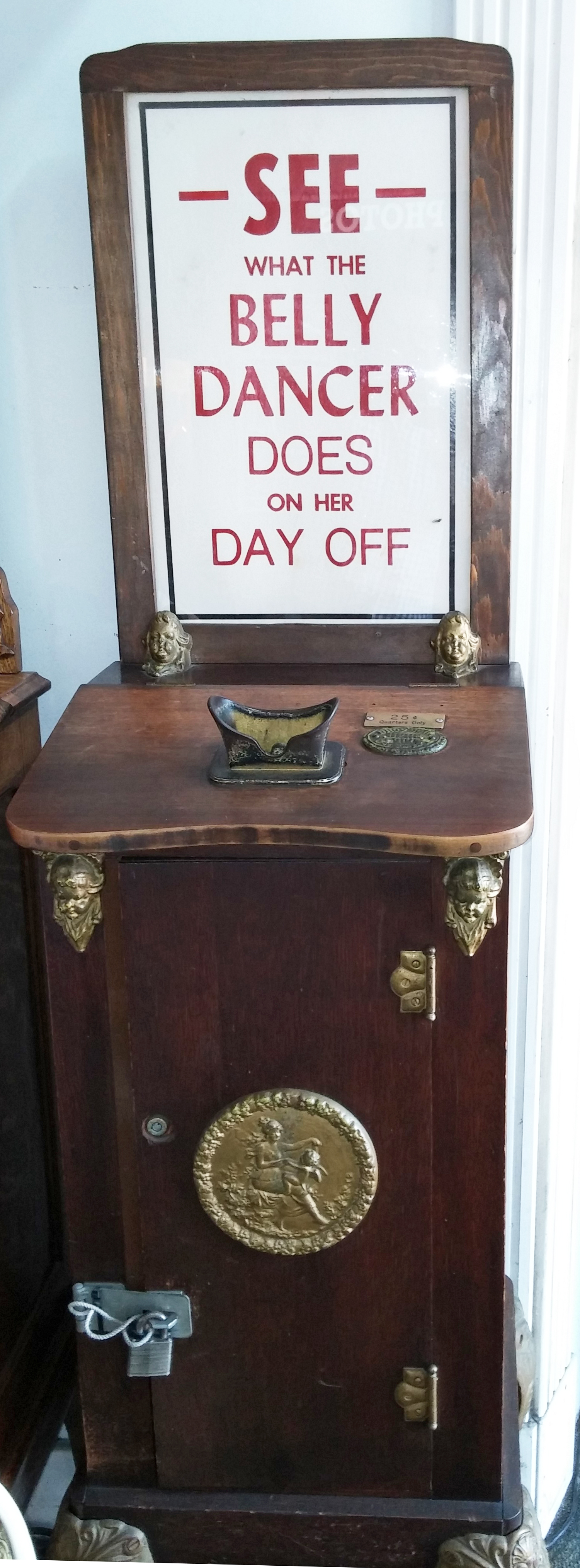
Those salivating at the thought can check it out here.

I loved the Career Pilot machine. It certainly helped me with my new career direction as a Lion Tamer. Here kitty, kitty, kitty.
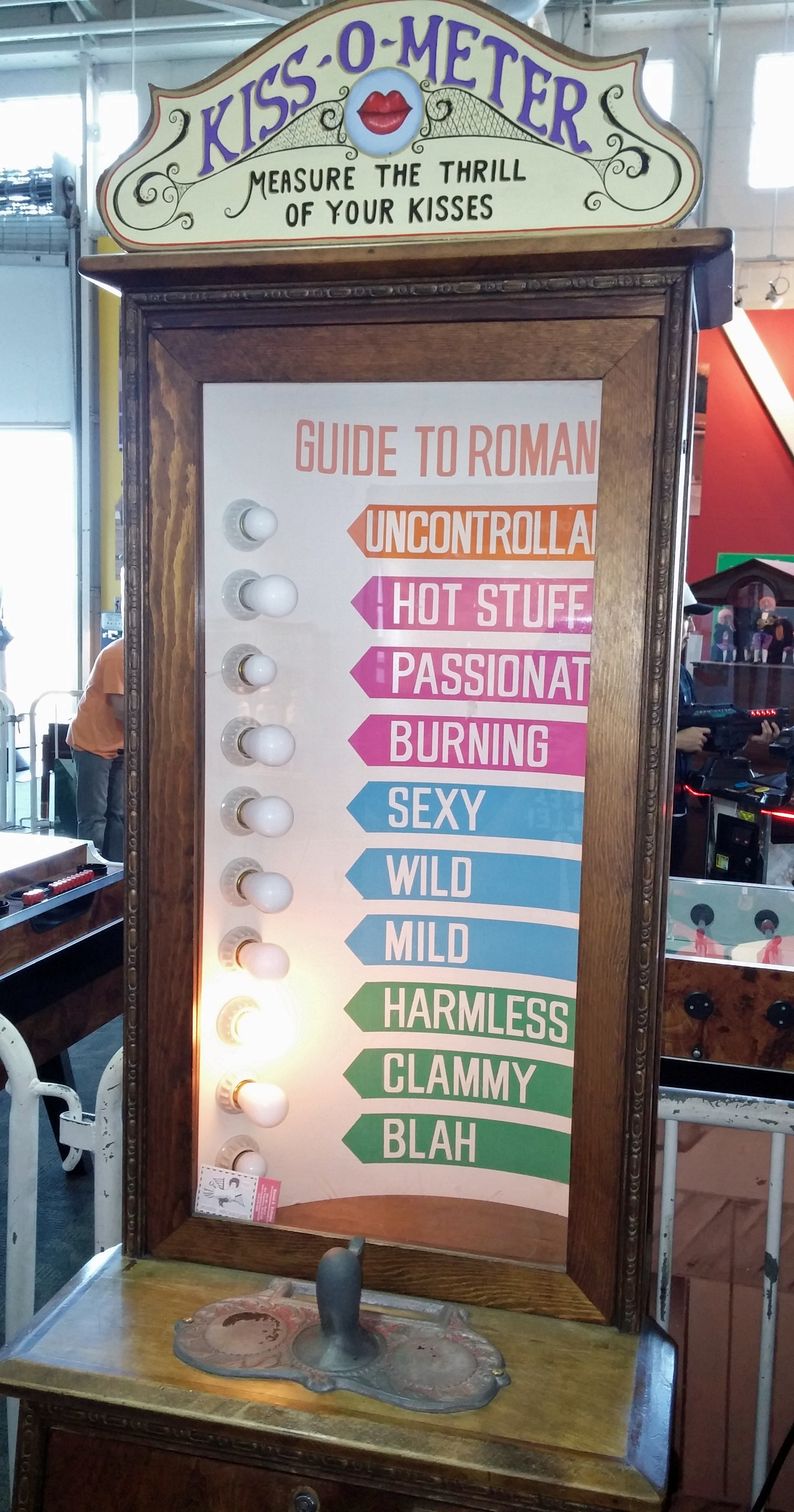
I couldn’t bring myself to kiss the corroded metal phallus.

There were quite a few of these lurid mechanical peep shows from the early twentieth century. They usually displayed scenes of crime or punishment. Mind you, you wouldn’t have had to look far to see a real opium den in San Francisco at that time. They were everywhere amongst San Francisco’s large Chinese population.
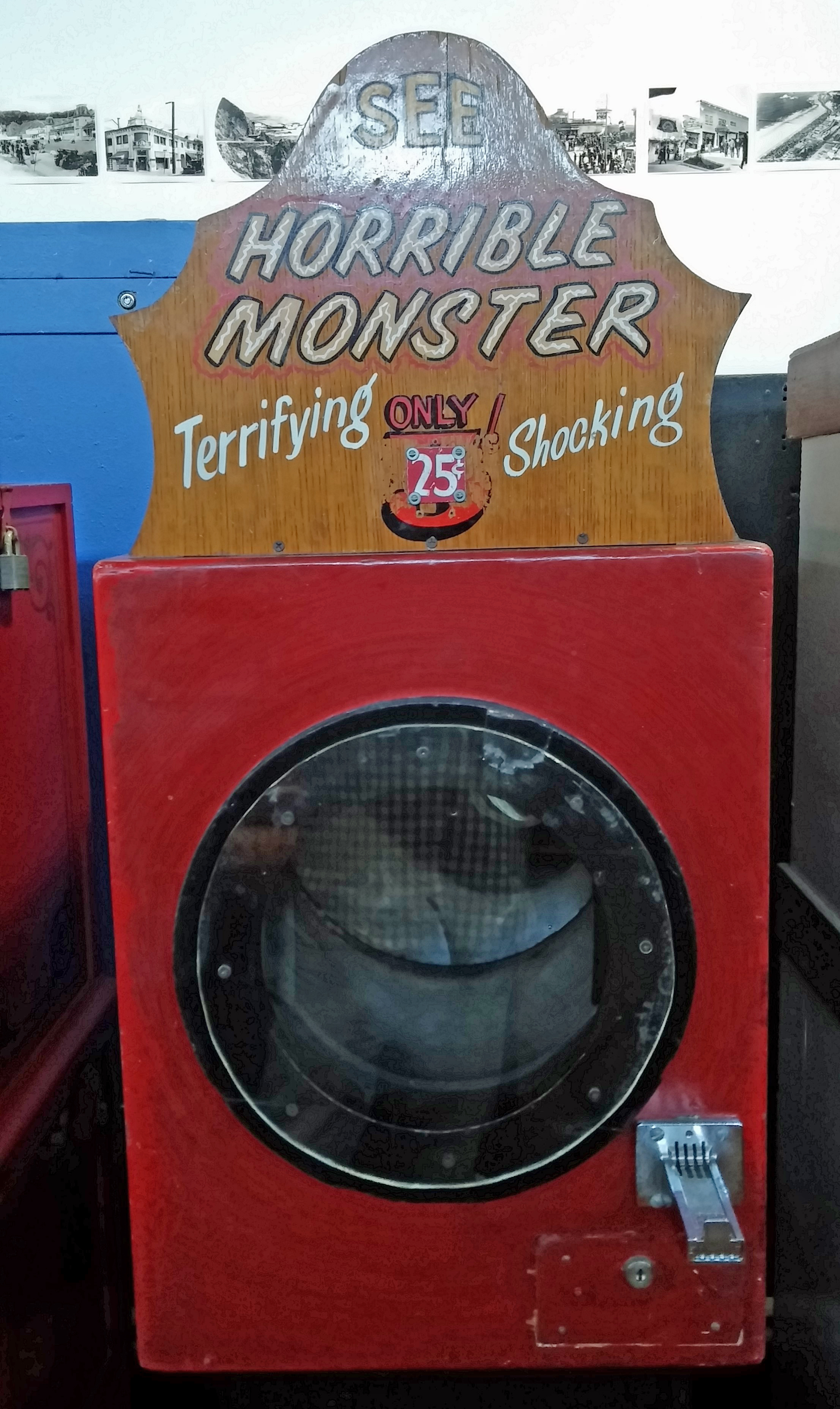
An oldie but a goodie. Put the coin in the slot and a black piece of carboard is drawn away to reveal a convex mirror. Yes, the monster is you.

A slightly-deranged bucking cowboy. I can’t see modern kids going for it. Mind you, I’m not sure kids from bygone times would have played it much either.

Woody Burke’s toothpick circus made up of over 150,000 toothpicks.
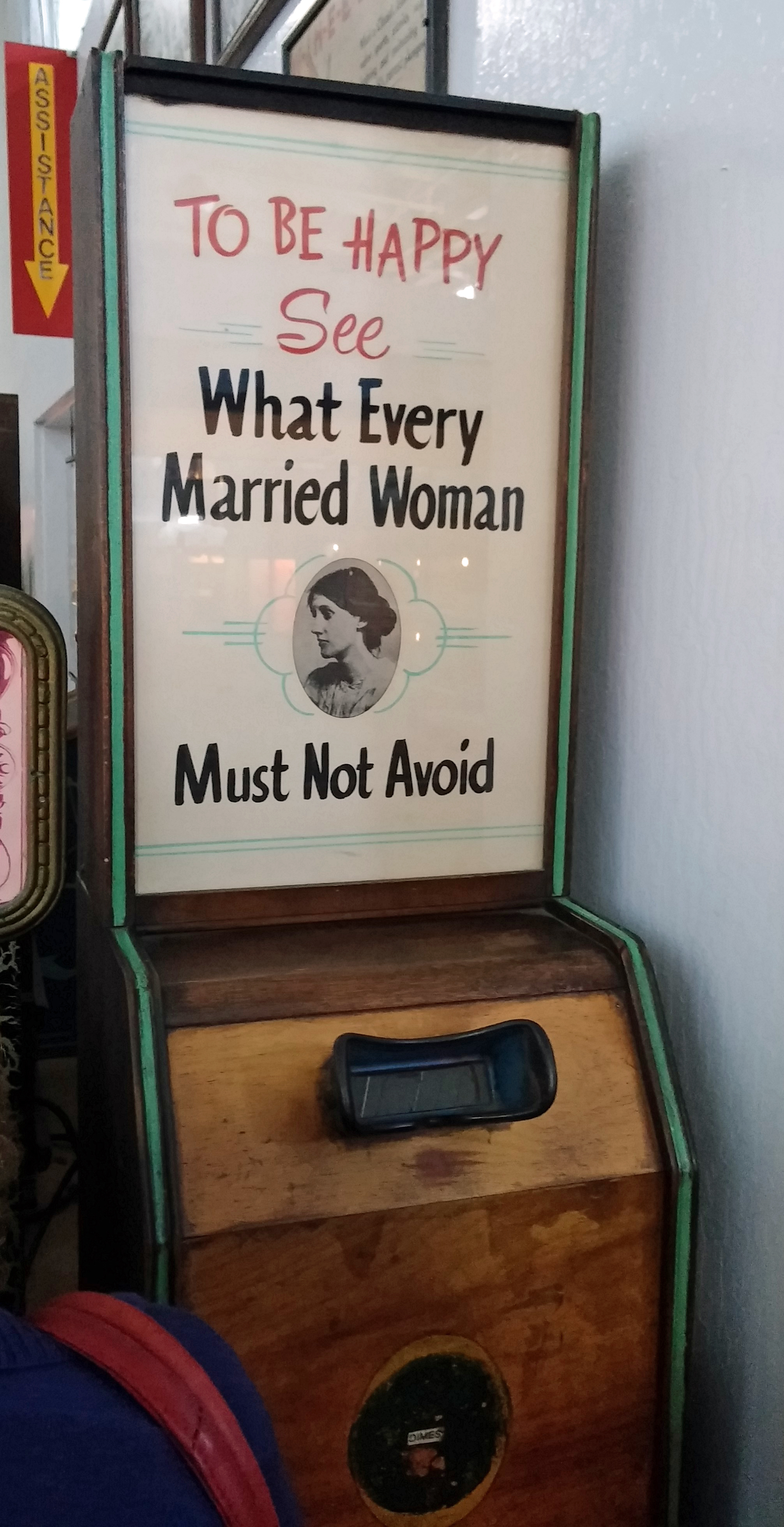
Michelle was intrigued by both the question and the accompanying photo of writer and early feminist, Virgina Woolf. She put in her money and looked through the viewfinder. The result was a simple picture of a man. This reminded me of the Harry Enfield video “Women Know Your Limits.” Yes, don’t be like that uppity Virgina Woolf and end up committing suicide, stick with your husband and be unliberated but happy.
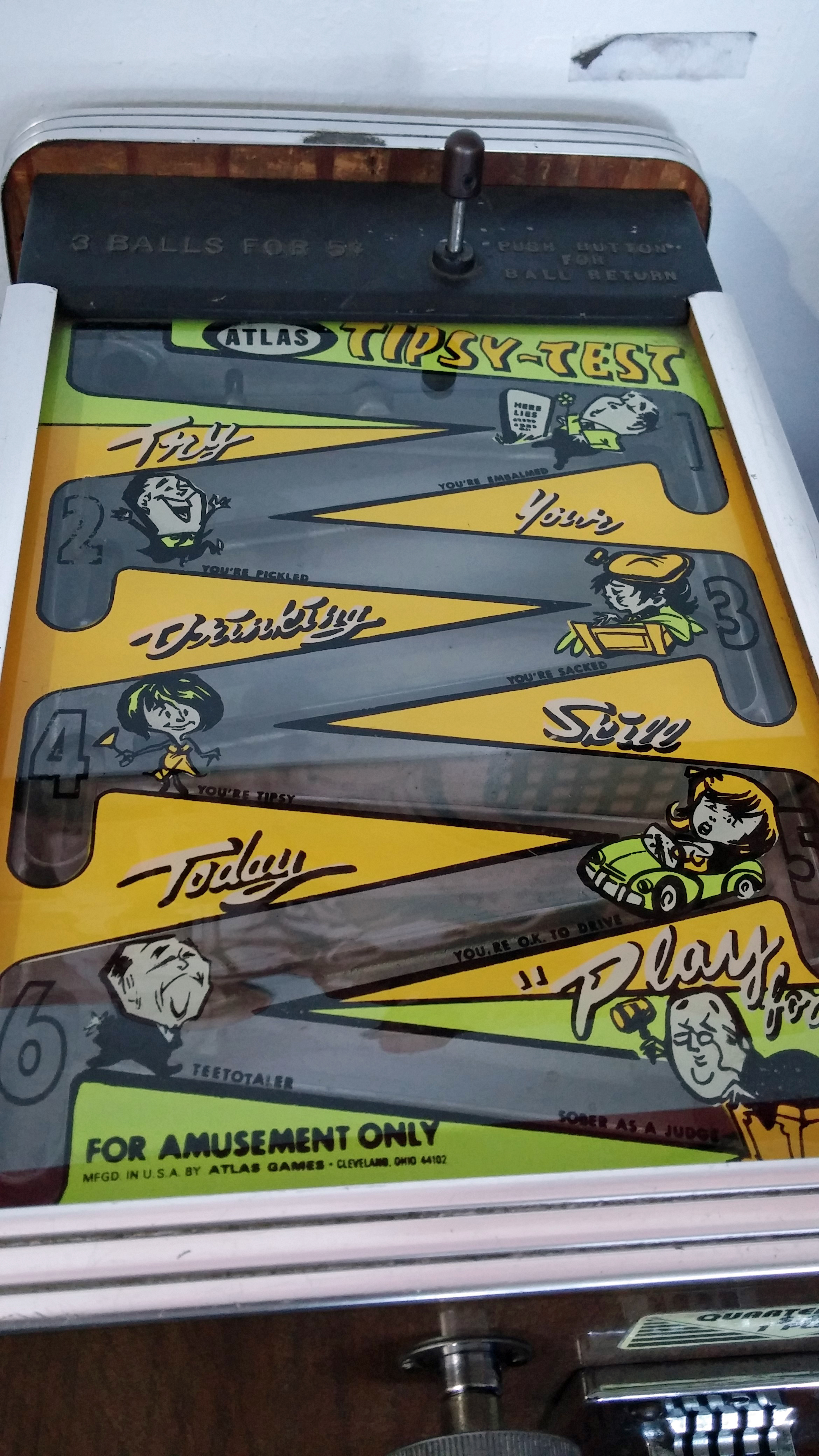
The Atlas Tipsy Test required an inebriated operator to navigate a ball-bearing through a balance maze. Where the ball landed would determine their state of intoxication from “Your Embalmed” (with a picture of a gravestone) to “Sober As A Judge.” Much better than a modern breath tester.

The Finger Striker. Here’s where you can really test the power of your typing skills. How hard can you pound that keyboard?
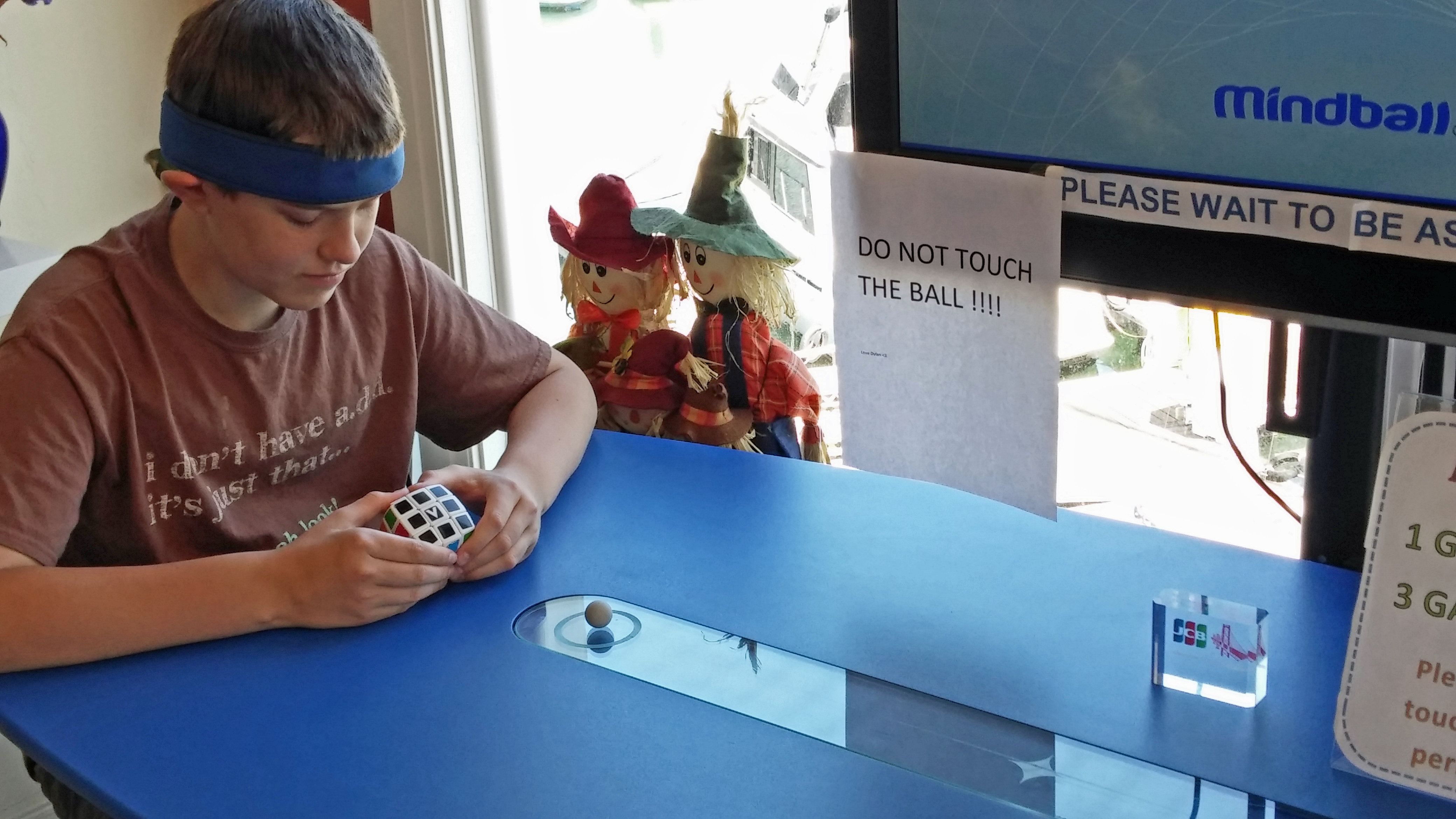
A few piers down from the Musée Mécanique we had a more modern arcade experience with Mindball at a cool puzzle store called Solve It! Think Out of the Box . Two opponents face each other at a table and use the power of their minds to push a ball towards the other player’s goal. The headband that Harrie is wearing measures brainwave activity. When the brain activity drops below a certain point a message is sent to the table to move the ball forward. So the winner is the person who can relax his brain the most. Harrie could not win at this game, despite frequent attempts. The game also introduced distractions such as the Rubic’s Cube in this picture to further challenge mindfulness.
Haight-Ashbury
We were advised by Scott McKenzie that if we were going to San Francisco that we should be sure to wear some flowers in our hair. Jim Gill went further and advised us to put some flowers on our foot, pack flowers on our back, show flowers on our toe, snap flowers to our lap, get dressed with flowers on our chest, buckle flowers to our knuckle, tie flowers to our thigh, spread flowers on our head and to finally to adhere flowers to our ear.
Flowered up, we travelled back to the groovy Sixties in The Magic Bus to see the beautiful people of Haight-Ashbury. The Magic Bus was a new tour being run in San Francisco that attempts to give squares the trippy feel of the golden age of Hippiedom.
The tour is named after Ken Kesey’s infamous bus of the same name that toured across America in the Sixties with his motley crew of Merry Pranksters. Kesey actually called his bus “Further” but everyone just referred to it as The Magic Bus. On entering the Magic Bus replica, we were greeted by Treeflower and Wild Thing who hugged us and told us how beautiful we were.
Sitting on two long bench seats, we faced the side windows of the bus as we made our way through the CBD of San Francisco. As we passed the financial district, we were encouraged to yell at the bread-heads in suits “working for the man.” “Money won’t set you free” yelled Treeflower to a middle-aged executive who just smiled and made the peace sign. “Quick, drive faster” said Treeflower to Wild Thing, “we’ve got, like a narc watching us.”
We were then handed some LSD and some groovy shades. A few seconds later we were away on a psychedelic trip. Vibrant three dimensional images leapt towards us and swirled around our heads, ever-expanding our consciousness.
Imagine our surprise when we later found out that the LSD was just Mentos mints and that the psychadelic images were just 3D projections on blinds that covered the windows of the bus. Gee Treeflower, I guess The Sex Pistols were right in warning us to “never trust a hippie.”
We then saw a film that gave us a potted history of the counter-culture movement in Sixties’ San Francisco before the blinds were opened to reveal Haight St in all of its faded glory.
We cruised down Haight and Ashbury streets and took in all of the colourful houses and even more colourful people. Treeflower singled out people on the street and encouraged them to show their love and to be part of the revolution that was coming. Haight St pedestrians were anything but, and didn’t need much encouragement to join in the fun. Treeflower pointed out important landmarks along the way such as places Jimi Hendrix crashed for the night or where the Grateful Dead used to buy drugs.
We ended up in the Golden Gate Park where the Gathering of the Tribes (or The Human Be-In) occurred in 1967 that brought the Hippie Summer of Love to the world. We frolicked in the park under the warm sun and thought back to when the place was filled with unwashed, drug-addled hippies.
We continued to tour around interesting hippie landmarks in the Haight-Ashbury area before being dropped off at Chinatown where a busy Chinese Moon Festival was in full swing. We had an enjoyable stroll through Chinatown taking in the sights, sounds and smells of celebration as we made our way to our next destination, The Beat Museum.
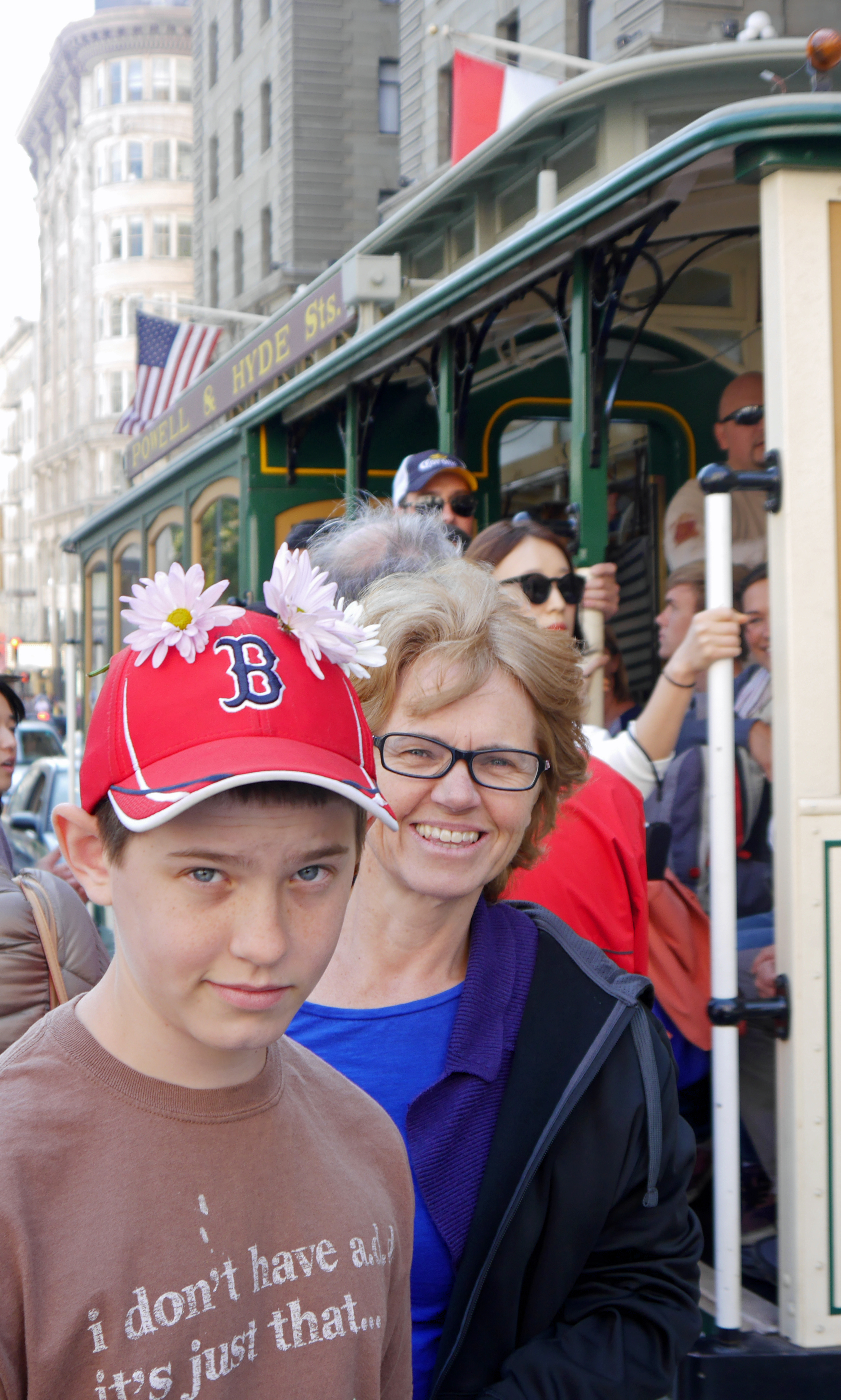
Two flower-children waiting to ride a cable car.

Harrie and I aboard a cable car on the world’s last manually-operated cable car system.

This is a poster to the big bang event that exploded the hippie culture onto television sets around the world. In 1966, California banned LSD. This led to psychologist and LSD advocate, Timothy Leary, calling his friends together for a “gathering of the tribes for a Human Be-in” to demonstrate to the authorities the power of the the emerging hippie counter-culture. This is the event where Leary famously encouraged everyone to “turn on, tune in and drop out.” An estimated 20,000 people turned up to turn on to Leary’s message. By the summer of 1967, 100,000 people had dropped out, descending on San Francisco to look for an alternative way of life. That Summer of Love would define the hippie movement for decades to come.
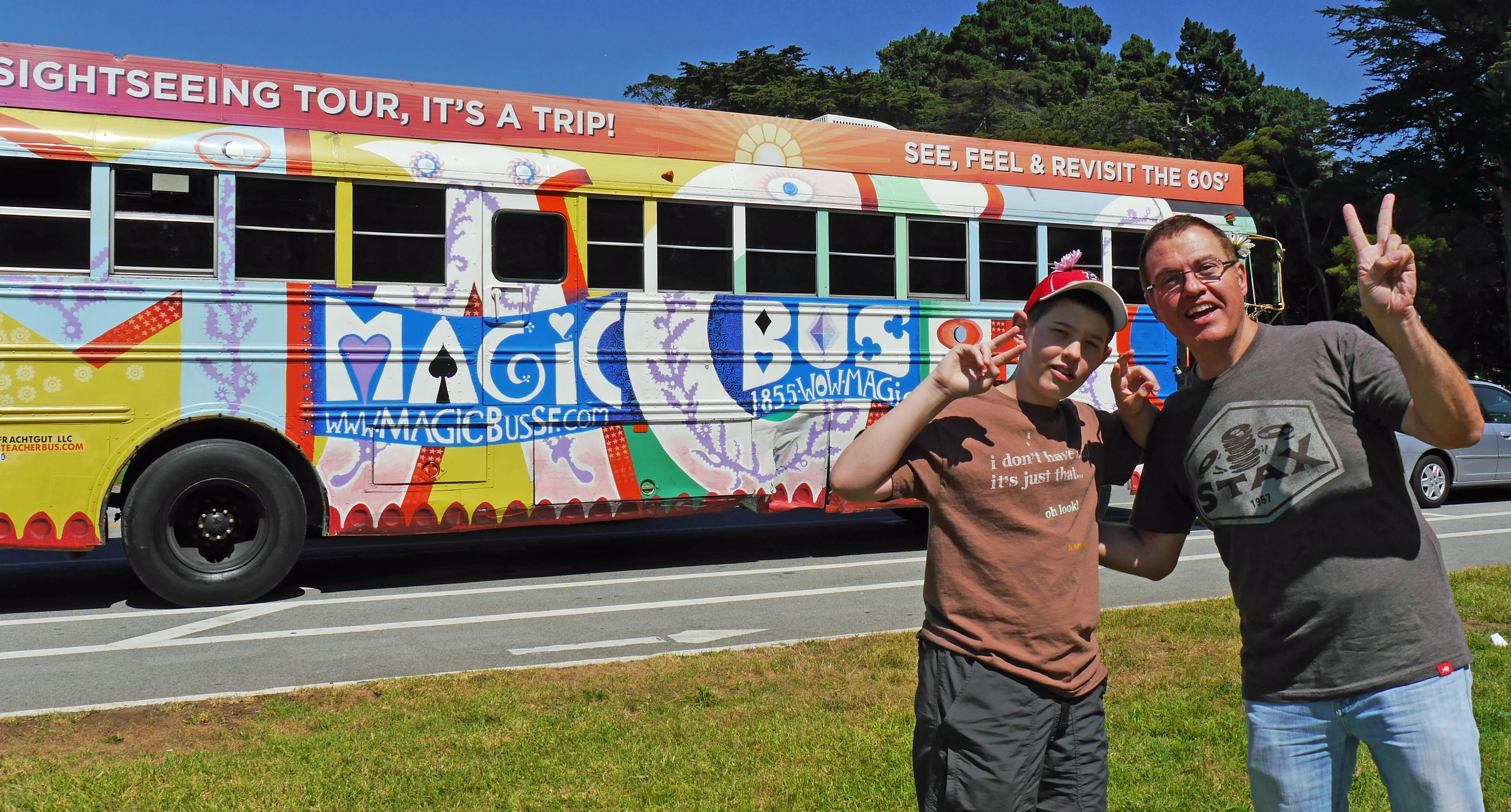
Like, dig The Magic Bus man.
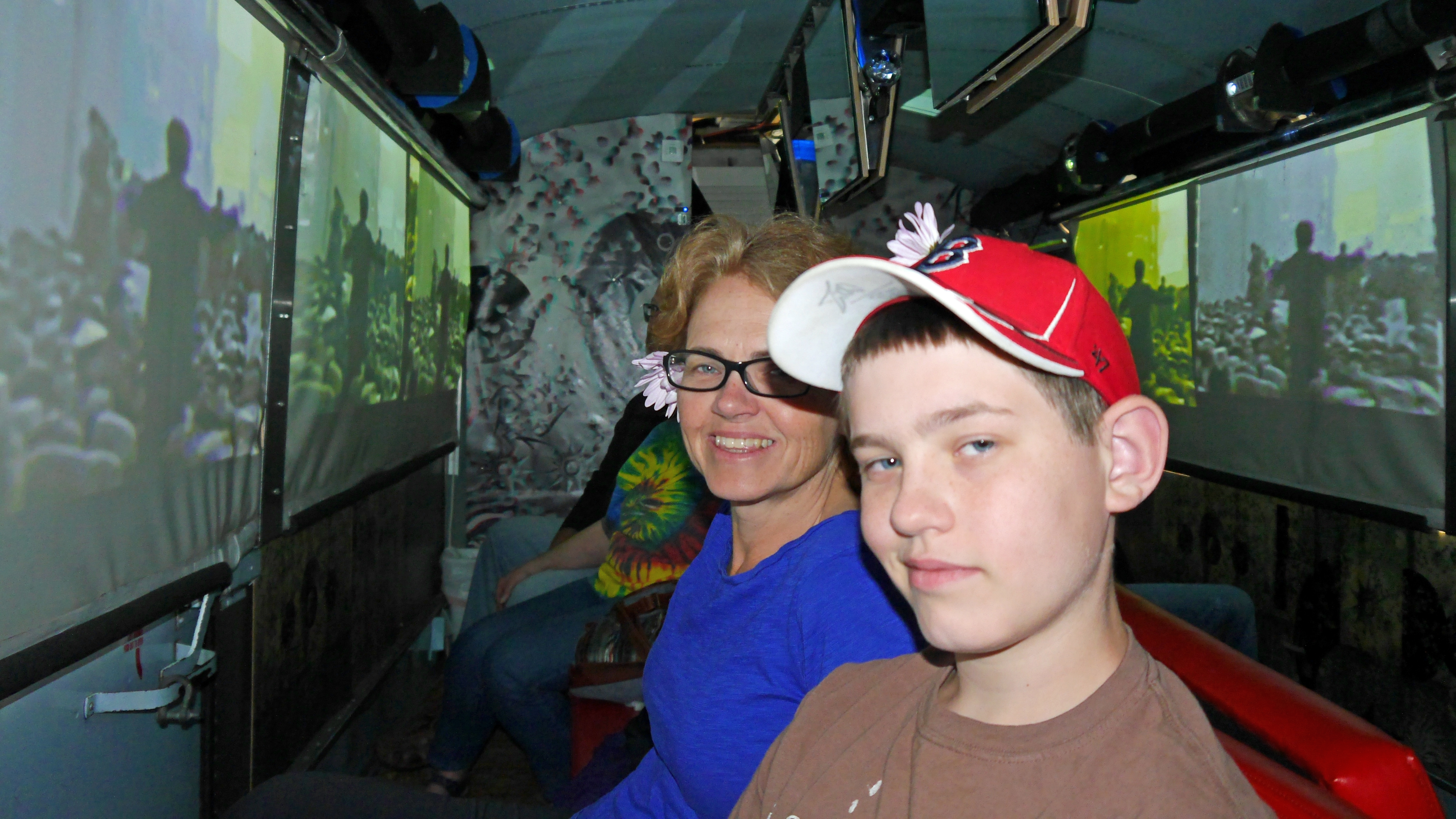
Inside the magic bus, where the blinds descended and took us on a different kind of trip.

The welcoming legs of the Piedmont Boutique on Haight St.
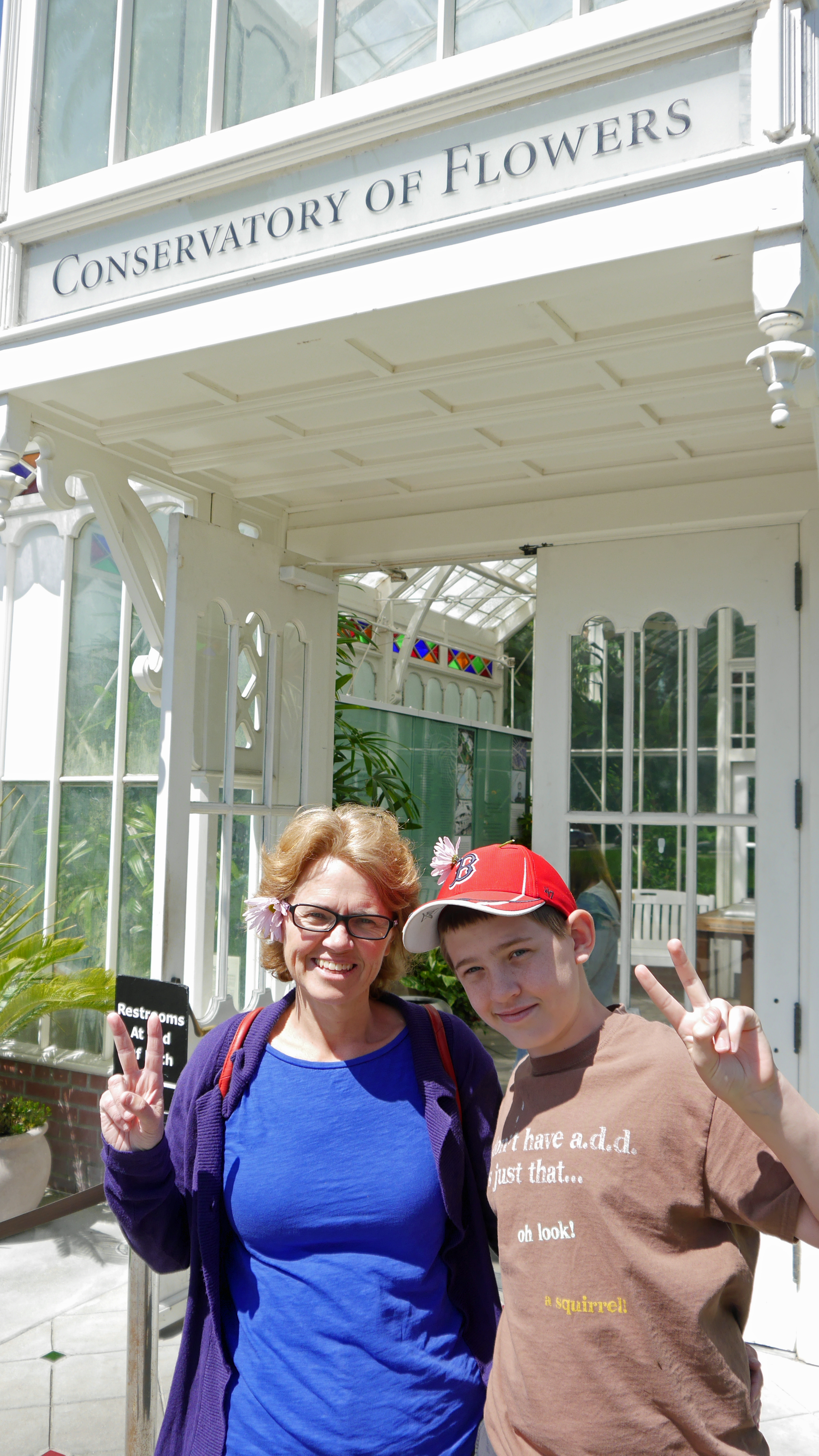
The two flower children attend the Conservatory of Flowers in Golden Gate Park.

Getting lost in Chinatown during the Autumn Moon Festival.
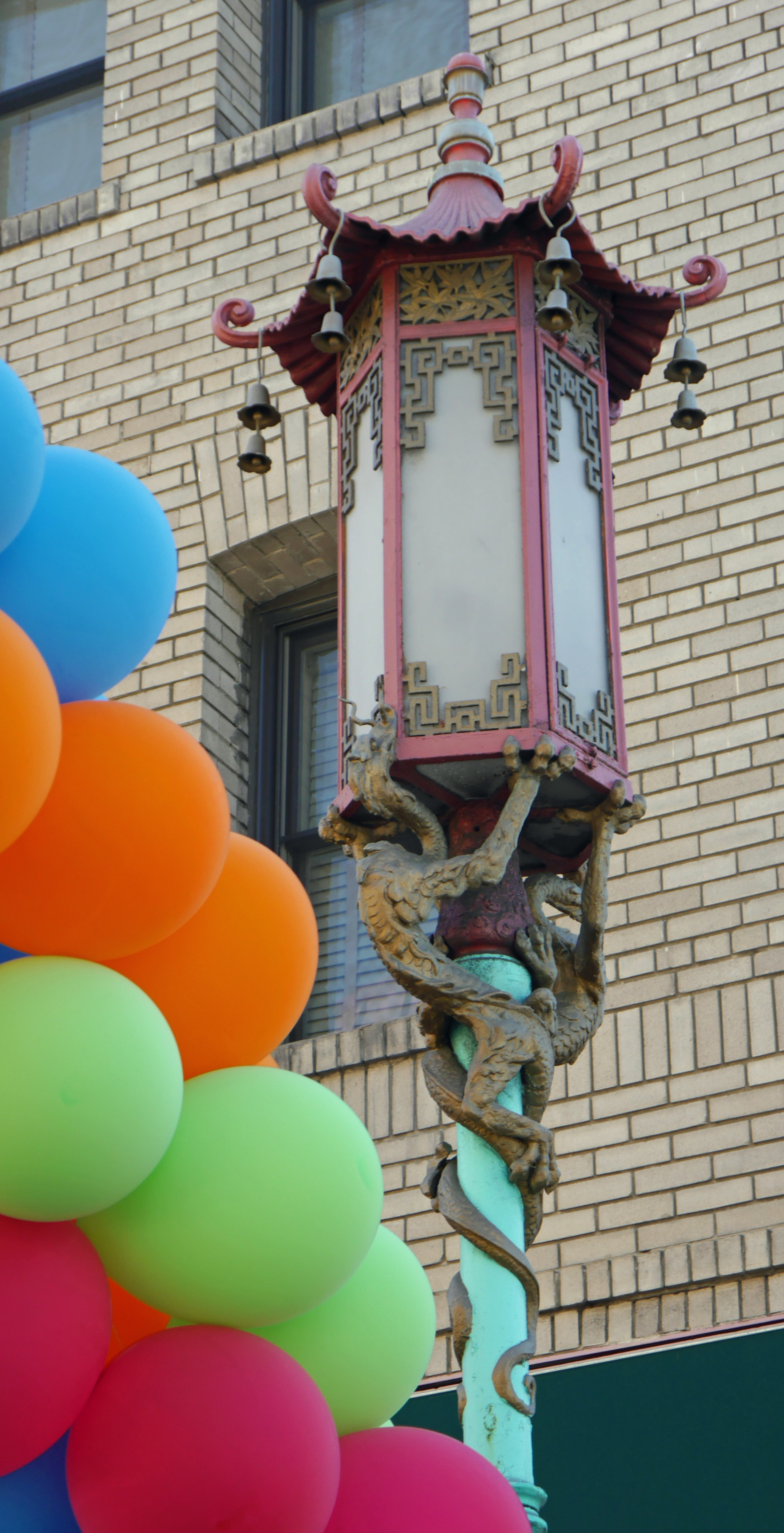
I loved the beautiful dragon lights that adorned every street corner.
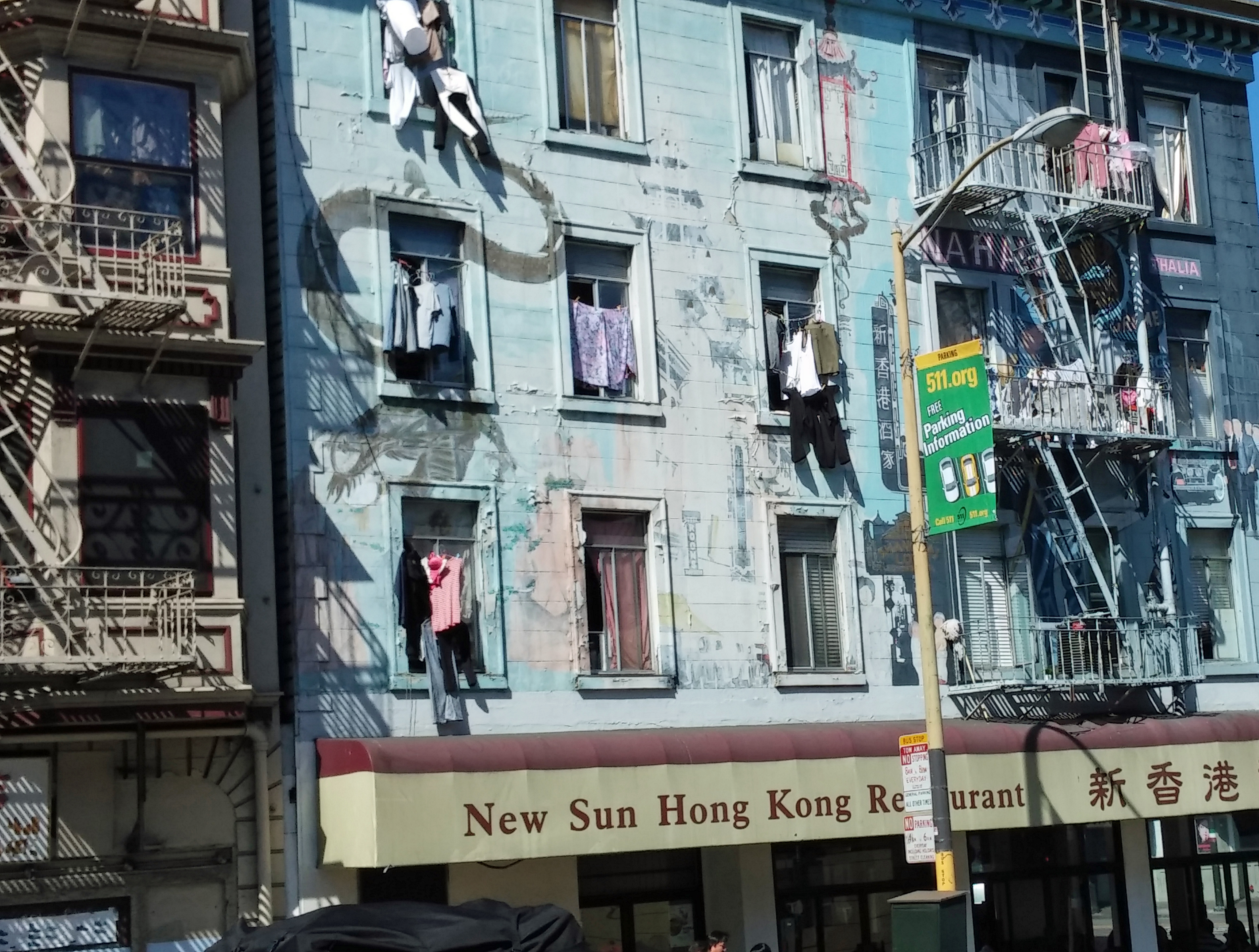
A typical San Francisco tenement in Chinatown where inhabitants hang their clothes out to dry.
The Beat Museum
Before the hippies, there was the beat generation. The name “beat” was coined by Jack Kerouac who said (possibly while snapping his fingers in two-two time) “Everything is going to the beat — It’s the beat generation, it be-at, it’s the beat to keep, it’s the beat of the heart, it’s being beat and down in the world and like oldtime lowdown and like in ancient civilizations the slave boatmen rowing galleys to a beat and servants spinning pottery to a beat…”
We visited the Beat Museum which is located near Jack Kerouac St in Chinatown. The place was empty and we received a warm welcome from the owner, Jerry Cimino who also wanted to hear about our travels on the road. The museum is small but there are lots of things to read and learn about. The museum also had a fantastic book shop with lots of stuff from the fifties but the prices were pretty steep.
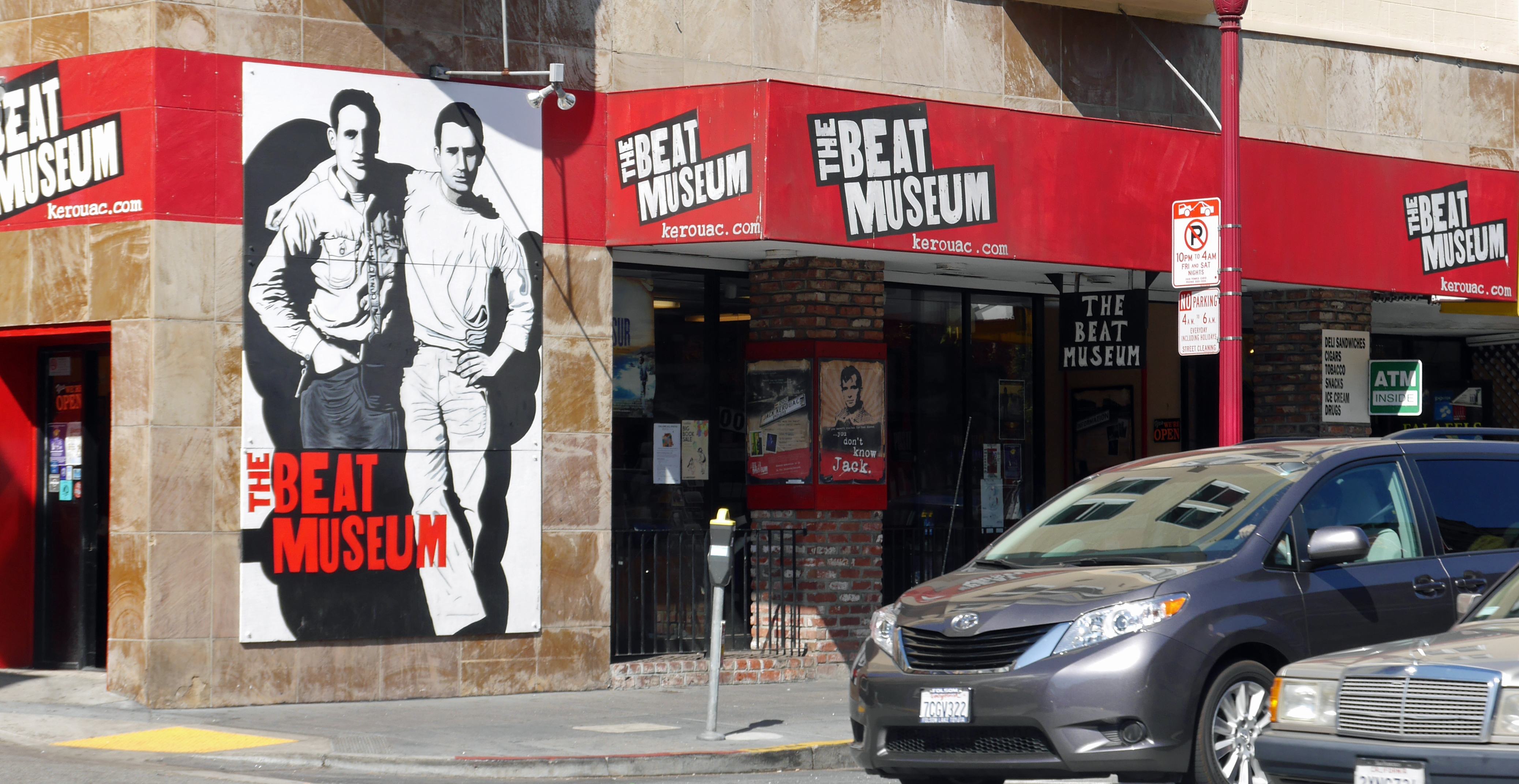
The Beat Museum, San Francisco. The picture is of Jack Kerouac and Neal Cassady.
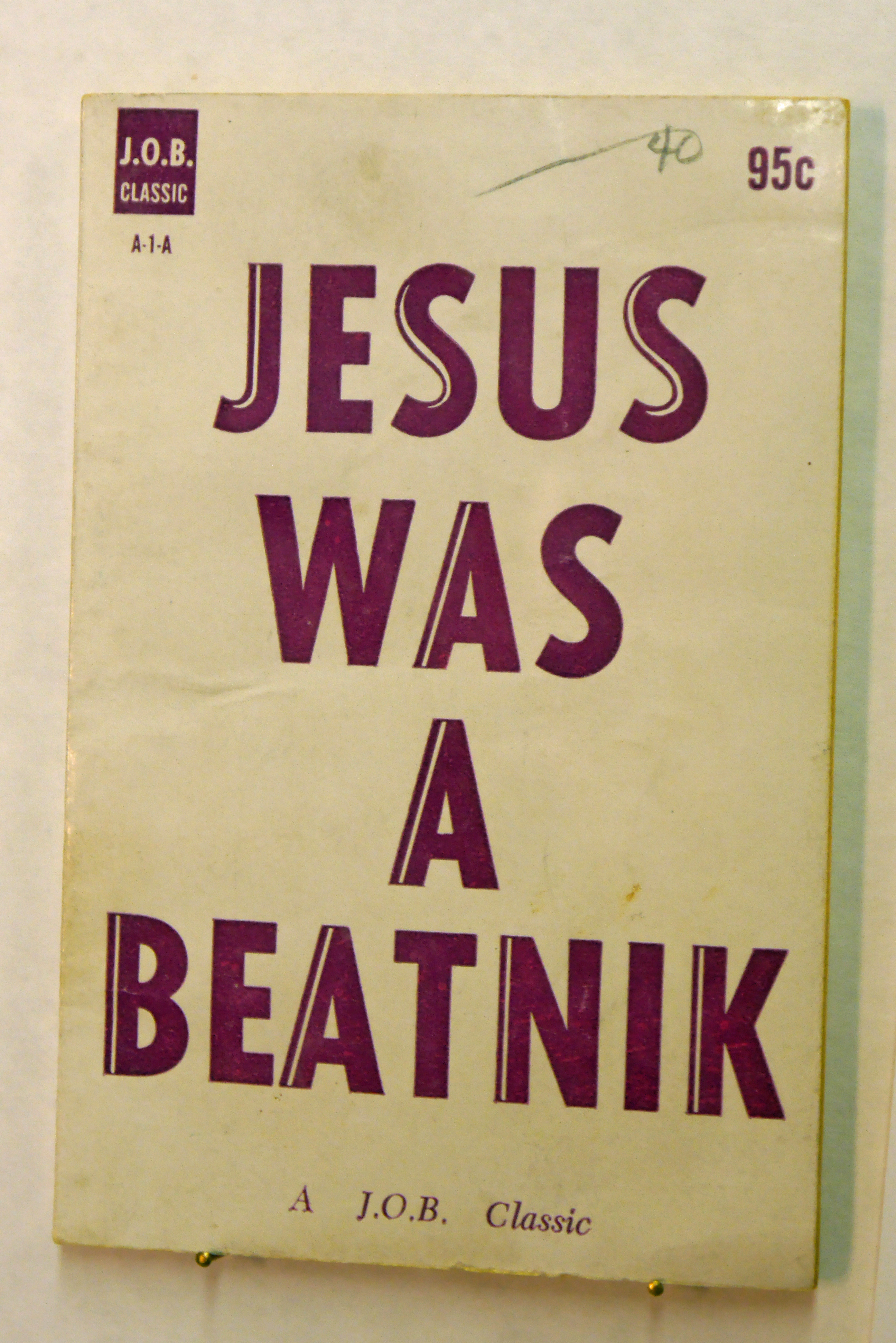
And if you don’t dig it, listen to Lord Buckley spruik the solid deeds of that carpenter kitty, The Nazz.
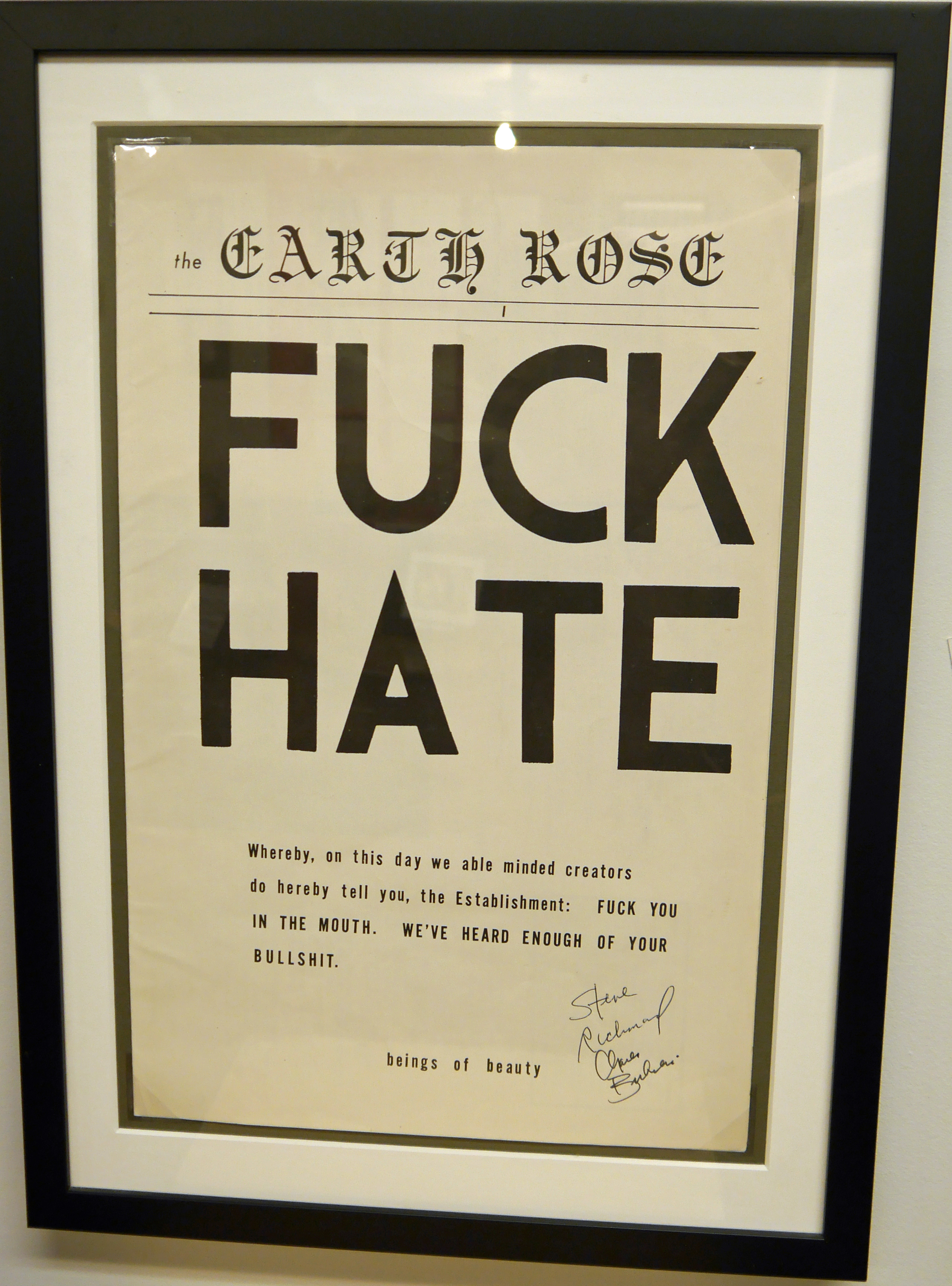
In 1966, poets Steve Richmond (The Doors’ Jim Morrison would cite him as one of his greatest creative influences) and Charles Bukowski (the beat laureate of American lowlife) joined forces to publish an independent magazine called Earth Rose and stick it to the Establishment. Ten thousand copies of the first issue (above) were printed and distributed to bookshops in San Francisco and Los Angeles. Ten booksellers were subsequently arrested by police and charged with selling an obscene publication. As a result, a second issue never eventuated.

A working draft of Allen Ginsberg’s Howl. Here the openly gay Ginsberg railed against the stifling conformity of Fifties America and how it destroyed the best minds of his generation – the people who were trampled down because of their sexuality, their creativity, their politics or their poverty.
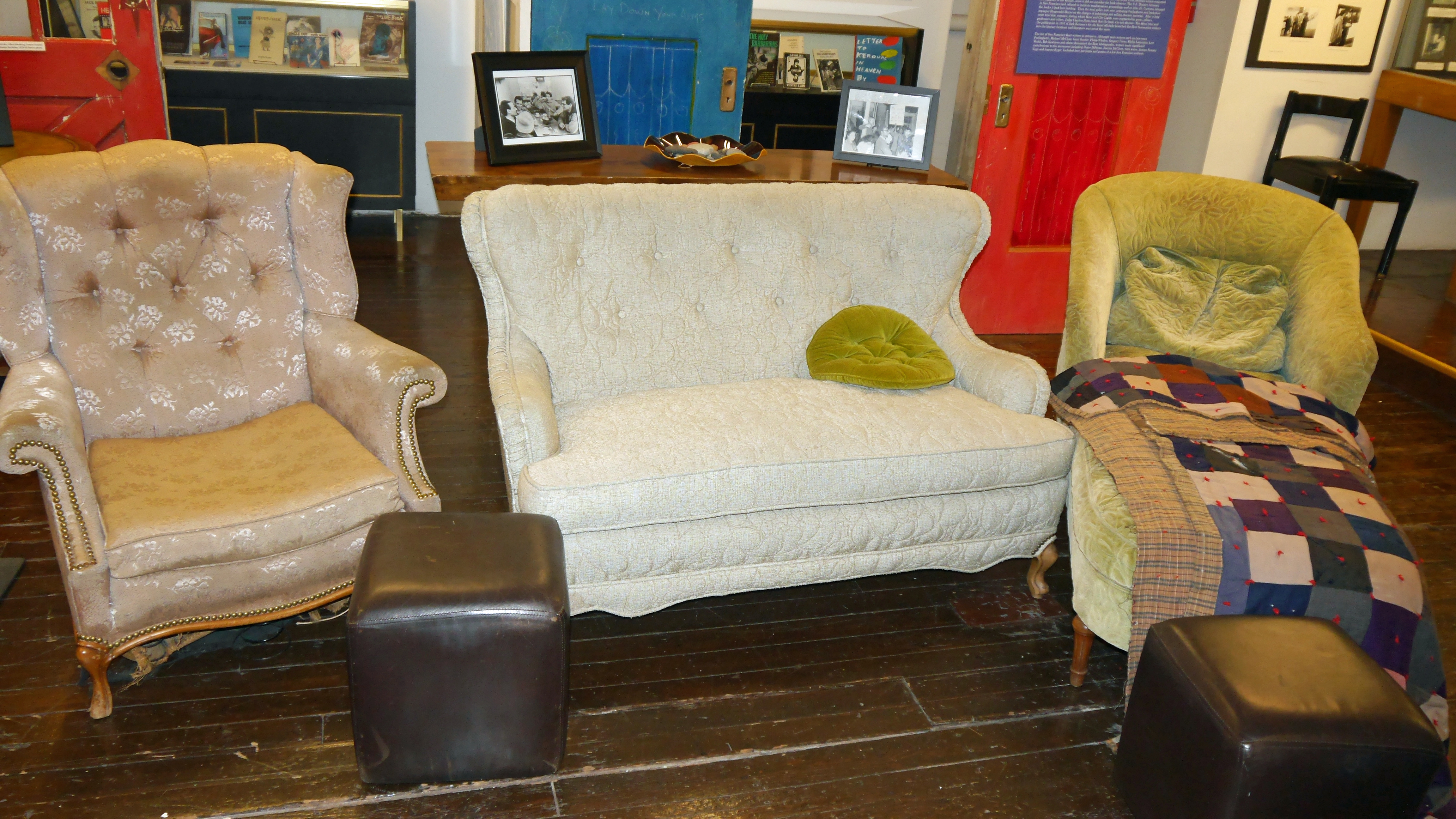
We thought we might be looking at Allen Ginsburg’s chair or William S. Burrough’s couch until we read the next caption.

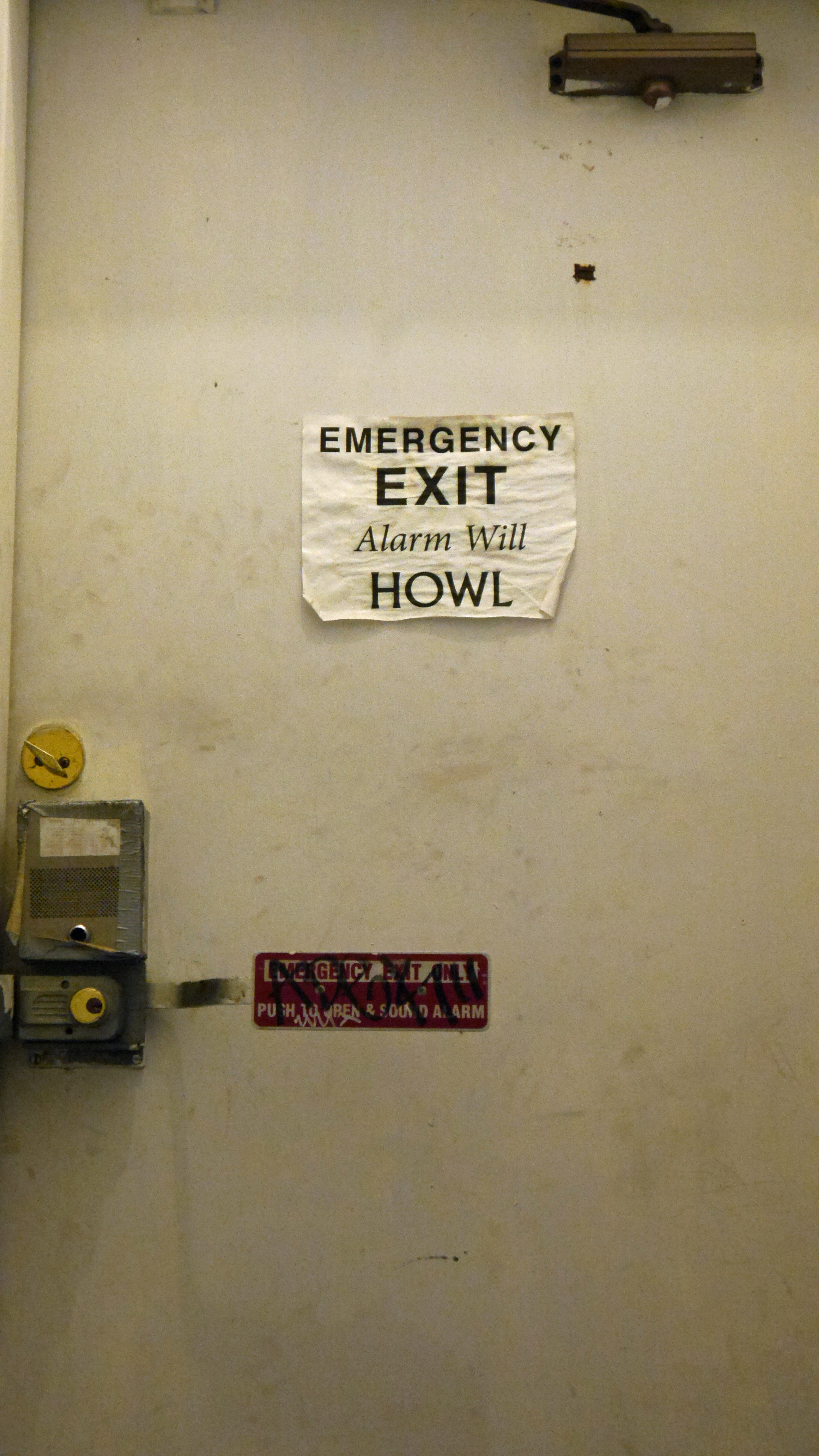
Loved this sign on the Emergency Exit.
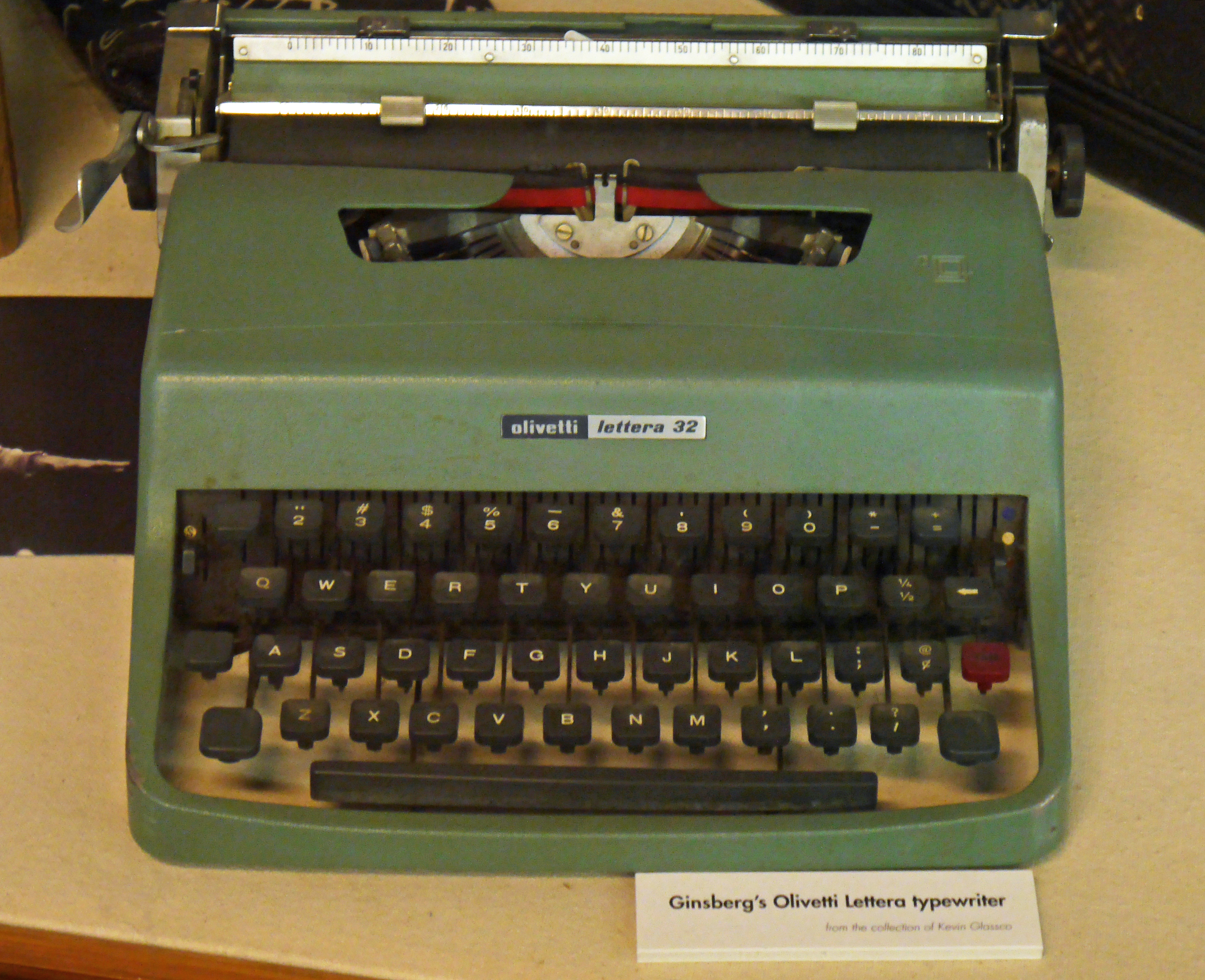
Allen Ginsberg’s typewriter. Nothing snooty or fancy about a plain Olivetti.
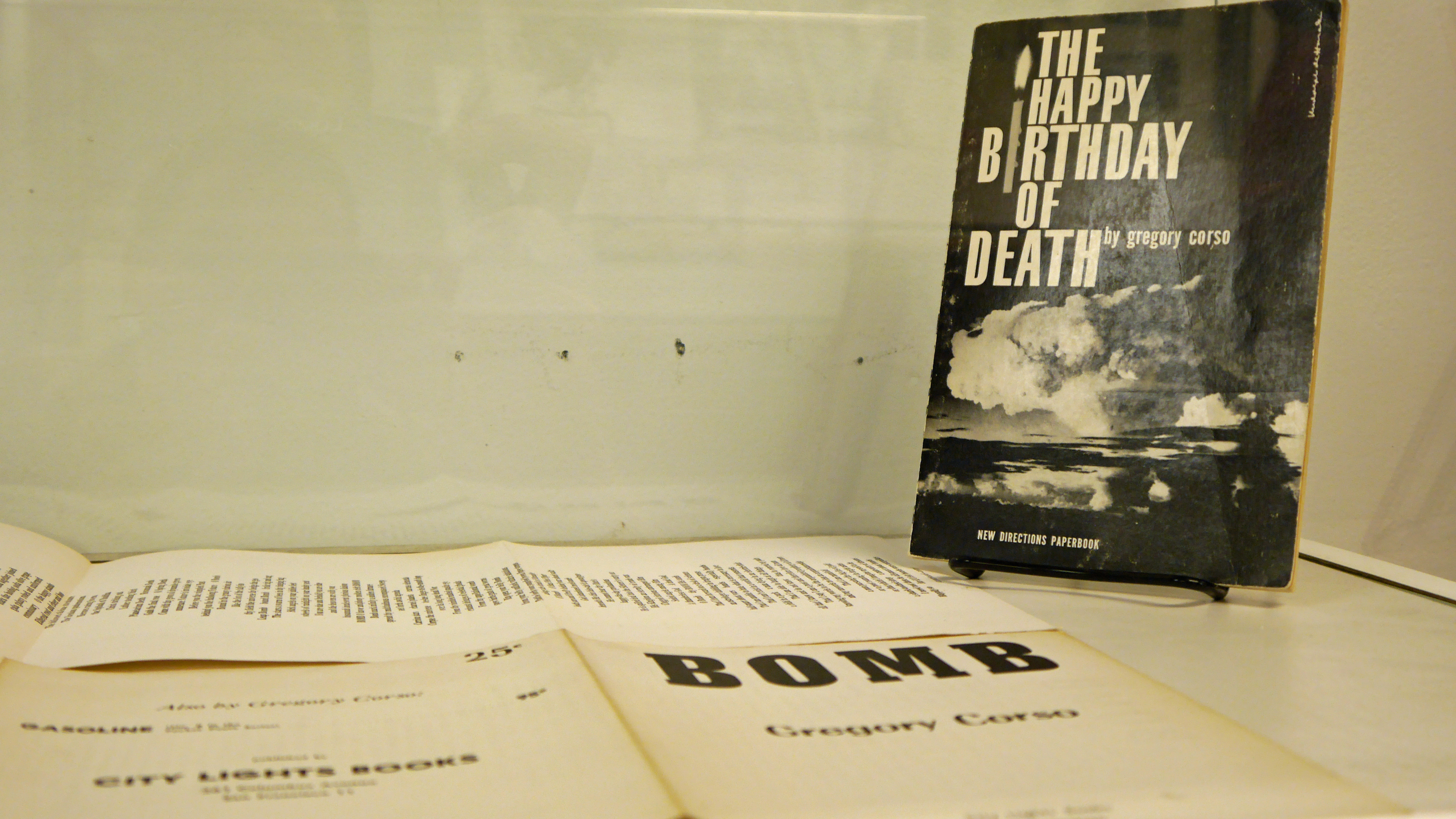
Gregory Corso’s famous Bomb poem which became the favourite poem of a young songwriter from Minnesota called Bob Dylan. Dylan later commented on its influence on his early life “The Gregory Corso poem ‘Bomb’ was more to the point and touched the spirit of the times better— a wasted world and totally mechanized— a lot of hustle and bustle— a lot of shelves to clean, boxes to stack. I wasn’t going to pin my hopes on that.”
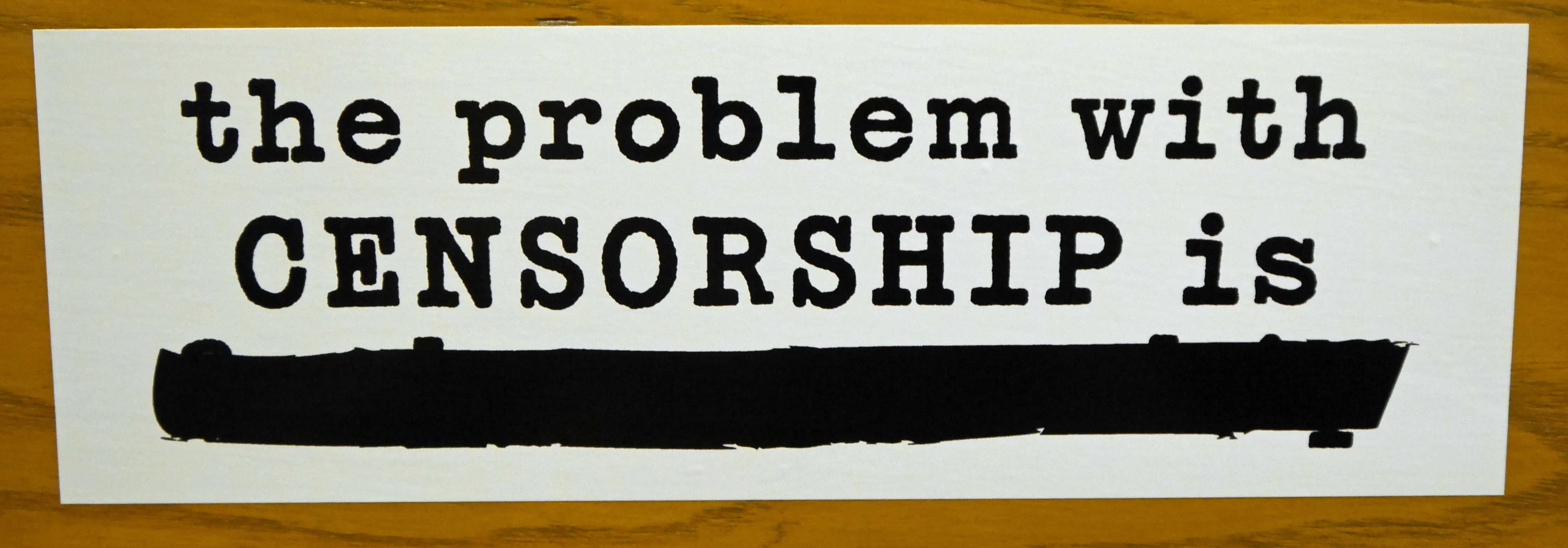
I loved this Beat response to the relentless banning and censorship of their work.
Alcatraz
Of course, a lot of beat poets like Gregory Corso spent some time in jail. However, they never went anywhere quite like Alcatraz which is where we set off to visit on a balmy Saturday night.
Alcatraz sits about 2.5km off the San Francisco bay and was originally built in 1853 as a military fort. At that time, California was growing increasingly worried that the gold from the Gold Rush would be seized by an invading foreign power and built the fort to deter invaders.
In 1867, a military prison was built to house captured Confederate soldiers during The Civil War and in 1933 this prison was handed over to the United States Department of Justice who viewed its isolation as the perfect place to house the roughest and toughest prisoners in the US Penitentiary system.
Alcatraz’s inmates included Al Capone, Alvin Karpis (also known as Creepy Karpis who was the last FBI Public Enemy No.1 and Alcatraz’s longest resident), Robert Stroud (he of The Birdman of Alcatraz fame), George “Machine Gun” Kelly (the man who popularised the submachine gun as the weapon of choice of gangsters and gangstas the world over) and notorious Jewish gang boss Mickey Cohen.
We arrived on Alcatraz just as the sun was setting. As the sun set, it became quite cold as if the weather was matching the starkness of the island. We walked up the winding concrete pathway past the old warden’s quarters to the main entrance. Entering the prison was like walking on the set of The Rock, Escape From Alcatraz or The Birdman of Alcatraz. The roughly-painted white and green walls and the rusted steel bars were instantly familiar as was the lonely exercise yard. We walked through the prison listening to an audio guide with anecdotes from previous inmates and guards. As night fell, and the cold overhead-lighting flickered on, we really got to experience how brutal and claustrophobic this place must have been for inmates.
Walking out in to the exercise yard, we were met with a cacophony of squawks from angry seagulls who seem to be the new inmates on Alcatraz. And speaking of birds, we also visited the upstairs infirmary where Robert Stroud, the Birdman of Alcatraz lived but actually kept no birds at all (unlike the movie). We explored the guards quarters and dared each other how long we could stay in the pitch-black solitary confinement cells. It was both a fun and sobering evening.
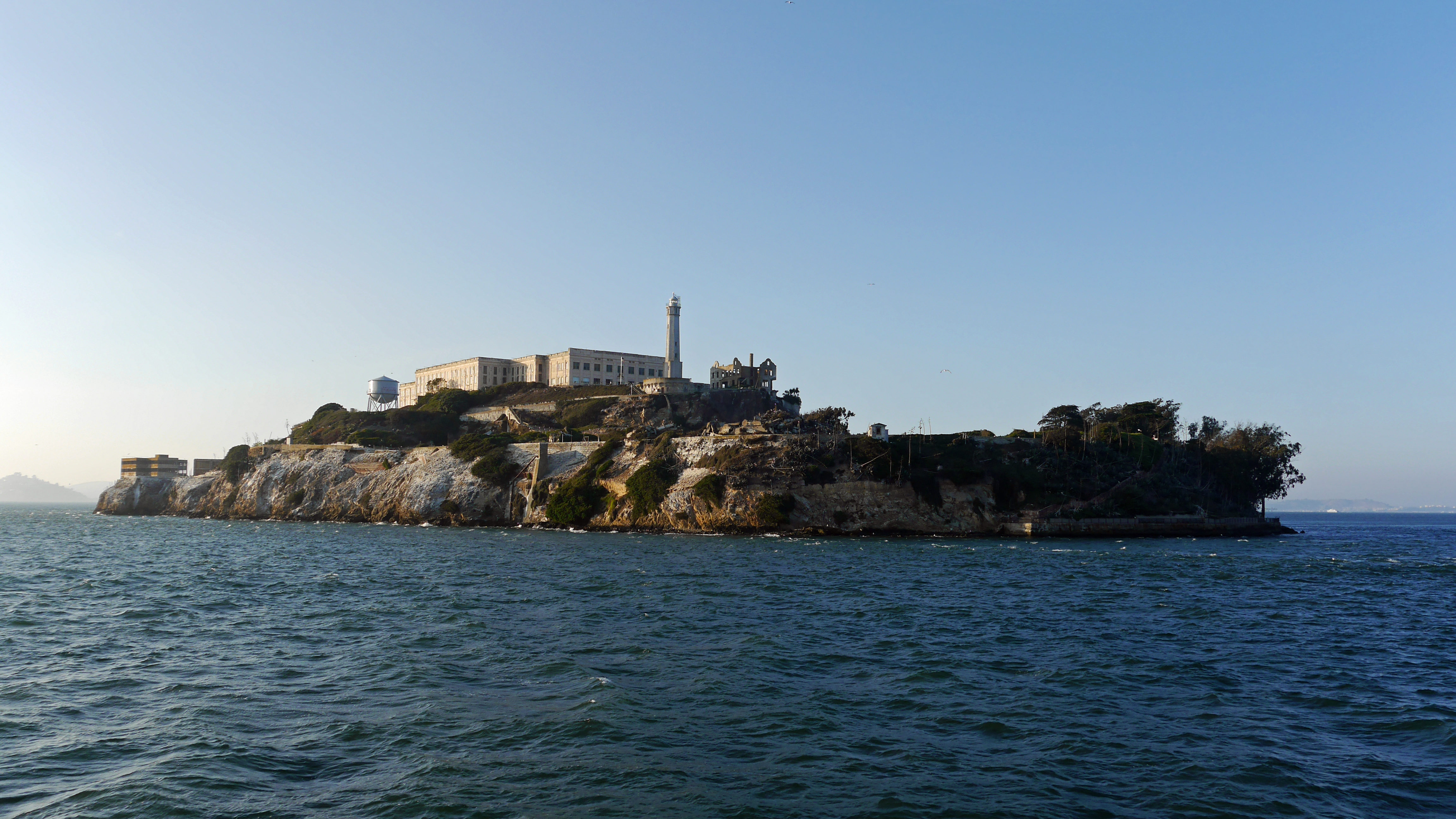
Alcatraz Island. “Alcatraz” is Spanish for “pelican” and the island used to be home to a squadron of pelicans. Now it is home to a flock of seagulls.
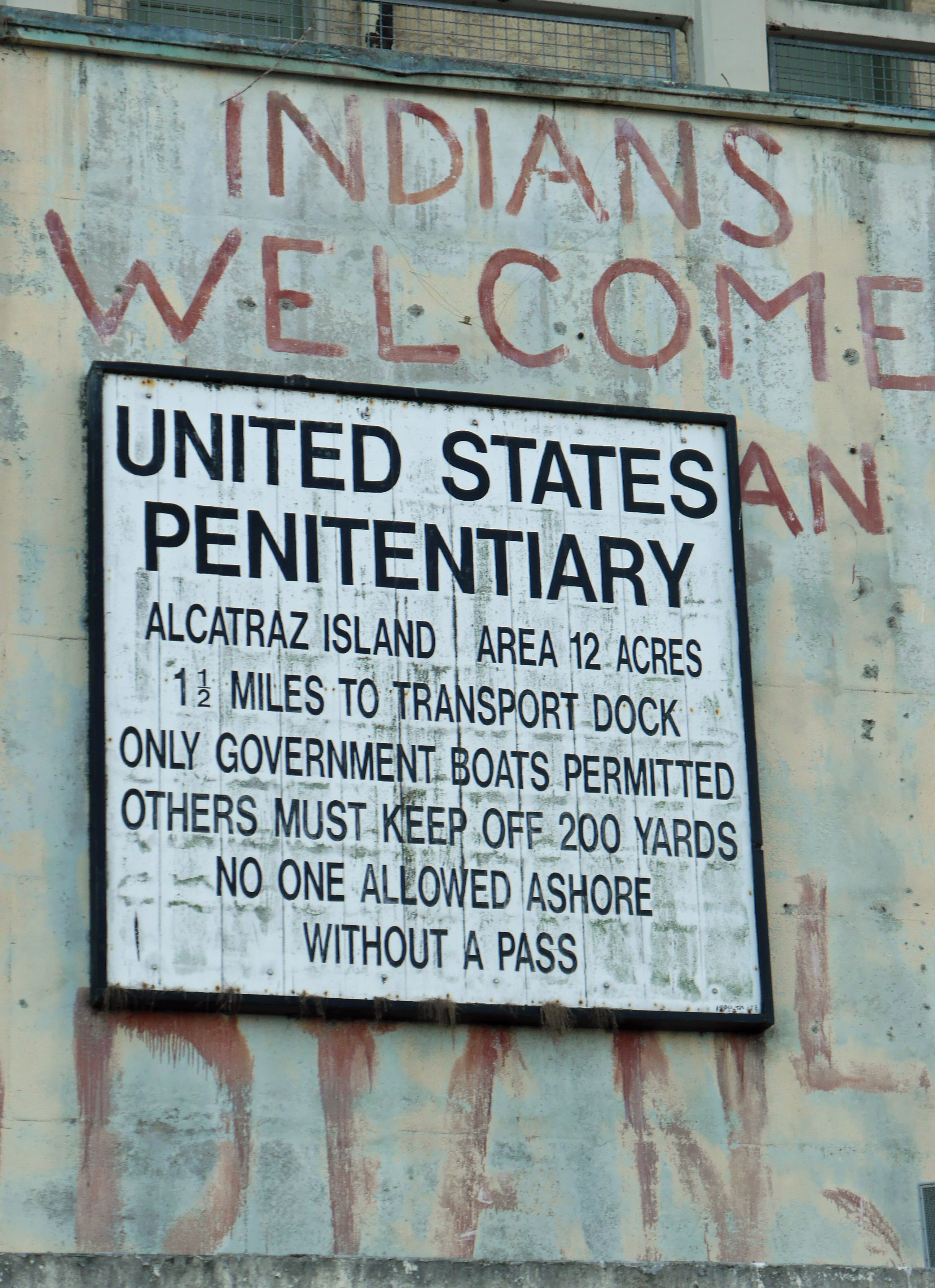
Alcatraz Prison was closed in 1963. The following year, Native American Indians occupied the island seeking reparations for past land seizures and for broken treaties. They occupied the island again in 1969 and stayed for almost two years. Their protests led to the withdrawl of the Indian Termination Act (where the Government could force Indians to assimilate rather than live by their own cultural traditions) and new Government policies of self-determination for Indian tribes.
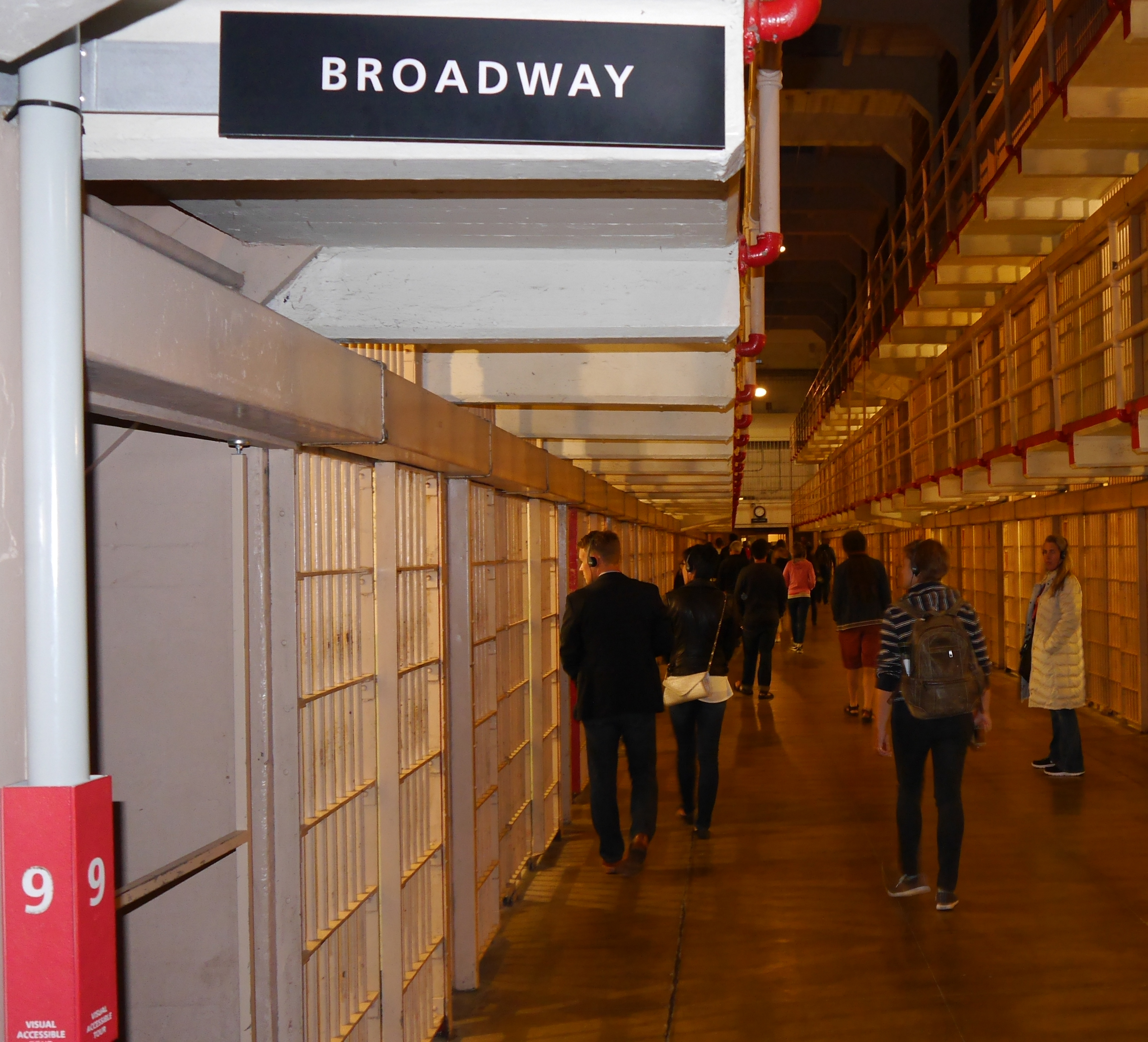
Just like every other big town in America, Alcatraz has its own Broadway. The corridor you see, is as broad as it gets.
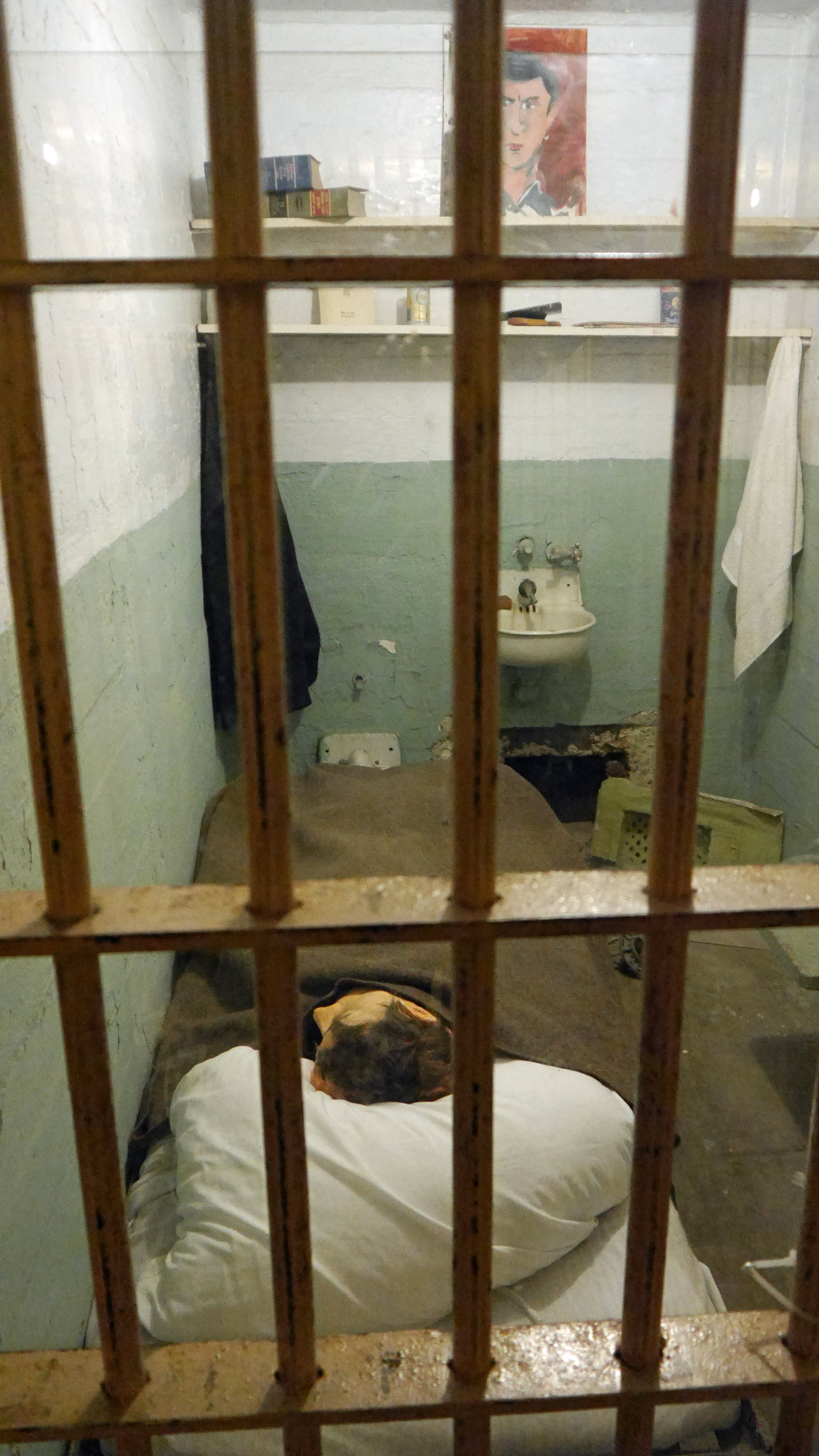
The prison has recreations of prison break attempts like this cell with a dummy head in the bed and a loose floor grille. Strangely, the portrait on the wall reminded me of the Go-Betweens’ Robert Forster.
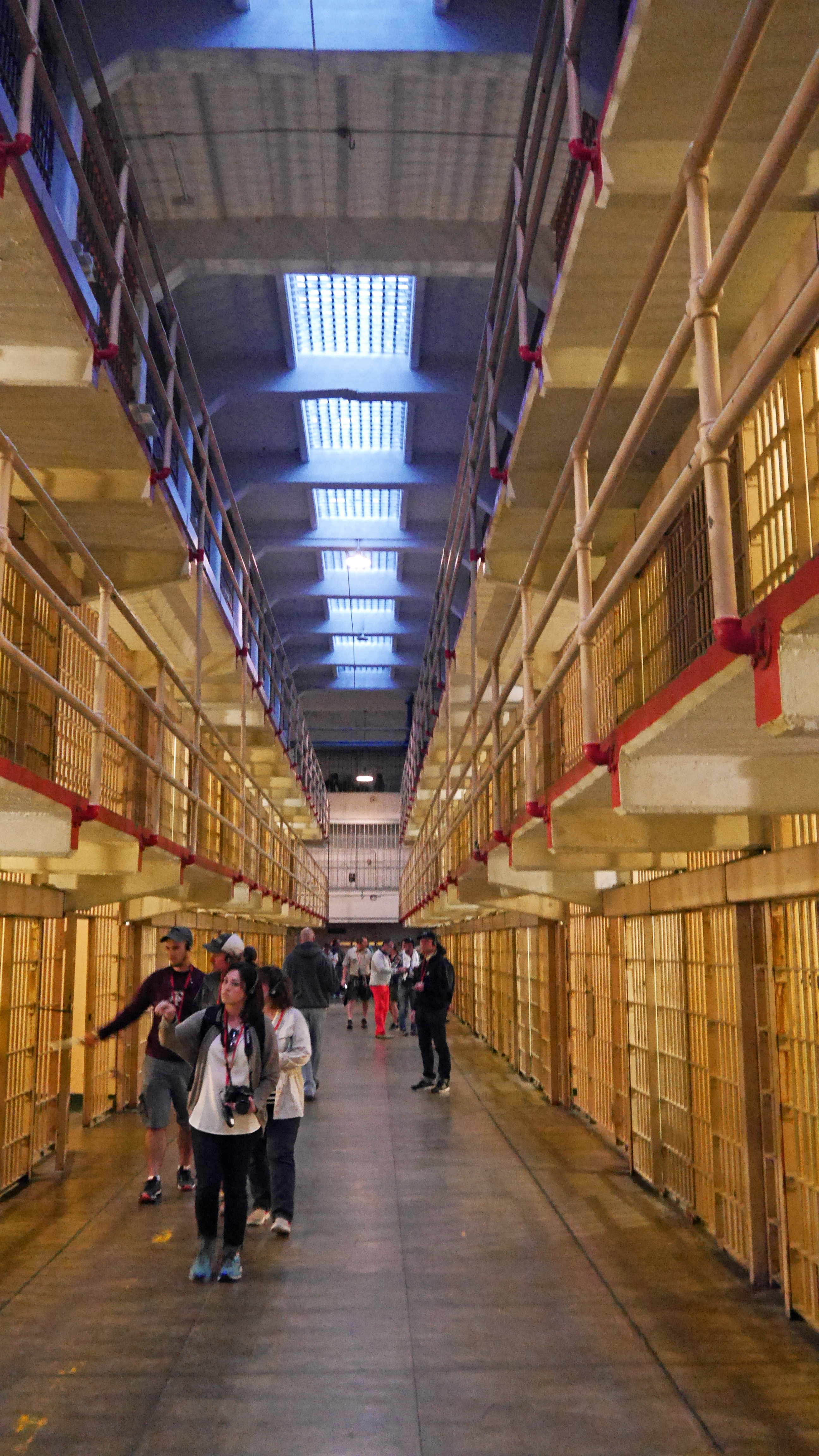
Another shot of Broadway.

The guard station. The levers in the front opened the doors in the maximum security cells which didn’t have locks that could be picked or keys that could be copied or stolen.
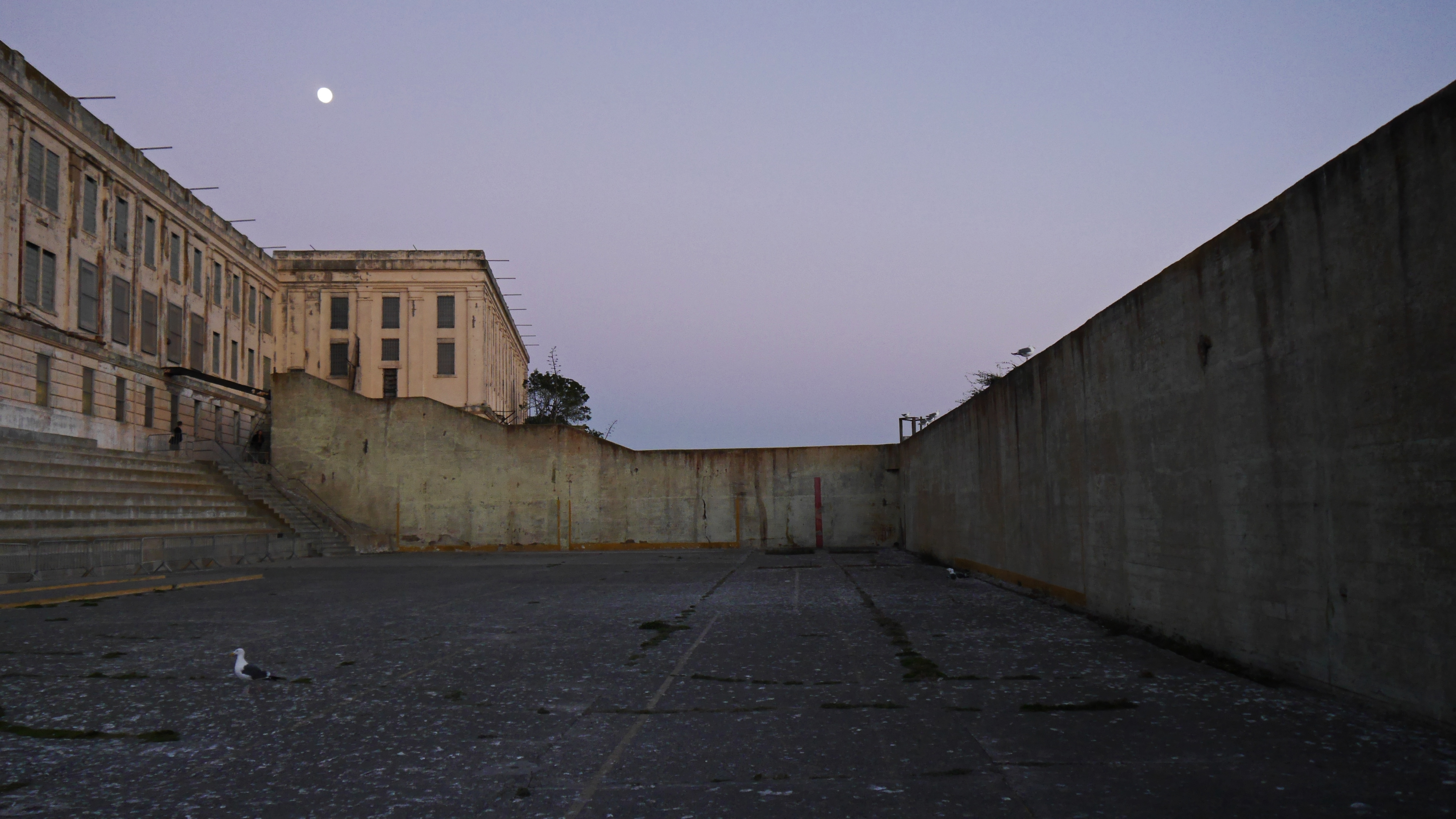
The prison exercise yard. And if you think that solitary seagull is quiet, check the next video clip.

We had a lovely view of the Golden Gate Bridge as the sun went down.
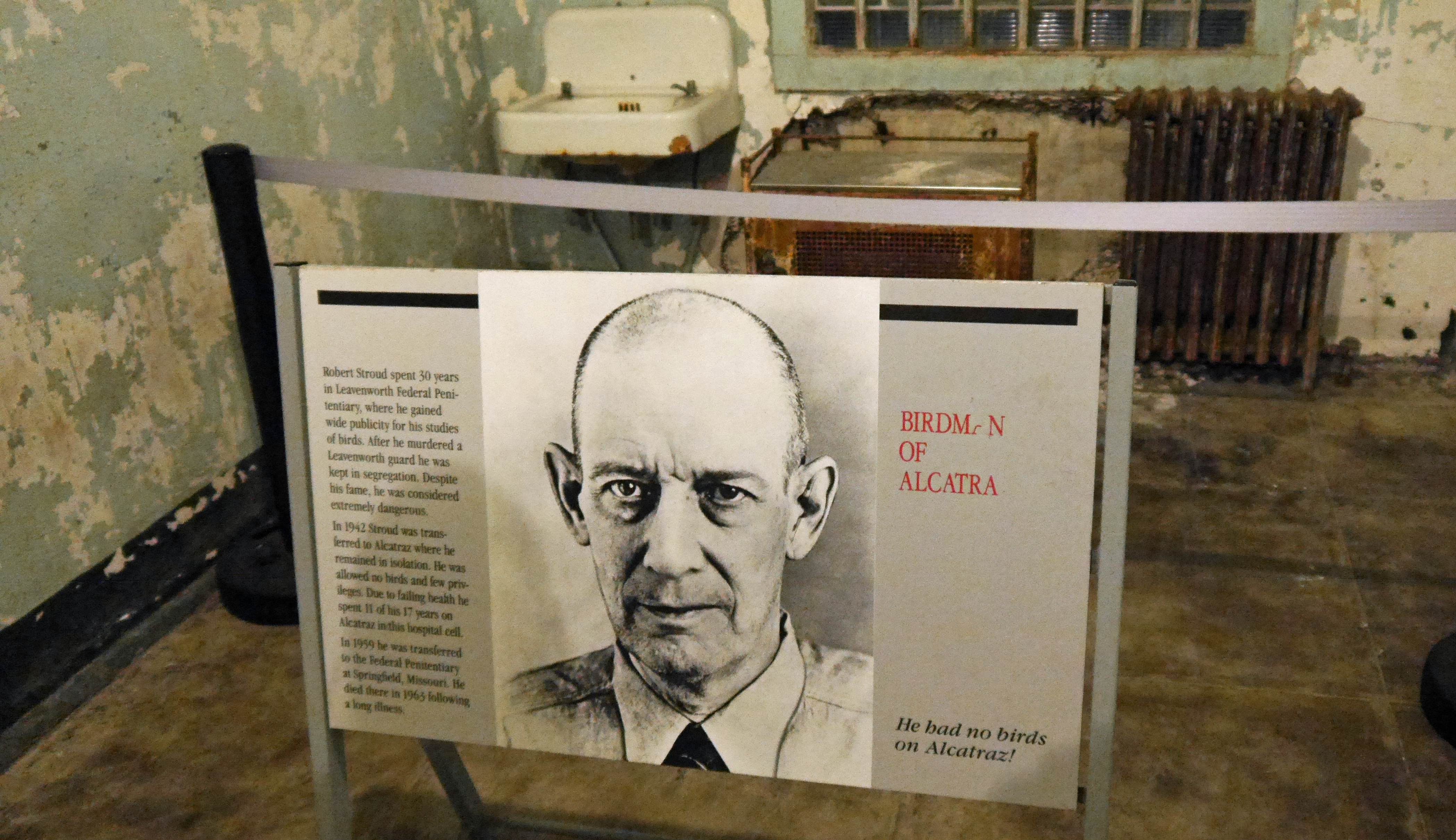
Robert Stroud’s cell in the infirmary. Stroud was a pimp who violently killed a man who hit one of his prostitutes. In prison, he was often involved in fights and ended up killing a guard and was sent to solitary confinement in Leavenworth Prison. It was in Leavenworth that he took an interest in birds after nursing three injured sparrows back to health after they had fallen out of their nest near the prison exercise yard. Stroud was encouraged by the Warden to study birds and ended up writing an influential book called Diseases of Canaries which was published in 1933. Those in the avian pathology profession were impressed and convinced the prison to give Stroud suitable equipment for conducting further scientific experiments on birds. The trouble is that Stroud used the equipment to distill alcohol. He also continued to display psychotic behavior (he was diagnosed a psychopath with an IQ of 134) and was becoming a high-maintenance prisoner with his 300 birds that he had in cages in the prison. So, in 1942 he was transferred to Alcatraz where he had no birds, no equipment and no support from the Warden. He was given ten minutes notice of his departure. At Alcatraz he became quite ill and spent his last years in a cell within the infirmary. Here he wrote a damning history of the US Penal System which the Warden refused to be released when he read it. Despite public calls for the manuscript to be released, it remains unpublished.
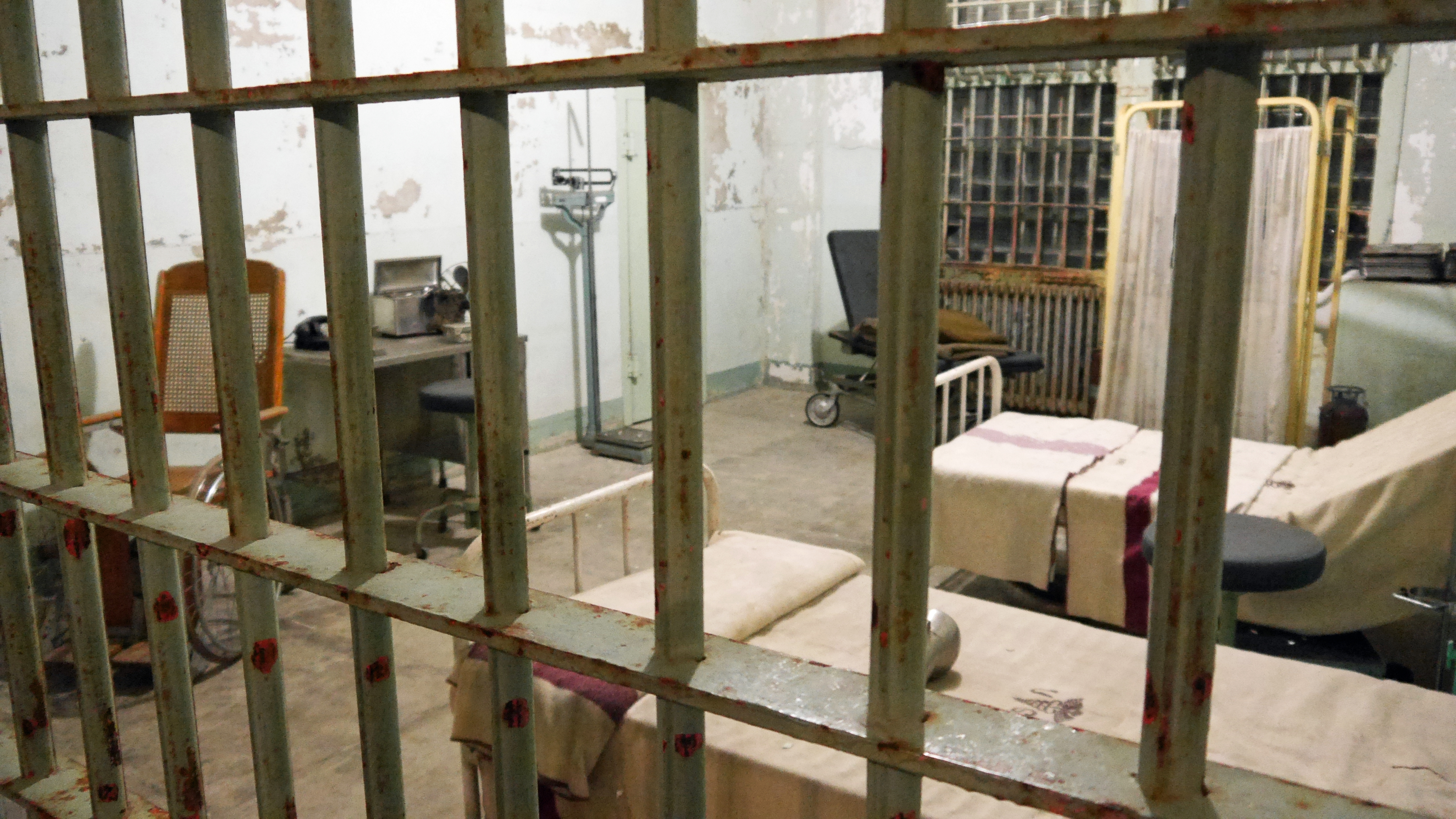
The prison infirmary.
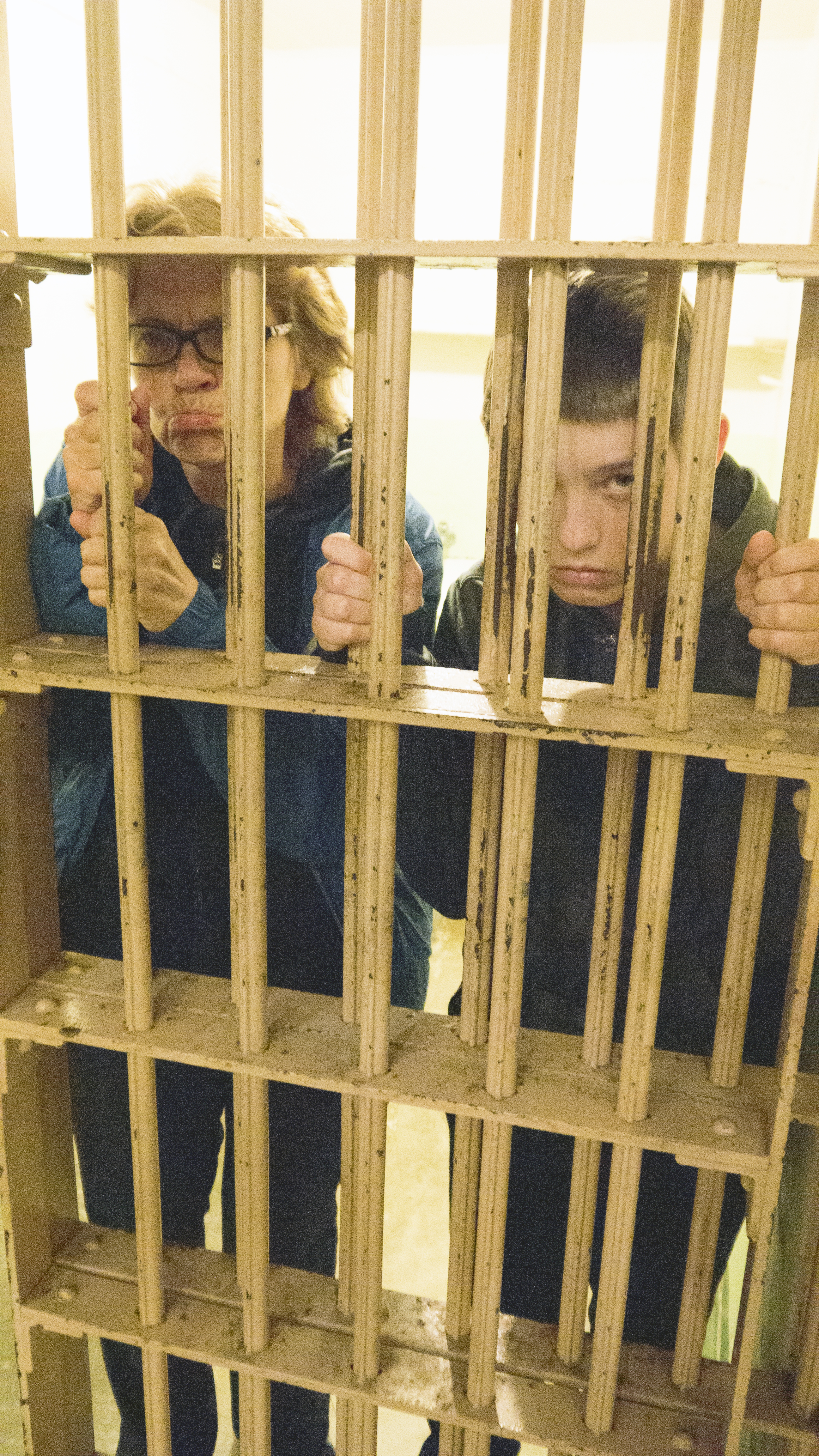
A couple of sorry lags.

The Lyneham Lyncher himself; safely behind bars in Alcatraz.

Harry “The Hacksaw” awaits his release at the Alcatraz docks.
Pepper Palace
Throughout our travels across America, I was often amused at America’s love of hot sauces and the competitive escalation of extreme hot sauce names. When we went to restaurants, it was not out of the ordinary to see someone pound their fist on the bottom of a hot sauce bottle to smother its contents on their meal. A little bit of that stuff goes a long way, so I can’t imagine what a lot of that stuff does.
Along the way, I had been taking pictures of funny hot sauce bottles on my phone. But it wasn’t until we reached San Francisco that we found hot sauce heaven (or should that be hell) – Pepper Palace is a chain of stores devoted entirely to hot sauces. The store had hundreds of bottles of hot sauces as well as free tastings. Of course, this still isn’t extreme enough for some people. So, I wasn’t surprised to find that Pepper Palace also host a hot-sauce eating challenge where people compete to win the record for the most extreme hot sauce eater. However, before you can enter, you need to sign an indemnity form that among other things notes:
“We at The Pepper Palace sincerely wish you the best but please remember that this is meant to be a fun and novel way to show your friends how foolish you can be. Be careful, stop when your body says stop. Winning is not worth the potential harm that can come from eating such fiery foods. A final note; if you feel you are going to be sick; we suggest out of the room in the garbage can. Please don’t start a chain reaction.”

Pepper Palace, San Francisco (taken from their web site)

A Pepper Palace advertisement.

Another hilarious hot sauce advertisement. The small print at the bottom warns “Use this sauce in moderation. Unless of course you’re testing the response time of local paramedics.”
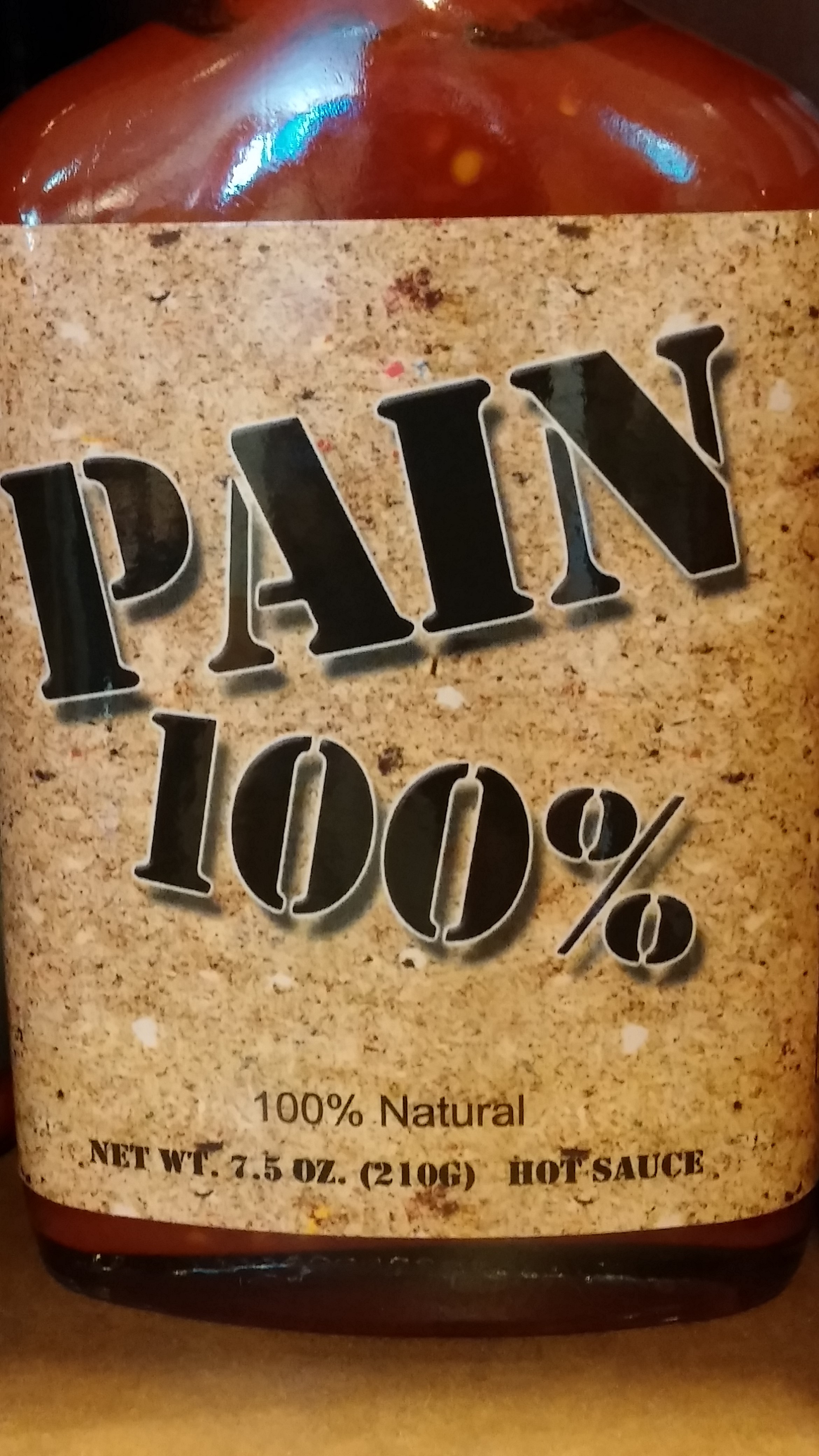
Pain 100%. Truth in advertising right there.

Dr Assburn’s Pepper Sauce. Of course, Dr Assburn is renowned specialist in proctology circles.
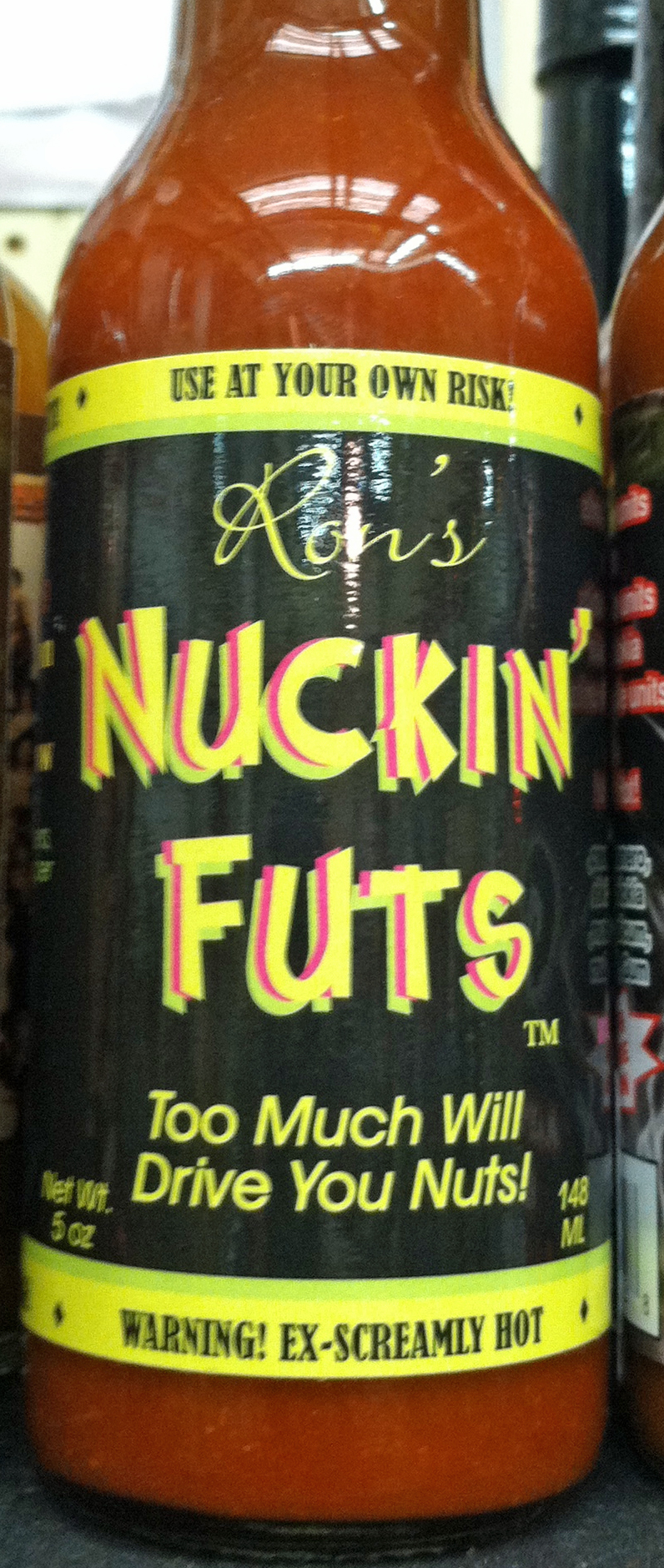
Ron’s Nuckin Futs.

Professor Payne Indeass’s XX Hot Sauce. I’m sure Professor Payne Indeass must share notes with Dr Assburn on rectal matters.

Blair’s Original Death Sauce. For those who like to suffer death with their meal.
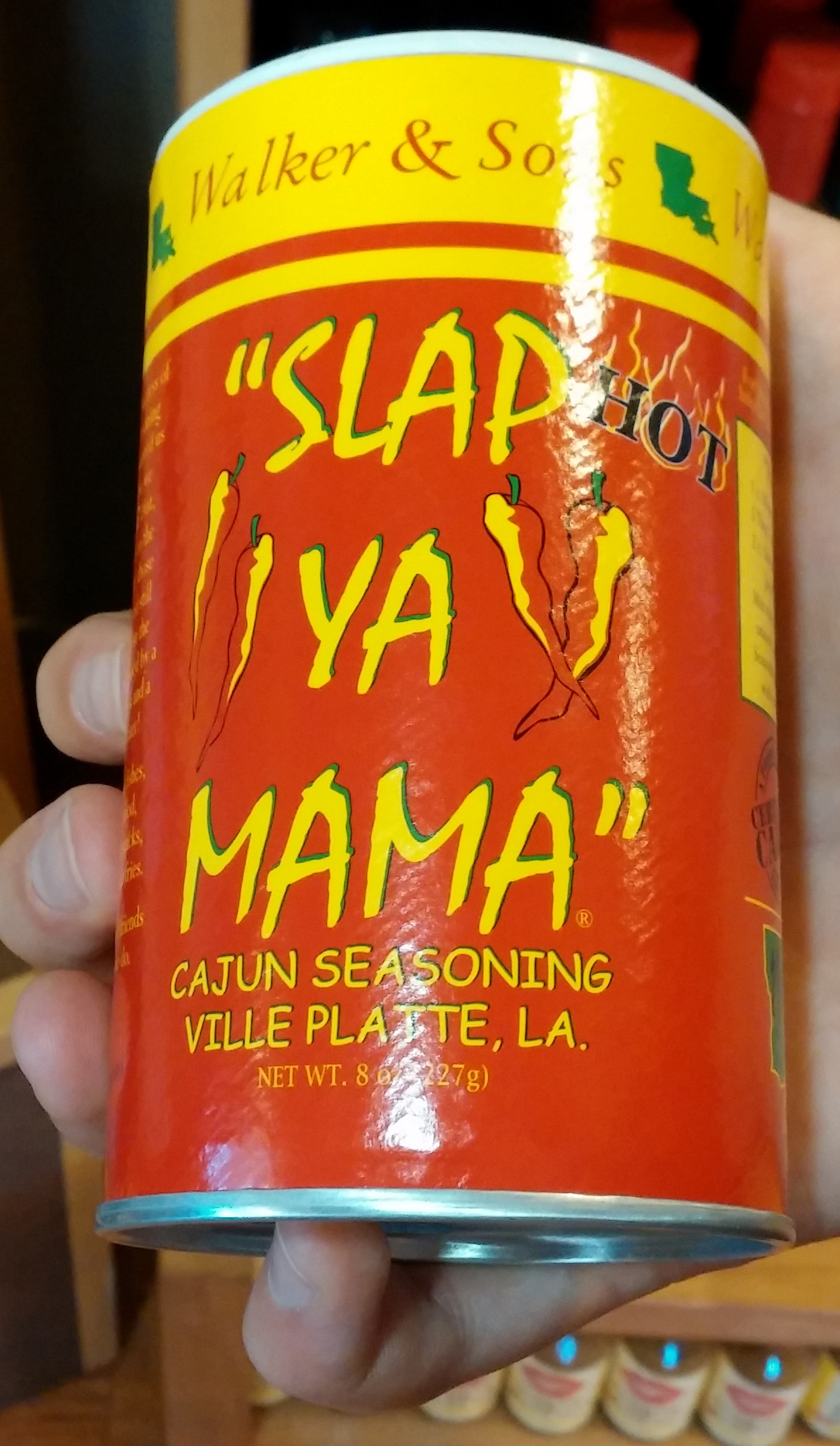
Slap Ya Mama Seasoning.

Queen of Farts Hot Sauce. By appointment to Her Majesty, Queen Elizafart A Second.

Neal’s Hairy Ass Hot Sauce. Sometimes these sauces drilled down to quite specific physical outcomes. According to Neal “You’ll wake up with an ass as smooth as a baby’s behind.”
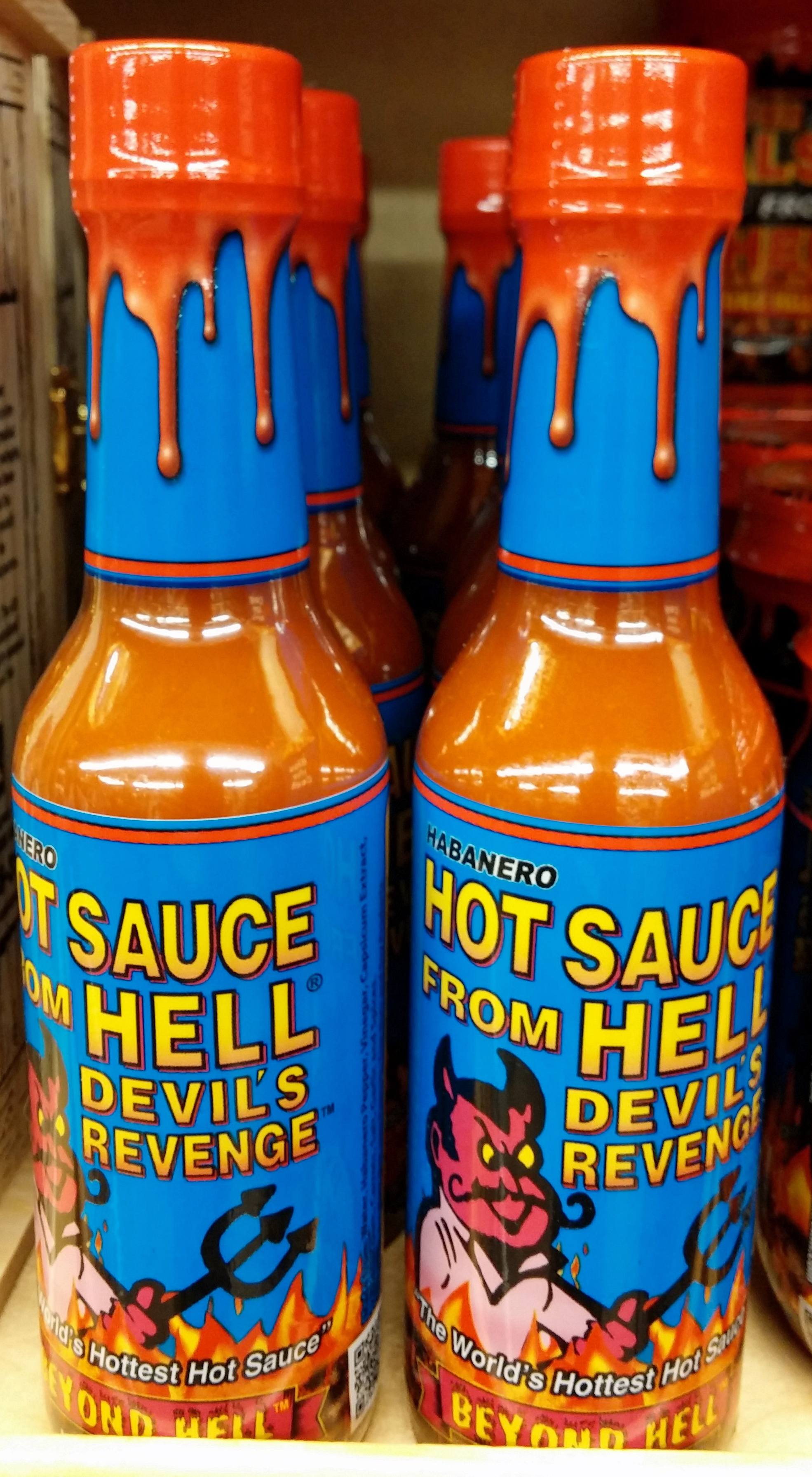
Hot Sauce From Hell – Devil’s Revenge. They later clarify at the bottom of the bottle that it is actually “Beyond Hell”
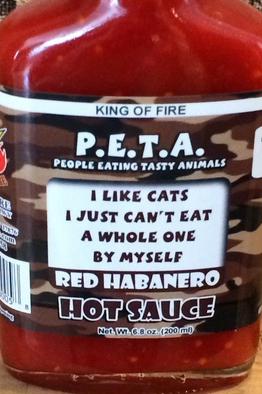
PETA Hot Sauce. PETA of course standing for People Eating Tasty Animals.

Professor Phardtpounder’s Colon Cleaner. Not sure if this treatment can be claimed on Medicare.
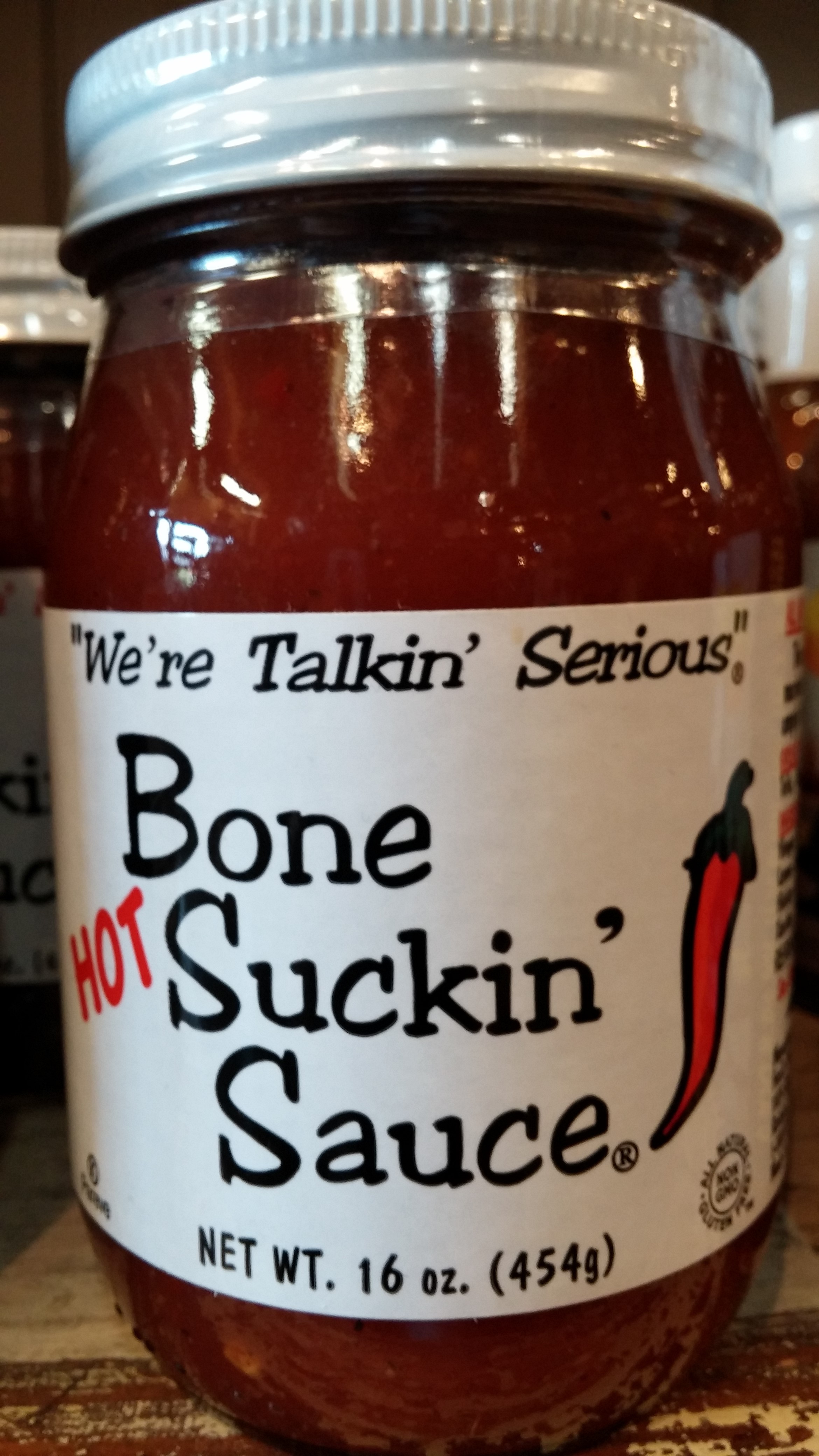
Bone Suckin’ Sauce.

Pappy’s Not Made In China Sauce. Not a hot sauce in its condiments but nevertheless inflammatory in its sentiments.
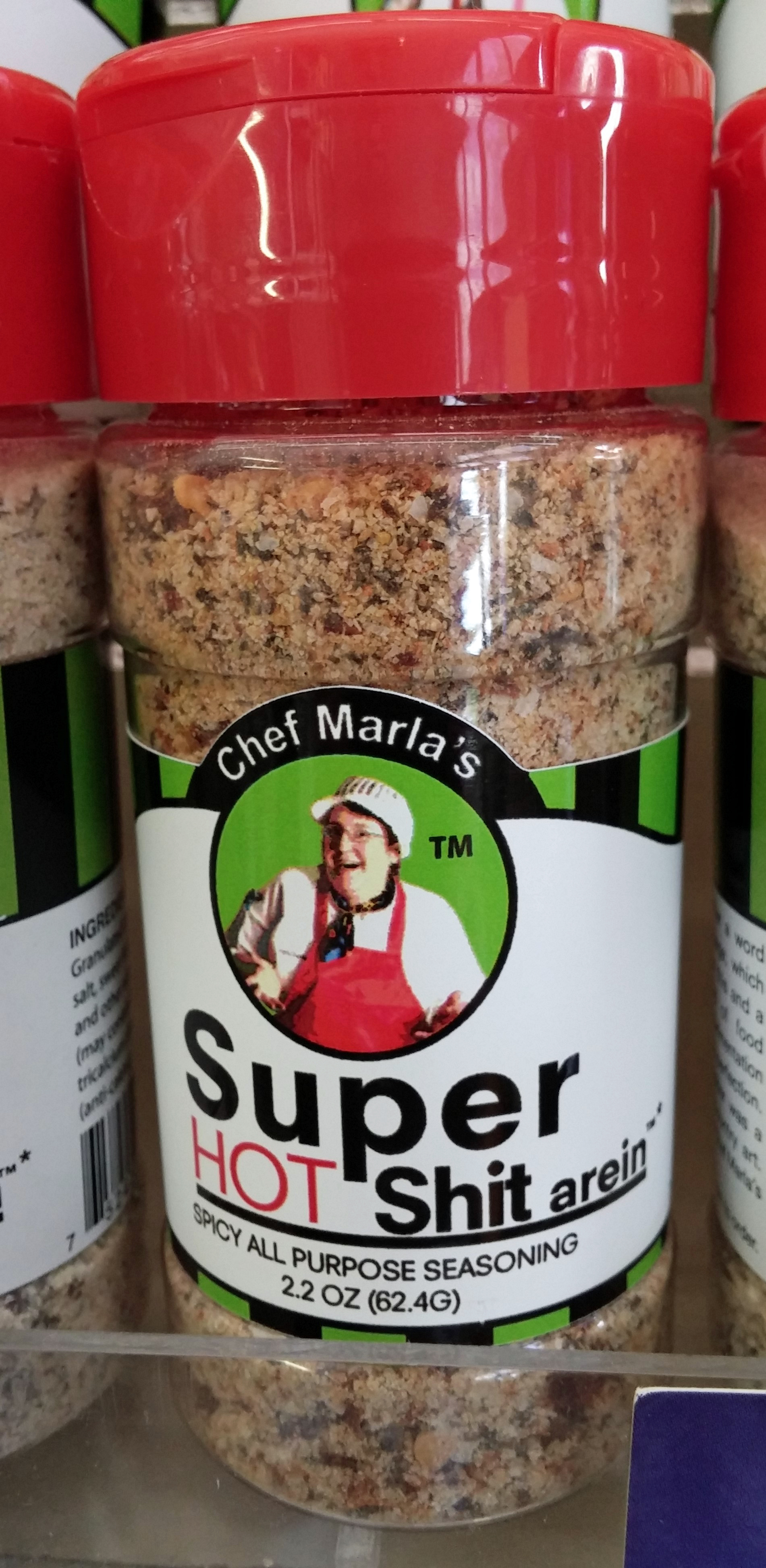
Super Hot Shit. It is what it is.

Satan’s Blood. “Bless us, oh Lord and these your gifts which we are about to receive… Now pass the Satan’s Blood please dear.”

Assplosion Hot Sauce.

Last Will & Testament Finishing Sauce. I wonder if they get many repeat customers?
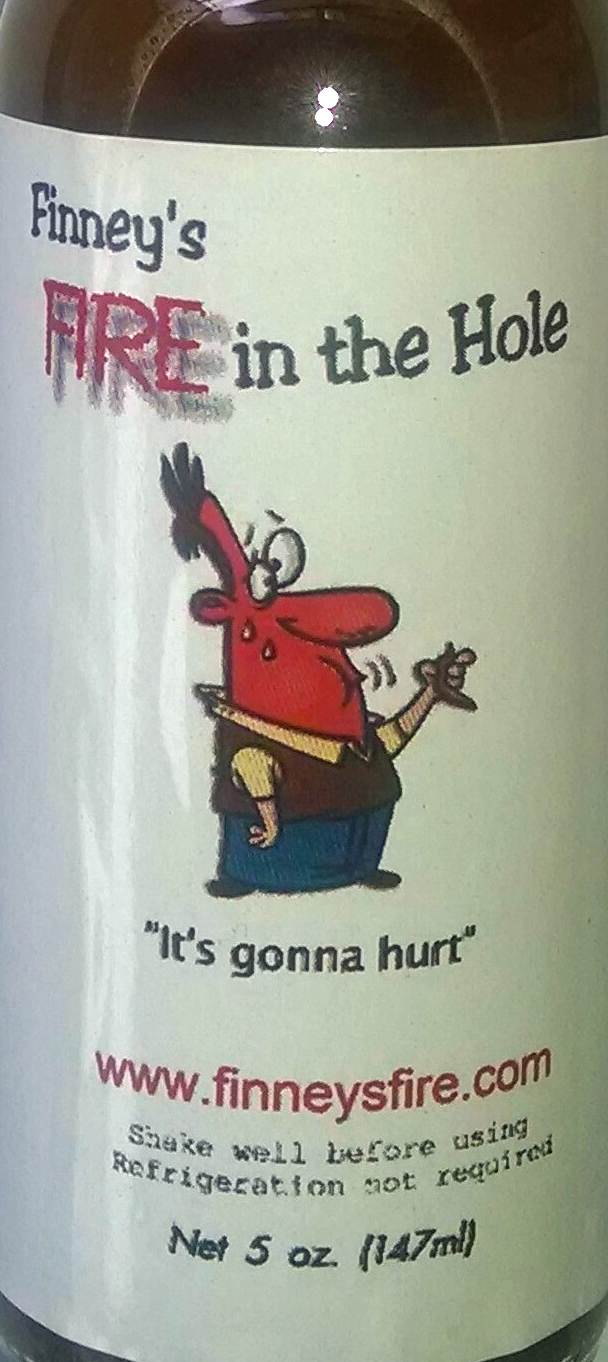
Finney’s Fire In The Hole Hot Sauce.

See Spot In Heat, See Jane On Fire and See Dick Burn. I loved these riffs on the old kid’s readers. They also manage to pack an underlying sexual connotation as well.
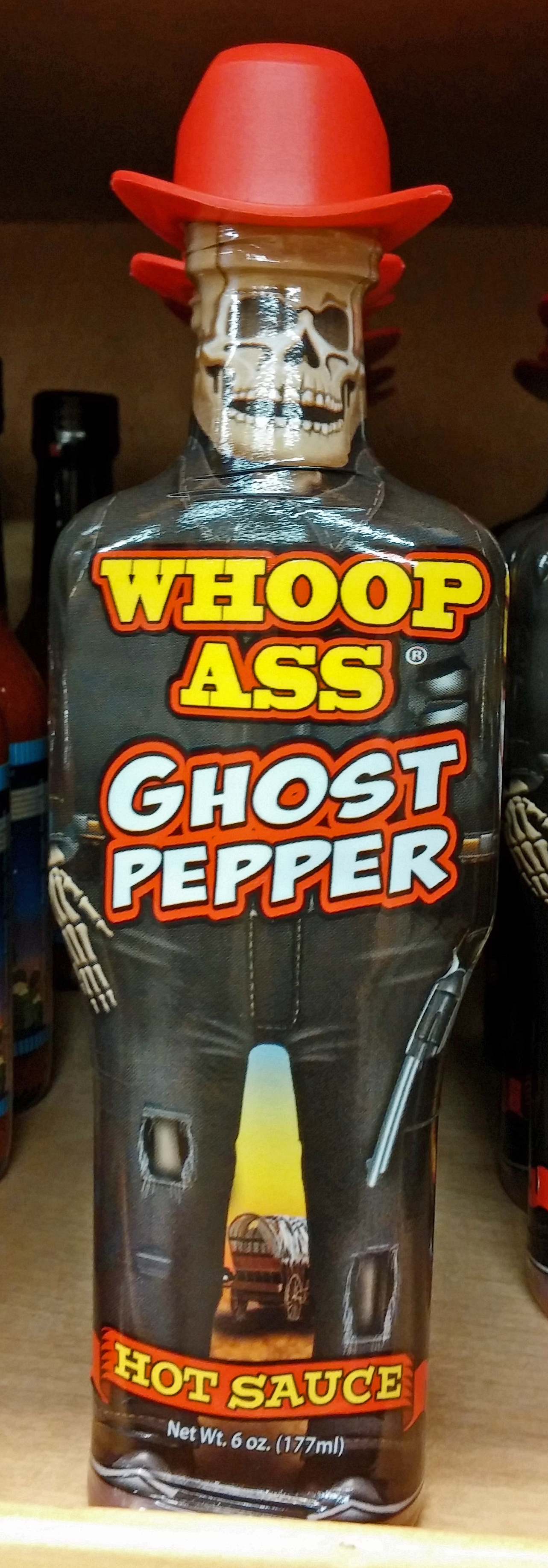
Whoop Ass Ghost Pepper Hot Sauce.
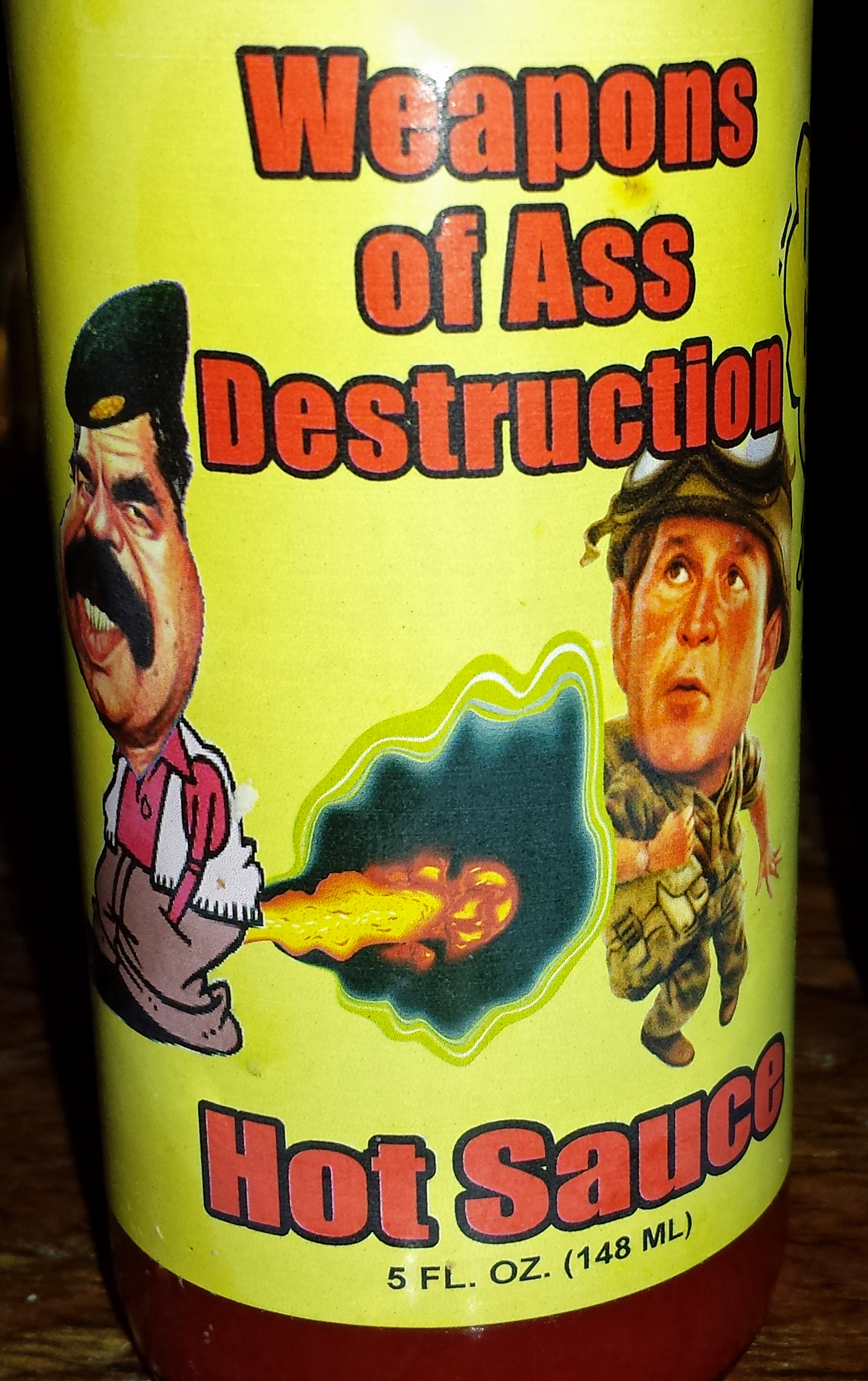
Weapons of Ass Destruction Hot Sauce. This one was a bit dated but nevertheless hilarious.
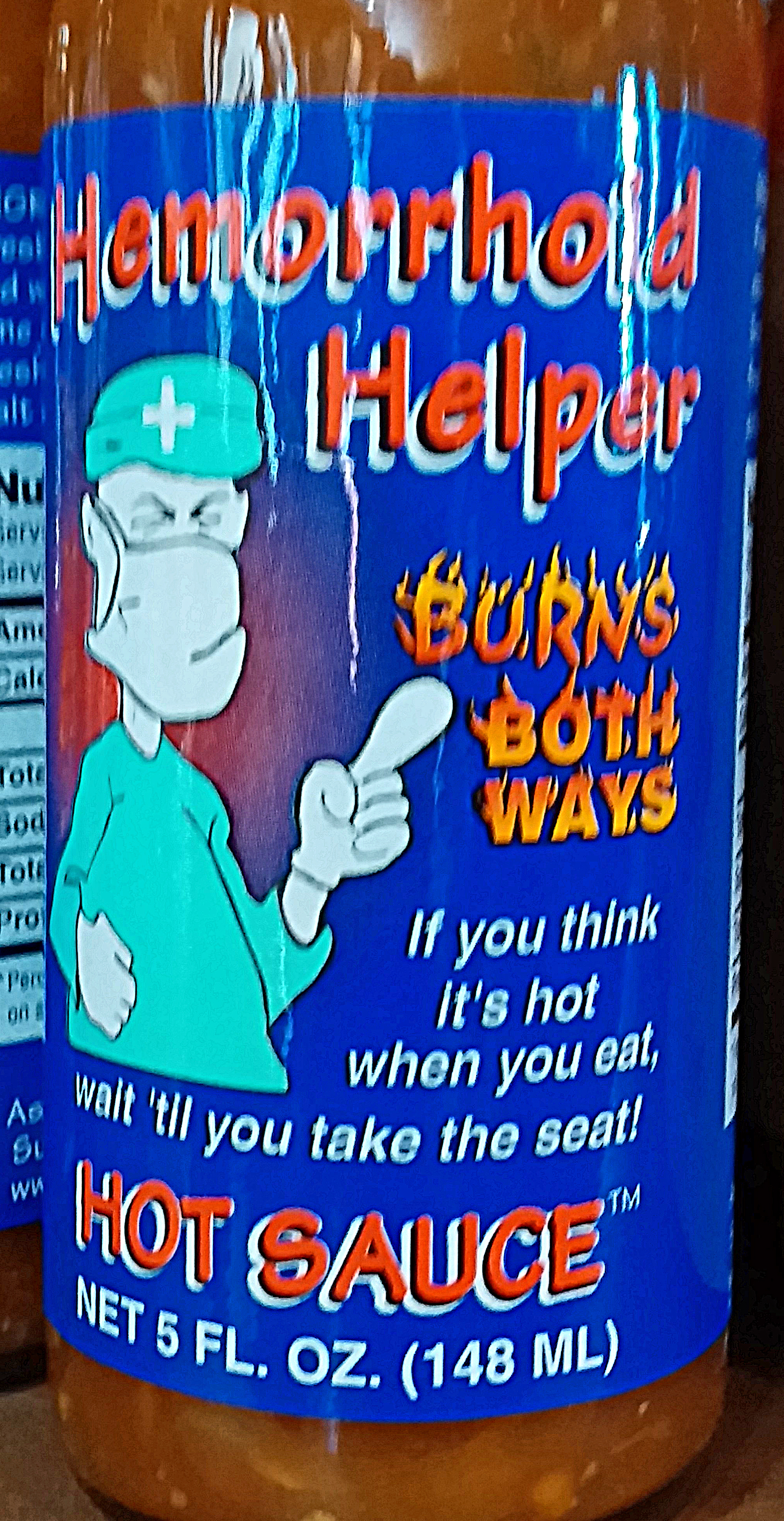
Hemorrhoid Helper Hot Sauce. If pain persists consult a medical expert. Like the guy on the bottle.

Spontaneous Combustion Hot Sauce. At least the pain doesn’t last for long.
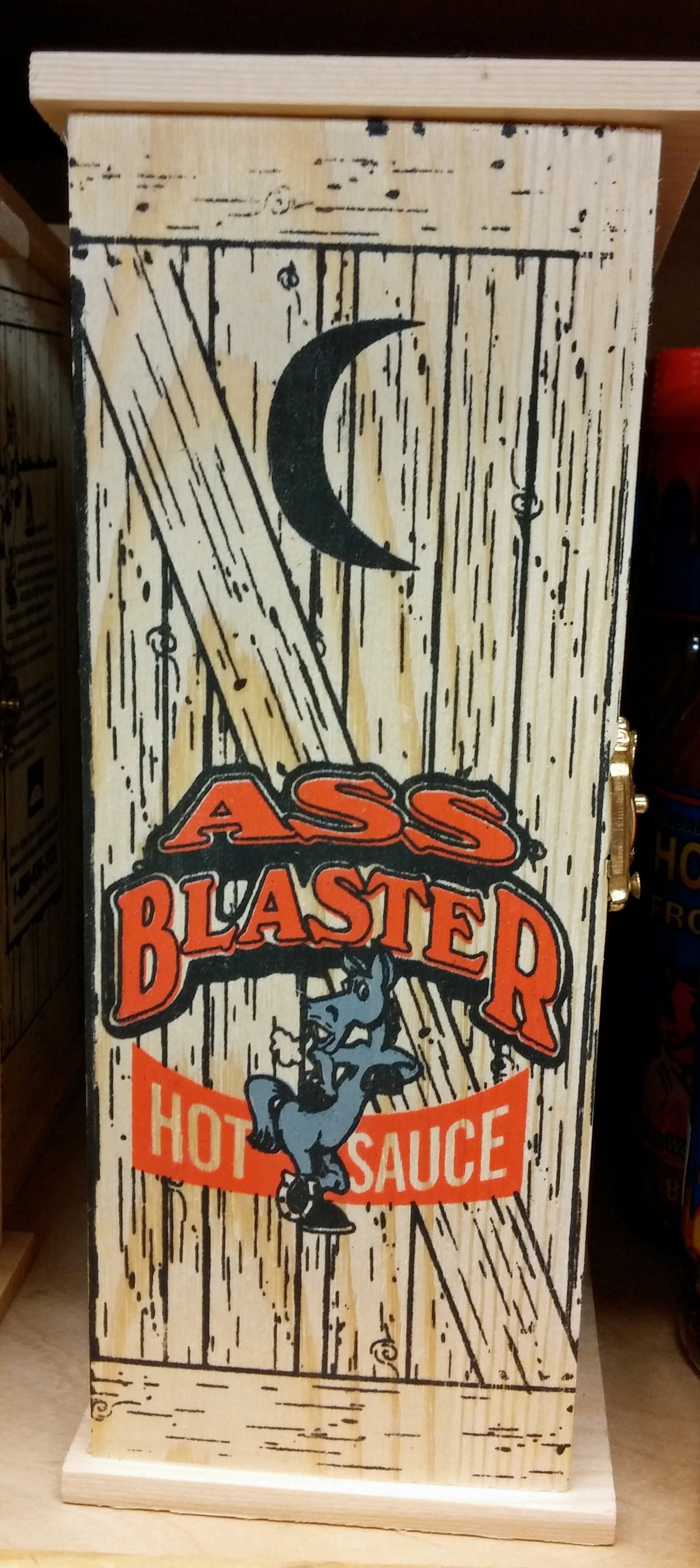
Ass Blaster Hot Sauce. With the special outhouse packaging.
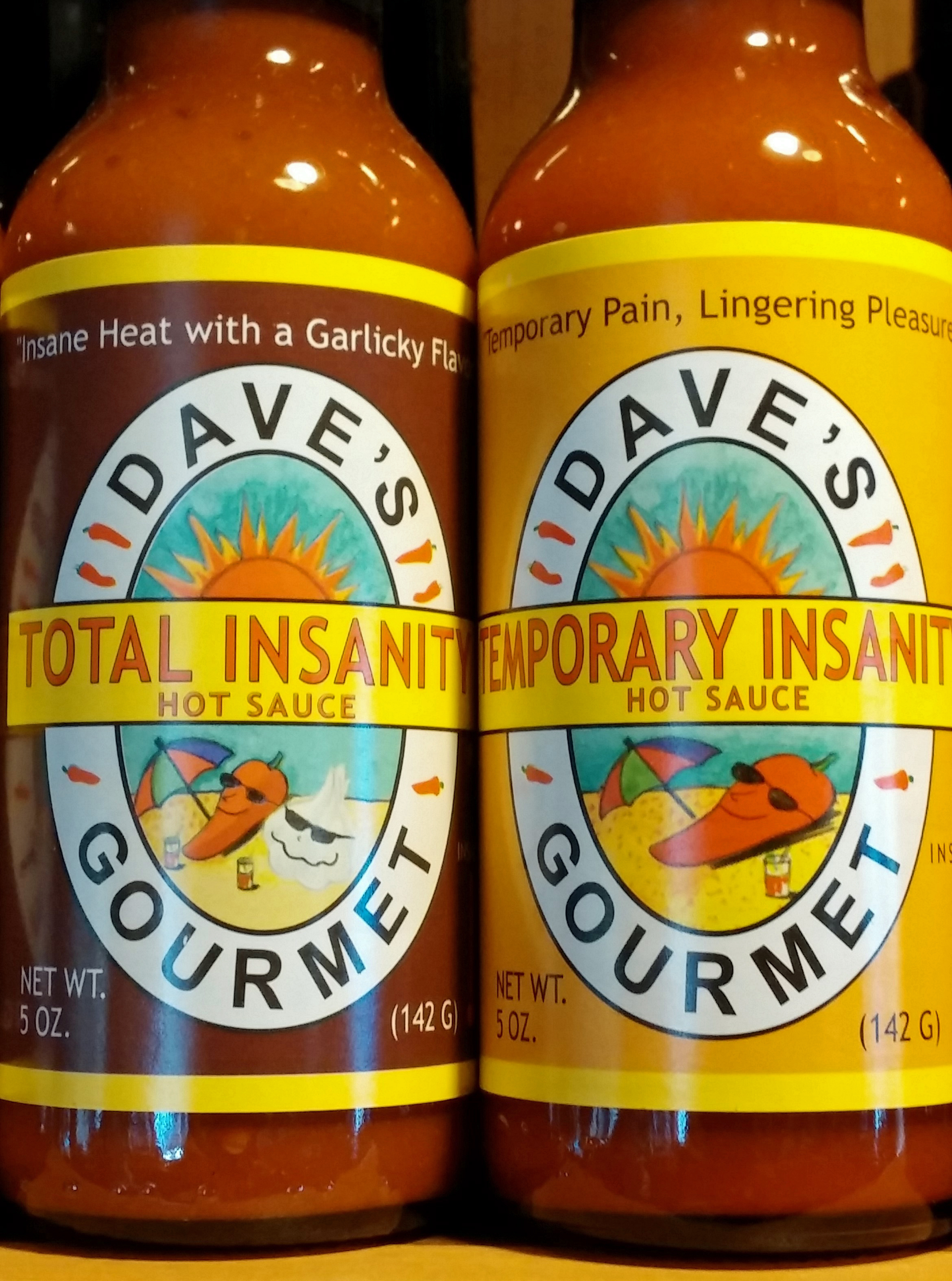
Dave’s Total Insanity and Dave’s Temporary Insanity Hot Sauces. Would sir like to go insane on a permanent basis or just for this evening?
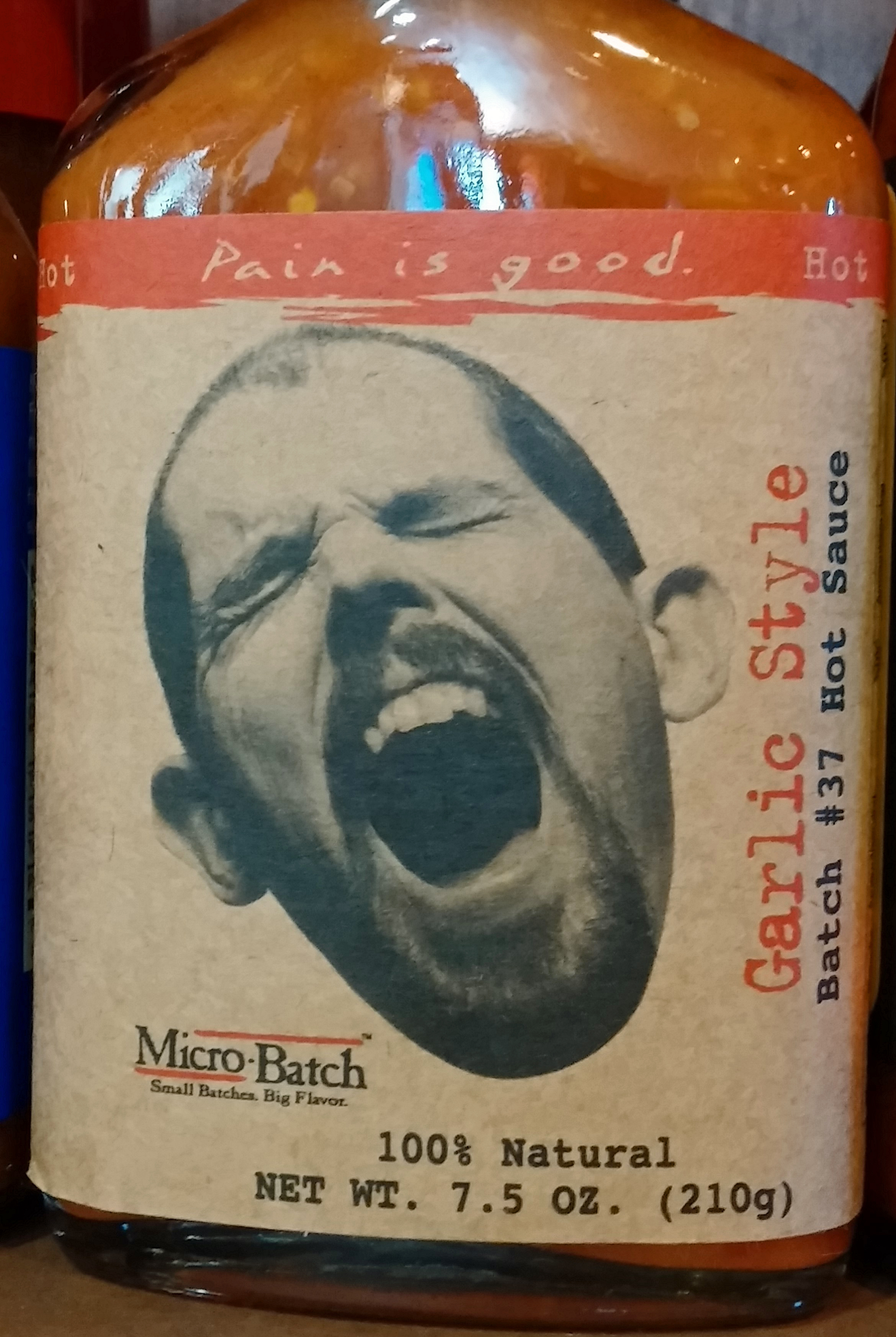
Pain Is Good Hot Sauce.

Red Rectum Revenge Hot Sauce. Possibly the most graphic illustration on any hot sauce bottle we saw.
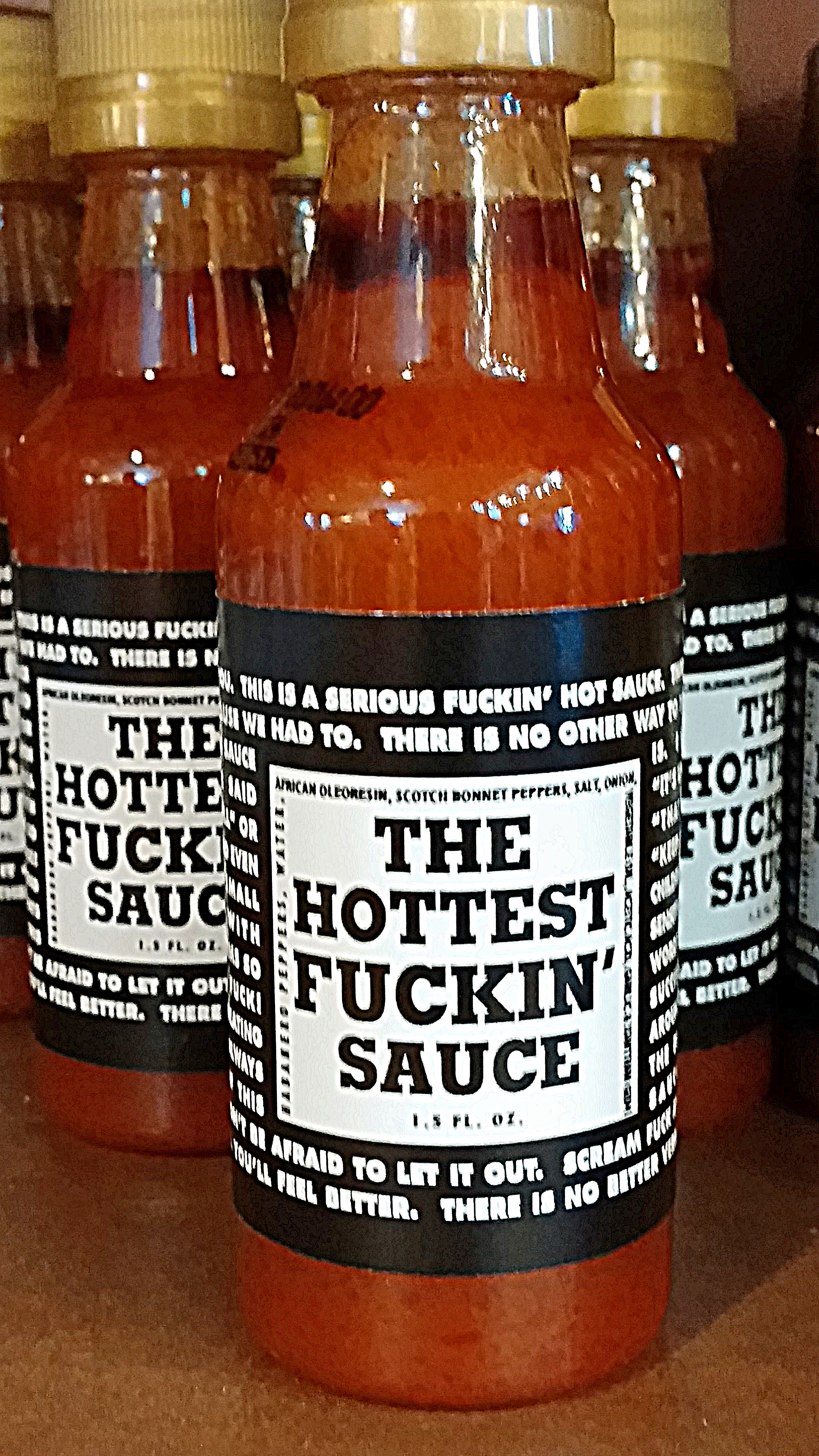
The Hottest Fuckin’ Sauce. Is this the last word in boasting rights?

Pappy’s Sauce For Sissies. For those who can’t handle the hot sauces.
The Streets of San Francisco
Yes, we actually walked them like the TV Show but didn’t see Michael Douglas unfortunately.
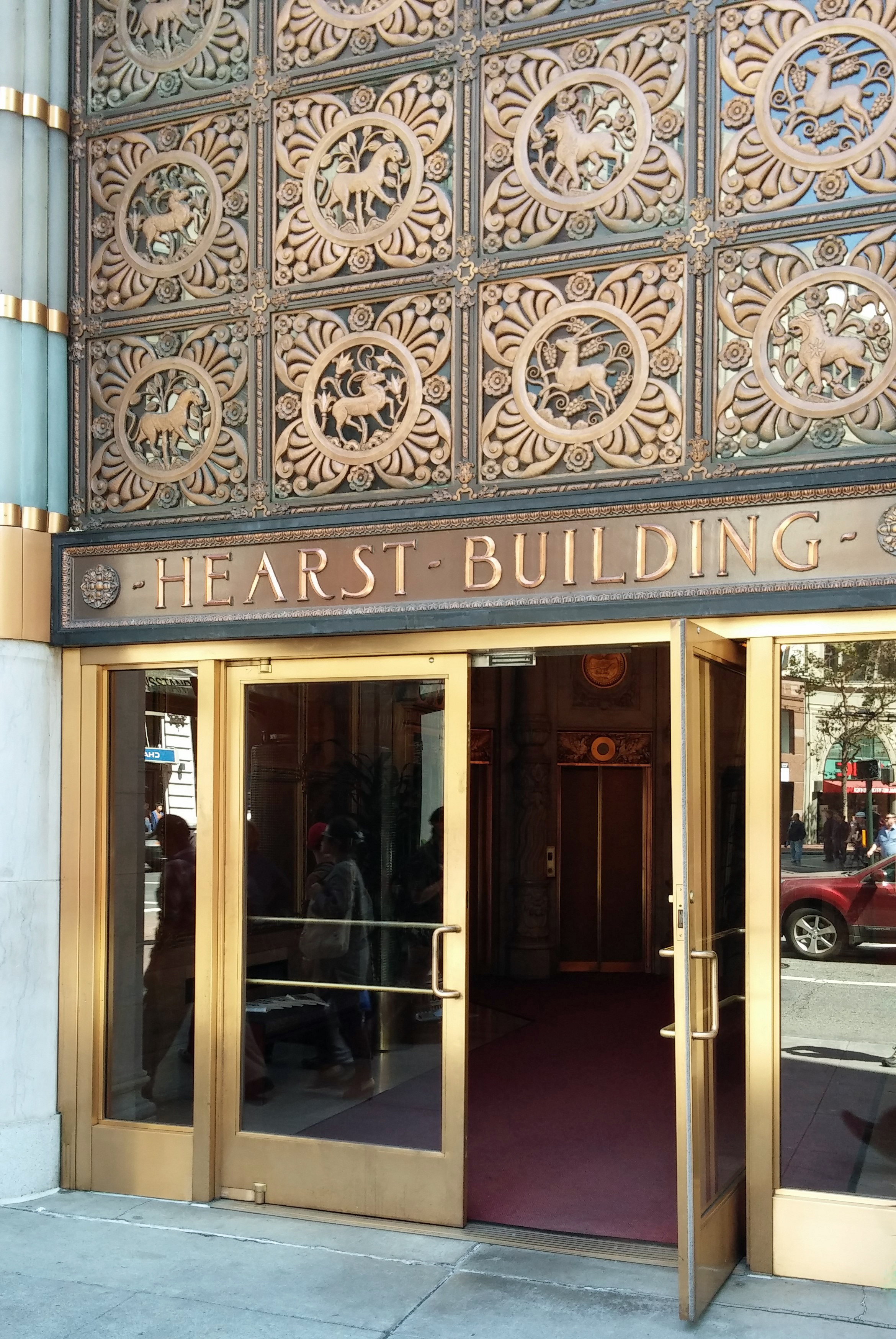
The original Hearst Building where Charles Foster Kane, sorry William Randolph Hearst, began his publication empire in 1887 by taking over the reigns of his father’s newspaper, The San Francisco Examiner.

We were really looking forward to visiting the Cartoon Art Museum and set aside half a day to tour it. It took us less than an hour as it is very, very small. Still, it did have a lot of interesting stuff from the golden age of cartoon newspaper strips.

We really liked the U.S. traffic light system with its prominent countdown of how many seconds before the light changes.
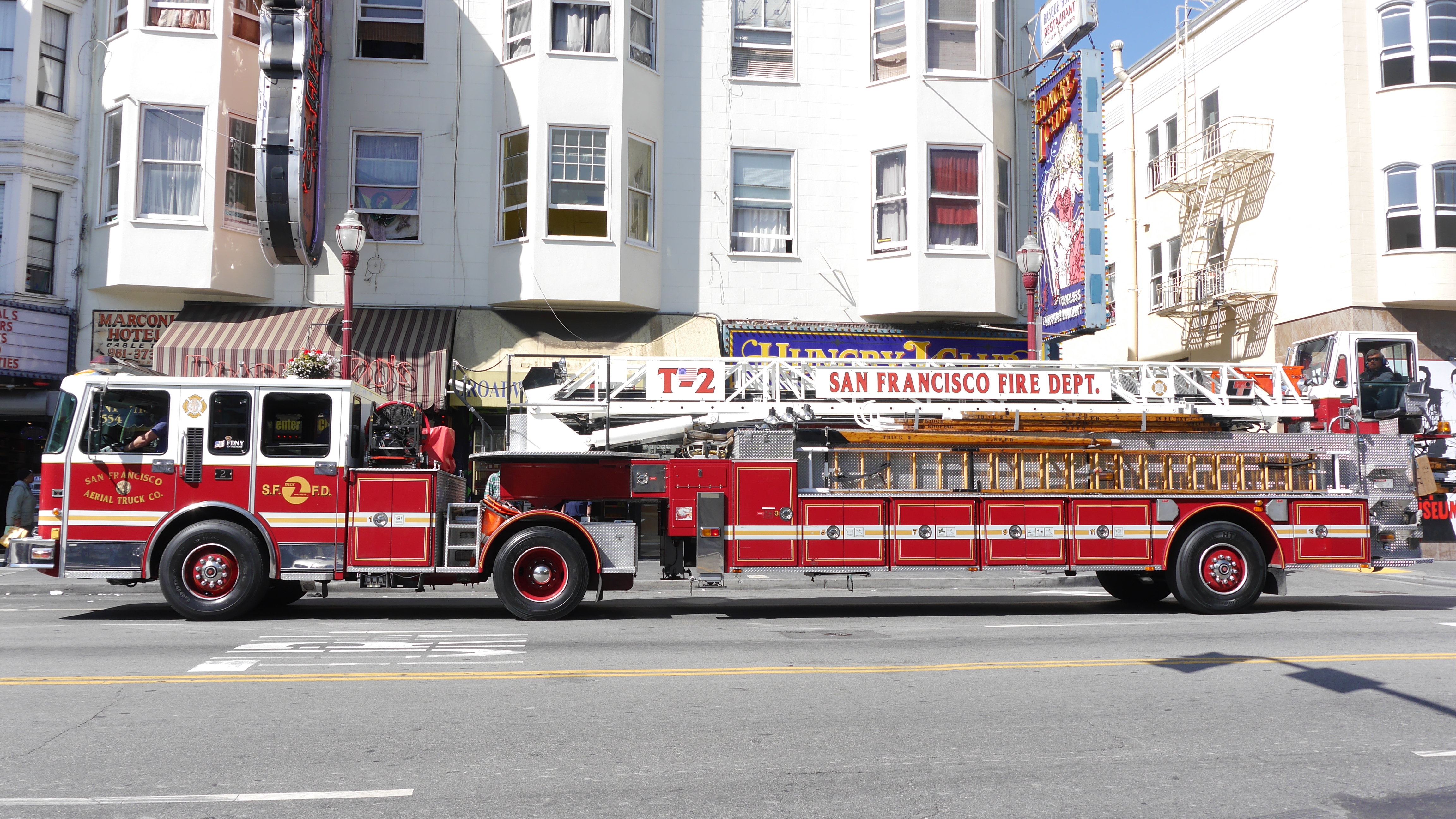
This was the longest fire engine I had ever seen.
The Golden Gate Bridge
On a beautiful sunny Sunday, Harrie and I decided to hire bikes and ride from Fisherman’s Wharf to the Golden Gate Bridge. Unfortunately, Michelle was still suffering back pain from her breakdancing injury in New York and decided to rest up for the day.
The San Francisco bike tracks were bit like Sydney bike tracks where one minute you are cycling in with the traffic trying to cling to the shoulder to avoid passing cars and the next minute you are on a dedicated path off from the main road and able to relax and take in the views. It was on those later stretches, that we really enjoyed ourselves; taking in the magnificent vistas across the bay and seeing what San Franciscans get up to on their weekends.
The Golden Gate Bridge was just as impressive up close as it was from a distance. It is said to be the most photographed bridge in the world and when it was built it was also the largest suspension bridge in the world. What was most striking about the bridge to me was its bright orange paintwork. We visited a museum just prior to crossing the bridge and found the colour is specifically “International Orange” and it is a colour mainly used in the airplane industry to warn people from a distance (you commonly see it on airport runways). NASA also use the colour for their astronaut space suits. International Orange was used on the Golden Gate Bridge as a warning sign to ships or airplanes who may not see it in the fogs that often shroud it on chilly mornings. Of course, when there are no fogs, it is strikingly visible from wherever you are in San Francisco.
We rode across the bridge and continued to the small town of Sausalito in Marin County. Sausalito was a very upmarket sort of place with lots of restaurants and coffee shops full of rich-looking people. Out on the water however was a different story as lots of hippie-looking people were taking in the sun on the decks of dilapidated houseboats. It turns out that there is a bit of a turf war going on between the houseboat community (which number over 400 houseboats) and the rich land folk who want them gone. It seems like the rich people are winning as new “approved moorings” are being built away from town and all houseboats have been given notice that they need to move to these new moorings or face legal action. Then at last the Sausalito land folk will have unimpeded views of the bay without the riff-raff.
After riding for half the day, Harrie and I decided to get a ferry from Sausalito back to Fisherman’s Wharf. While we were waiting for the ferry, we noticed an old poster for The Sausalito Humming Toadfish Festival. Intrigued, I later looked it up on Wikipedia and found that the Humming Toadfish, also known in fishing circles as the Plainfin Midshipman, is native to the waters around Sausalito. It is called the Humming Toadfish because it makes loud humming sounds. These are most prevalent during the mating season which is when the Sausalito Humming Toadfish Festival is held. According to Wikipedia, “The sound of the vocalization has been likened to a chorus of kazoos, B-29s flying in formation,an amplifier, a didgeridoo, “a drone of bees or maybe even the chanting of monks,”and “an orchestra full of mournful, rasping oboes.
I was disappointed that we hadn’t been to Sausalito earlier to hear the toadfish in action.
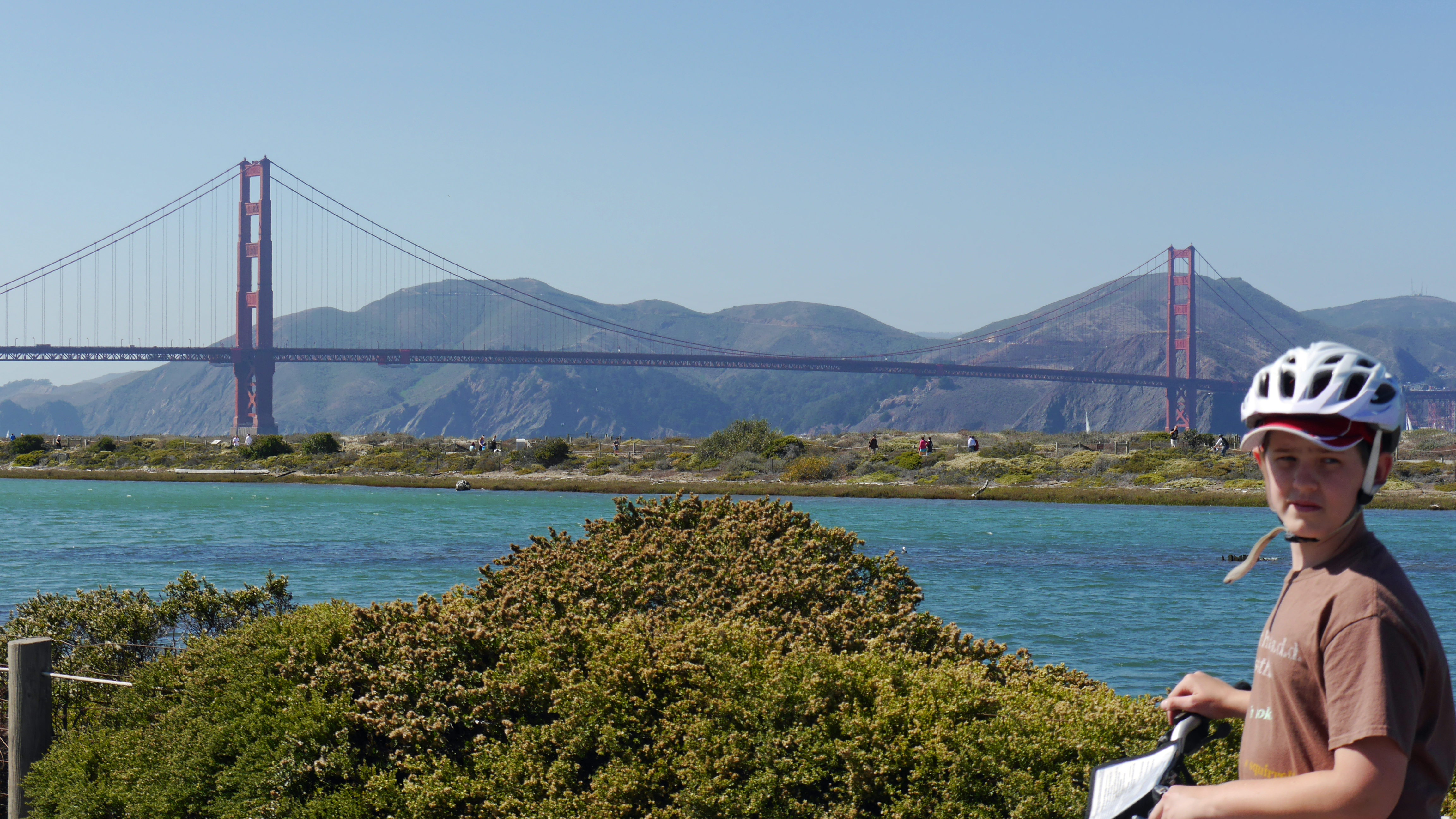
Riding towards the Golden Gate Bridge.
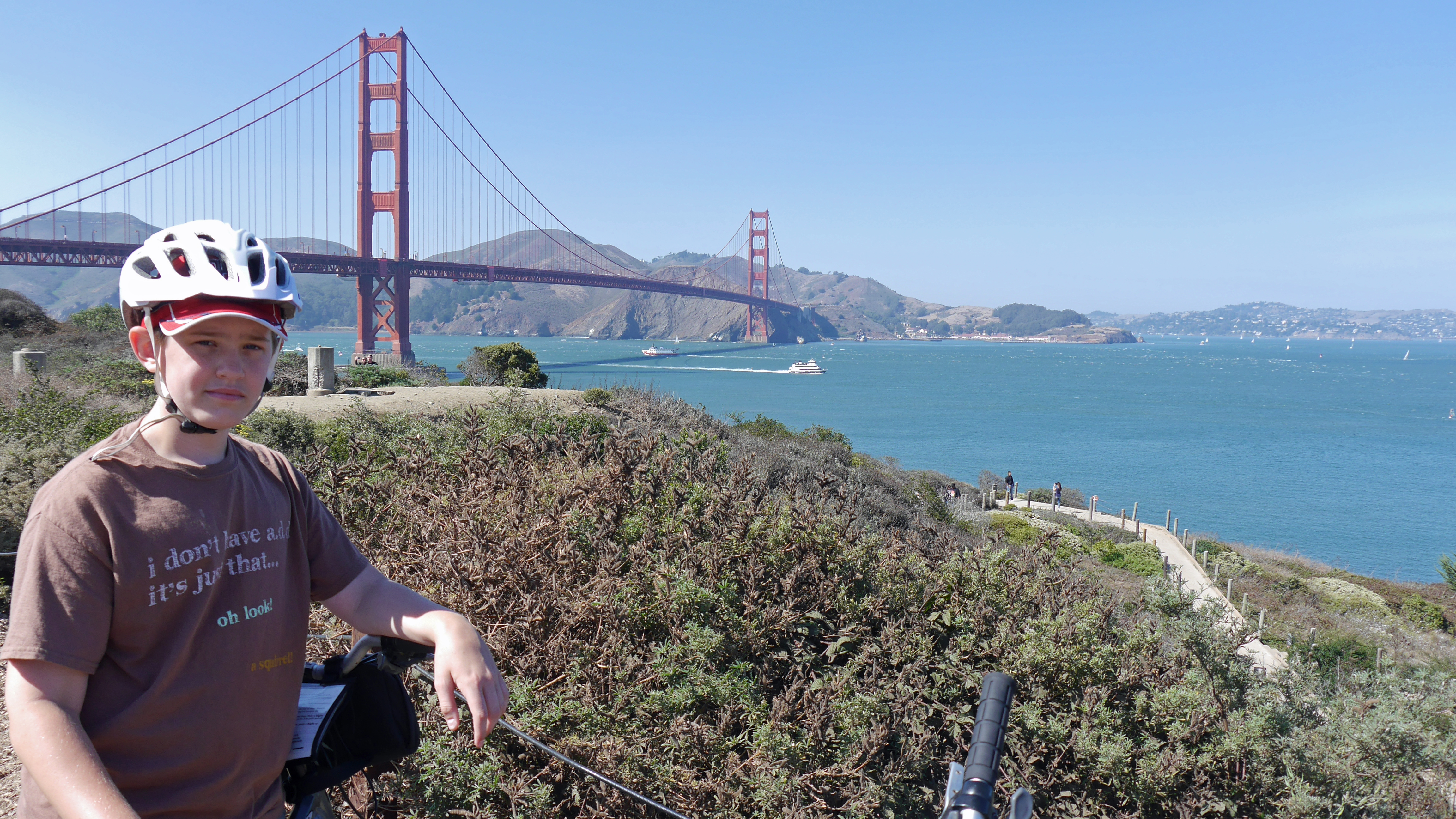
The Golden Child in front of the Golden Gate Bridge.
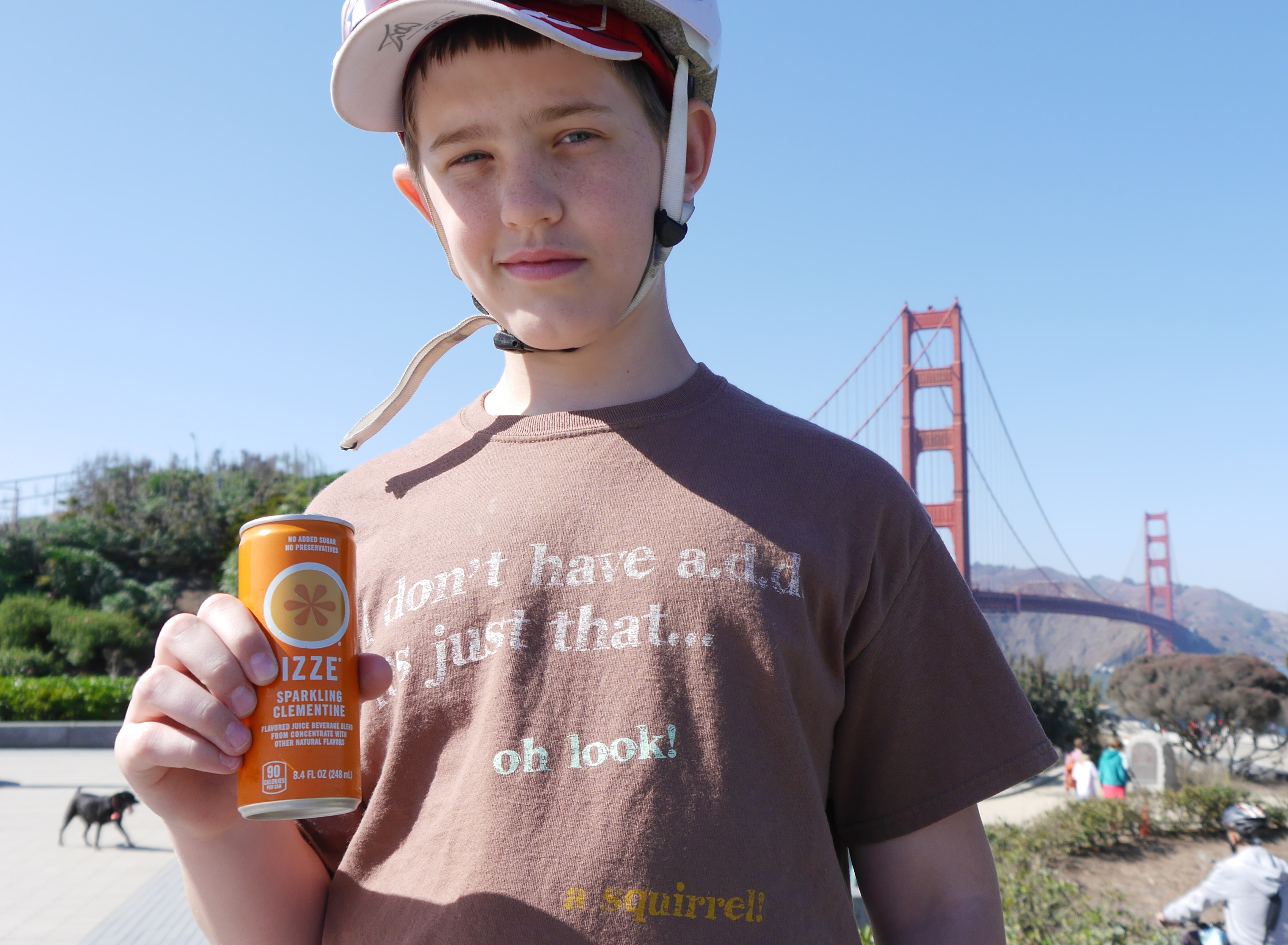
We stopped at a small museum before the bridge where Harrie bought a can of IZZE. Harrie’s cousin Isolde (also known as Izzie) had visited San Francisco some years earlier and obviously had a big influence on local orange soft drink manufacturers.
Harrie conducting water experiments on the Golden Gate Bridge.
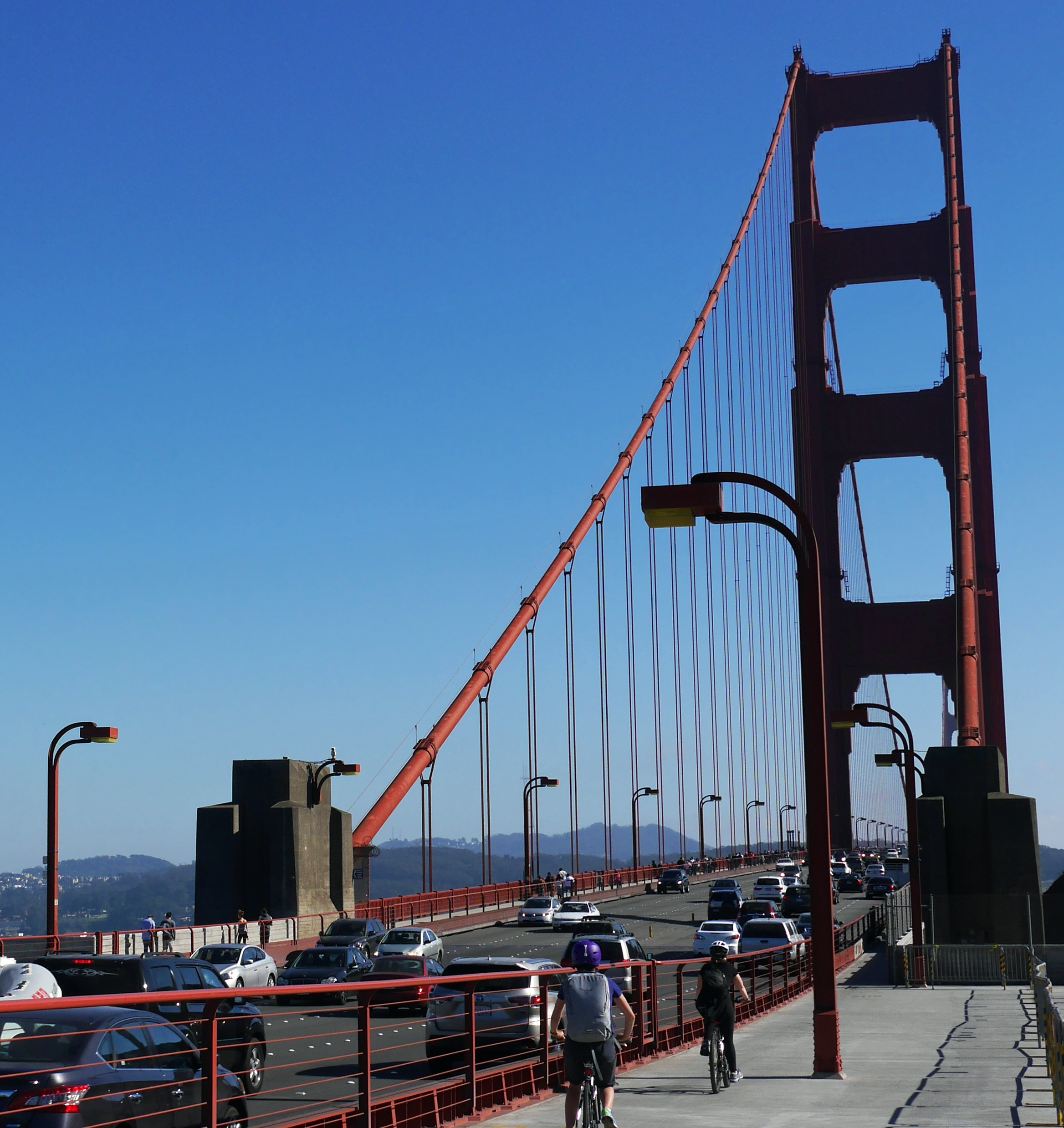
Looking back once we had crossed the Bridge.

On the waterfront at Sausalito where this guy was gingerly placing rocks on top of each other to form precarious rock statues.

One of the Sausalito rock towers. No tricks or glue, just gravity.
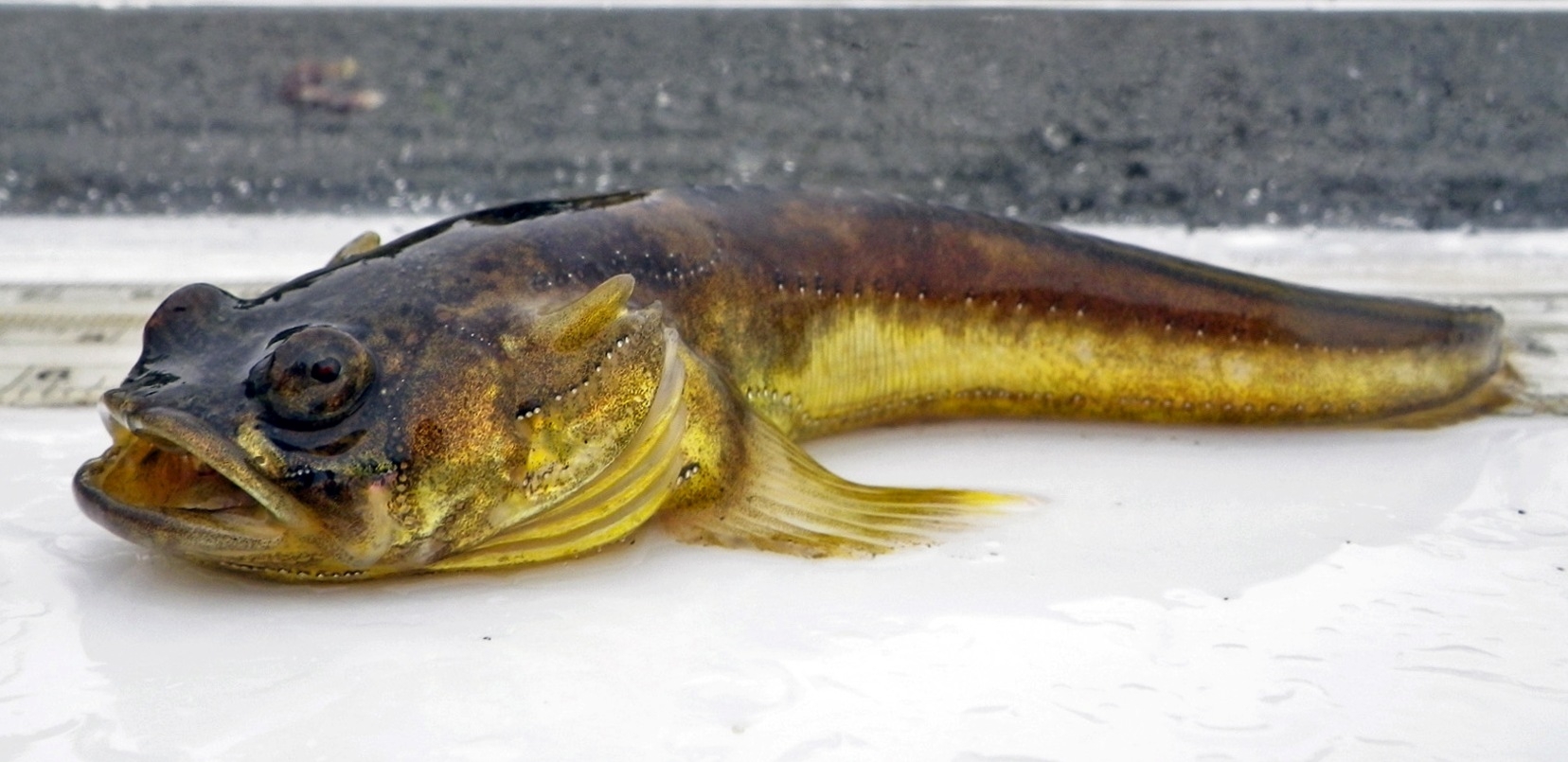
The Sausalito Humming Toadfish (picture courtesy of Wikipedia). You can hear the humming sound it makes to attract mates here. Of course, with a face like that it has to have something else up its fins to attract a partner.
Silicon Valley
We went to pick up our Ford Mustang Convertible from the Dollar Rent-A-Car in San Francisco. When the guy behind the counter saw our bags (which had by now numbered two bulging suitcases and three carry-on) he just sadly shook his head and advised us that our bags would not fit in the convertible’s boot. When we saw the car, we had to agree and so my dream of driving a Mustang convertible down Highway 1 was cruelly dashed.
Feeling sorry for us, the guy at Dollar gave us a luxury Chrysler 300C which was quite a big and showy car. It was also a bit of a nightmare to drive due to the stylish, yet complicated, controls. Almost everything was controlled through a series of buttons on the steering wheel. The Dollar Guy had described the experience as like “driving a spaceship” but I would probably equate it to driving a Bosch oven. This is because the buttons had no descriptions but instead had little symbols like the ones you see on upmarket European appliances. These symbols obviously meant something to their creator but baffled me. Is the squiggly dotted-line button the windscreen-wipers or the indicator I tried to remember as we braved the traffic getting out of San Francisco.
We drove our new spaceship down the interstate to San Jose without having to stop and ask someone the way to San Jose.
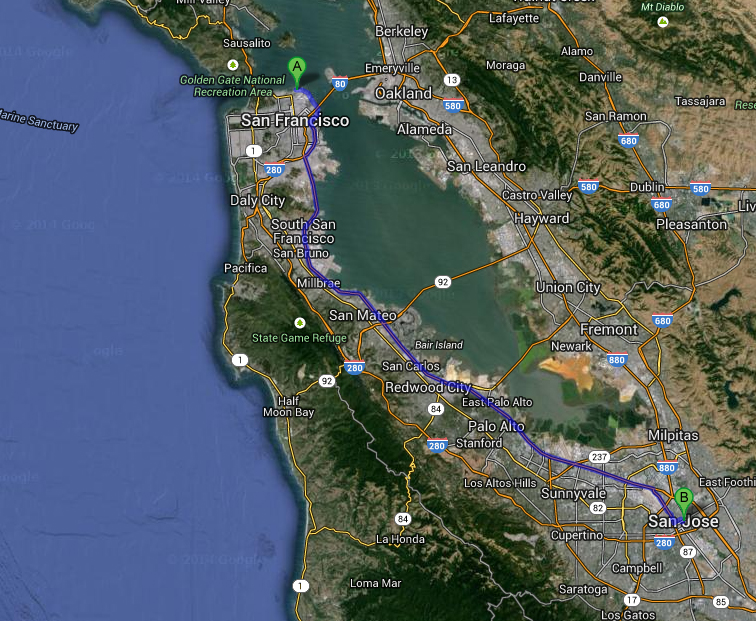
Driving in our Chrysler spaceship from San Francisco to San Jose.
Stanford University
We went on an organised a tour of Stanford University that, much like our previous Harvard tour, was conducted by keen students.
Stanford was the best place to begin our exploration of Silicon Valley, as it is where the tech industry was first nurtured in the 1940s. Back then, the Dean of Engineering, Frederick Ternan, had the radical idea of using the university as a commercial playground for young entrepreneurs. He had the university buy up a piece of adjacent land and turned it in to the Stanford Industrial Park. Here a young William Hewlett and David Packard were mentored by Ternan and encouraged to start up a fledgling electronics business. While much has been made of Hewlett and Packard having their original office in a garage, it is really Stanford, where lot of the the action took place.
Ternan’s idea of nurturing tech start-ups took off and has flourished in and off Stanford ever since. Now, 1/3 of all venture capital spent in America, goes to Silicon Valley. And a large degree of that money goes to graduates from Stanford. If you don’t believe me, try this for a list of tech companies either started at Stanford or started by Stanford graduates – Google, Hewlett-Packard, Cisco Systems, Yahoo!, PayPal, Logitech, Instagram, Snapchat, Sun Microsystems, LinkedIn, Netflix, Pandora Radio, Electronic Arts, Dolby Laboratories, Firefox, VMware, MIPS Technologies and Wipro Technologies.
And if that is not impressive enough, the following non-tech companies were also founded by Stanford alumni – Nike, Gap, Victoria’s Secret and Trader Joes (seen everywhere if you visit the States).
Our tour party consisted of mainly rich girls who were planning to enrol at Stanford. They seemed bored which only spurned our peppy tour guide to try harder to engage them; telling personable tales about his own experiences on campus. However, they looked like the type of girls who wouldn’t give the tour guide the time of day if they met him on campus. After tolerating the tour guide’s blather about the history of Stanford, one girl decided to pipe up and ask the guide where the sorority houses were which prompted a lively discussion among the girls about which was more popular and the types of frat parties that were held by each sorority. Our poor tour guide seemed crest-fallen.
While the girls didn’t glean much from the tour to help their social lives, we really learnt a lot about the history of Stanford which was founded in 1885 by Leland and Jane Stanford in memory of the of their only child who died of typhoid at fifteen. In a radical departure from universities at the time, the Stanfords insisted that the university “afford equal facilities and give equal advantages to both sexes” and that entry and tuition be free. Of course, the Stanford’s goodwill was taken up in droves by students seeking a free university degree and within ten years the university was in serious debt. Fees were introduced but assistance was given to those who could not afford them. This assistance is still in place today (such as no-interest loans) and it is what allowed many of the poorer tech geniuses to attend Stanford.
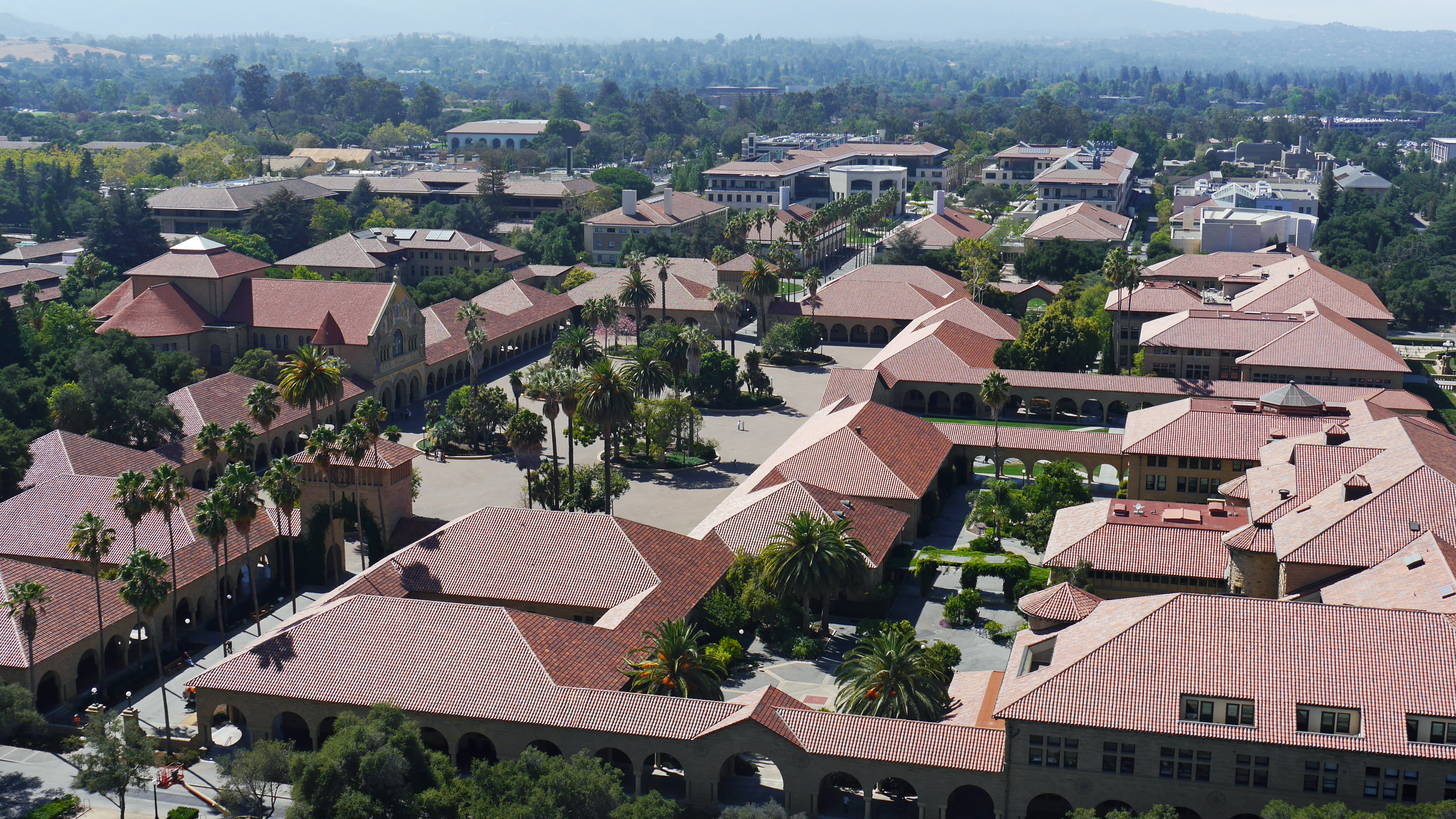
Stanford University.
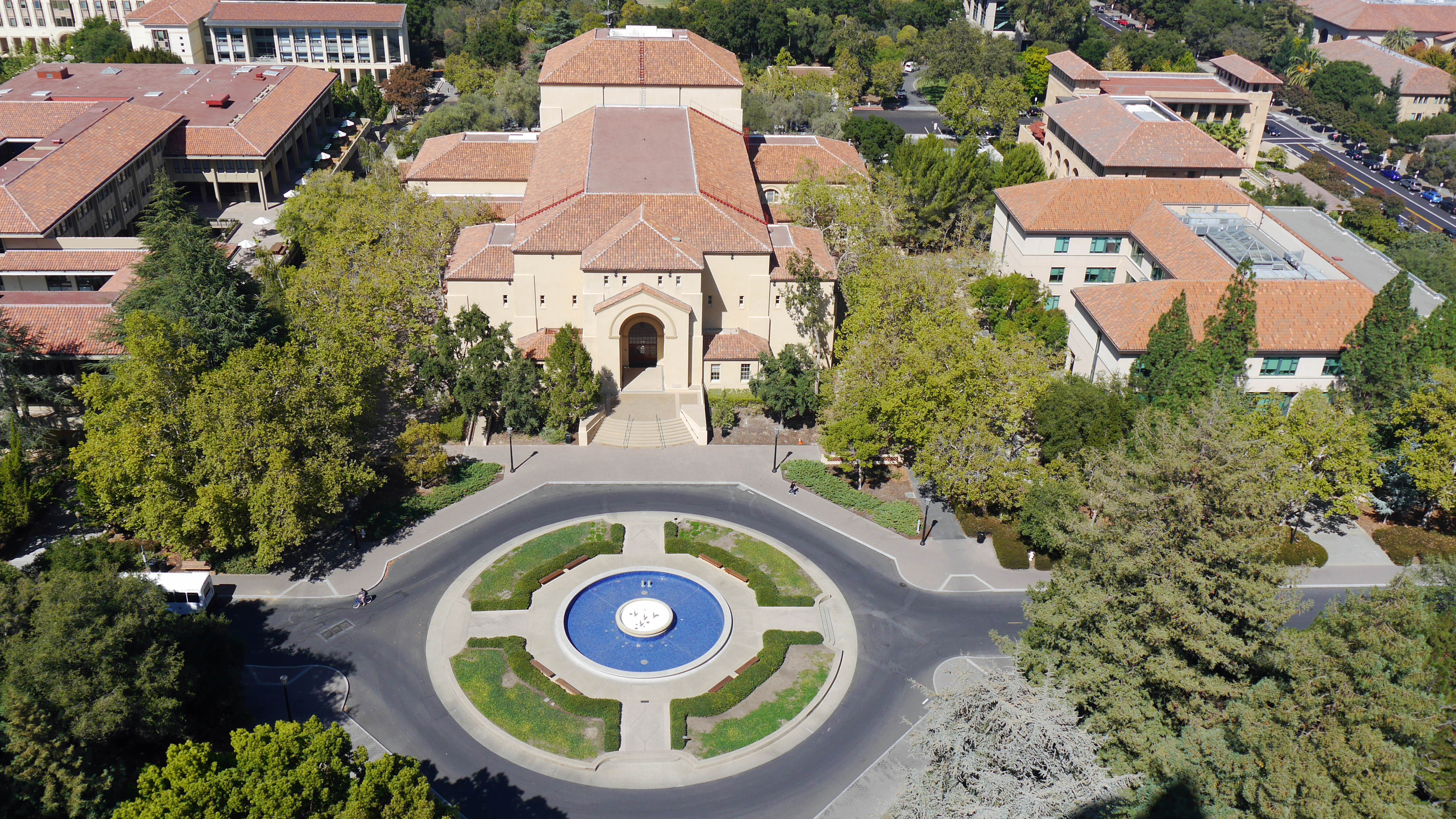
Looking down on the entrance to Stanford from the tower on top of the Herbert Hoover Memorial Building.

Our spirited tour guide trying to engage the girls who all, like totally, spoke like y’know valley girls.
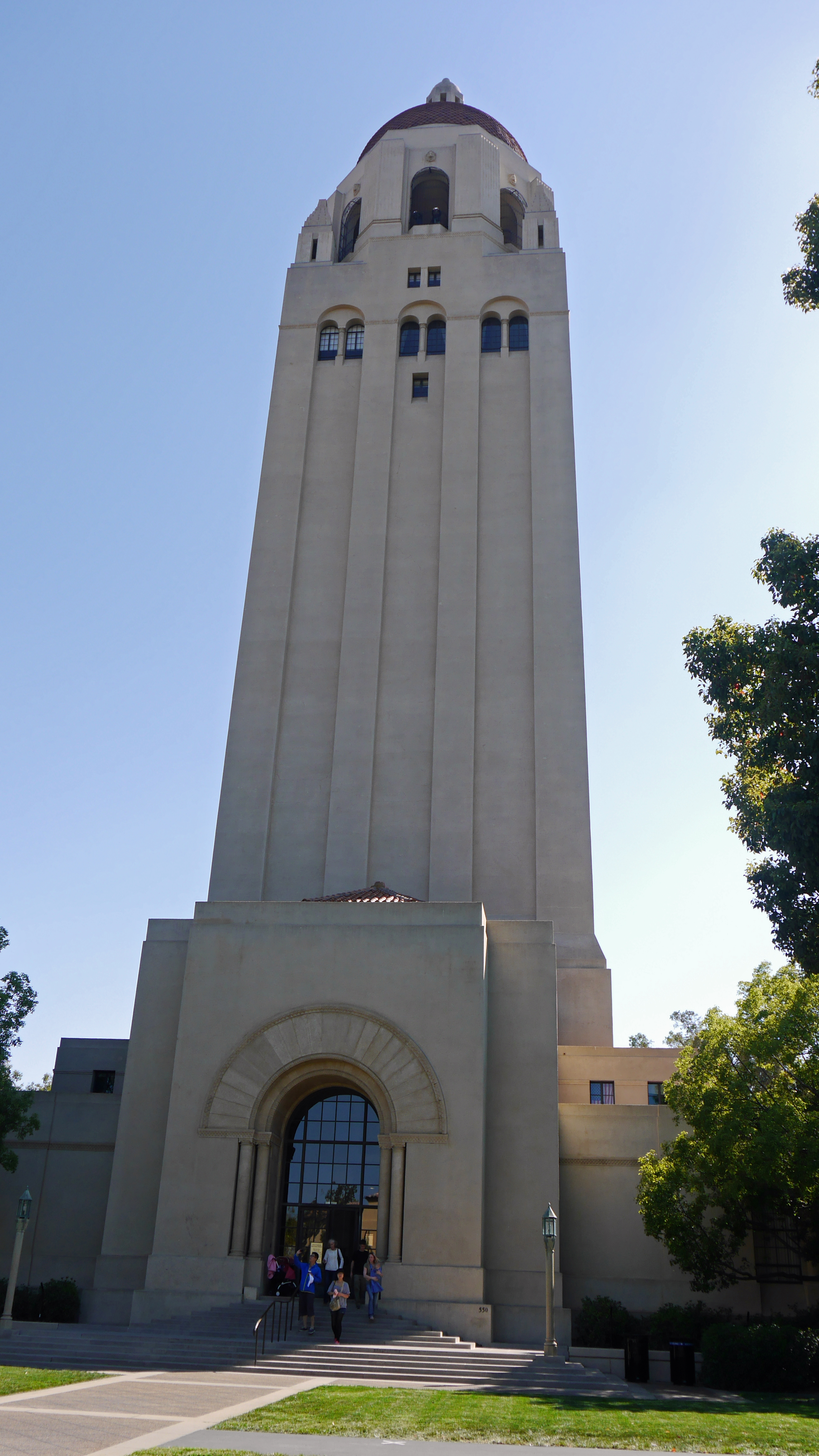
The Herbert Hoover Memorial Building. Having previously seen how vain Hoover was in insisting on the Boulder Dam being named The Hoover Dam, we weren’t surprised to find this building was built before Hoover even became President, such was Hoover’s confidence in his manifest destiny. Condoleezza Rice works here as professor of Political Science.
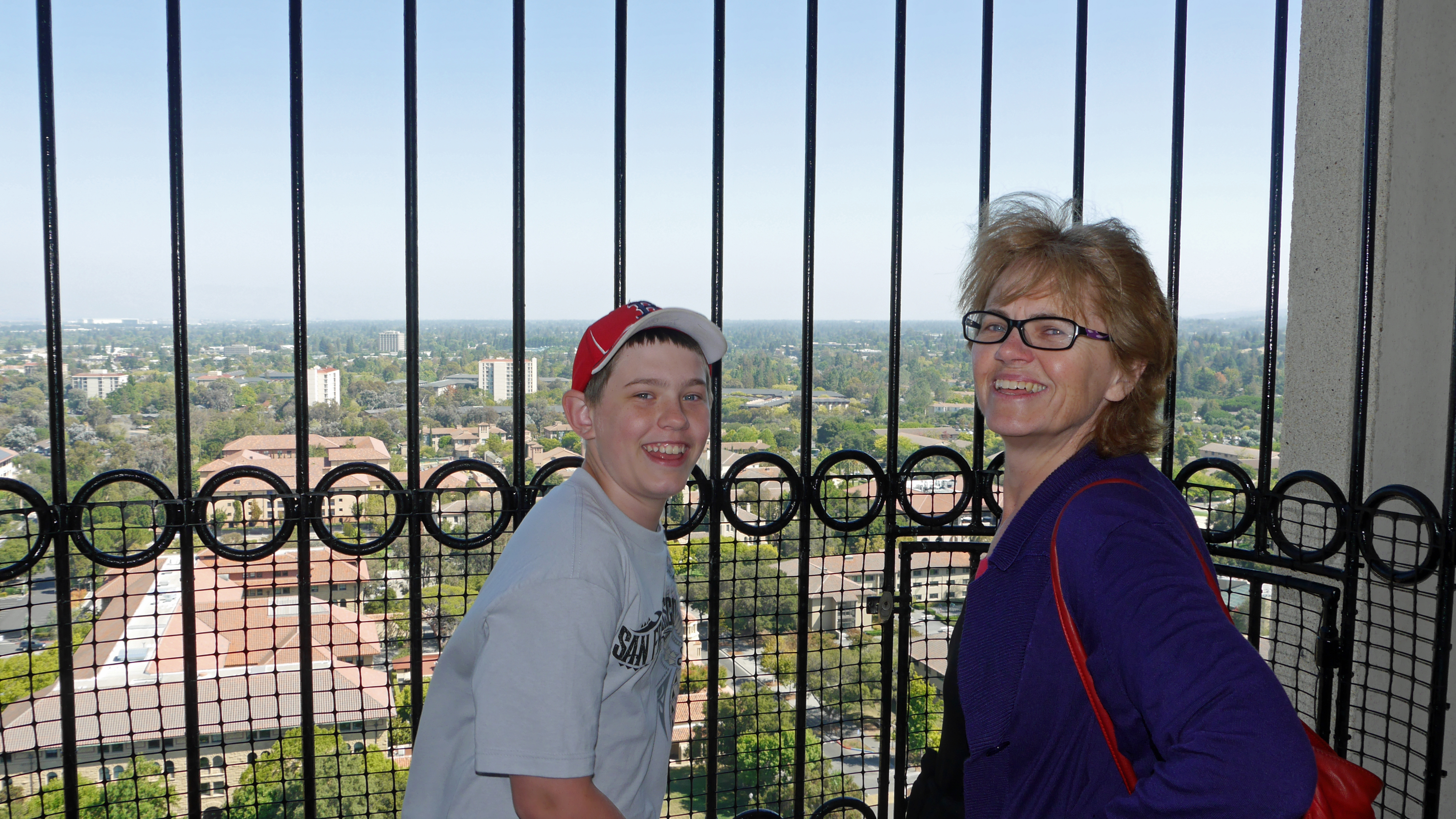
Harrie and Michelle share a joke looking out from the top of the Hoover Tower. Can’t remember what the joke was though.

We saw lots of buildings honoring past Stanford Alumni. I presume these corporations and/or individuals also donate money to achieve this.

Apart from starting Hewlett Packard, David Packard would also go on to become the U.S. Deputy Secretary of Defense under the Nixon Government. He also established the Monterey Bay Aquarium (more of which below).
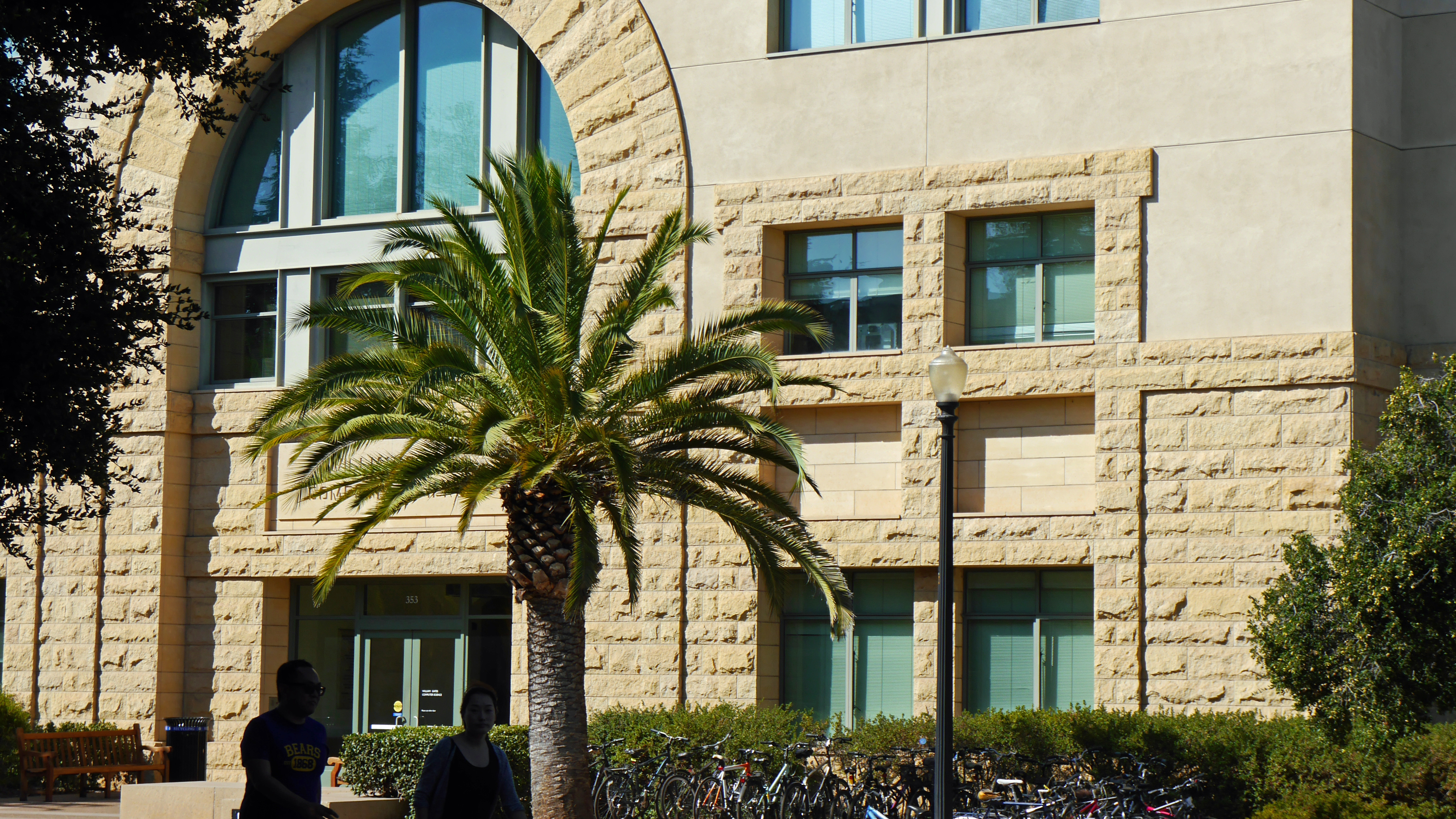
The Gates Computer Science Building. Bill Gates went to Harvard but decided to drop out. Our tour guide speculated that this is why he donated so much money to Stanford University.
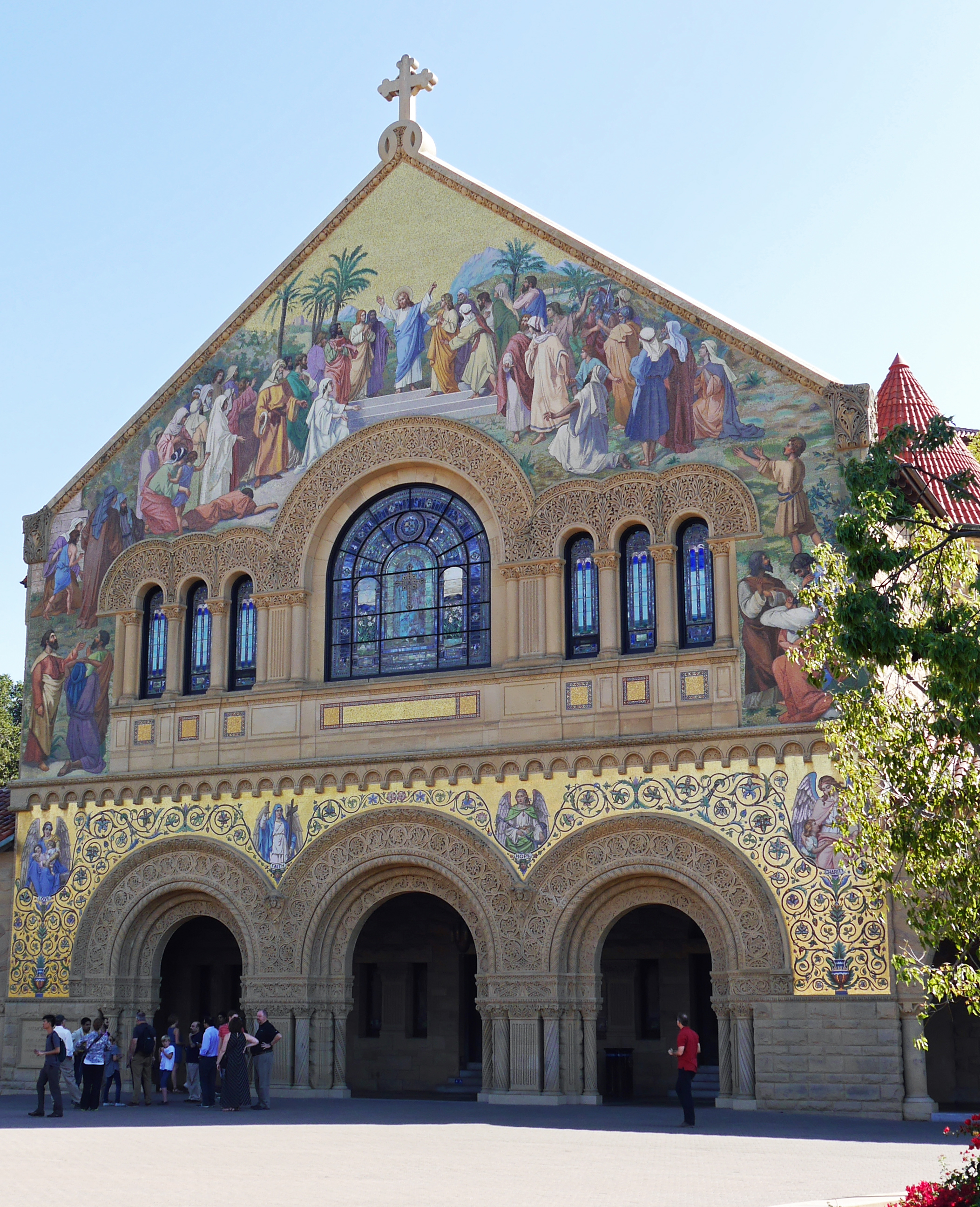
The interfaith Memorial Church on Stanford Campus.
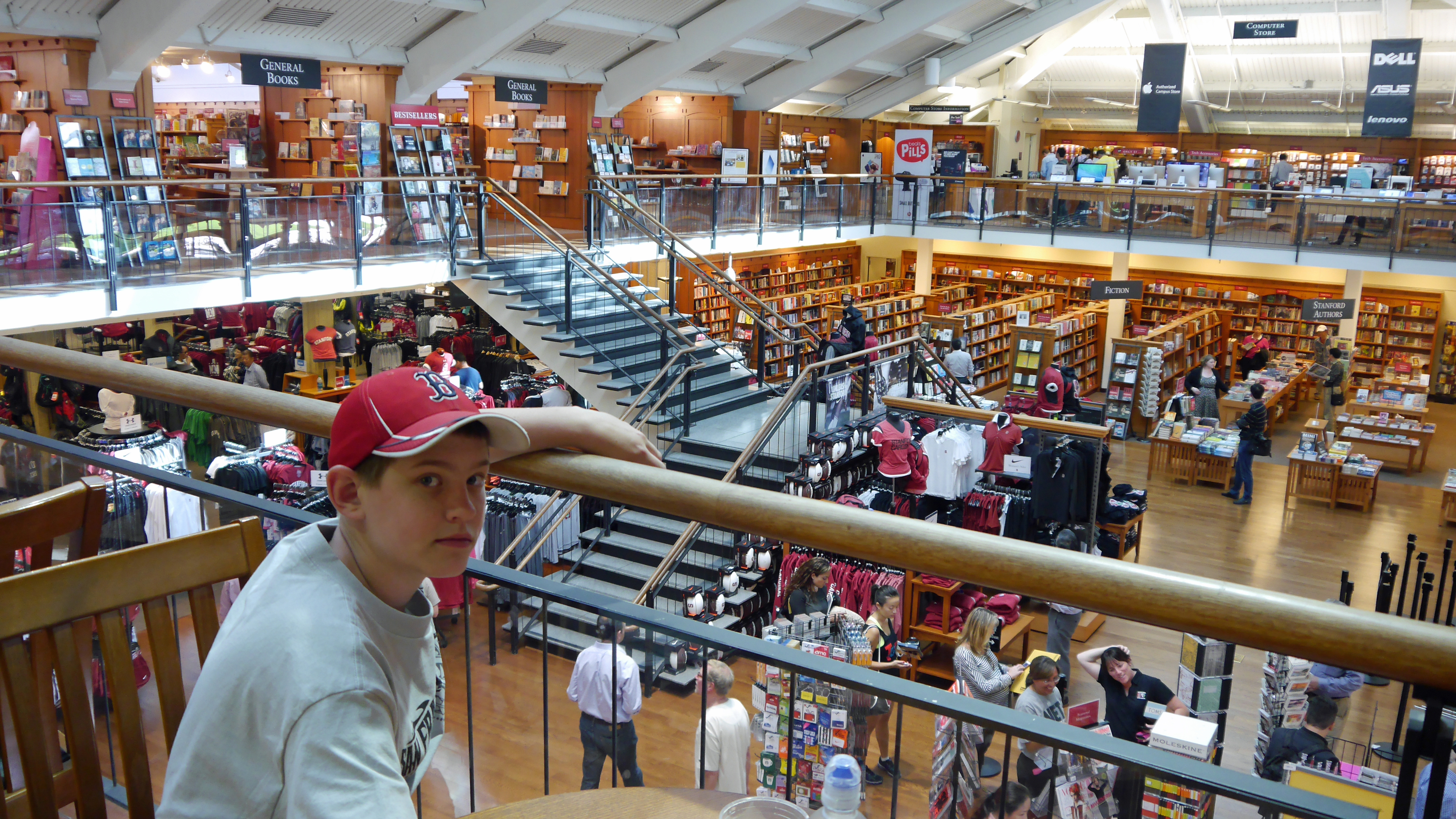
We had a coffee at the Stanford Campus Bookshop where they had lots of cool computer books.

We kept seeing posters around campus saying “Fear The Tree” and wondered what tree we should be looking out for. Thankfully, our tour guide cleared it up telling us that the Stanford football mascot was a tree. Usually sporting teams have animals for mascots but Stanford was always different, having an American Indian as its mascot up until 1972. During the 1970s Stanford became ashamed of having an Indian as a mascot and held a student referendum on a suitable alternative. Students being students came up with suggestions including a robber baron (founder Leland Stanford had been a rapacious railroad baron), a french fry, and a steaming manhole cover. The students overwhelmingly voted for the team to be called the Stanford Robber Barons which was refused by the university administration. The University President instead declared that there would be no mascot as students weren’t taking the decision seriously. No, instead the team would simply be represented by the colour Cardinal (a vivid shade of red). The student body didn’t accept the decision and said it was so boring you might as well have a tree for a mascot. So they did. The Tree has been the unofficial sports mascot for Stanford ever since.
Googleplex, Mountain View.
We were disappointed that Silicon Valley had almost no tourism of the tech industry. The only thing going was a $600 tech tour conducted by a local in his car.
So, we decided to seek out the tech giants ourselves using the phone book and our GPS. Driving around Silicon Valley was pretty awful though. For starters, the roads are busy and always seemed to be full of traffic. Secondly, apart from a few exceptions, you are mainly driving through industrial areas without a lot of greenery. And finally, and a bit like Canberra, it is easy to take the wrong turn and find yourself stuck for miles on a road to nowhere (this happened to us on the road to Cupertino where we ended up in another town before we could turn around).
Our first stop was the the Googleplex, Google’s headquarters in Mountain View. We didn’t really know what to expect and were anticipating gates (not of the Bill variety) and guards. Instead we parked on the street in front of the Google headquarters and simply walked in. We strolled around the big Google campus and checked out all the interesting facilities for employees. People just smiled at us and seemed happy for us to be there. Emboldened, we started taking pictures and peering in windows. We went to the cafeteria and explored the different wings of the campus.
The original buildings on the campus used to be the headquarters of the once-mighty tech behemoth Silicon Graphics Inc (SGI). When Google took over, they expanded and the headquarters now has almost 300 thousand square metres of floor space.
With its corporate motto of “Don’t Do Evil”, Google processes over one billion Internet search requests every day. But Google are not just a search engine. Google are in the phone business (developing the Android mobile operating system and owning Motorolla), the mapping business (Google Maps), the email business (the ubiquitous Gmail), the media business (they own You Tube, DoubleClick (perhaps the largest online advertising agency in the world), Google News and Google Books), the hardware business (Chromebook tablets and laptops, Chromecast TV, and Google Glass) and the software business (Google Docs (aggressively competing against Microsoft Office), Picassa and Blogger). With over 200 different products and services, Google are slowly but surely creeping in to all facets of life. Let’s hope they stick with their corporate motto.

Just when we thought we were lost, we saw this reassuring sign and knew we were on the right track to the Googleplex.

I loyally use my Android phone in front of my Google masters while Harrie cocks a snook with his Apple IOS device.
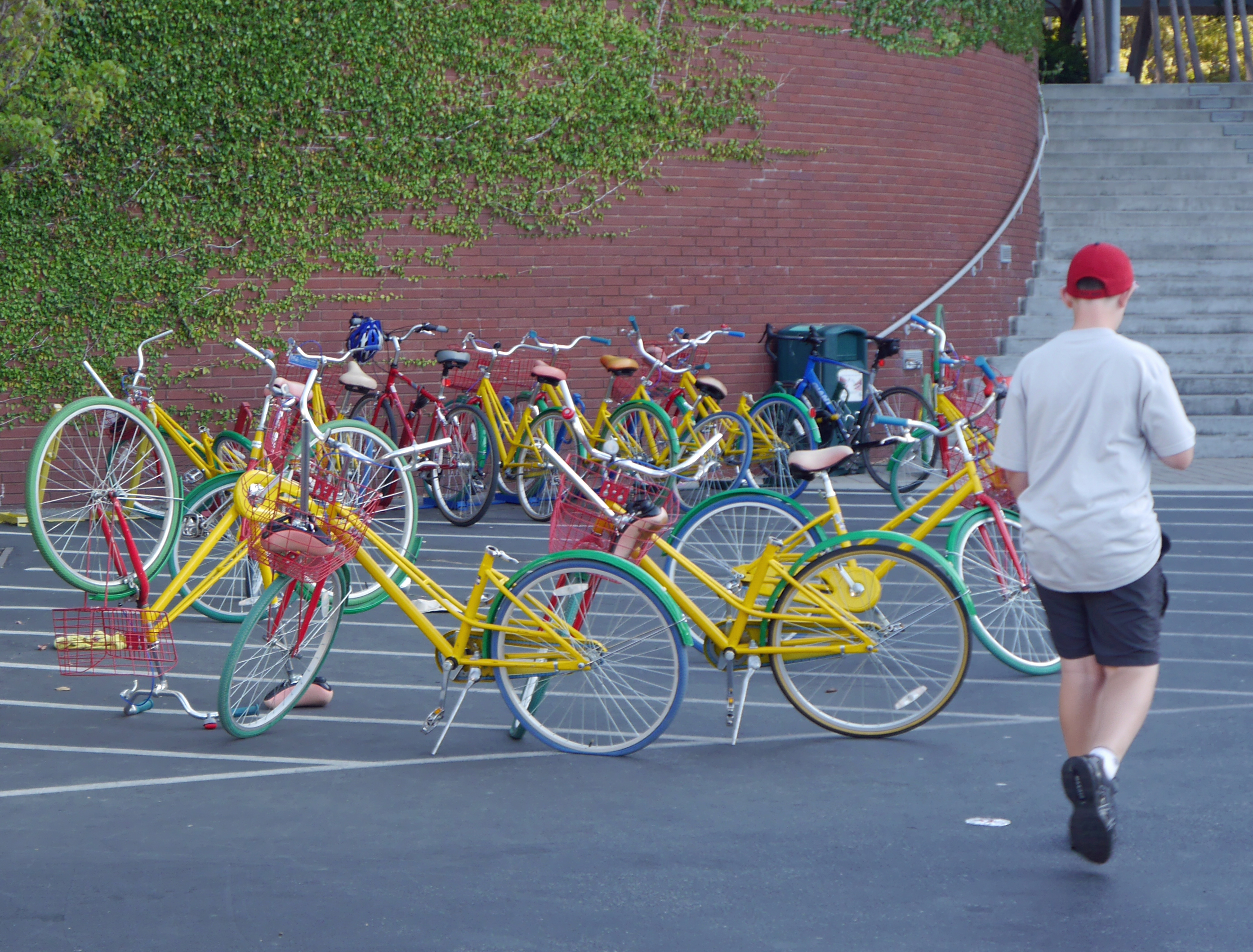
The colourful Google bikes that employees can use around the campus. In fact, anyone could come in and use them as they aren’t locked up.

Enjoying the funky deckchairs at the Googleplex.

Google had this nice veggie and flower garden off one wing.
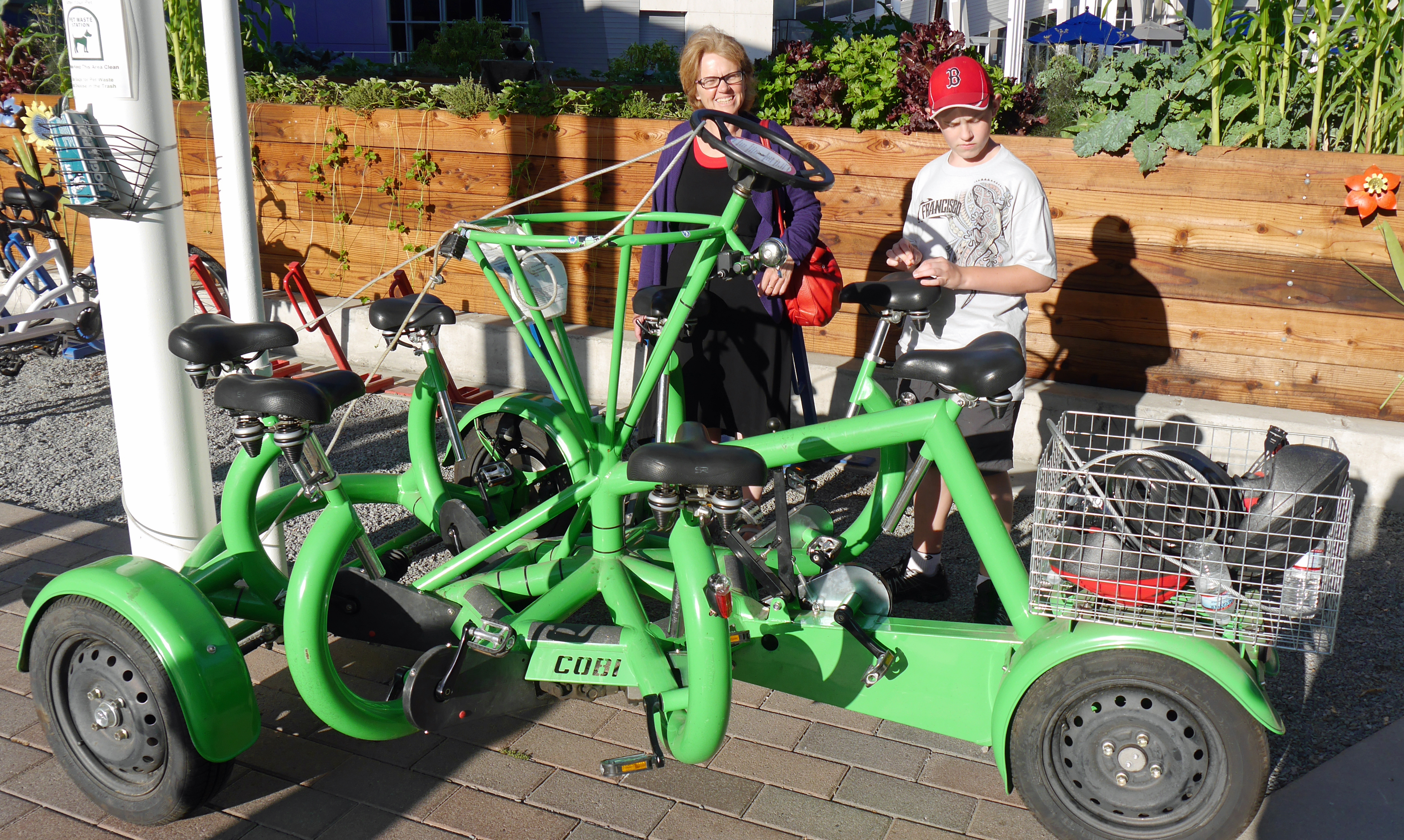
Only at a place like Google would you find the Conference Bike. The idea is that rather than convene a meeting in a stuffy meeting room you all jump on this bike and start thrashing out your issues as you pedal around the campus. The circular piece in the middle is the meeting table and one person has to be delegated to steer.

A statue of the Android mascot next to a T-Rex skeleton called “Stan.”

It is California after all, so you have to have a beach volleyball court for employees.
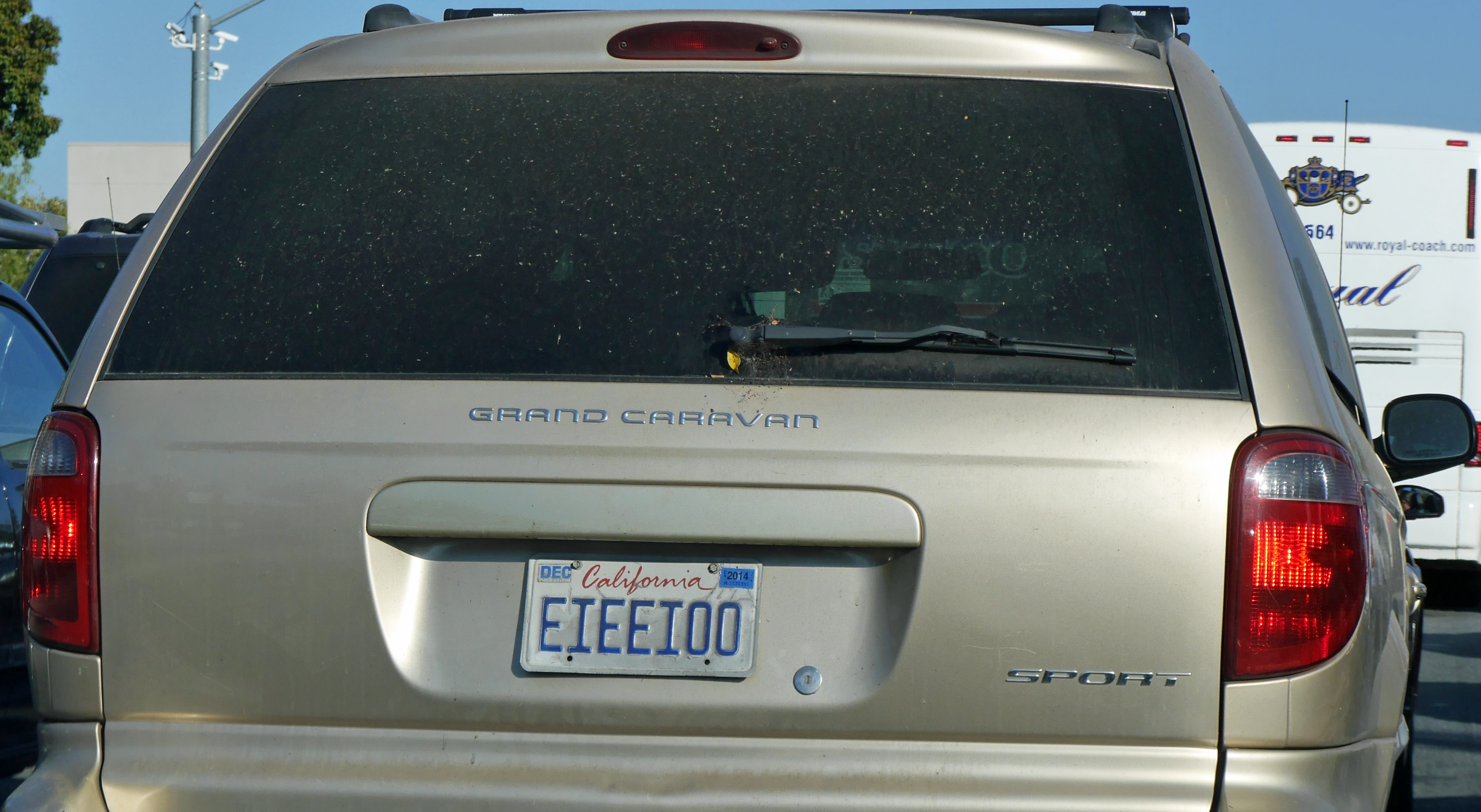
Nothing to do with Google but we saw this great number plate when leaving. We guessed that the owner must have been Old MacDonald.
Driving in Silicon Valley.
We found out that Facebook had their headquarters on Hacker Way and put it into our GPS and were led to the intersection from Hell where we made two attempts to turn into Hacker Way.
Unlike Google, Facebook HQ was a much duller affair, possibly because the place used to be the headquarters of serious corporate, Sun Microsystems. Like Google HQ, it was kind of funny to see the older and stuffier corporate tech giants being supplanted by the younger and friskier tech companies.
We dutifully took our picture in front of the giant “like” sign and posted a Facebook post which read “Facebook HQ” as the location.

The likers going to like, like, like.

And the dislikers going to dislike, dislike, dislike.
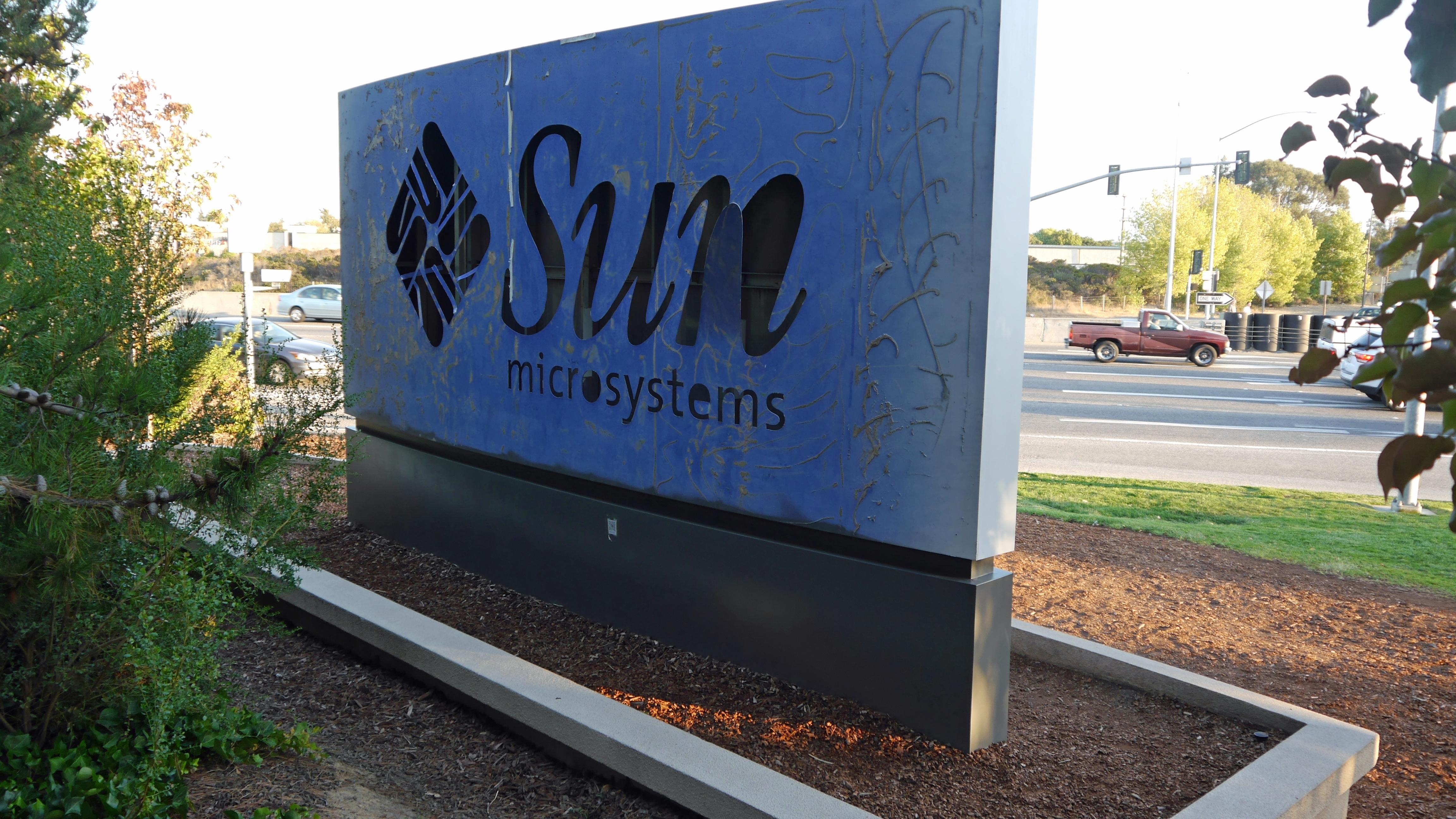
The back of the Facebook sign told a different story. Sun Microsystems used to rule the roost in providing high-end computers and servers to the corporate world. That is until others did it faster and cheaper. Sun hung on in there with their operating language Java but, like IBM, they are not the company they used to be. I expect in twenty years time, there will be another tech giant here replacing Facebook.

We liked how the Visitor Parking sign used the Facebook “friends” icon.
Apple Headquarters, Cupertino
Under some strange degree of synchronicity, we happened to be in Silicon Valley when Apple was launching the iPhone 6. The event itself was invitation only at the Flint Center for Performing Arts in Cupertino, however the public was able to see a live feed from the Company Store at Apple Headquarters.
We drove to the Headquarters at 1 Infinite Loop in Cupertino on the morning of the launch only to find we couldn’t get a park anywhere. So, Harrie and I got out while Michelle drove in almost infinite loops around the Apple car park.
All of our previous expectations of security guards leaping on us came true at Apple where we were immediately accosted by two men-in-black types who ran towards Harrie when he pulled out his iPod. “No Photos” they said forcefully to us. After a bit of negotiation, they agreed that we could take two pictures only – one of the Infinite Loop sign and one of the Company Store sign. But under no circumstances, were we to take pictures of their main building which is also known (creepily) by employees as “The Mothership.”
Not feeling very welcomed, we entered the Company Store where a crowd of people were watching the telecast of the Apple iPhone launch with the same sort of beatitude as those witnessing Jesus’ Sermon on the Mount. Apple CEO and prophet, Tim Cook, would talk and “ooohs”, “ahhhhs”, and “oh-yeahs” would rise from the crowd. While we were watching, Harrie tugged my arm and informed me that his iPod had automatically connected to the Apple Wi-Fi network and a lot of strange background activity was occurring. I looked at his iPod and sure enough it was flickering away as if The Mothership was probing his iPod’s very soul.
Conscious of Michelle circling the car park and also conscious of the oppressive atmosphere of the place, we spent about fifteen minutes in the Company Store before leaving. On the way out, Harrie took a sneaky picture of the Mothership in defiance of the men-in-black before running quickly to the car.
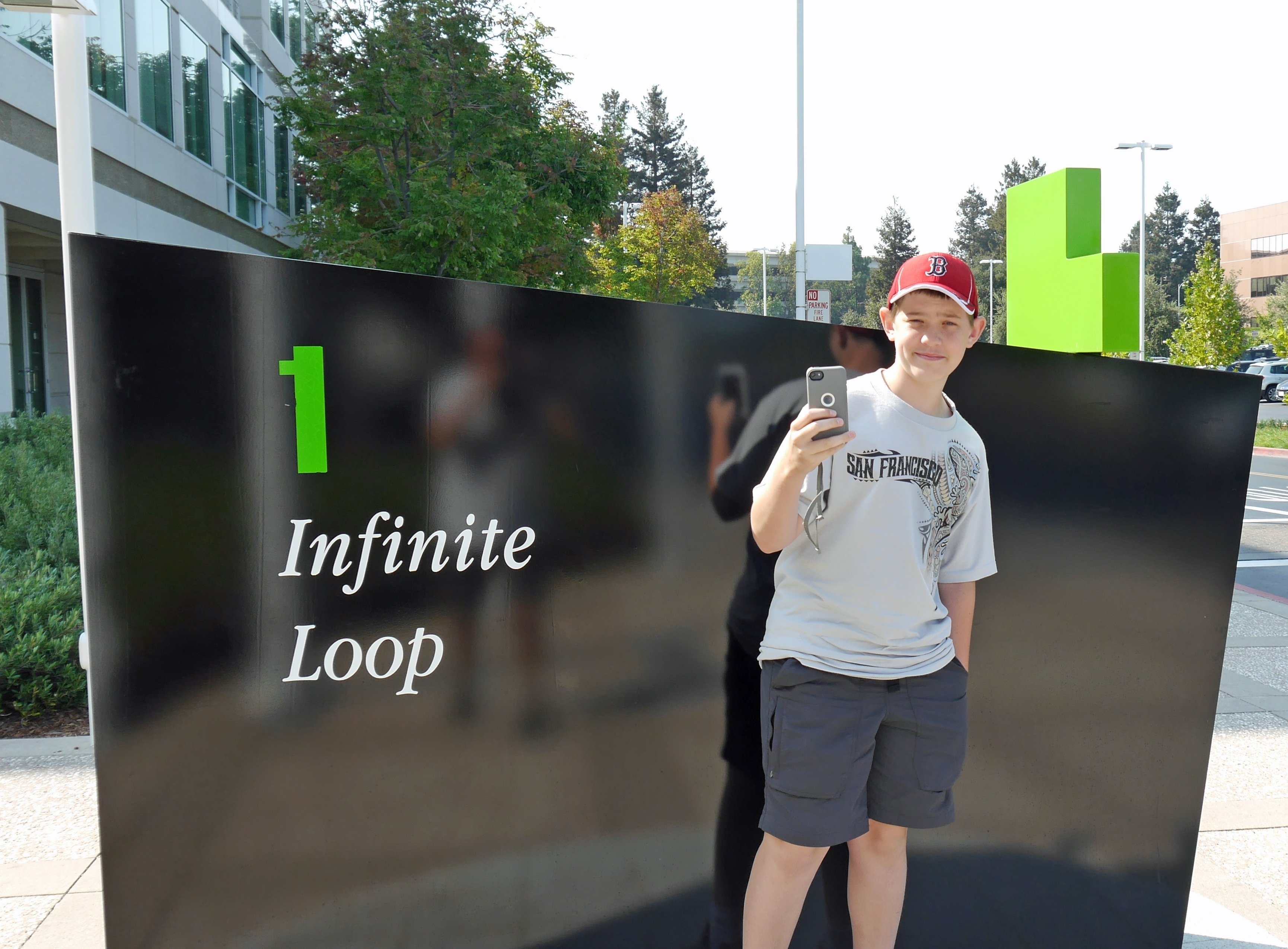
Our first authorized picture of Apple Headquarters. Harrie kills two birds with one stone by taking a selfie on his iPod.
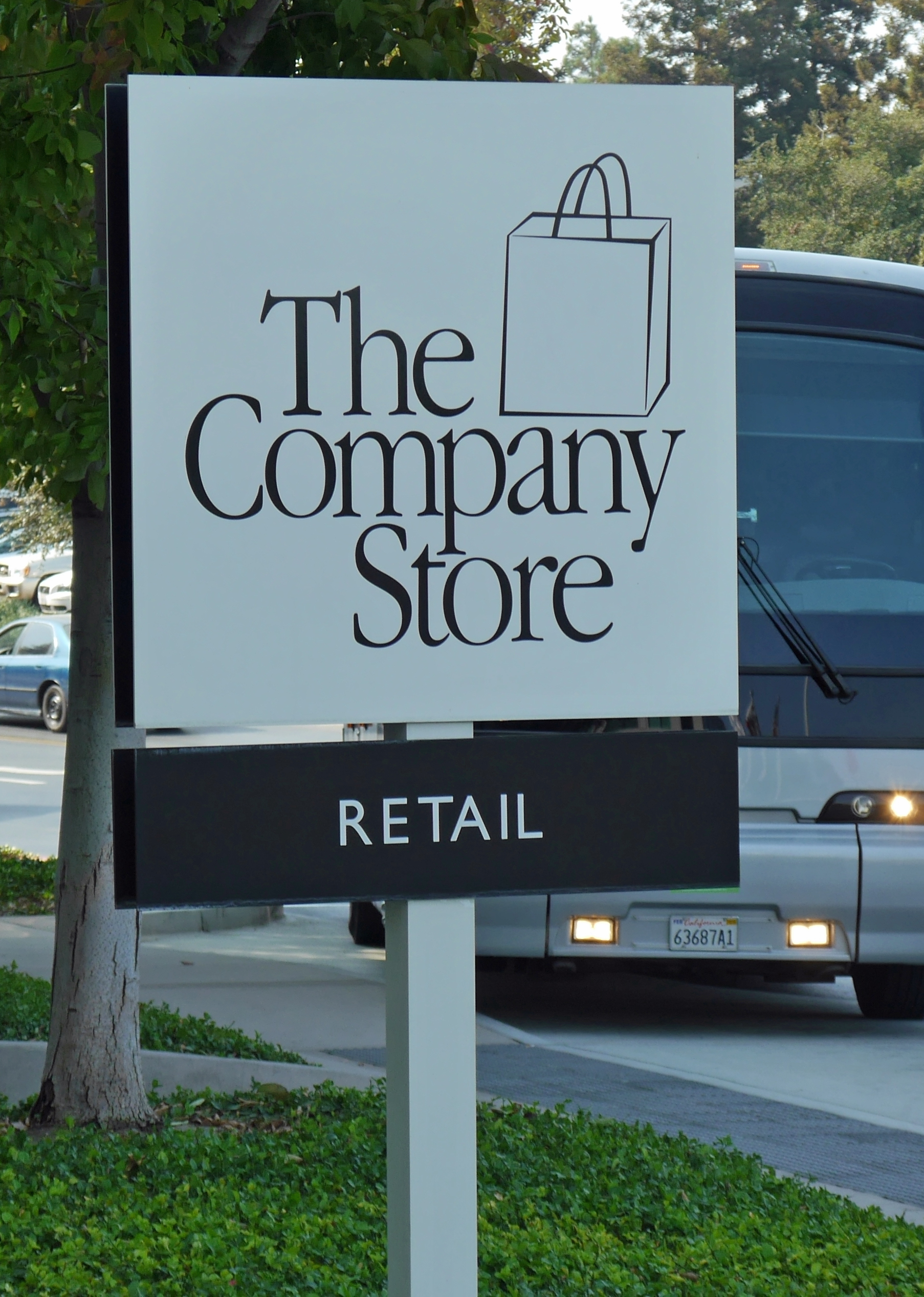
Our second authorized Apple picture of the Company Store sign. This picture was taken under the hawkish supervision of two Apple security guards who were standing next to me, making sure that I complied with their rules. Gee, thanks Apple for letting us take a picture of your shop sign. We are just so grateful. It very much reminded me of the song 16 Tons – “I owe my soul to the Company Store.”
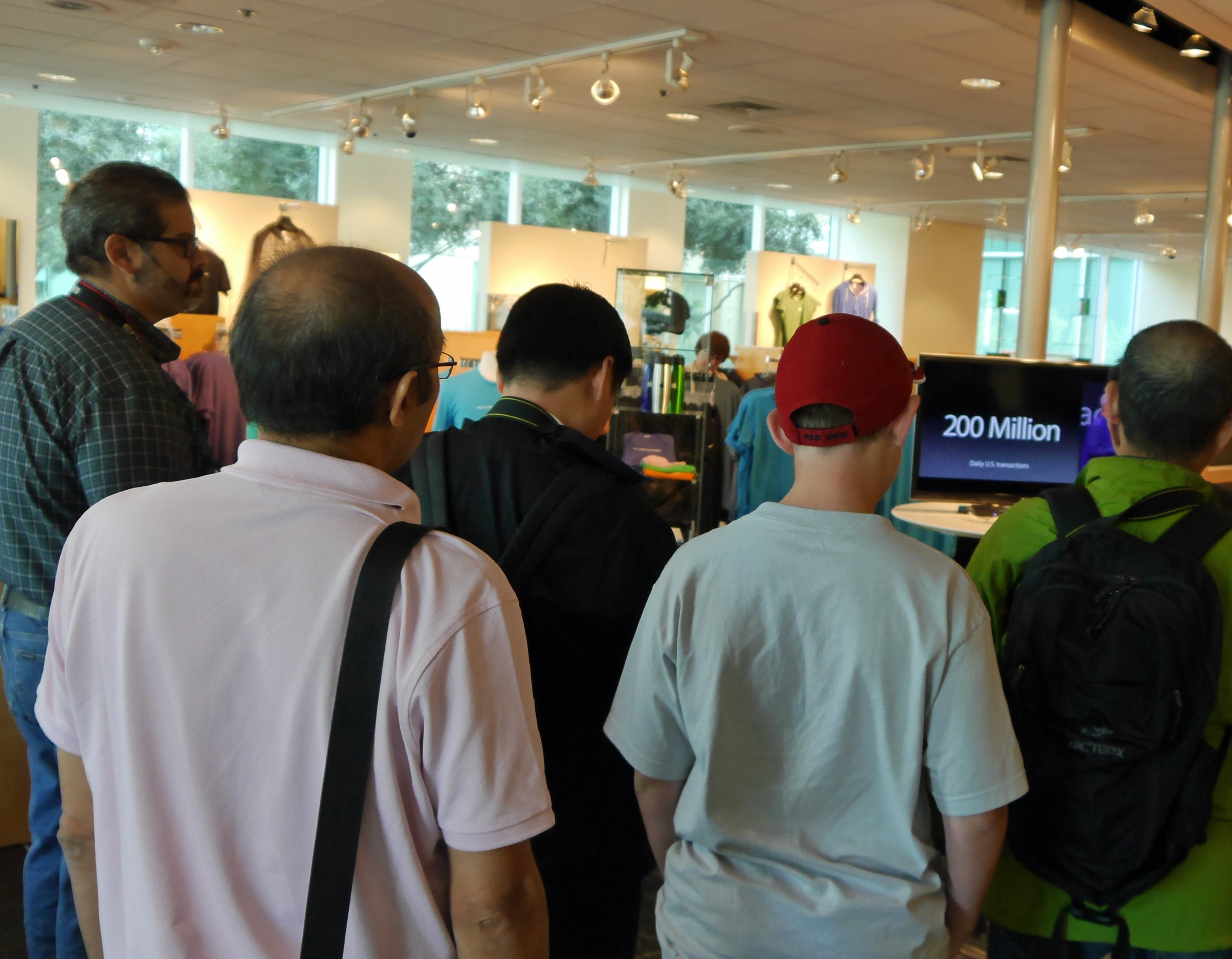
Our first unauthorized picture inside the Company Store. Apple devotees listen to the prophet Tim Cook tell of the coming of the messiah – the iPhone 6. I’m proud to say that I heretically took this non-Apple approved photo on my Android phone. My soul will burn in Apple Hell.
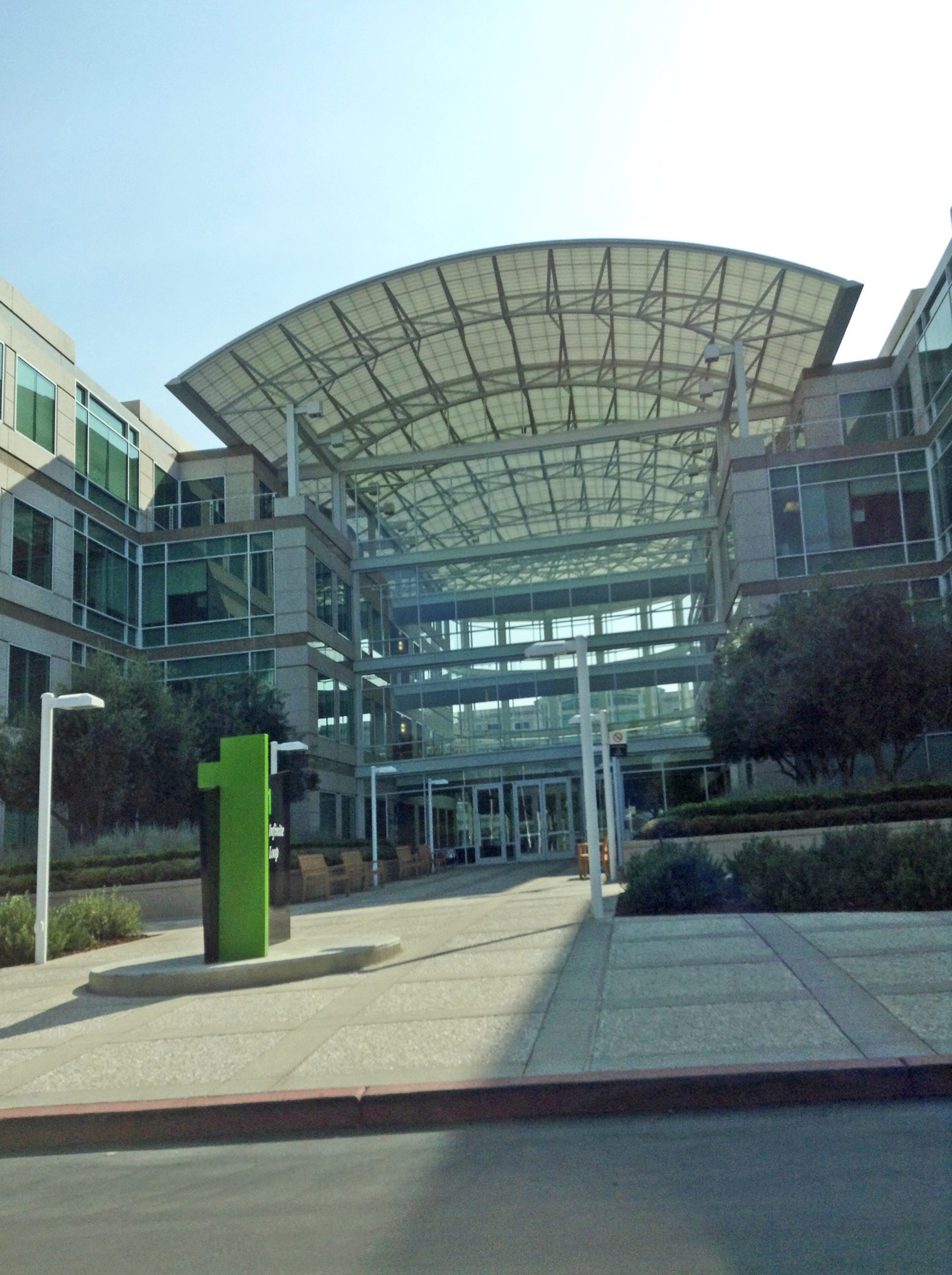
Harrie’s seditious photo of The Mothership, Apple Headquarters. We await the legal action and/or black-ops assassination.
Xerox Parc
Of course, Apple wouldn’t be the company it is today without Xerox Parc. It was here in 1979 that a 24 year old Steve Jobs saw the Alto computer (named after the city of Palo Alto where the Palo Alto Research Center or Parc resides). The Alto computer introduced three revolutionary concepts that would change computing forever – the graphical user interface or GUI (the Alto introduced icons and object-orientated rather than text-orientated controls), the world’s first mouse, and the Ethernet – the networking standard between other computers and also other devices such as printers.
This was a eureka moment for Steve Jobs who couldn’t believe Xerox weren’t planning to commercially release the Alto. Xerox considered it to be too way-out and too expensive. Jobs negotiated a deal with Xerox to have commercial use of their ideas for a million dollars in Apple stock. Xerox agreed and thought they had pocketed a nice little earner from a romantic fool.
Jobs returned to Apple and instructed his team to begin work on an Alto clone. The result was the Apple Lisa, which was released in January of 1984 and named after Steve Job’s daughter. However, at US$10,000, it proved too expensive for mainstream success. Jobs tried again later in the same year with a cut-price version of the Lisa at a retail price of $1,995. The result was the Apple Macintosh which garnered much public love with its intuitive WYSWG (What You See Is What You Get) interface.
It wasn’t long before an antsy IBM started looking to its old pal Bill Gates to help them compete with these new-fangled computers. IBM asked Gates to come up with a graphical user interface that could work with their text-based DOS operating system (which was also designed by Gates). Of course, Gates’company Microsoft already had quite a bit of experience programming for the new Apple GUI having been invited by Steve jobs to be the Macintosh’s first external software developer.
Microsoft played both sides of the field in developing software for the Mac while secretly developing their own version of the Mac’s operating system. In 1983, Microsoft released the first version of Windows for the PC.
On hearing about the release of Windows, Steve Jobs apparently went crazy with rage demanding an immediate meeting with Bill Gates. According to those who witnessed the meeting, Steve Jobs greeted Gates by yelling “You’re ripping us off!” Gates apparently calmly replied “Well, Steve, I think there’s more than one way of looking at it. I think it’s more like we both had this rich neighbour named Xerox and I broke into his house to steal the TV set only to find out that you had already stolen it.”
Apple immediately took legal action against Microsoft for copyright infringement but the case was dismissed as the courts found that, if anything, it was Apple who stole their ideas from Xerox.
If the GUI (Graphical User Interface), mouse and Ethernet were not enough, Xerox Parc also developed the first Laser Printer, E-paper (the display technology used in E-readers such as The Kindle), Unicode (the universal standard for alphabet character sets on the Internet and personal computers), and the first fibre-optic communications network.
Disappointingly, the place itself was very boring for an outside visitor with just rows and rows of old buildings. We walked in to the main foyer and spoke to the receptionist about whether we could see anything. She said that only Xerox partners could get a tour. I guess they learnt their lesson from letting Steve Jobs in all those years ago. Disappointed, I saw a pile of business cards on the desk and asked if I could take one as a small souvenir of my visit. She agreed but I could see from her expression that she thought it was strange that an Australian tourist would bother to seek this place out.

Perhaps appropriately wearing my “Past Shapes The Future” T-shirt as I stand in front of Xerox Parc.

The business card I was given by the receptionist. Xerox Parc certainly were in “The Business of Breakthroughs.”
The Tech Museum, San Jose
The two main tech museums in Silicon Valley are the Computer History Museum in Mountain View and the The Tech Museum in San Jose. Unfortunately for us, the Computer History Museum was closed on the day we wanted to visit but we were able to see The Tech Museum of Innovation.
Located in the centre of San Jose, the Tech Museum houses three floors of exhibits covering the past, present and future of technology. The museum had a great selection of gadgets and gimmicks that particularly entertained Harrie. We had our portraits done by a robot artist, we genetically engineered jellyfish DNA, we made our own songs on the Reactable music creator, we saw the most up-to-date satellite picture of our house and constructed our own lifesize robots.
All of the interaction at the museum is recorded on a small “Tech Tag” that you are given upon entry. You can later go online to the Tech Museum Web site and either relive your experience, compare it with others or explore your interaction in more detail. So for example, you can follow the incubation of your Jellyfish DNA and see how it may have mutated in a different way to others. Great stuff.
Upon leaving, we had a chat with the woman in the gift shop who explained how tough it has been to keep the museum running. It seems that the Silicon Valley companies haven’t been particularly generous in either donating money or exhibits to the museum despite many overtures. Nevertheless, all of the majors (Microsoft, Google, Adobe et al) except for Apple have donated something to support the museum.
I asked the woman why Apple hadn’t donated anything and she just snorted a laugh. “My husband works for Apple” she said “and even I don’t know what he does.” She then put up her fingers to her lips. “He is sworn to secrecy.” She went on to tell us that “Apple like to do things the Apple way and I guess the museum doesn’t do things the Apple way.” She paused and added “whatever that is, because they never communicate with anyone outside of Apple.”
This experience further hardened my views about Apple. Not that I was a die-hard Apple hater either. I had previously owned an Apple II and an Apple iMac as well as using the original Macintosh when I was at university. I had loved them all. I loved Apple’s 1984 Ridley Scott assault on the greyness of the IBM world. I loved that Apple were the underdog.
But over the last few years, the underdog has become a particularly nasty, top dog. I now find Apple to be a strange cult-like company fixated on forcing users to do things the Apple way (talk about 1984; why do Apple users have to use iTunes for everything?) and paranoid about outsiders. Even in the normal cut and thrust of the marketplace, they take threats from competitors like personal slights. Steve Jobs commonly painted competitors as either thieves or non-believers. Would you see Sony make the same accusations to Panasonic if they released a competing TV set? Apple need to relax and stop the siege mentality or their brand will become damaged over time. Maybe with the uber-controlling Steve Jobs gone, things might improve.

The Tech Museum of Innovation, San Jose.

The Google Liquid Galaxy. Five giant screens immerse you in the most recent satellite images directly from the Googleplex.
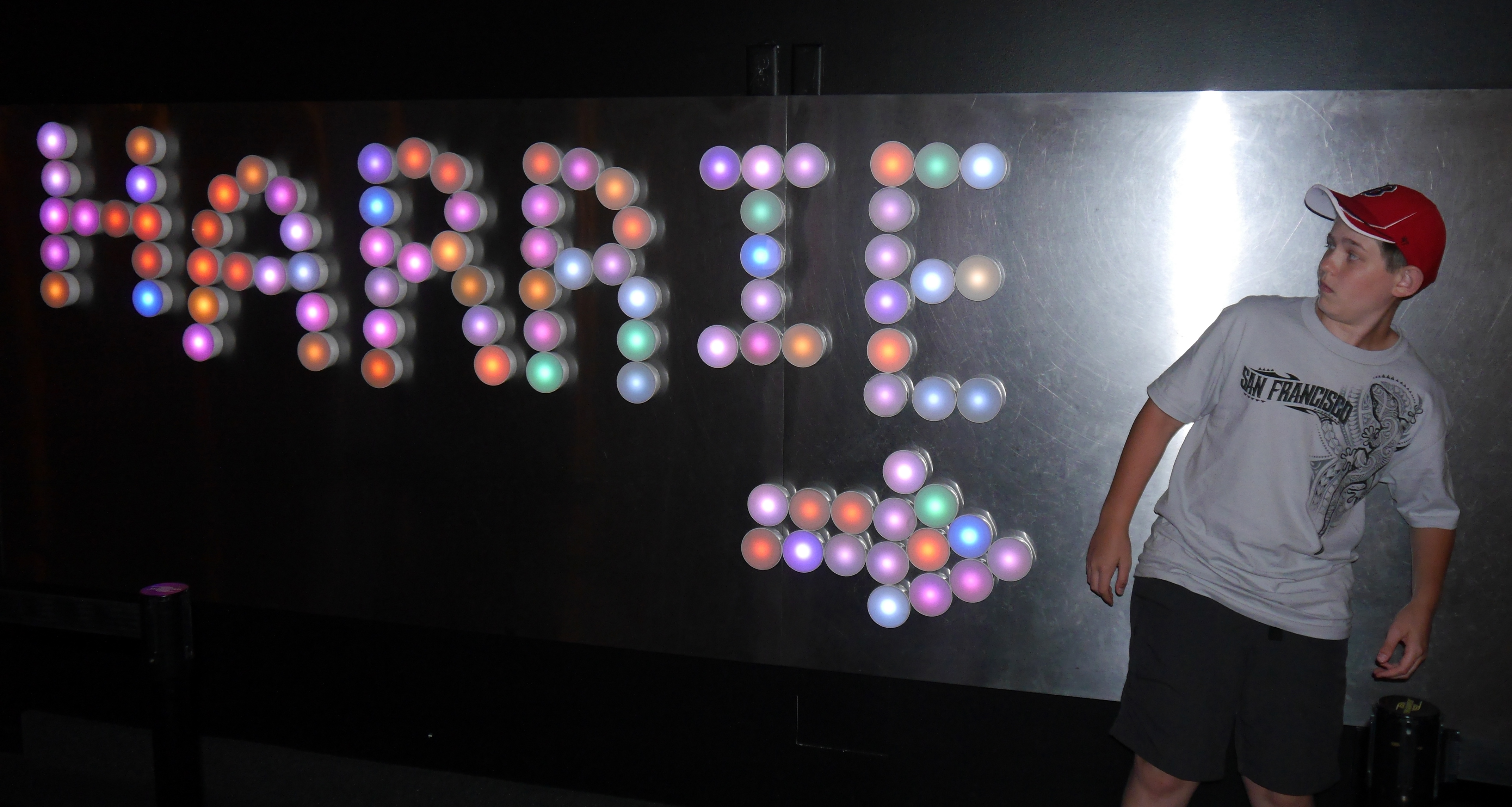
Harrie hogged all the LED magnets to create this homage to himself.
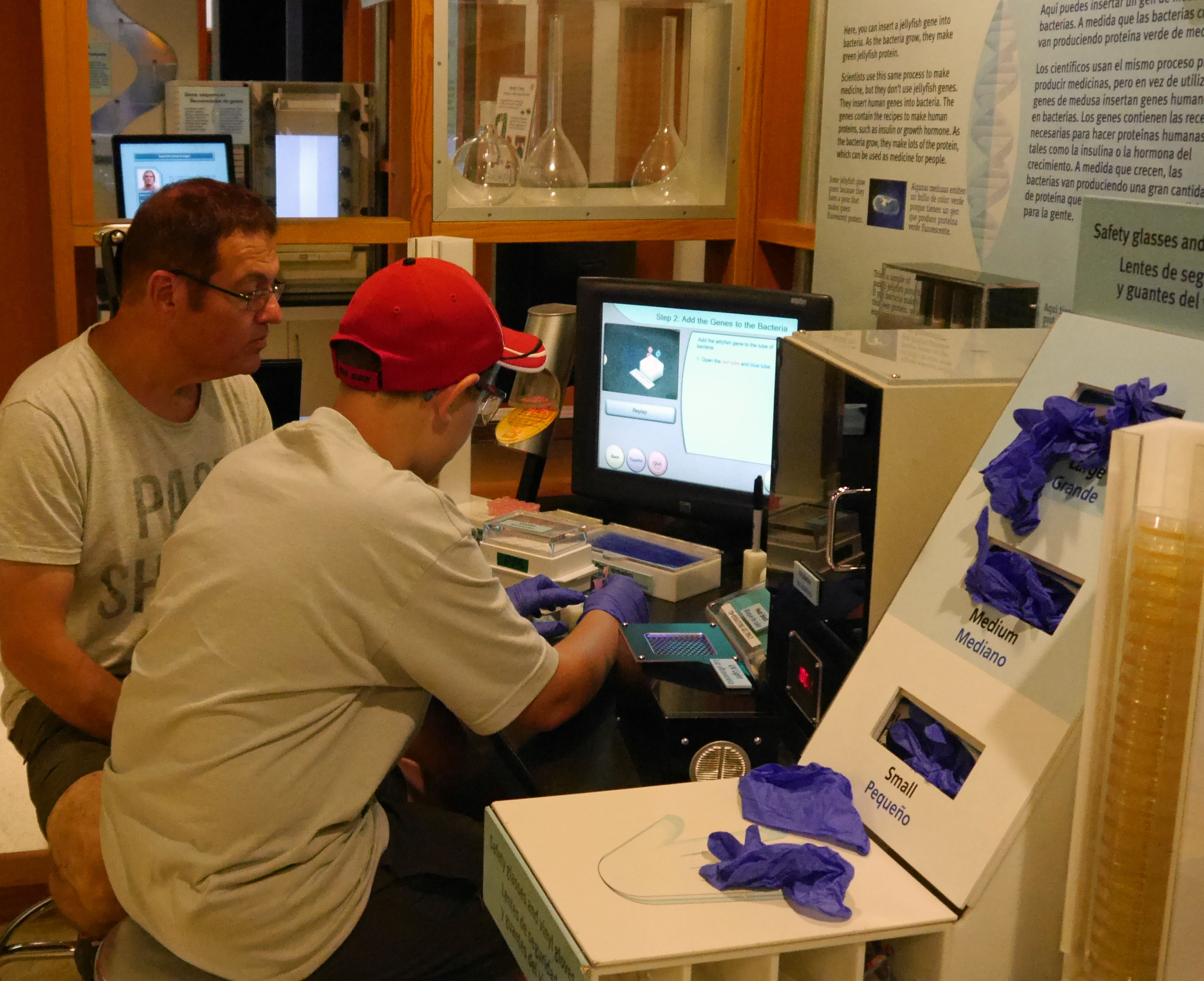
The Tech Museum’s Wet lab where we donned gloves, used pippettes’, petri dishes and all the other stuff associated with a biological wet lab. I felt like we were either in an episode of CSI or genetically engineering a monster for Jurassic Park.
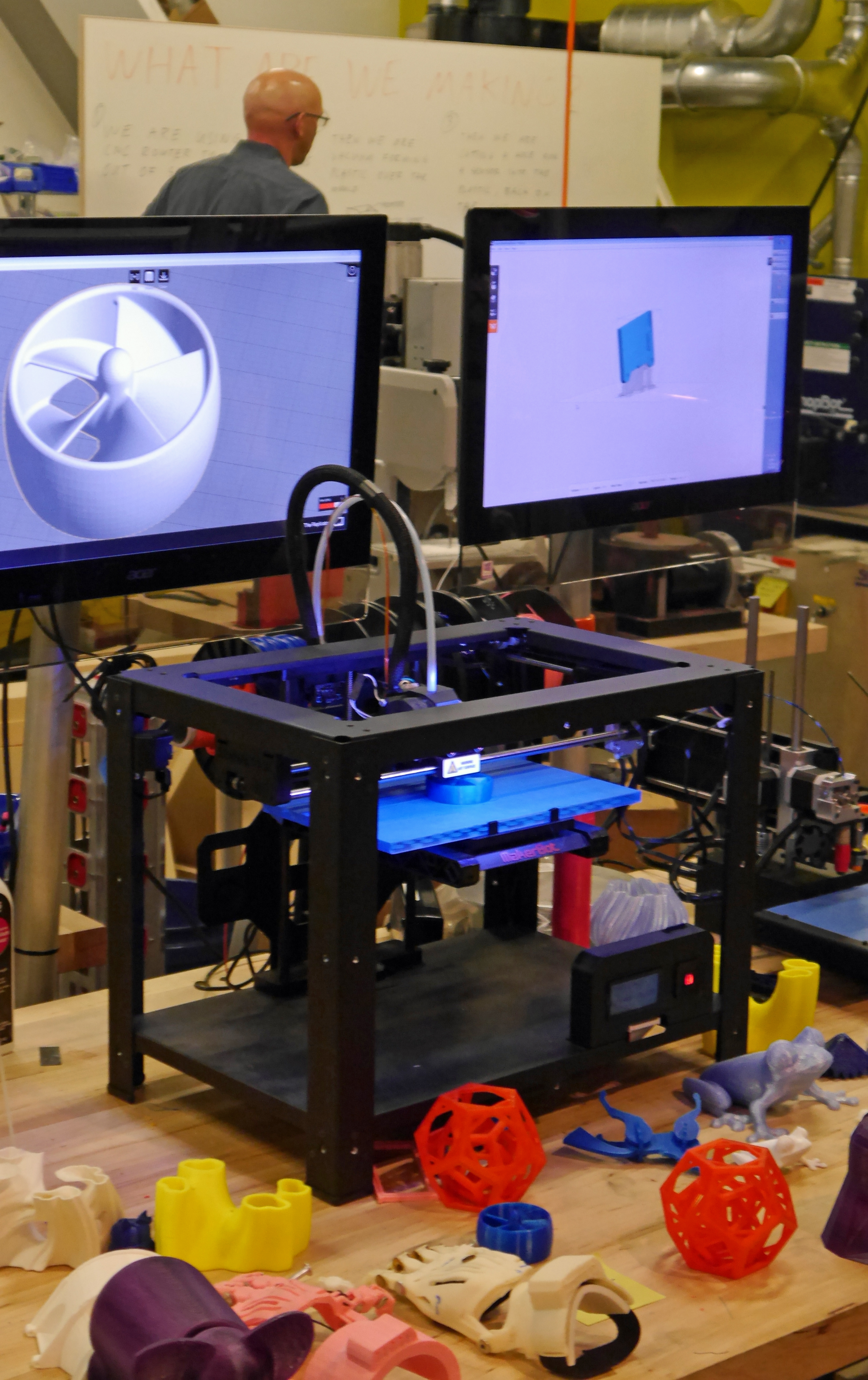
We didn’t have time, but visitors can design 3D objects and have them printed on the museum’s 3D printer.
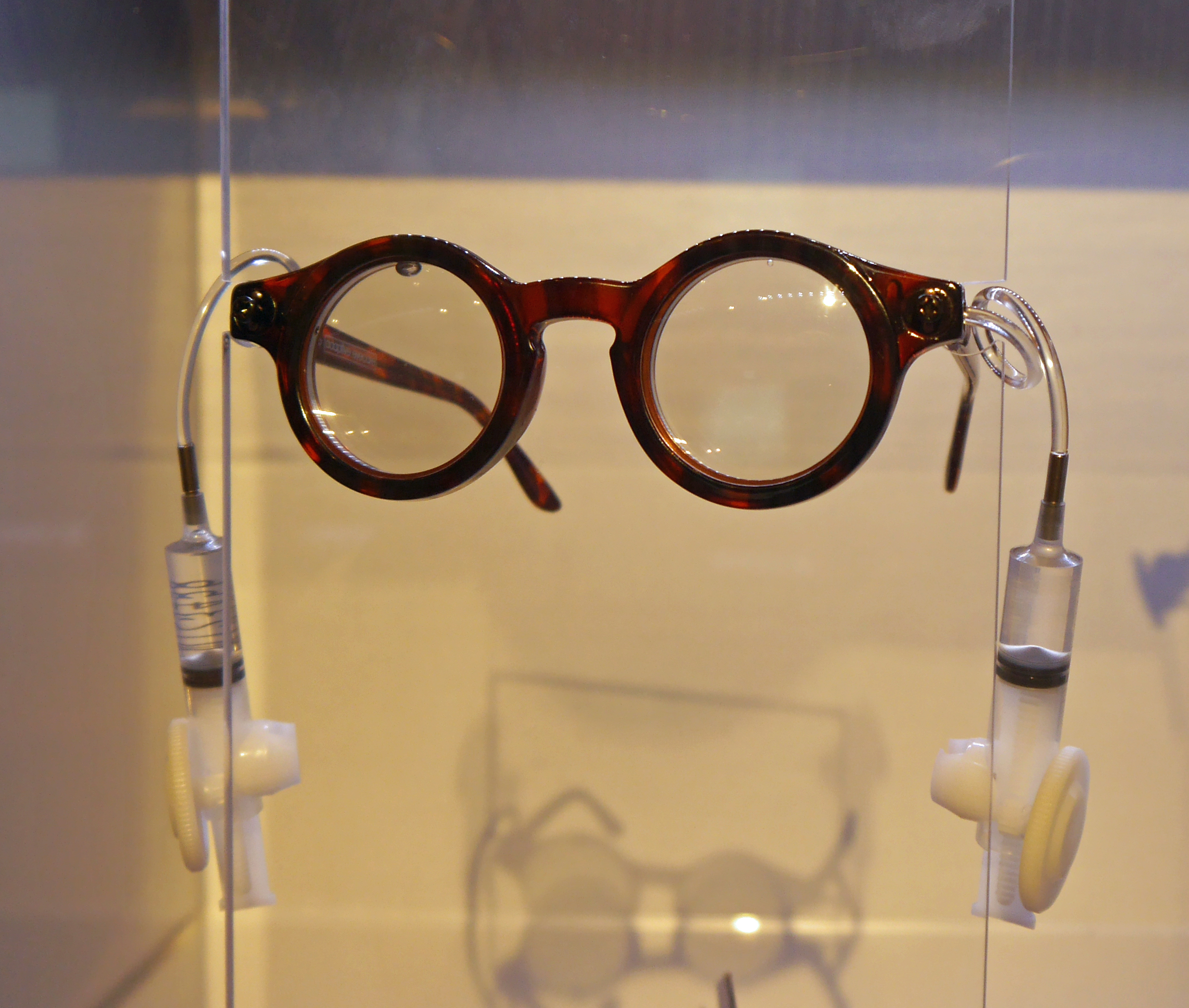
There was a special exhibit on technology to improve developing world countries. This was my favourite – AdSpecs. These are glasses that can be adjusted by the wearer to change the magnification in each lens. It works by pumping or withdrawing water from the hollow lens membrane. This changes the degree of refraction in the lens to suit short-sighted or long-sighted people. The idea is brilliantly simple and affordable to the estimated one billion people who can’t afford prescription glasses.

Robot portrait of Michelle.

Simon

Harrie

Driving from San Jose to Santa Cruz.
Santa Cruz
We drove from San Jose to Santa Cruz and arrived just on nightfall.
We had wanted to go to a six screen drive-in nearby but were disappointed to find it was closed. So instead, we walked from our motel down to the boardwalk which reminded us of Coney Island and the glory days of old amusement parks. Everything was closed as it was a week night but the place came alive in our heads. We walked past the grand old Cocoanut Grove Ballroom which was a big deal back in the Big Band era. I could almost here an announcer say in a rising voice “Live from the Cocoanut Grove, it’s…” as we basked in the green light of the Ballroom’s distinctive neon sign.
We walked out on the Santa Cruz wharf and ate a nice seafood dinner in a family-run restaurant that stayed open solely for us. As we ate we saw a full moon ascend in to the night sky. I had never seen a moon so big in all my life. I could visibly see landmarks without a telescope and its illumination was like a night time sun. It made me appreciate why people used to talk about the man in the moon as you could definitely make out a face if you looked at it in a certain light. I was only sorry, I hadn’t taken our camera to properly capture it. My phone photos did not do it justice.

Under the Boardwalk, down by the sea at Santa Cruz.
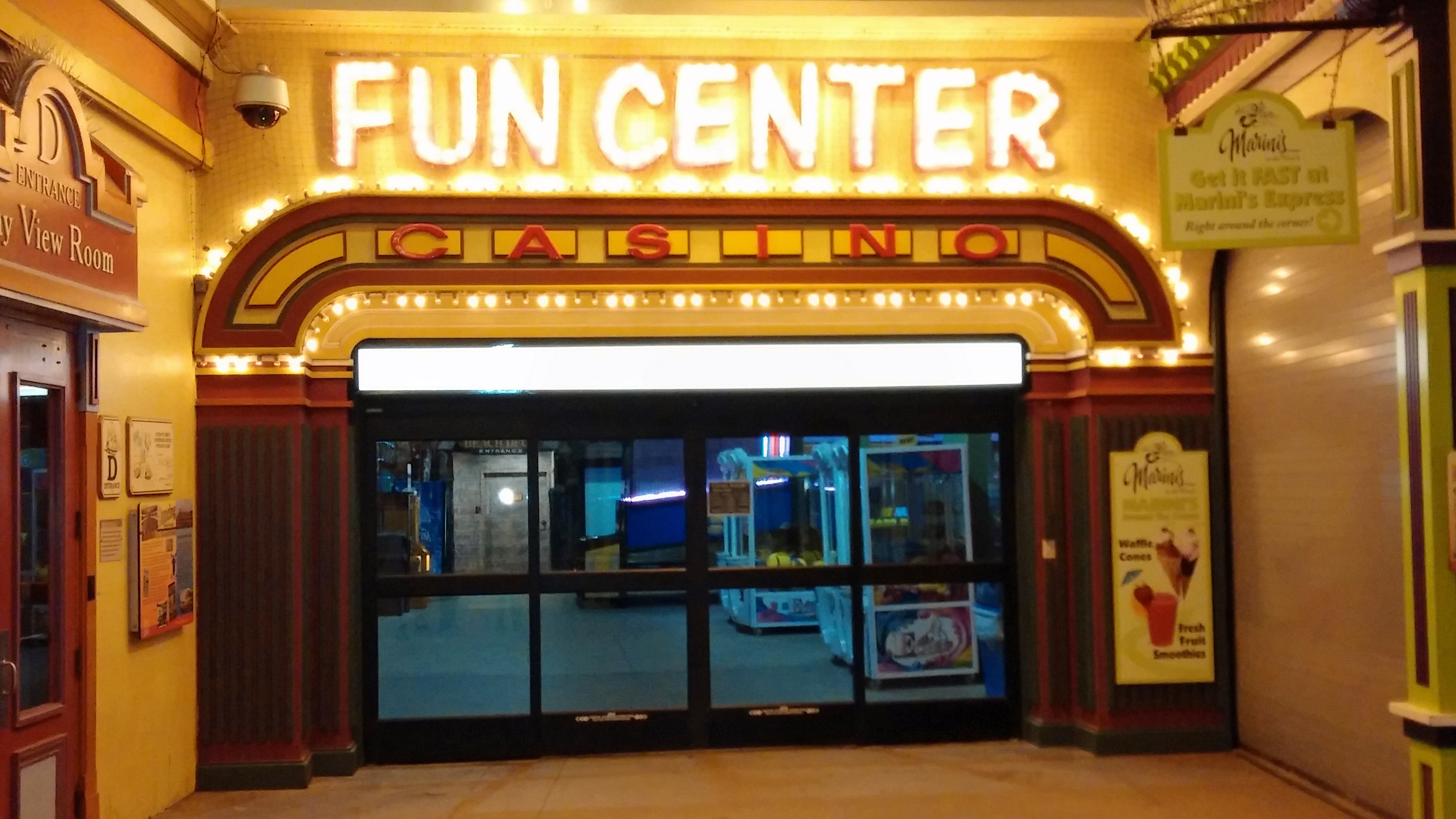
The old side entrance to the Cocoanut Grove Casino. Now an amusement centre.

Two hominids get to know caveman cat Alley Oop. The hominid on the right is a mean motor scooter and a bad go-getter.
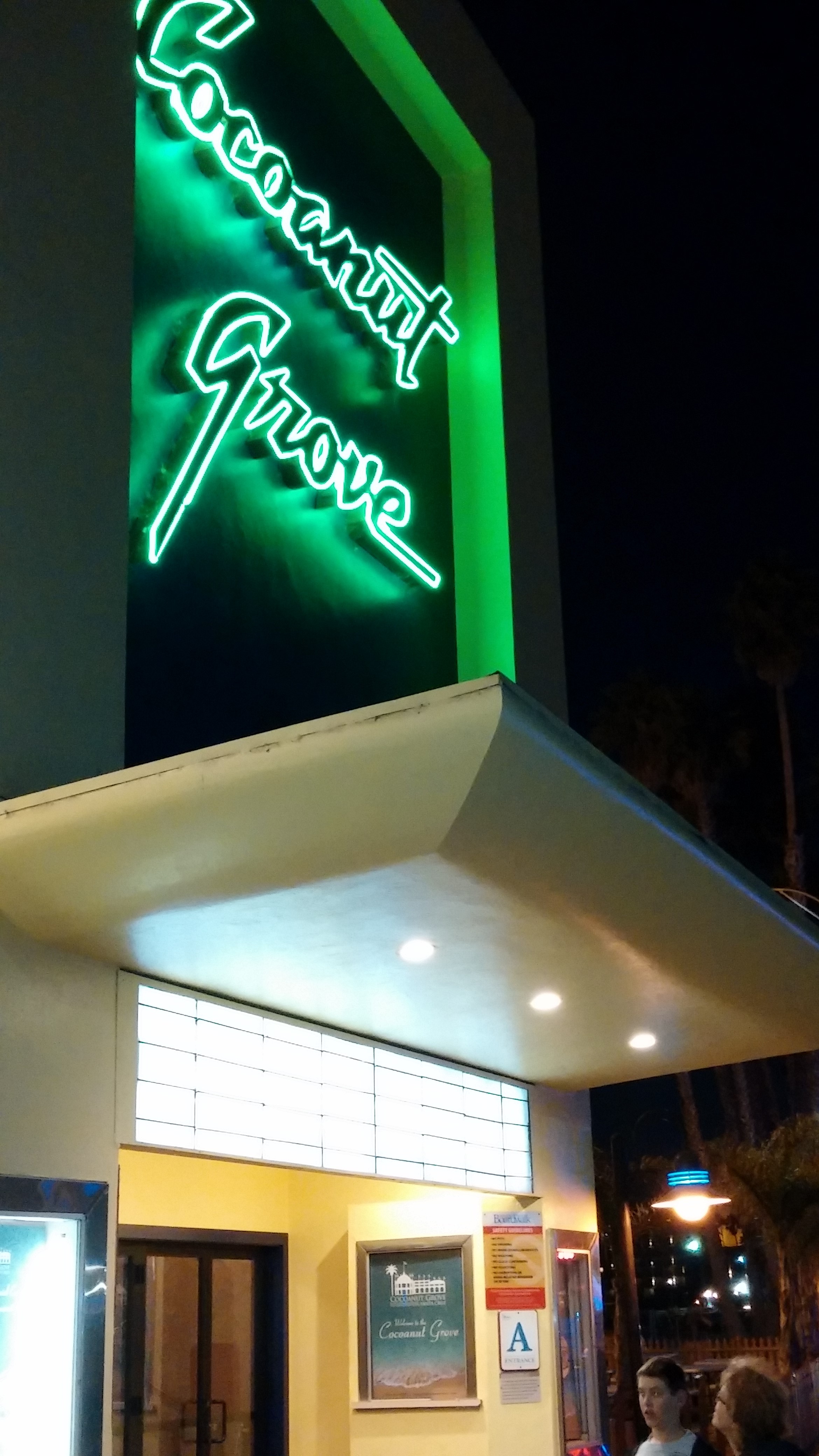
The Cocoanut Grove Ballroom and Casino. Built in 1907, it attracted all the big names in the thirties and forties before becoming synonymous with cheezy televised beauty pageants and seventies TV specials.

The massive moon we saw from the Santa Cruz wharf. My phone couldn’t do it justice but it does show you how bright it was.

Here is a professional photo from the Internet on how the moon looked. Here you can see the eerie face of The Man in the Moon.

Driving from Santa Cruz (A) to University of California (B) to Capitola By The Sea (C) to Monterey (D).
University of California
Having studied at the University of California, Santa Cruz 25 years ago as part of a student exchange program, Michelle was keen to visit the campus again on this trip so I’ll let her tell it in her own words:
Michelle here: In 1989, UC Santa Cruz was the most beautiful campus I had ever seen, with redwood forests between the colleges, deer roaming freely at the bottom of the forest valley and gorgeous views of the sun setting over the Pacific on the ocean side. It is still unique in its design and landscape. I used to walk to classes over footbridges (see photo below) stretching above the valley floor, which I always looked forward to. The local bus service was free for all students so I was able to travel at my leisure to the famous Santa Cruz boardwalk for clam chowder, the cafes of downtown Santa Cruz for books and hot chocolate and to the beautiful neighboring seaside suburbs like Capitola by the Sea for movies and beach walks. After 25 years, Santa Cruz seems like a metropolis now, with its people, tourist hotels and freeways. Not the quieter, lazier place I remember.
I lived in a group apartment in Kresge College, established in 1971 with money from the K-Mart family. The College was designed with the concept of participatory democracy as a means of encouraging a strong sense of community. I chose Kresge over the other colleges because it had a reputation for attracting people that embraced a post-hippie, left wing counter culture. This was romantic and magnetic to someone like me who had demonstrated against the introduction of student fees at Australian universities and American bases in Australia. I had also studied the anti-war movement of the 1960s and 70s so a counter culture experience of California was the one for me. However, while liberal and right on, the counter culture days were in the past and one of my flat mates, conservative and well groomed at all times, openly admitted she was only at college to find a husband. I wonder what happened to her. It did however, have a community food coop, which was still there in the same place in 2014.
My main memories of Kresge College are the long hours I spent in the dark room developing photos and trying to be artistic, the five young American girls, mostly from rich families, who shared my apartment (this was the first time I was exposed to the ‘valley girl’ language – Total!) and the college’s ‘clothes option’ clause. Whether this clause actually existed or not (I found nothing about it in my research for this blog) it was a great story that residents told to highlight how liberal they were, compared with the more conservative colleges across the redwood forest valley. The clothes option clause was only exercised by two male residents on Kresge day during the time I was there. Kresge day was essentially a day of underage drinking, music and dope smoking and an opportunity to let it all hang out. It was a mixed experience. My valley girl flatmates were much younger than me. They could be quite trying and I had to share a room with a whiny, needy crazy one. They were addicted to the soap, Days of our Lives and made sure they were all back home for lunch at midday when “Daze” was on. I have to confess that I too, became addicted for the time I was there. It was a lunchtime ritual we all enjoyed and it probably brought me closer to them. Nevertheless, my time at Santa Cruz gave me the all American college experience of the movies and TV that I had grown up with. This after all, was one of the reasons I applied for the exchange program in the first place. Cultural immersion – it’s the only way to go! I left the country understanding why people said it had the best and the worst of everything. It does and I loved it. Fantastic to return there for more adventures with my loved ones in 2014.
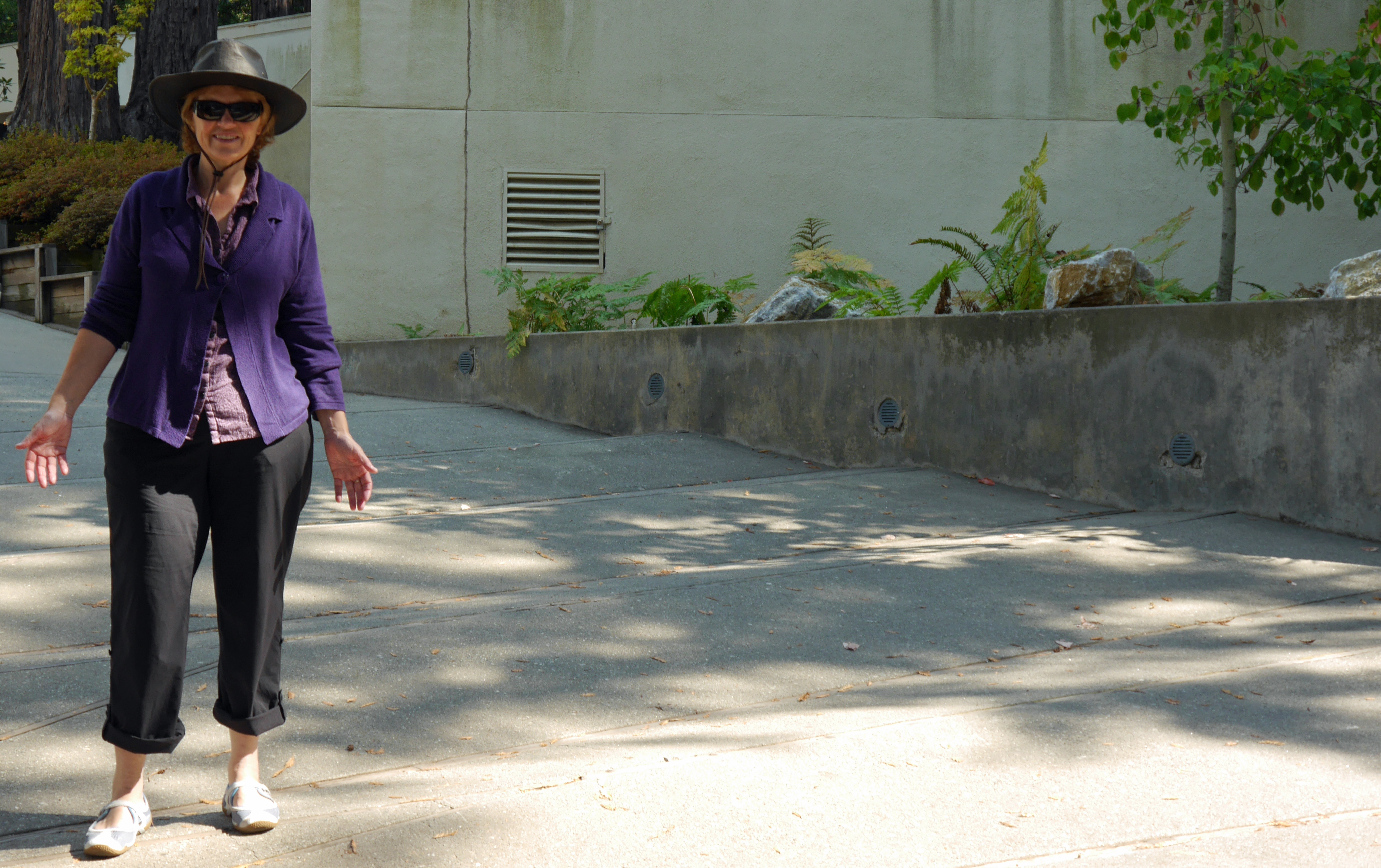
Above: I am standing on the supposedly ‘riot proof’ stairs at Kresge College. Legend has it that the ‘stairs’ were designed to prevent the Berkeley style student riots of the 1960’s. They were not uniform so a mob would find it difficult to move quickly together without injury. I also remember being told that the college design of the Santa Cruz campus was meant to prevent large groups of students from gathering like they did on the Berkeley campus. While these legends were much discussed in my time there, I have found no mention of them in my research for this blog. If you have a any information about the design for this purpose, please comment.
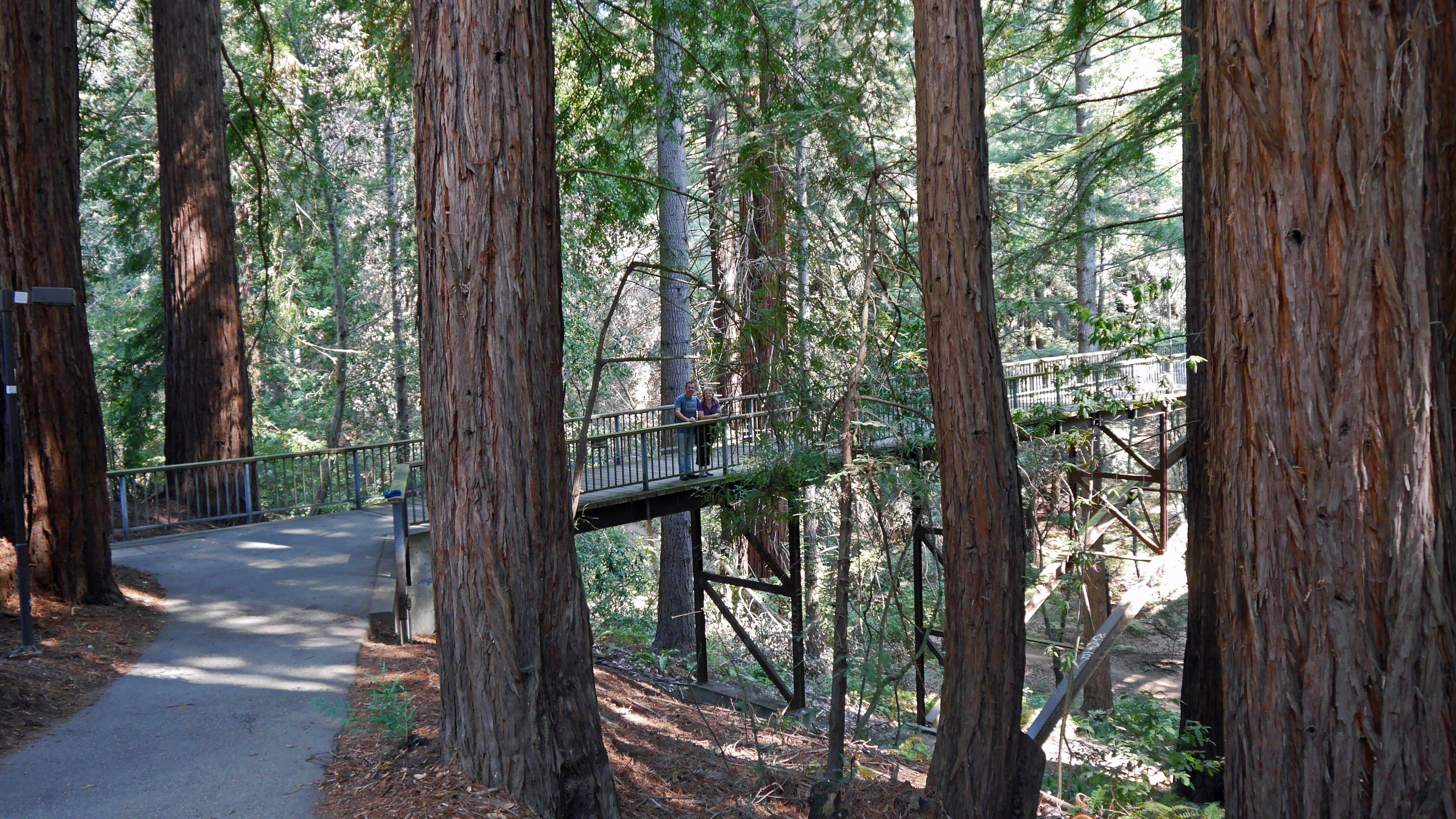
Simon and I standing on a bridge that traverses one of the redwood valleys between colleges. We saw a few deer the day we visited but didn’t get our cameras out quickly enough. What amazes me is that I studied photography when I was at UC Santa Cruz but didn’t take any photos of the forests, deer or the landscape in general. I guess that’s the difference between being young and being middle aged.
Capitola By-The-Sea
Still Michelle here. After leaving the residence at Kresge College during Spring break, in 1989, I boarded in a house in nearby Aptos for the Spring semester. Aptos was close to the gorgeous seaside town of Capitola By-the-Sea. My memories of Capitola were of the colourful houses, the many seagulls and the families building castles on the sandy banks where Soquel Creek met the sea. But most of all, I remember the beautiful old Capitola Theater or ‘The Cap’ on the waterfront. The Cap was a family owned cinema which showed a double feature on Sunday afternoons. I often went there for a lazy Sunday outing as it suited my student budget and indulged my passion for movies. It didn’t matter that the Cap showed films months after they were released in more expensive cinemas. I used to buy a Butterfinger chocolate during intermission – my first experience of food that mixes chocolate and peanut butter! I also have great memories of sunny afternoons walking on the beach after the movies in the sun and watching all the people go by and do their seaside thang. If you know the Cap, you may enjoy reading these reminiscences from others who enjoyed the Cap as much as I did. Sadly, we were told by a jogger stopping for a water break, that the Cap had stopped operating as a theater a decade ago and the building was demolished in 2010.
In 1989, it always seemed to be sunny in Capitola. When I visited again in September 2014 with Simon and Harrie, it was a cold, windy theaterless afternoon. It was also a much busier place and we had to endure a mega traffic jam to get there from Santa Cruz. I guess too many people had discovered this jewel by the sea. Michelle signing out.

Monterey
Simon back again. After leaving Santa Cruz, we drove to Monterey to check out the former capital of California and home of John Steinbeck. Back in the 1800s, Monterey was the place where California’s first public infrastructure sprang to life. California’s first school was built here along with its first library, theatre and newspaper. Monterey’s big industry however was fishing and the associated sardine canneries that sprung up along Cannery Row. John Steinbeck who grew up in nearby Salinas, best captured the place in the opening of his novel Cannery Row:
“Cannery Row in Monterey in California is a poem, a stink, a grating noise, a quality of light, a tone, a habit, a nostalgia, a dream. Cannery Row is the gathered and scattered, tin and iron and rust and splintered wood, chipped pavement and weedy lots and junk heaps, sardine canneries of corrugated iron, honky tonks, restaurants and whore houses, and little crowded groceries, and laboratories and flophouses. Its inhabitants are, as the man once said, ‘whores, pimps, gamblers, and sons of bitches,’ by which he meant Everybody.”
By the 1950s, the place had been over-fished and under-developed and its working class population drifted away to find other work. Tourism is now the main industry of Monterey and perhaps its best attraction is the Monterey Bay Aquarium.
Built in the old Hovden Cannery, the Aquarium holds 623 different species in over 100 different tanks. It was established by David Packard (of Hewlett Packard fame) in 1984 as a present to his marine biologist daughter Julie Packard who remains the Executive Director of the Aquarium (I’m sure there was a rigorous merit-selection process).
The displays were some of the most beautiful displays we had seen in any aquarium. This was largely due to the exquisite lighting and the rhythmic surge of waves in many of the tanks due to the pumping of fresh ocean water from Monterey Bay. But this is an unusual aquarium in that the most mundane creatures are its most exciting exhibits. Yes, it has the showy animals like sharks, turtles, and otters that attract most visitors to aquariums but you leave the place being more impressed with sardines, jellyfish and kelp.

Cannery Row, Monterey.
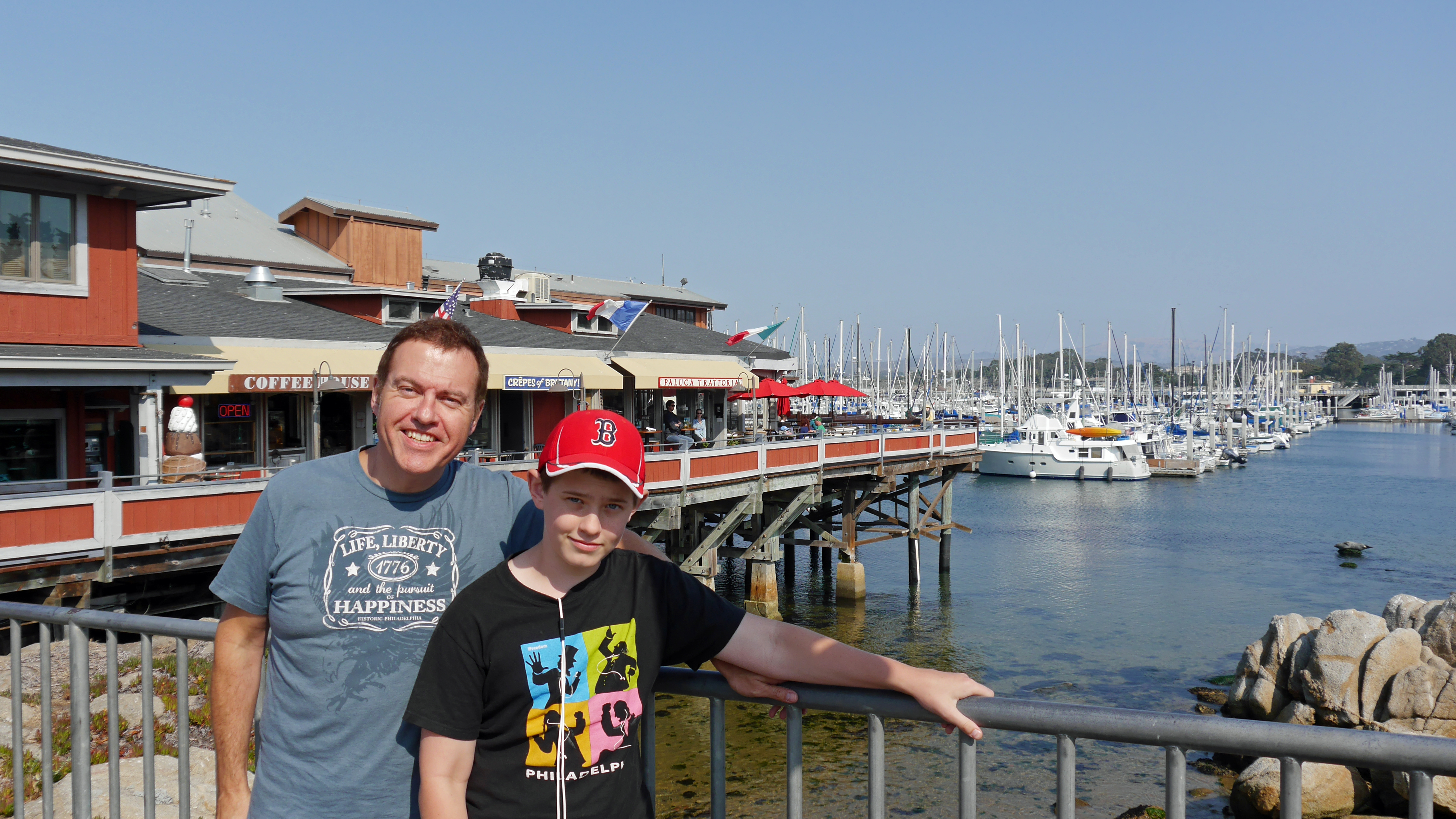
Looking across to the Marina at Monterey.

Statue of John Steinbeck. As travellers on Route 66, we doffed our caps and cowboy hats to the man who gave Route 66 its name of The Mother Road (from “The Grapes of Wrath”).
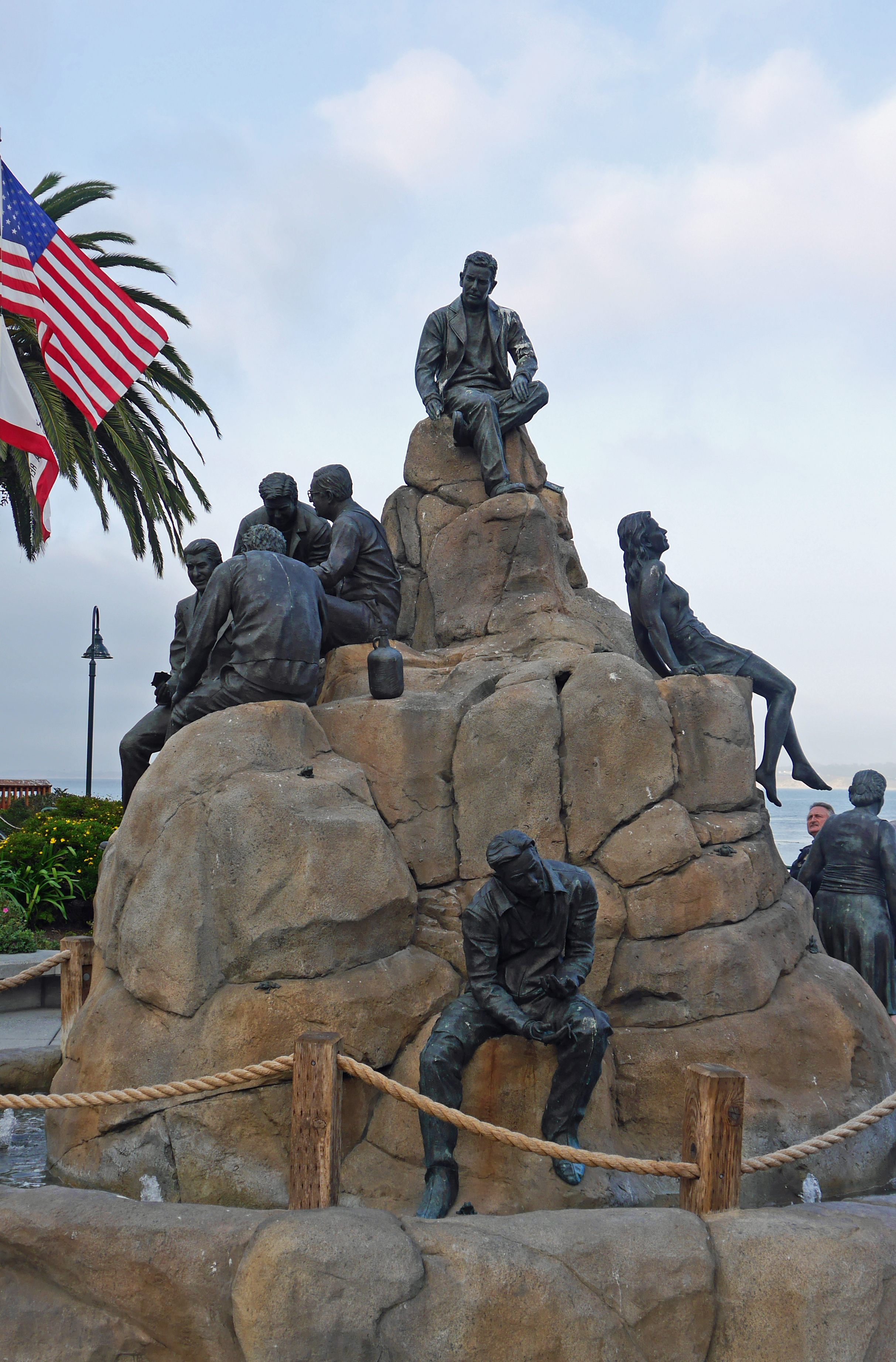
The Cannery Row Monument. The sculpture features John Steinbeck on top with his good friend, marine biologist Ed Ricketts directly below him. The four men to the left are Ted Balestreri, George Zarounian, Hary Davidian, and Bert Cutino; the entrepreneurs who revived Monterey’s commercial stocks after the decline of the canneries in the 1950s. The two women are a token prostitute and a token mother. Great to see Monterey honouring its famous women.

The bronze head of John Steinbeck gazes at the Monterey Canning Company building.
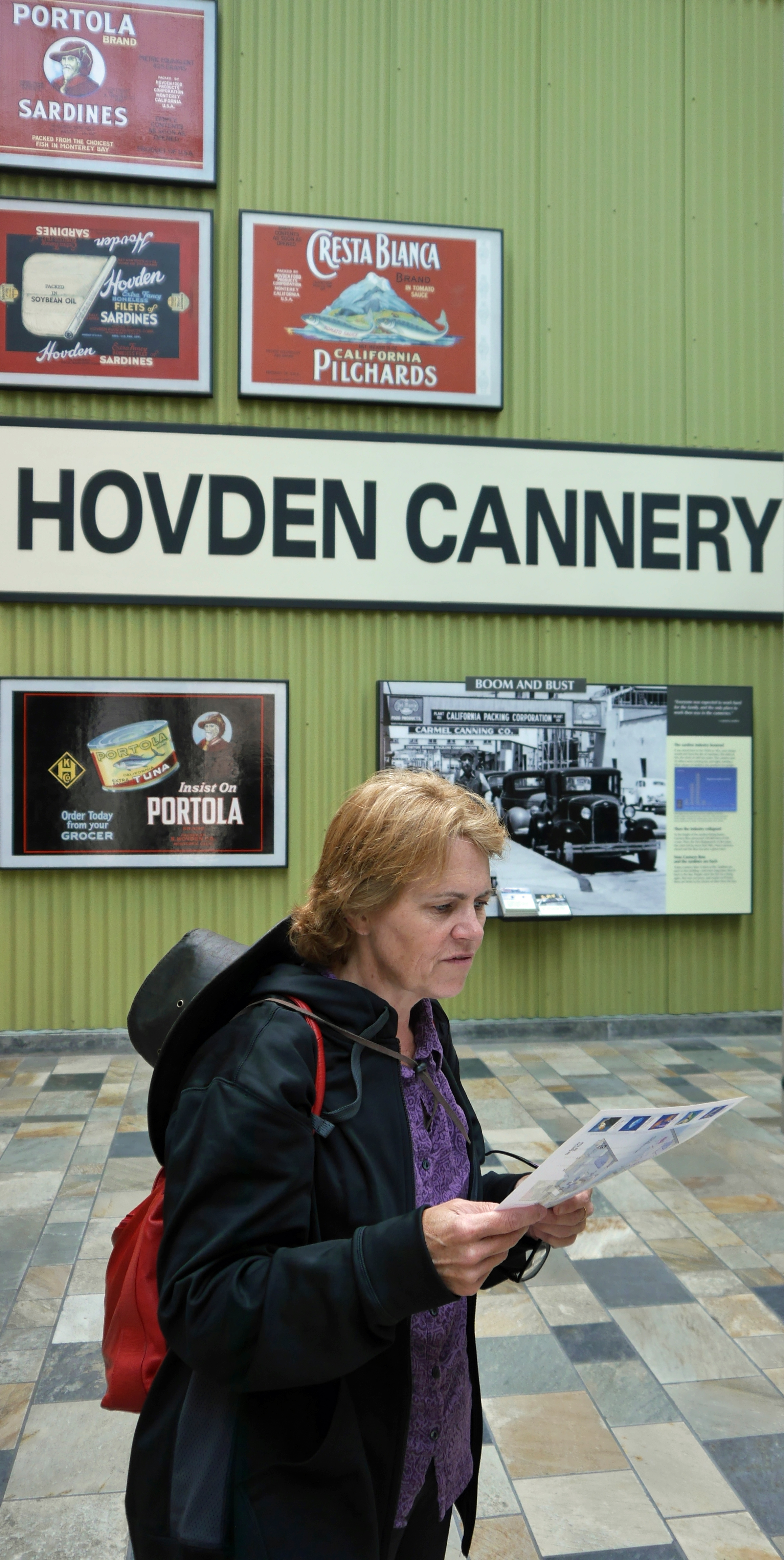
Michelle mapping out her future in the old Hovden Cannery building.

I liked this greeting at the entrance to the Monterey Bay Aquarium.

The Monterey Bay Aquarium also has a glorious view of Monterey Bay and the nearby seal colony which you can view through binoculars on the deck.
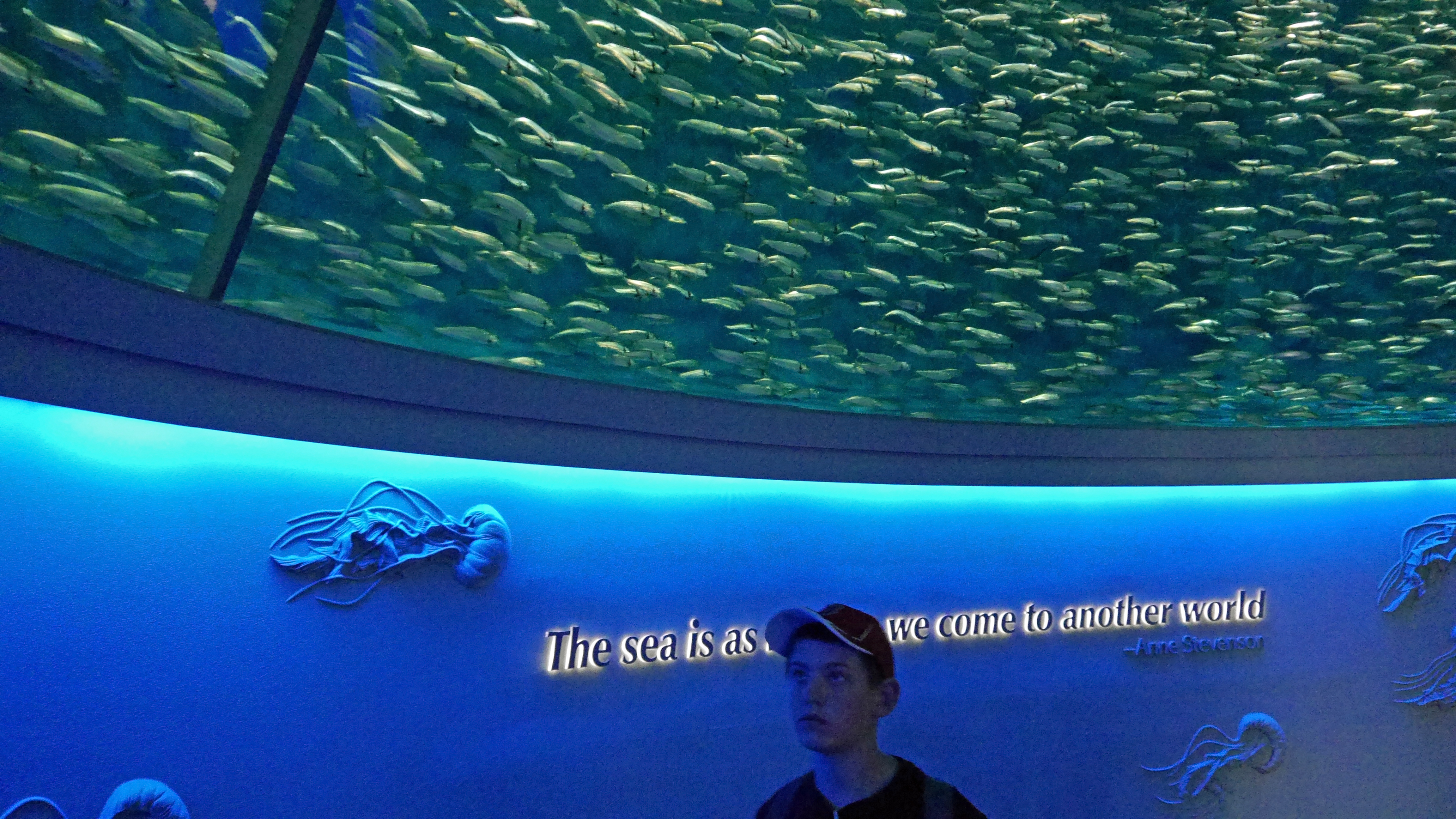
Given we are in Cannery Row, it only seemed appropriate that there was a tank housing a school of sardines. It was amazing to see them all huddled together as their silvery forms swarmed up and down the tank.

The ethereal jellyfish at the Monterey Bay Aquarium. We spent ages watching their beautiful undulating heads propel them gracefully across the tank as their wispy tentacles trailed behind them.
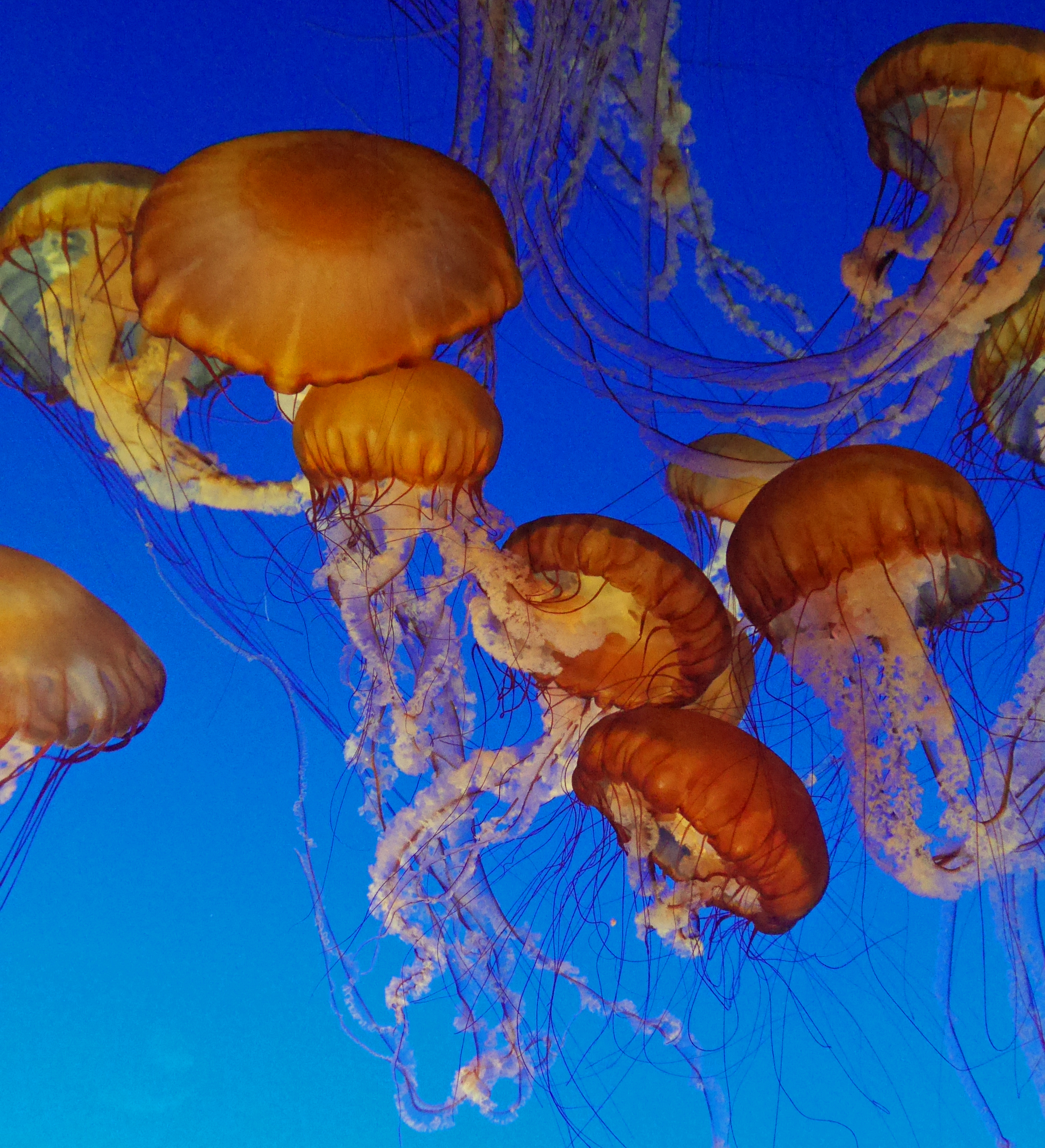
Another beautiful bloom of jellyfish.
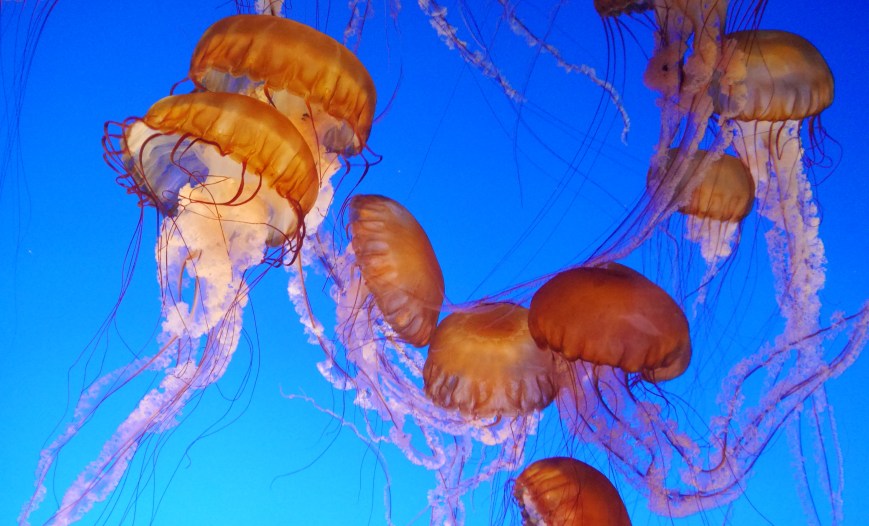
You just can’t take too many pictures of these strange creatures.
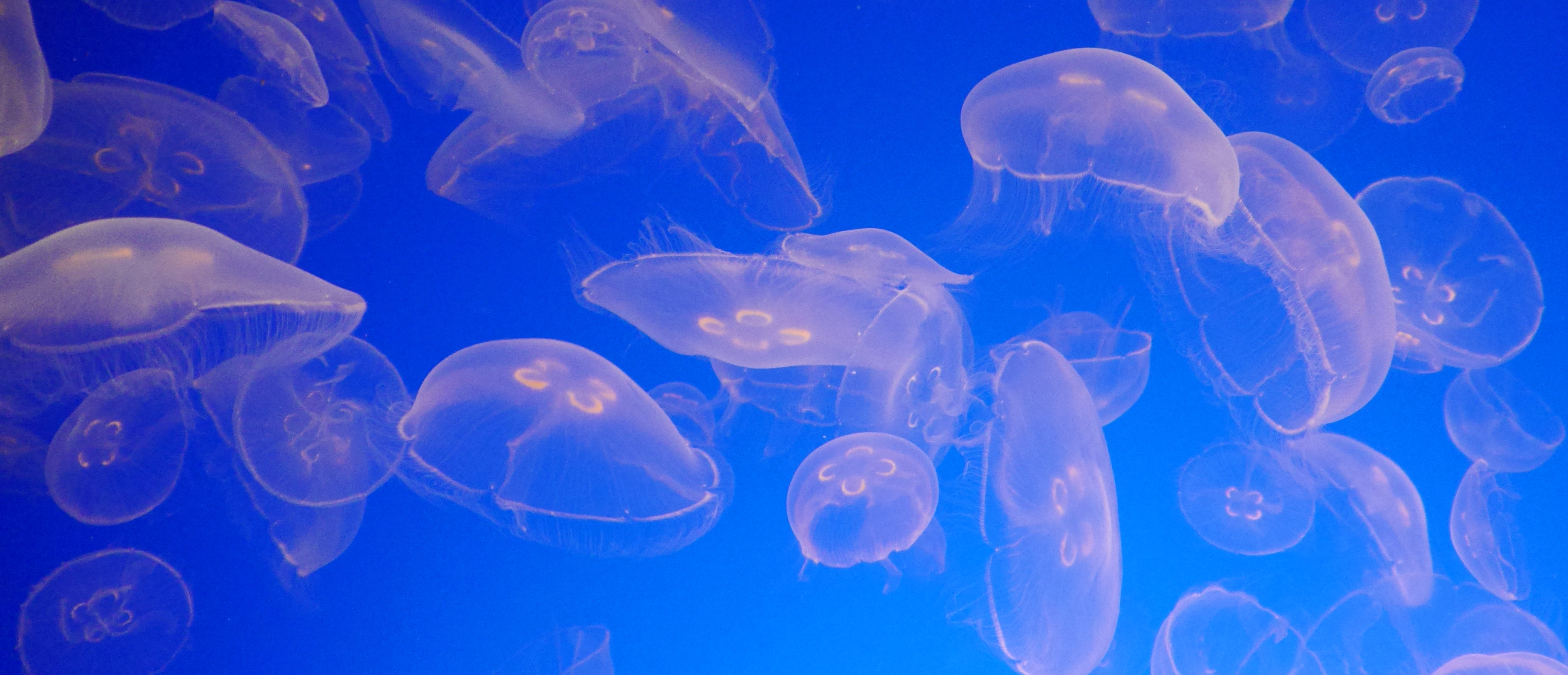
These jellyfish were like the ones I swam through in Honduras. At the time they felt all blubbery and weird. Here they looked soft and inviting.

A hammerhead shark hunts a swarm of fish. There several different species of shark in the massive central aquarium.
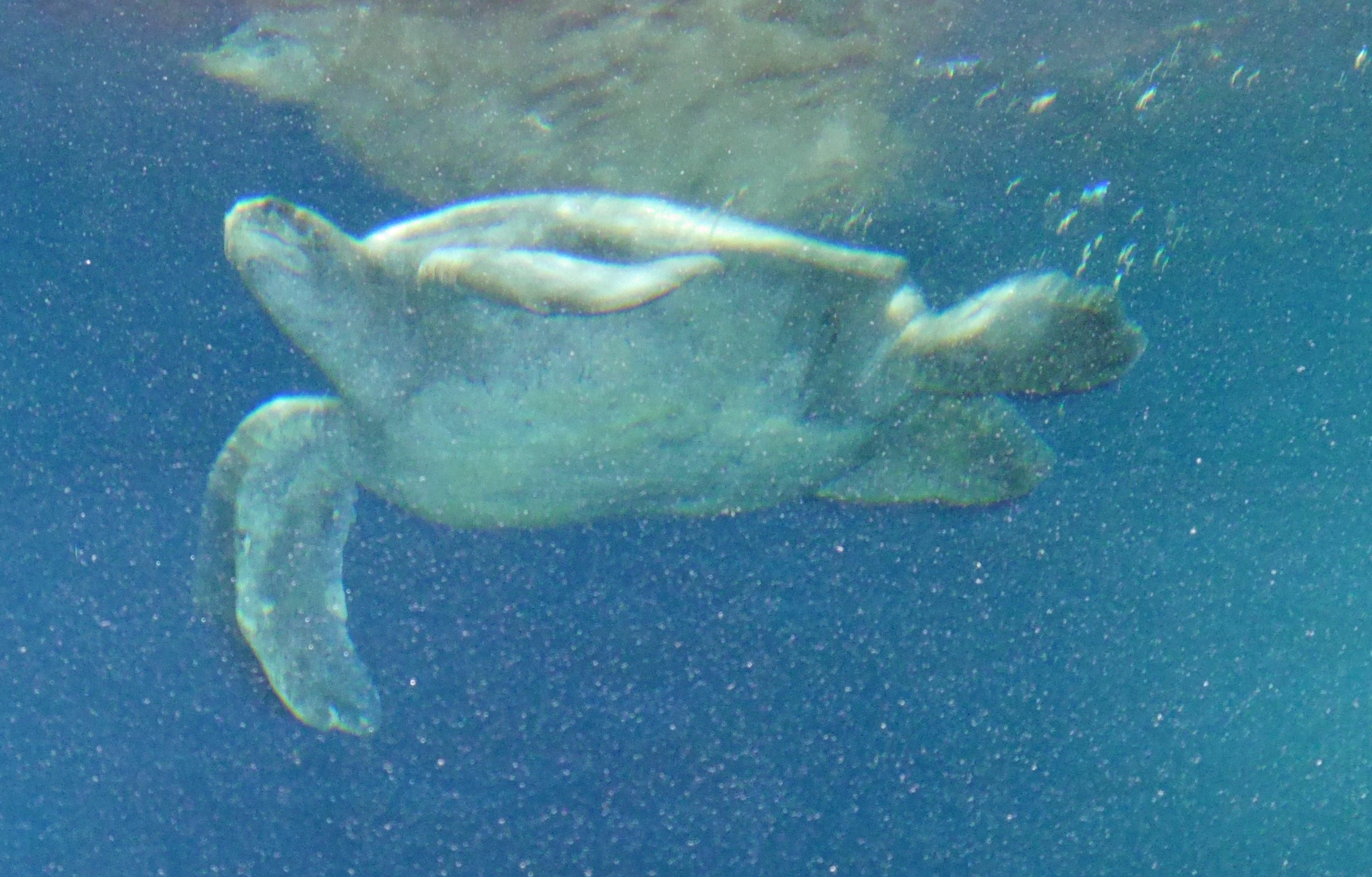
A sea turtle. It was hard to take good pictures through the magnified glass.
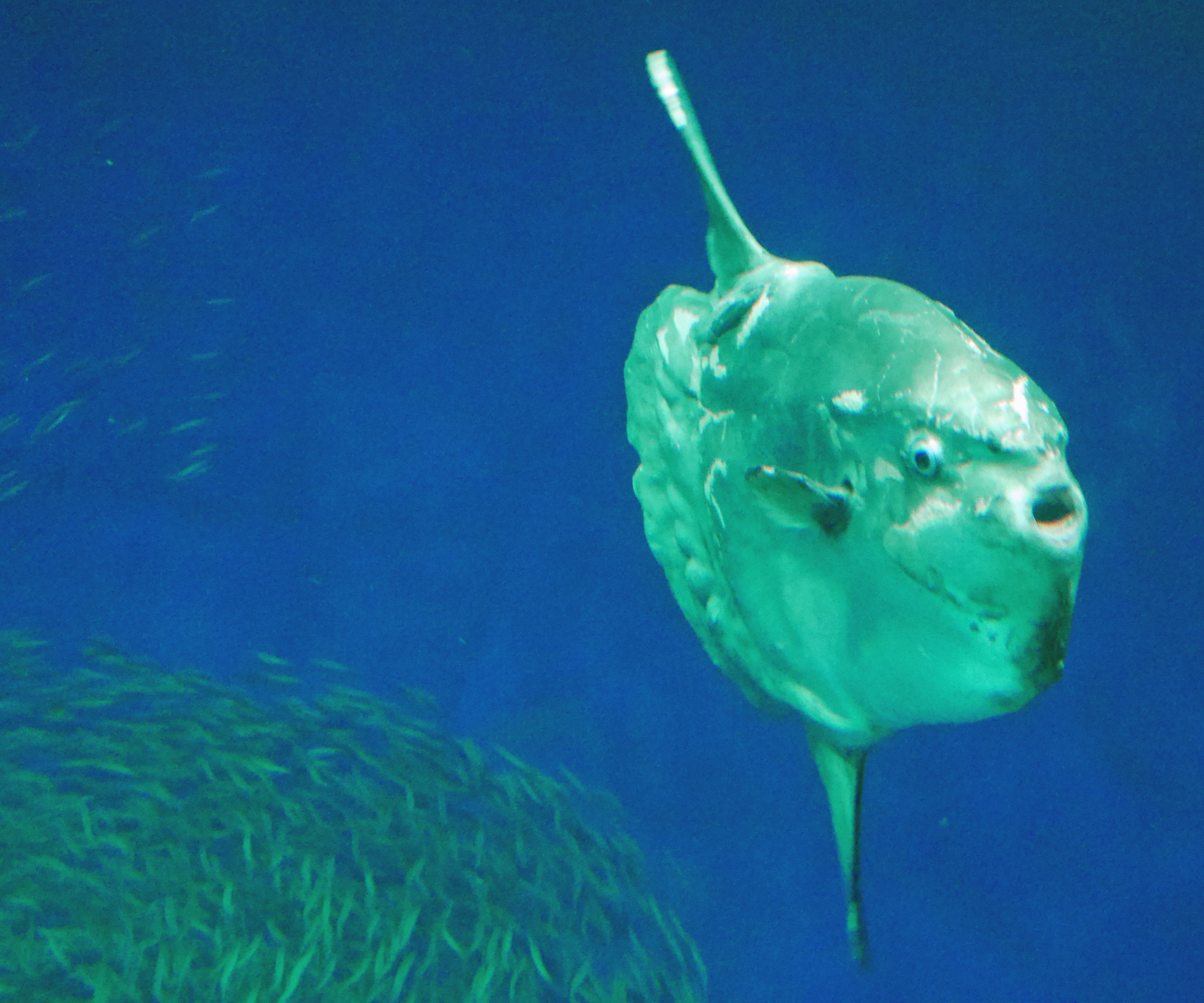
A sun fish.
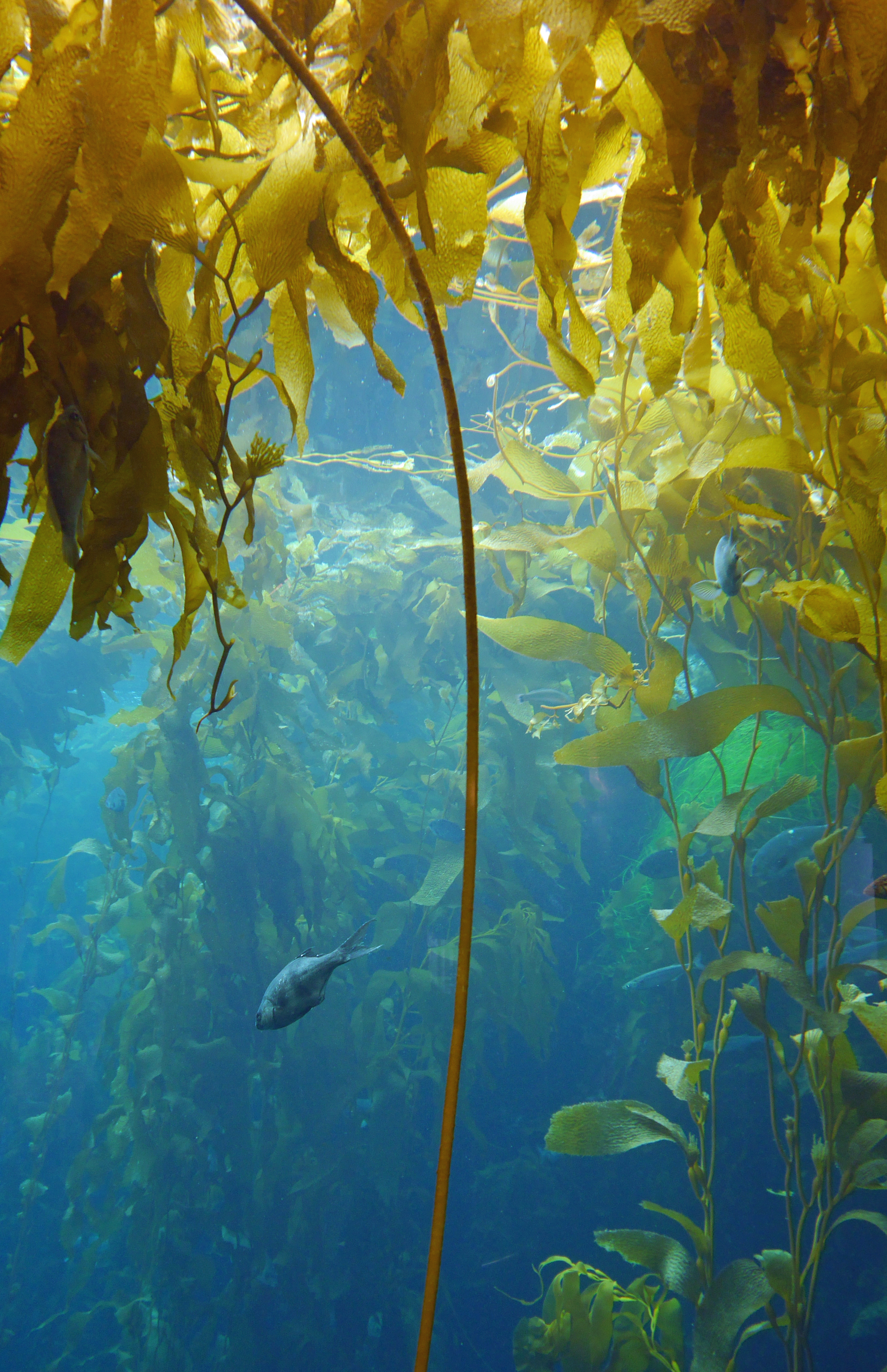
A kelp forest. Who would have though looking at a tank full of different species of kelp could be so interesting?
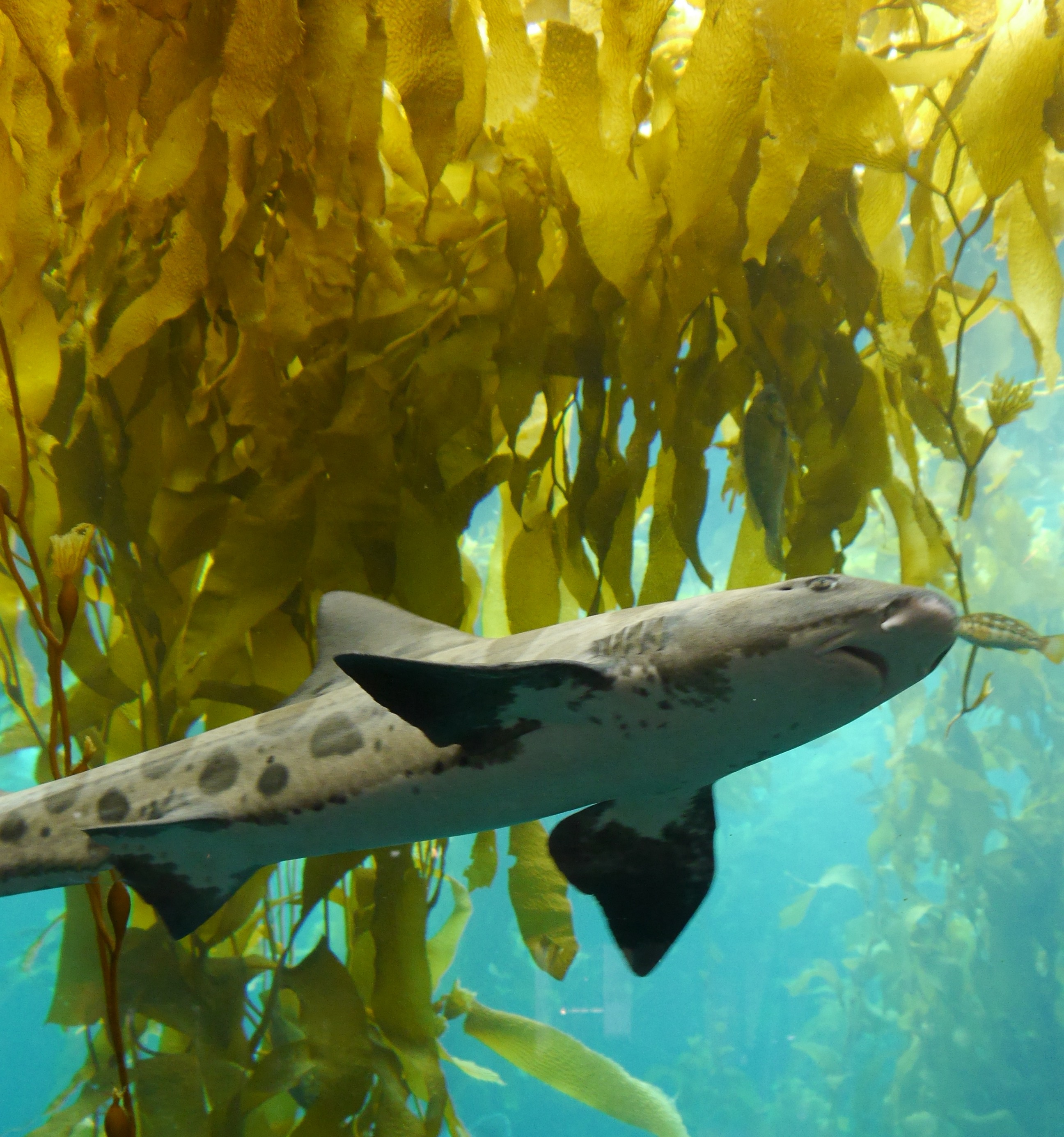
A small shark in the kelp forest. It paid to be persistent in looking at the creatures who could camouflage themselves against the different types of kelp.
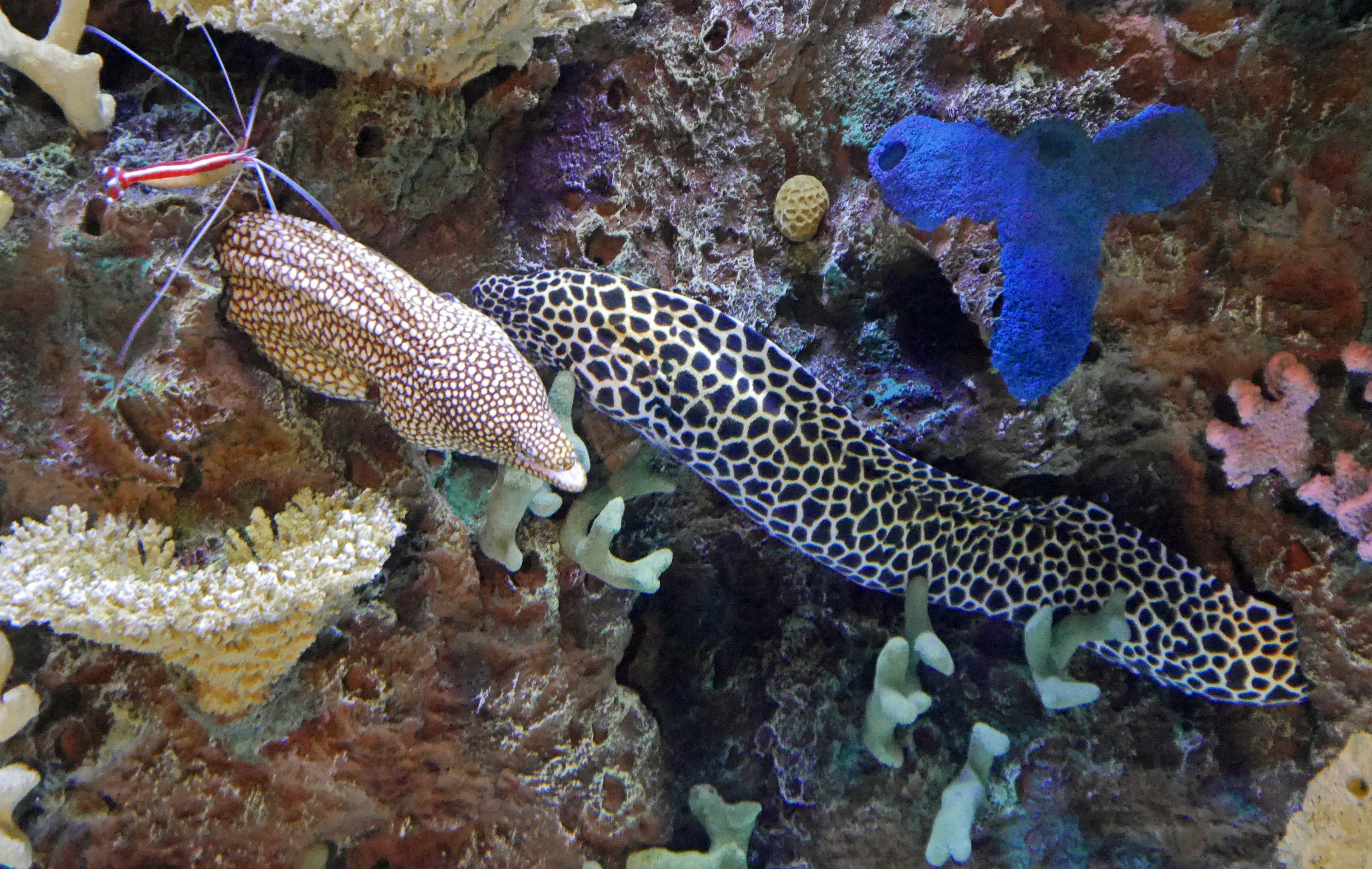
Two elated eels.
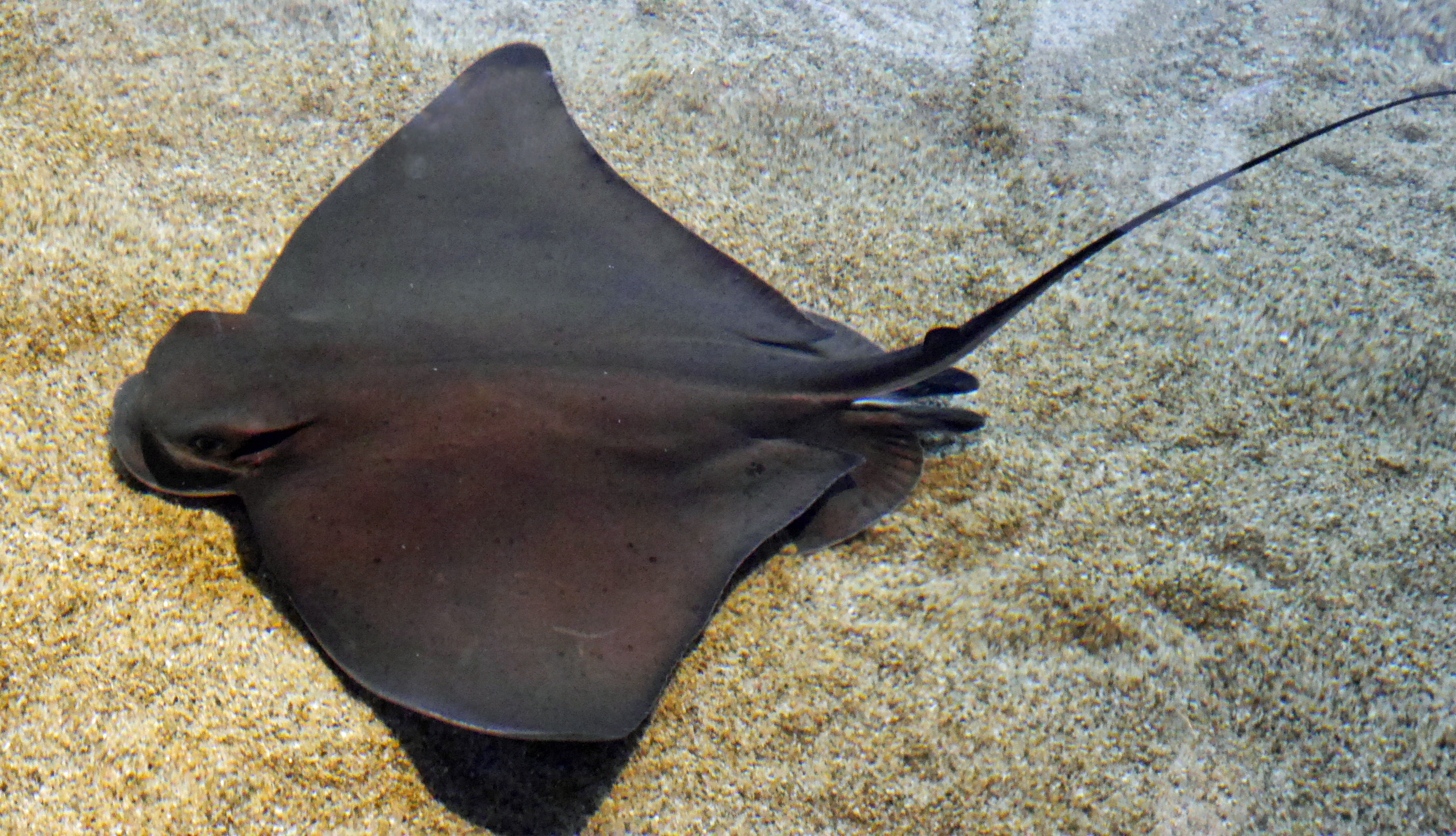
The Californian Bat Ray. Visitors are able to stroke their leathery skin without harm. We stroked the skin singing “nah, nah, nah, Bat Ray.” to the tune of the Sixties Batman TV theme song.
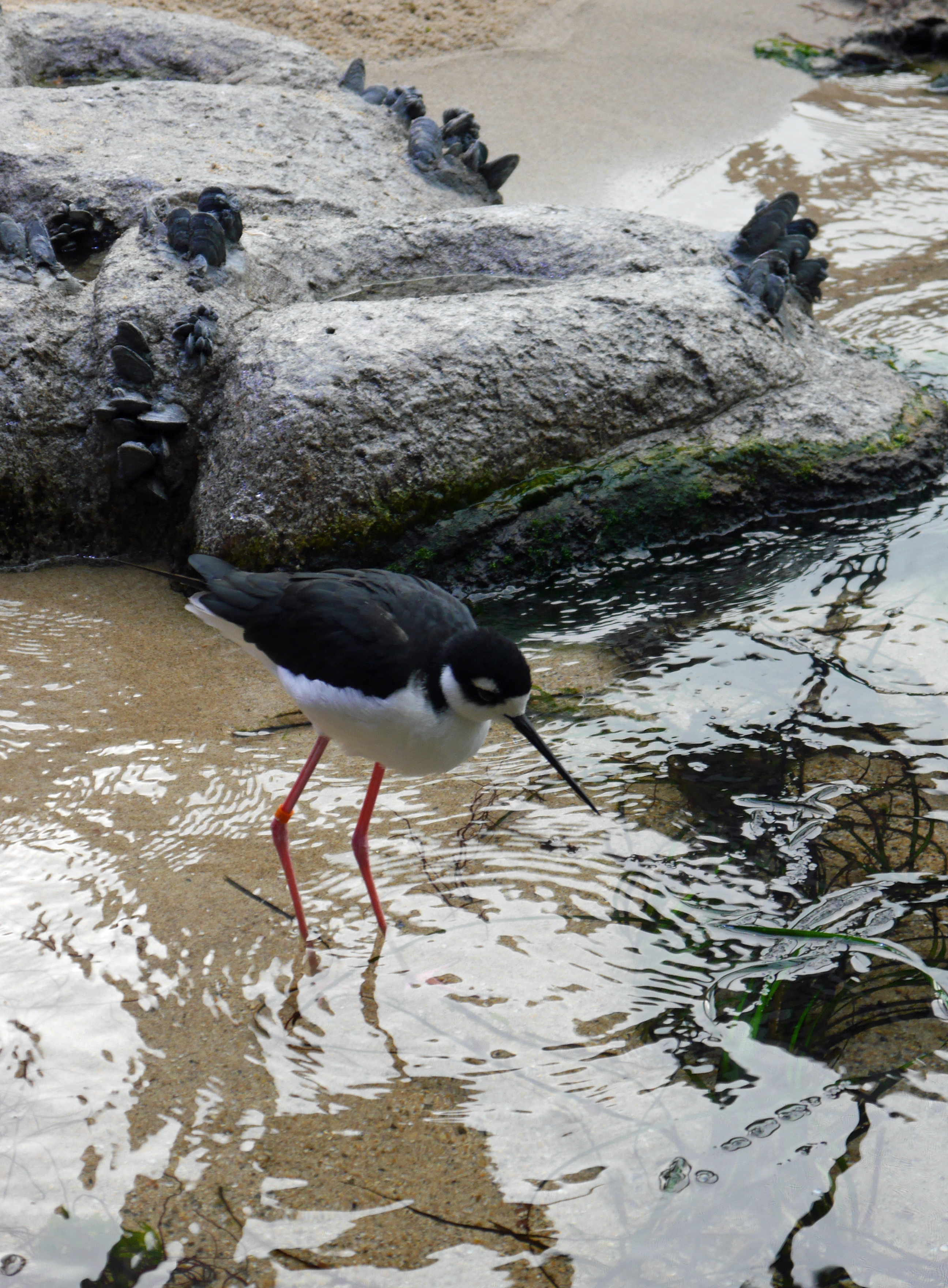
This photo is taken indoors in an enclosed artificial tidal pool. You can see the giant artificial waves at the end of the video below.
The Puffins and artificial ocean.
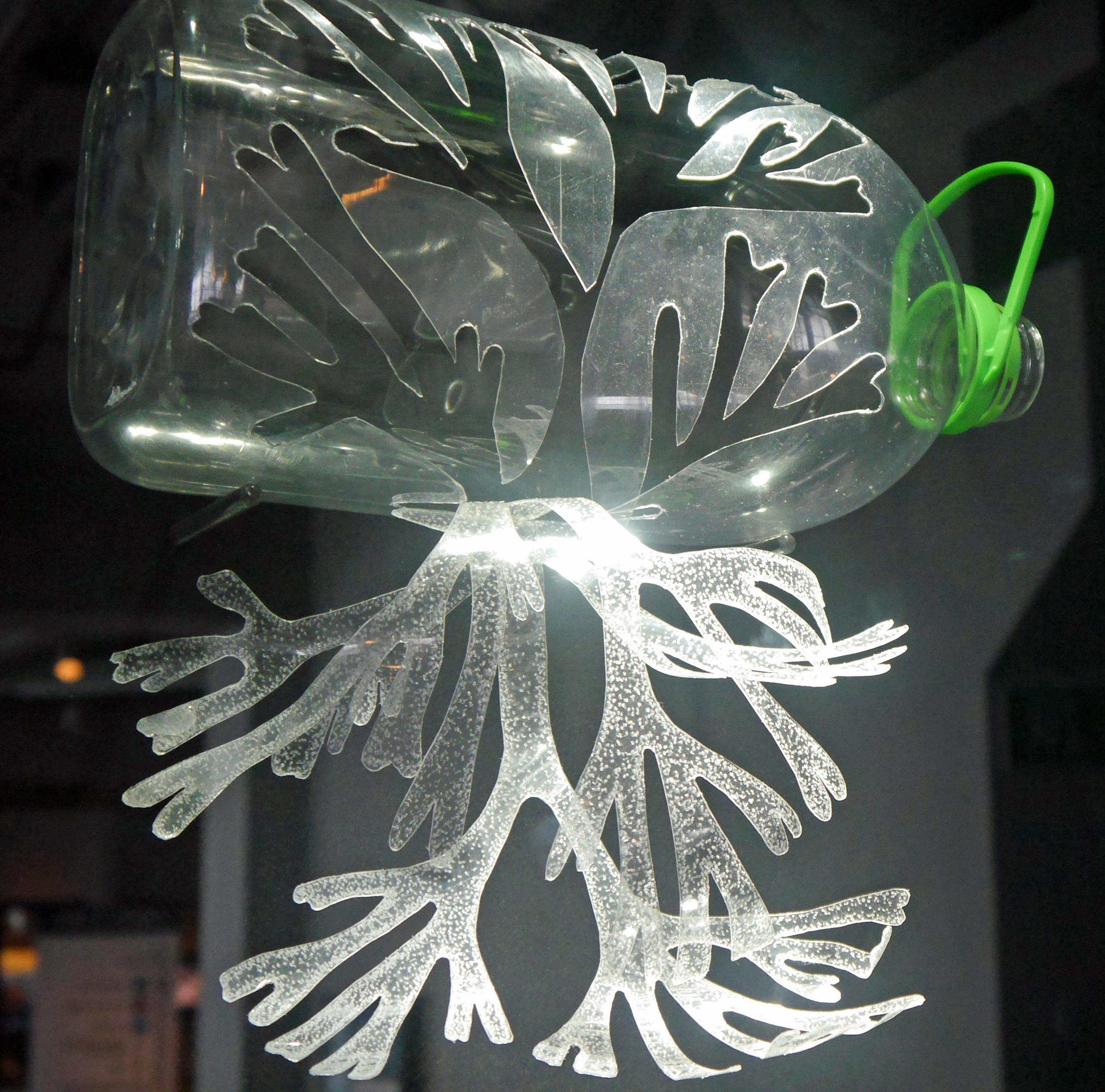
We saw an exhibit of fantastic sculptures from Australian artist Alison McDonald who takes old plastic and other found objects that may pollute waterways and turns them into marine sculptures. This one is called “Antagonism.”
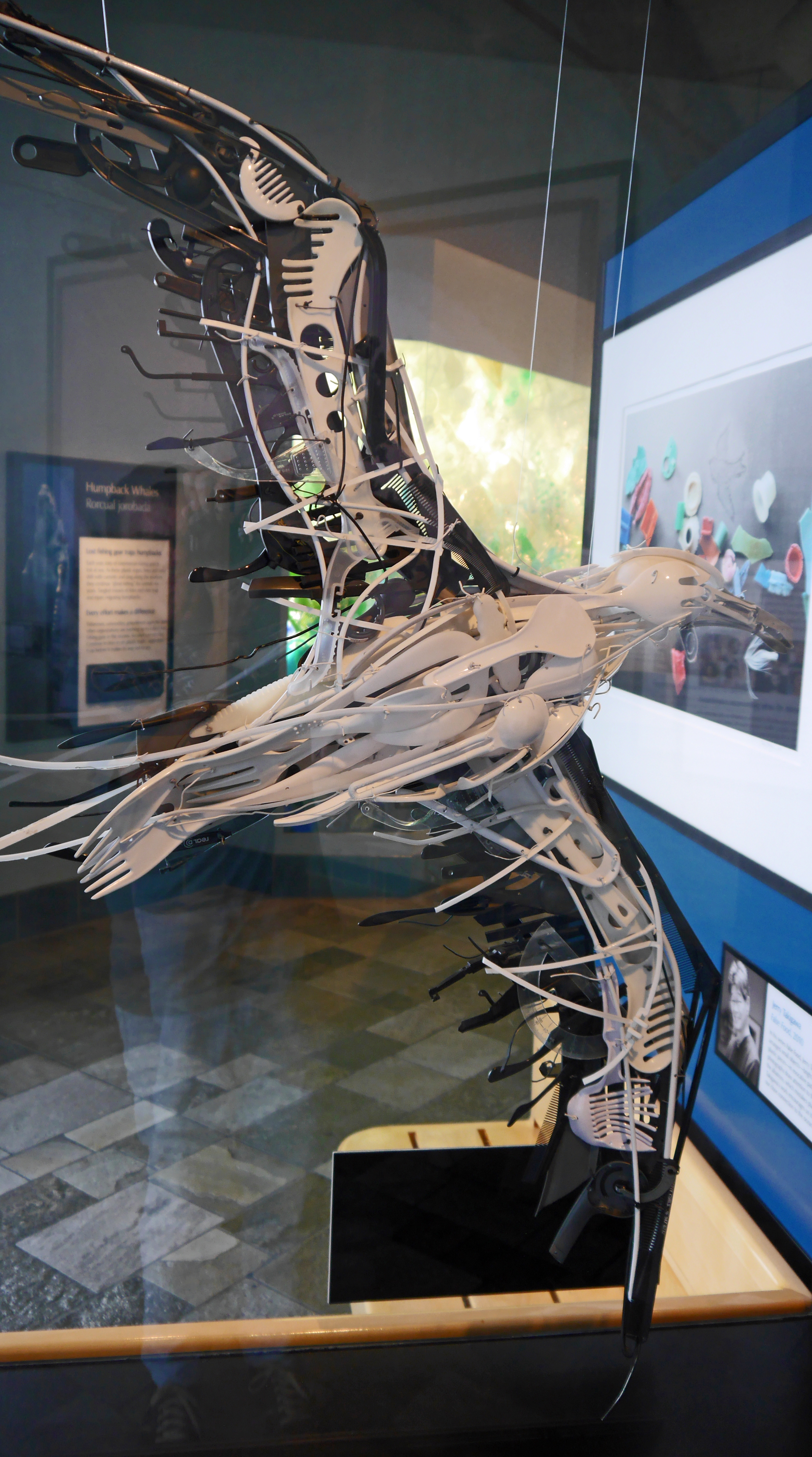
Another great “found object” sculpture of an albatross by artist Sayaka Gans.
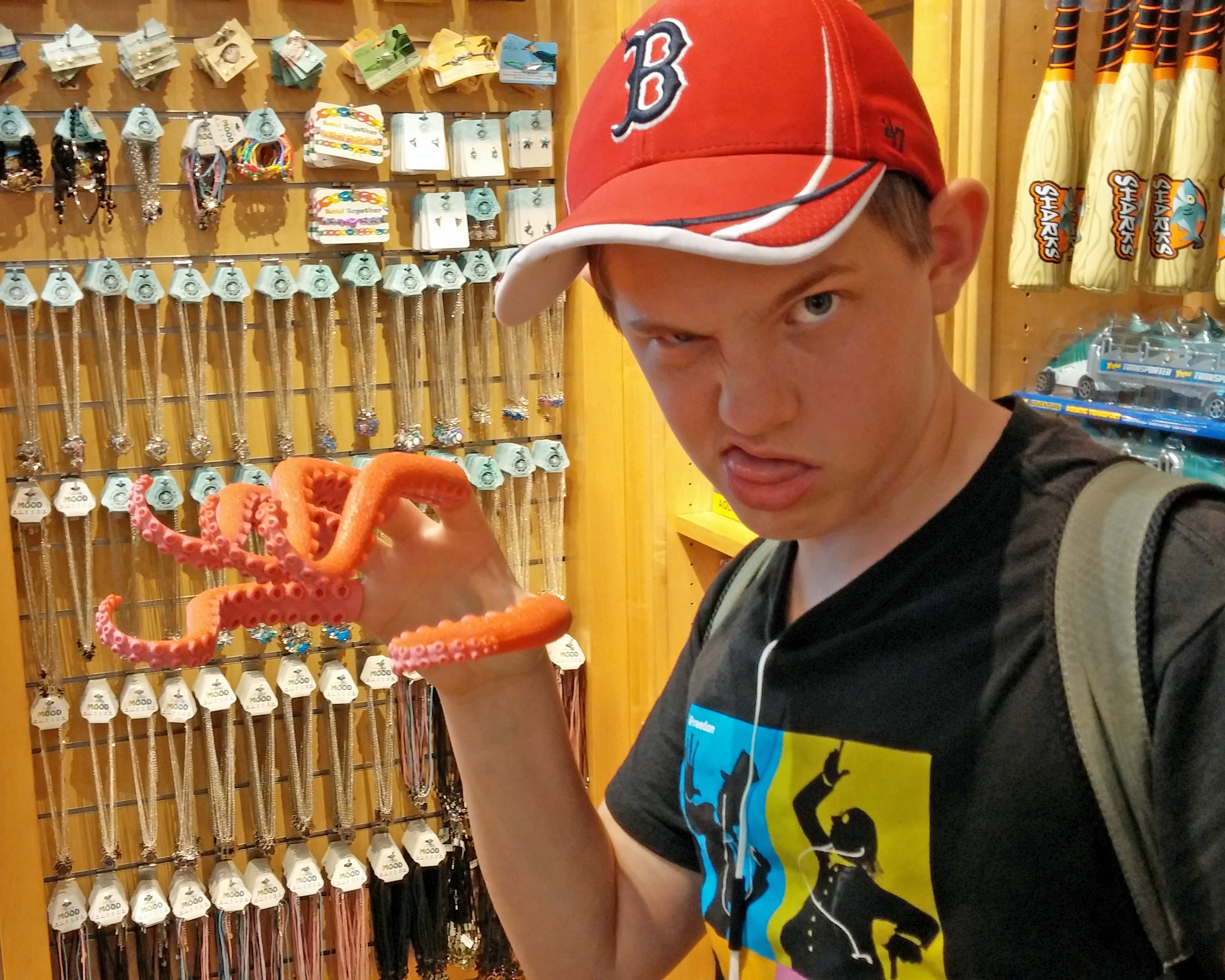
Avast ye scurvy landlubbers! Ye best beware of Cap’n Squidface here. They say he lurks in the depths of the gift shop to prey on unfortunate souls…

While browsing the aisles of a shop in Monterey , we came across a display devoted to bacon-flavoured products including Bacon Toothpaste and Bacon soft drink.

The same place also stocked this confronting cereal.

Driving from Monterey to San Simeon down the Big Sur coast.
Pebble Beach
Leaving Monterey we decided to take the coast road to meet up with Highway 1. This meant paying ten dollars for the privilege of driving seventeen miles within the Pebble Beach gated community.
Pebble Beach is owned by a consortium made up of actor Clint Eastwood, golfer Arnold Palmer and Baseball executive Peter Ueberroth. We drove past expensive looking estates that encroached upon the surrounding Del Monte Forest and admired the famous Pebble Beach Golf Course.
Driving past Pebble Beach, we stopped at Pacific Grove to add another picture to the record books for the most photographed tree in America – The Lone Cypress Pine. Described by journalist Christopher Reynolds as “God’s own advertisement for rugged individualism”, the Lone Cypress was immediately recognizable from countless photos and advertisements. But the recognition did not diminish the experience of seeing the tree through my own eyes. However, as I moved along the headland, there was a natural tendency to look at the tree as though framing shots for great photos. It just seemed too iconic to be real.
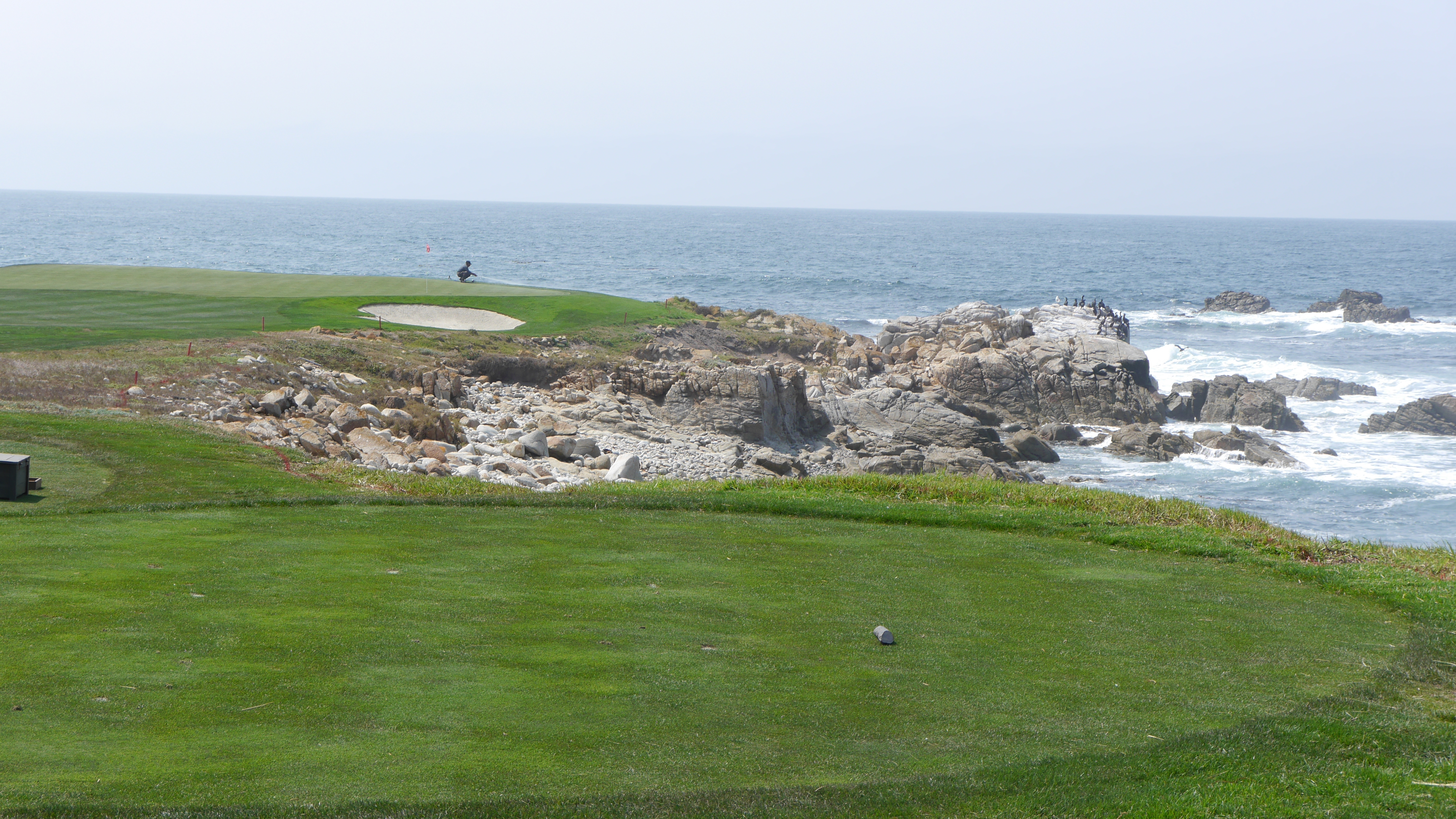
The Pebble Beach Golf Links. A single game of golf here costs U.S. $495.
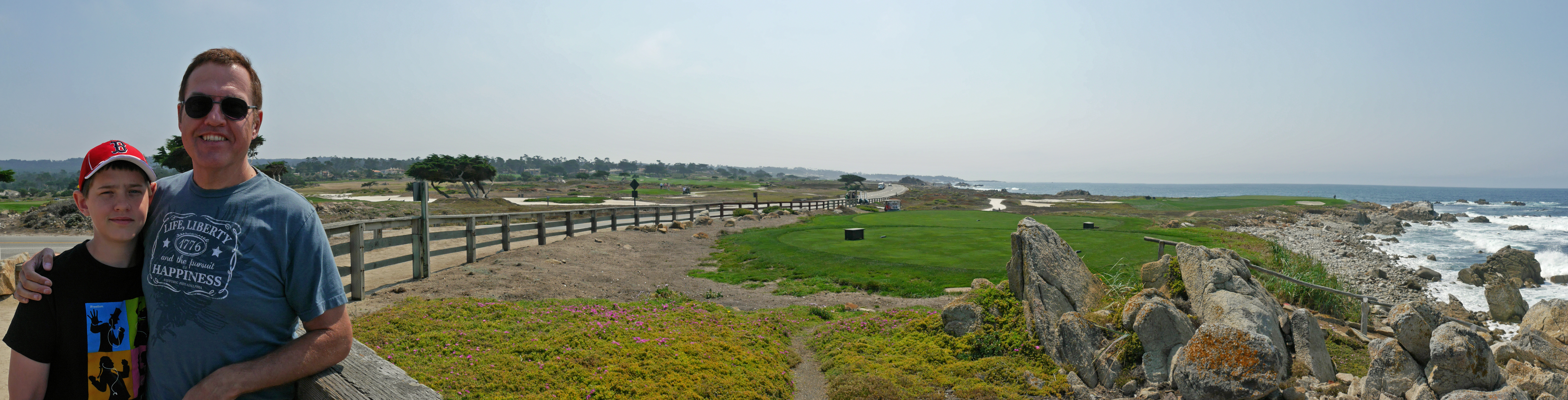
Checking out the coast line near Pebble Beach.

The famous Lone Cypress Pine at Pacific Grove. It is also forms the logo of The Pebble Beach Company. This picture was taken from a distance so that it wouldn’t look as isolated as it normally does.

How the Lone Cypress is normally photographed. Here is another one to add to the record books as the most photographed tree in America.
The Big Sur
We exited the Pebble Beach gated community and drove into Carmel-by-the-Sea. The place was swarming with Carmel socialites and other well-heeled visitors. Driving through the streets and checking out the houses, boutiques and trendy restaurants, it was clear that a lot of money swishes around this place. We hoped to stop and have a coffee there and maybe spot former Mayor Clint Eastwood but we found it impossible to get a park.
So we headed on to Highway 1 down the Big Sur coastline. Even though it was mid-morning, a heavy fog hung over coast preventing us from seeing anything in the distance. We drove through Malpasso Creek (Clint Eastwood’s production company is named after it) and along the coast, pulling off at lookouts on occasion to get a glimpse of the rocky coast.
I knew Highway 1 had a bad reputation for car accidents, but I was still surprised how narrow it is in parts for something that calls itself a highway. Also, like most American highways, there was no shoulder to pull off to, if needed. Combined with the heavy fog, it was not the most relaxing of drives. However, once the fog lifted and once I had grown accustomed to missing oncoming trucks, I could enjoy the road and its rugged scenery.
We stopped for coffee and hot chocolate at the Big Sur River Inn which was nestled amongst the giant redwoods in Pheneger Creek. Getting out of the car, we were immediately dwarfed by the giant trees that towered above us. The Inn itself was almost entirely comprised of wood and rock; from the roughly-hewn rock and log exterior to the heavy redwood furniture. It was rustic and warm but also a bit overwhelming.
We also pulled in to Piedras Blancas where we saw a giant elephant seal colony. We couldn’t believe the number of seals on the beaches along this strip of coastline. The seals whooped and grunted and looked like they were having a glorious time in the sun. While we were watching, a man suddenly yelled “snake” and people looked around in a panic. The man pointed to a nearby bush. A mild-looking man in his forties came forth from the crowd and casually stepped in to the bush to emerge a minute later carrying a giant brown snake. Holding its head, he calmly showed the snake to the crowd before walking off down a path with it. The seal-viewing crowd, including us, rapidly dissipated after that.
We pulled in to San Simeon for lunch at Sebastian’s Store where we had a tasty hamburger with fresh beef from the nearby Hearst Cattle Ranch. San Simeon was a bustling place when Hearst used to live here but is now, apart from Sebastion’s Store, pretty much a ghost town.

Stopping for a break along The Big Sur (The Big South).

The Big Sur River Inn where Michelle and Harrie raved about their hot chocolates.
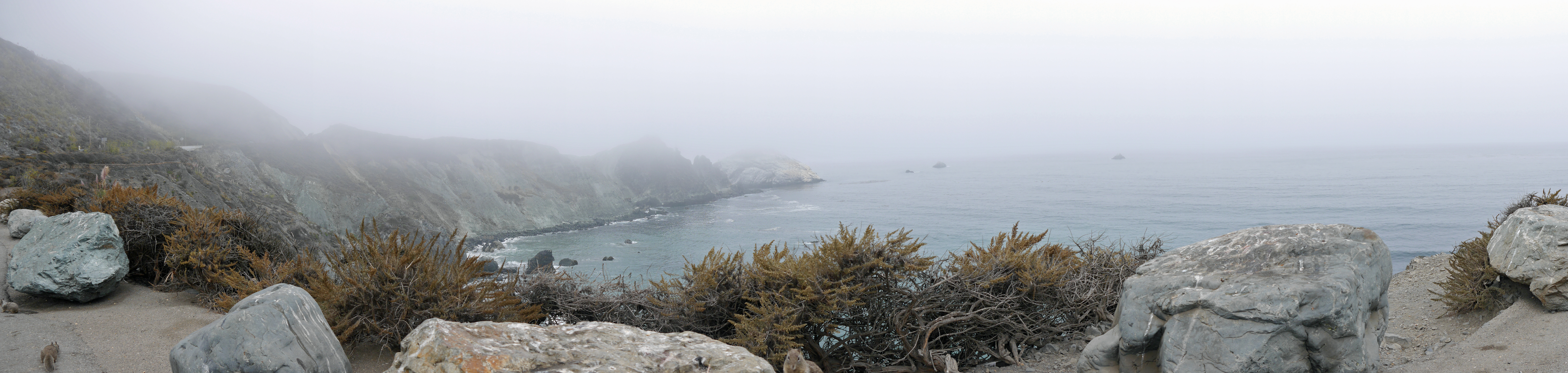
The fog began to lift along the rugged coastline.

A giant Californian Gull stands as a sentinel along The Big Sur.
Harrie and Michelle feed The Big Sur squirrels
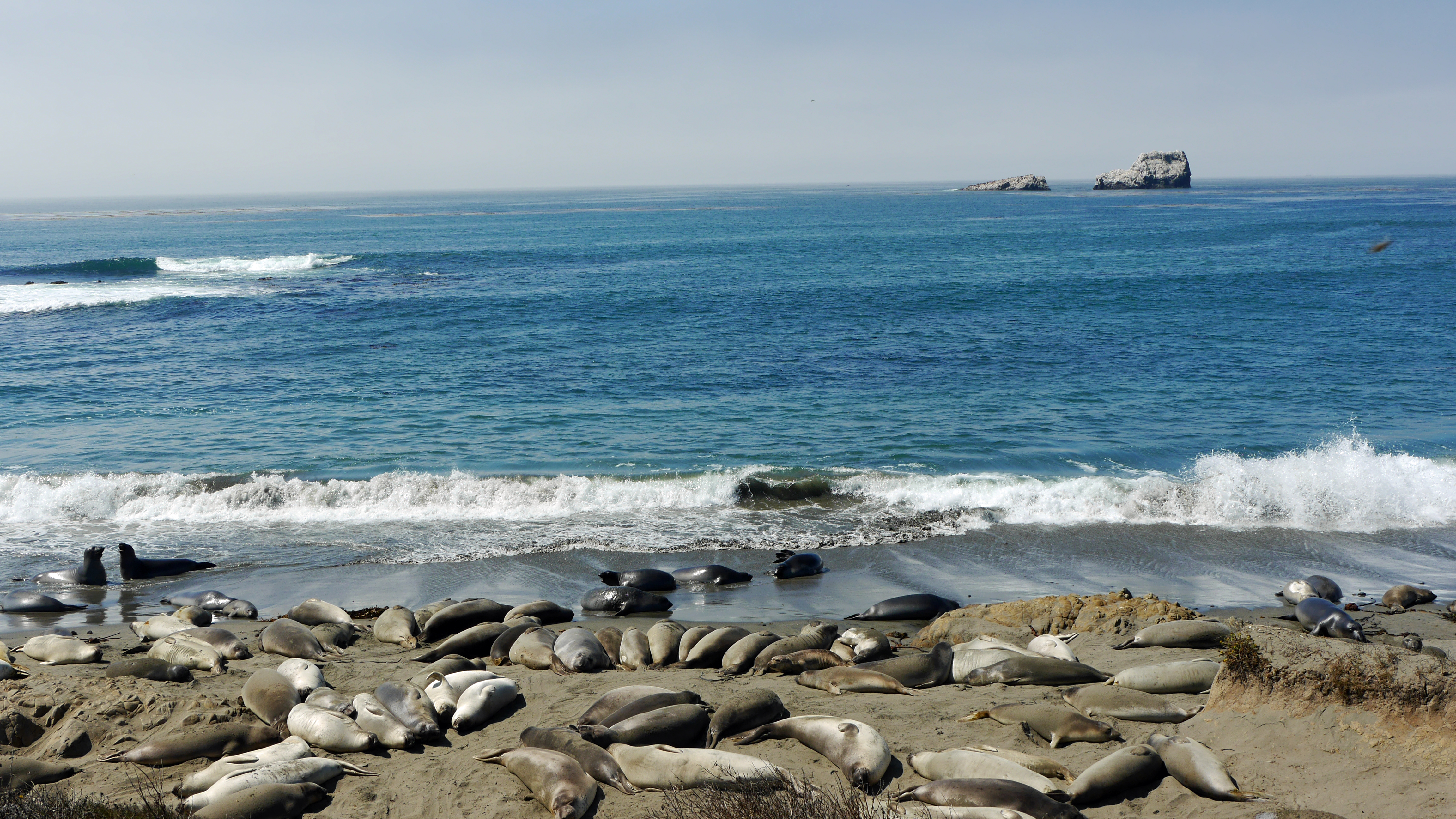
Elephant Seals at Piedras Blancas.

Sebastian’s Store at San Simeon. Also home to the Hearst Ranch Winery.
Hearst Castle, San Simeon
We pulled in to the Hearst Castle Visitor Center. The place was full of different shops with gaudy souvenirs and fast food. To see all of Hearst Castle you have to go on at least three of the six tours offered. It reminded me of Graceland and the feeling I felt there of commercial rapaciousness. In the end, we decided to go on The Grand Room tour and the Upstairs Suites tour.
We boarded a bus which took us up the hill to where Hearst Castle was built. Again, much like Graceland, we were made to watch a cheesy video which told us how great William Randolph Hearst was and how anyone comparing him to the fictional Citizen Kane would be making a grave mistake. Well the information that I did know certainly seemed to uphold the Citizen Kane stereotype. After all, this was a man who led his country into war with Spain in order to sell papers; reportedly telling his doubting correspondent in Cuba at the time “you furnish the pictures and I’ll furnish the war” (which was cheekily aped in Citizen Kane as “You provide the prose poems; I’ll provide the war”).
Hearst was born rich and got richer as a result of his transformation of the newspaper business. Hearst helped pioneer what would become known as “yellow journalism” and which we know today as the Murdoch press. This was where lurid headlines, confected outrage and the proprietor’s political views would be distilled into cheap papers for the average citizen. Working class Americans could relate to Hearst’s publications. They were deliberately populist and resultingly popular.
Hearst, like Murdoch today, understood that by strategically reflecting the values of his readers, he would attract a loyal following. Hearst chose to fan sympathy for the underdog and antipathy towards bureaucracy. His papers were suspicious of political idealogues and intellectuals believing them to be out of touch with the working Americans. Hearst also had a Victorian hypocrisy towards sex and violence by expressing outrage at any moral turpitude while devoting lots of column inches to its reporting. But primarily, Hearst’s main value was his strong belief that readers needed to be entertained first and informed second.
However, and again much like Murdoch, prosecuting these values often resulted in good. Hearst papers regularly exposed unfair or corrupt practices and pricked the pomposity of the elites of American society. While Hearst was an elite himself, he related to the plight of the common man. At Harvard, he had written for the Harvard Lampoon and had admired Joseph Pulitzer who in working life, was the opposite of the elite prize that would later bear his name.
In fact, Pulitzer was a huge influence on Hearst. When Hearst was at Harvard, Pulitzer was the new editor of the New York World. The New York World was a paper that would literally and figuratively bring real colour to newspapers.
As a Hungarian-born Jew, Pulitzer knew that a lot of the people living in New York were immigrants with English as their adopted language. Pulitzer soon realised that immigrant New Yorkers were not likely to read wordy newspapers. He decided he could better attract an immigrant readership with a paper that had more visual clues for its readers. He thus set about changing The New York World to have more pictures than any other paper in America. And where Pulitzer couldn’t get photographs, he used illustrators. In 1896, he introduced the first four-colour printing in a lift-out comic section that featured the popular cartoon The Yellow Kid. Now largely forgotten, modern audiences may still recognise the The Yellow Kid as looking a bit like Mad Magazine’s Alfred E. Neuman and that would be because Alfred E.Neuman is a modern homage to The Yellow Kid in both looks and attitude. It was The Yellow Kid strip that led to the phrase “yellow journalism” where critics at the time felt that people were buying the paper for the comics rather than the articles.
Hearst watched Pulitizer’s developments with awe and when he left Harvard, he set about trying to crush Pulitizer by setting up a rival paper called The New York Journal. From that point on, it was a race to the bottom as Pulitzer and Hearst used every trick in the book to attract readers. Prize giveaways were introduced, publicity stunts were hatched and both papers started pulling out their chequebooks to secure exclusive interviews.
By the late 1800s, Hearst had grown a chain of newspapers across the country and had also started a profitable magazine business. Hearst discovered his political clout in 1898 following the sinking of the U.S, Navy ship, The Maine. To this day, no one knows how the ship sank off the coast of Cuba but the likely explanation from investigators (both at the time and later) was that the explosion was caused within the ship. Dog-whistling to American patriotism, Hearst had his papers report that The Maine was sunk by the Spanish who ruled Cuba at the time. Back home, Hearst started a public catch cry of “Remember The Maine, To Hell With Spain!” and inflamed public anger that the U.S. Government was doing nothing to retaliate over Spain’s act of aggression. The pressure on the U.S. Government was intense. This was despite no evidence of a Spanish attack at all. On 20 April 1898, President McKinley finally relented to public pressure and declared war on Spain. The ensuing Spanish-American War was a godsend to Hearst’s papers resulting in their highest circulation to date. Hearst now realised that he not only reported on events that unfolded but could also create events to unfold as well.
Of course, Hearst’s private life was just as dramatic as his professional life. He married a 21 year-old showgirl when he was 40 and then, a few years later, became infatuated with the even younger Hollywood actress Marion Davies. Hearst built Davies a large mansion on Santa Monica beach where he frequently stayed the night. Tiring of the travel, he then had Davies live as his mistress in Hearst Castle where he was still living with his showgirl wife. Hearst’s wife never divorced him but negotiated a deal where she would live in New York in her own swanky mansion and would appear when necessary with Hearst at important corporate functions.
While Hearst didn’t really care what his wife got up to in New York, he was fiercely protective of Marion Davies and used his clout to both boost and control her film career. On the control front, he became paranoid that Davies was having flings with younger men in Hollywood. Through his spies, he had heard stories of Davies having “sleepovers” with Charlie Chaplin.
Allegedly to confirm his suspicions, Hearst invited Chaplin to a soiree on his yacht with other Hollywood types. When the yacht returned to port, film director Thomas Ince was dead. Ince’s body was quickly cremated and police had to rely on the testimony of a local doctor for the cause of death that was put down to a heart failure. However, within hours of Ince’s death, stories started circulating that Ince was the unfortunate victim of a bullet aimed at Charlie Chaplin by William Randolph Hearst. Those present on Hearst’s yacht refused to confirm or deny the rumours. Hearst gossip-columnist Louella Parsons who was on the yacht at the time and could generally be relied upon to spill the beans was also mum about the incident. Coincidentally, a week later Hearst gave Parsons an unheard of, lifetime contract and expanded her syndication to all of his papers. No further investigation took place and no one on the yacht talked about the incident again. One of Thomas Ince’s colleagues, famous film director D.W. Griffith would often say “All you have to do to make William Hearst turn white as a ghost is mention Ince’s name.” The whole story was dramatised recently in the great film The Cat’s Meow.
So, saddled with my knowledge of Hearst’s professional and personal baggage, I entered Hearst Castle to get a peak at how the man lived. The place was every bit the Xanadu of Orson Welle’s Citizen Kane. The place consists of 56 bedrooms, 61 bathrooms, 19 sitting rooms, 127 acres of gardens, two swimming pools, tennis courts, a movie theatre, an airfield, and what was then the world’s largest private zoo.
Our tour guide gleefully told us the provenance of various items (“that ceiling was taken from a French Medieval cathedral” or “that statue used to be in the centre of Rome”) before being asked by a tourist if the items were stolen. “No,no,no” said the tour guide. “Mr Hearst obtained all of the items legally and if anything, he was the one who was exploited as people in those countries knew he had a lot of money and that they could overcharge.” Of course, it was the unhindered plundering of the world’s antiquities by people such as Hearst that led to international treaties preventing such sales ever taking place again. Even if it was legal at the time, I would imagine many would have considered it to be at least unethical or even just gauche to rip a ceiling off a medieval cathedral to put in your home.
But while Hearst Castle contains much real gold, it also contains a fair degree of brummagem (fake stuff) as well. Hearst Castle architect Julia Morgan designed and built faux-European architecture and artifacts to mingle in with the real stuff and fool visitors. Our tour guide showed us the impressive castle wall that looked like large blocks of stone and marble but which were really just a thin veneer on a concrete wall. I felt this was kind of in keeping with Hearst’s journalistic career and sense of showmanship. However, the end result, at least to my eyes, was a chaotic mixture of Disneyland and disorganised history.
I left Hearst Castle feeling saddened that a man with so much money and influence had only left a showy lair as his chief legacy. We were further saddened driving through empty town of San Simeon that had been built up by Hearst to service his Castle but which had subsequently collapsed after his death as it had no other industry. It was as Charles Foster Kane lamented towards the end of Citizen Kane “You know, Mr. Bernstein, if I hadn’t been very rich, I might have been a really great man.”

Hearst Castle. We couldn’t get a good external shot so this picture is taken from Wikipedia.
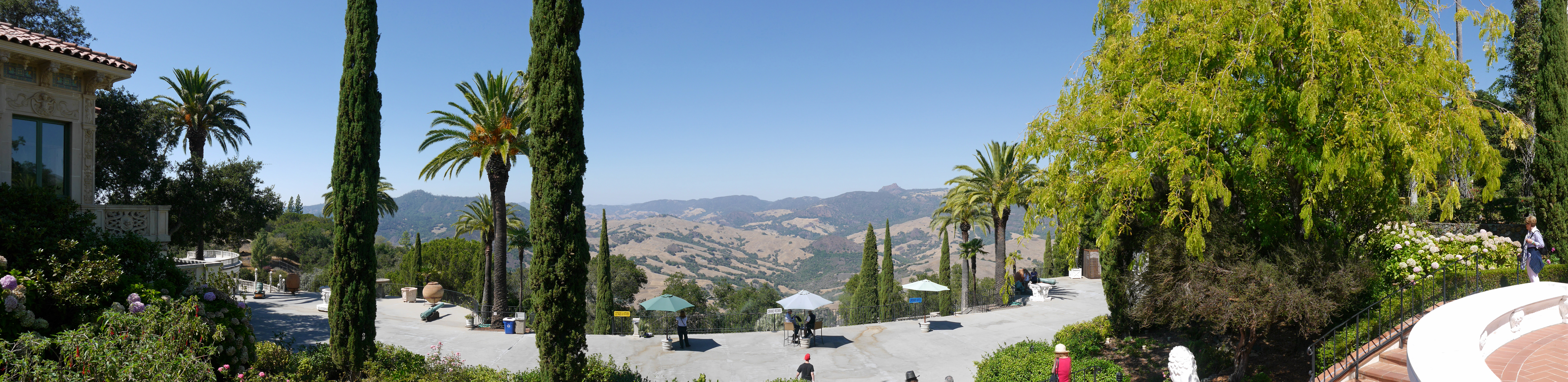
Looking out from Camp Hill at the Hearst Castle.

The Casa Del Monte. This is the original cottage that the Hearst family stayed in.
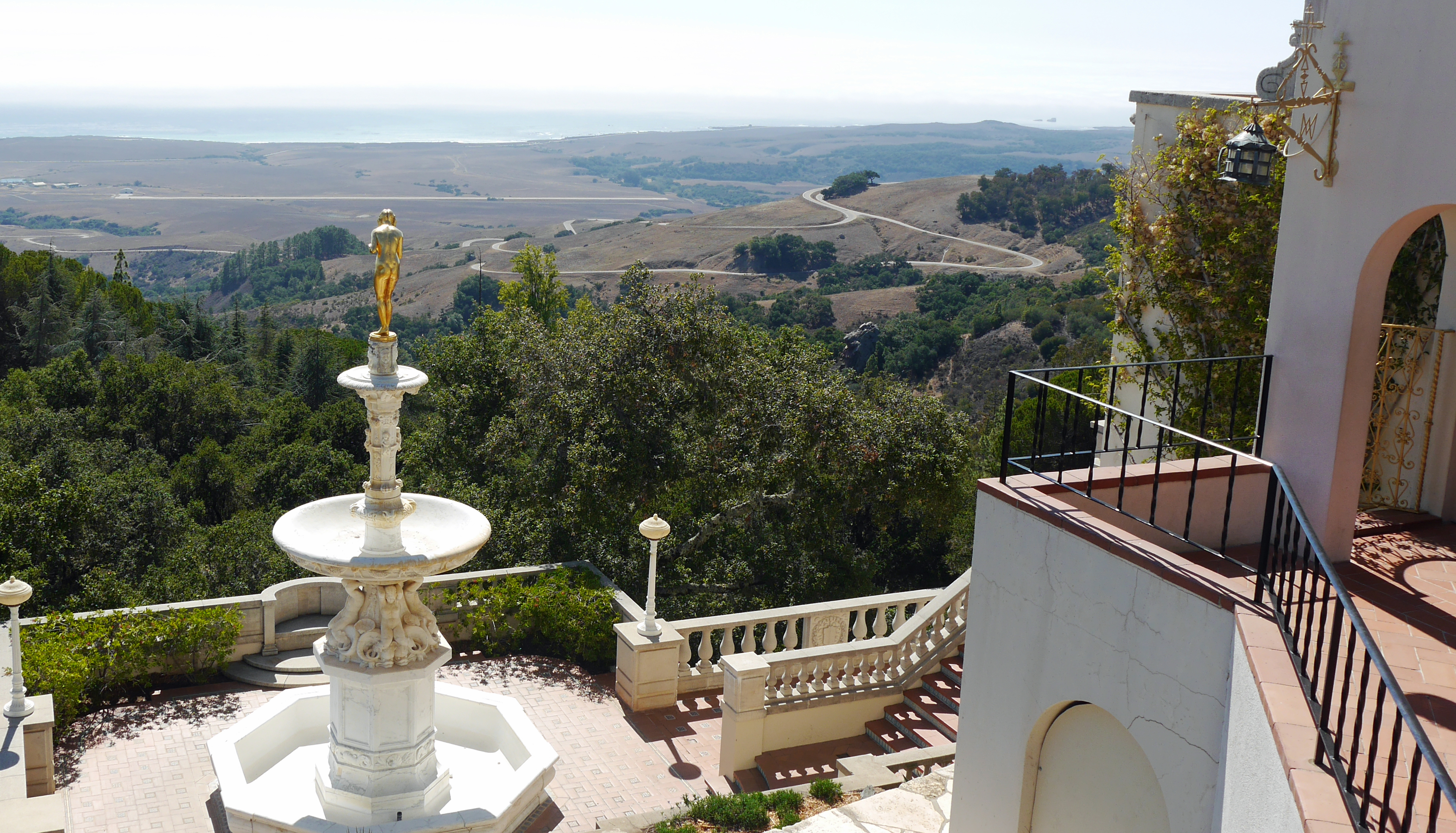
The Casa Del Mar. This is the second cottage built for Hearst to stay in while his castle (Casa Grande) was being built.
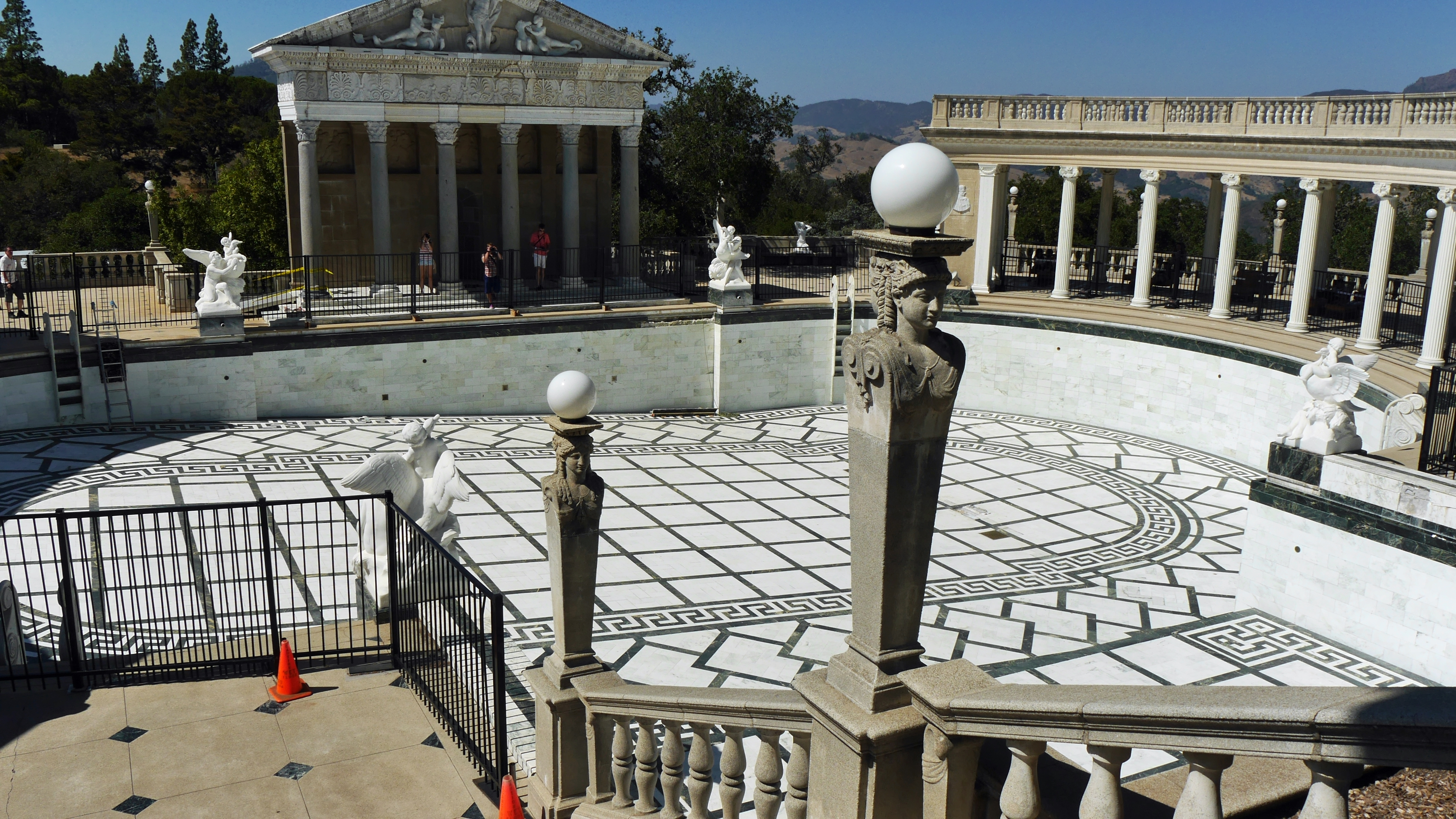
The Neptune pool as seen in Spartacus. Unfortunately , the pool had to be drained of its 345,000 gallons of water due to the Californian drought. Mind you, that didn’t stop Lady Gaga filling it up for her recent video clip.
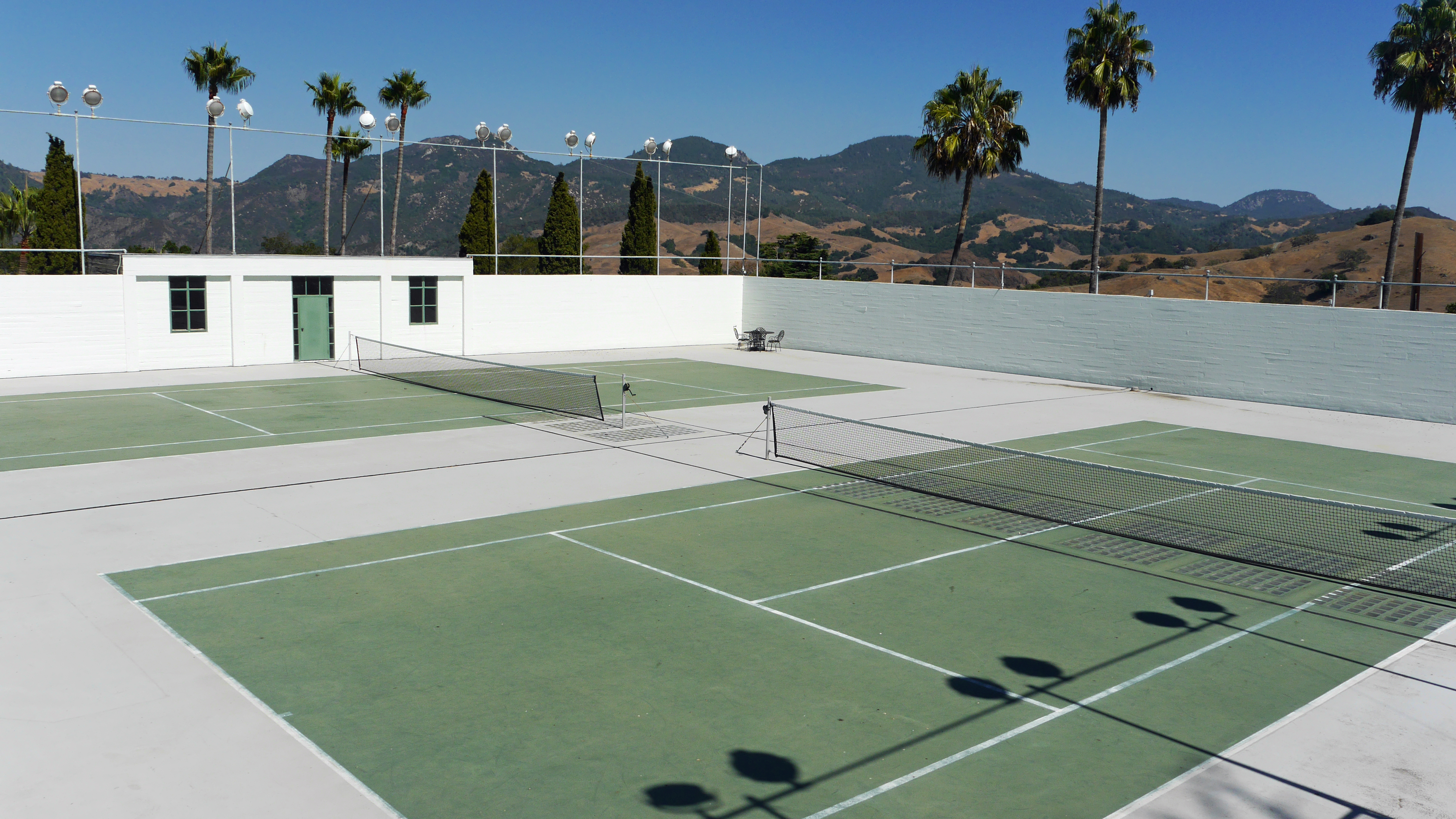
The Hearst tennis courts.
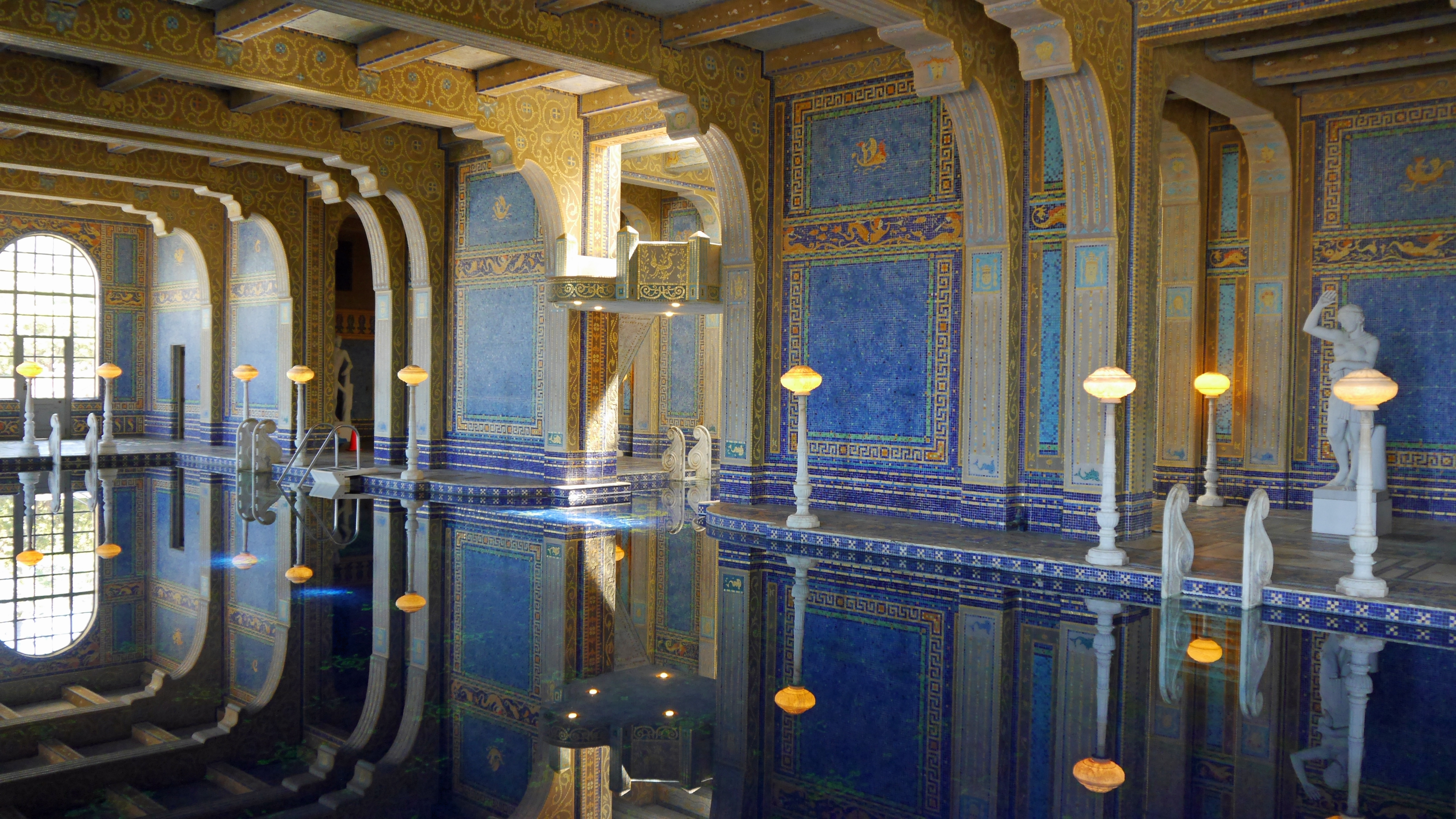
The Roman Pool. I would like to have a pool like this at home. No, seriously, I would.

The indoor Roman Pool.

The Assembly Room where Hearst would greet guests. Here you will find a 16th Century Italian ceiling, four large Flemish tapestries from the 15th Century, a 17th Century French fireplace, 18th Century Venetian sculptures and Baroque and Renaissance paintings. All shoved together in a crazy mish-mash.
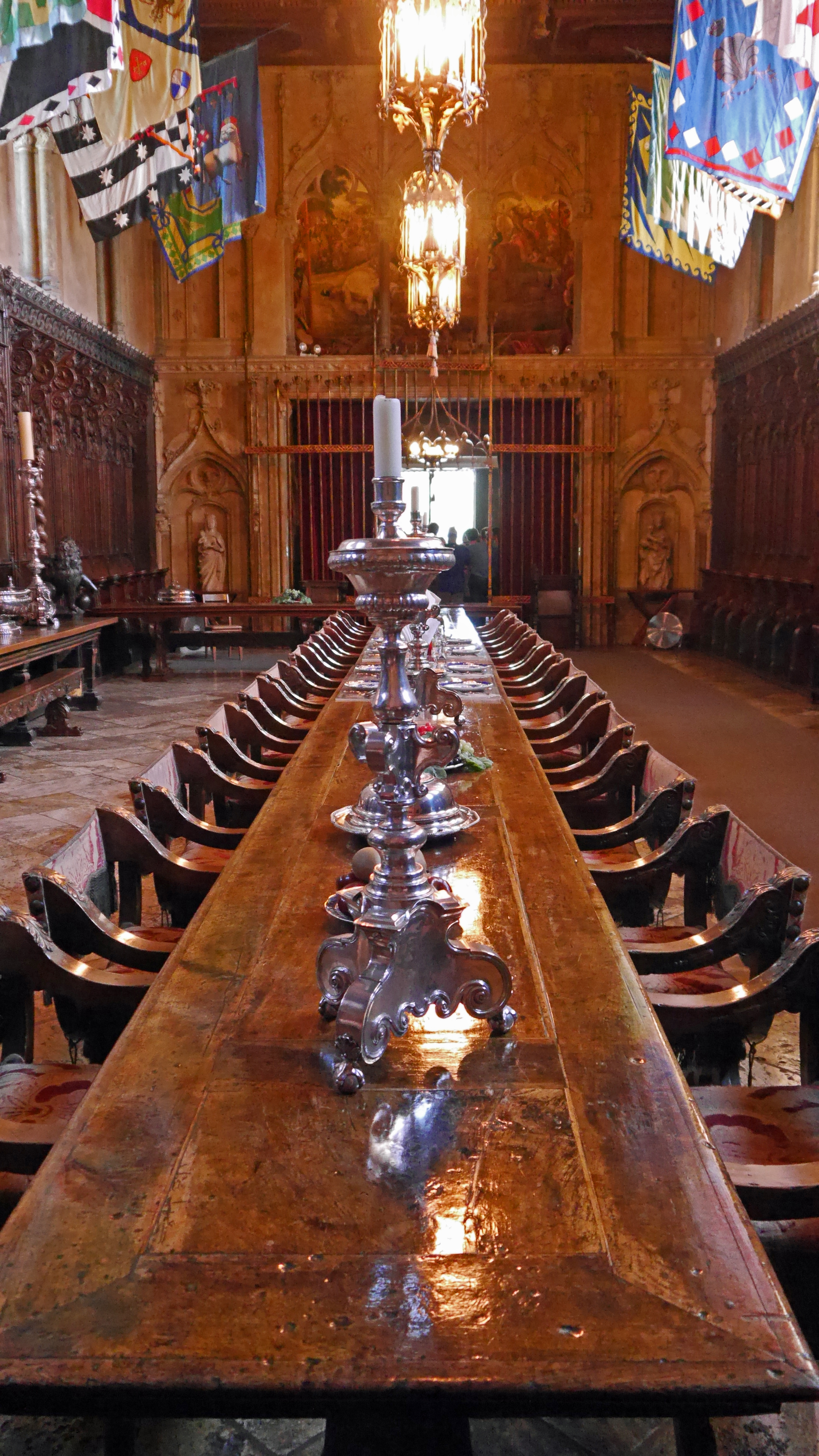
The Refectory where Hearst would eat and hold dinner parties. The ceiling is from a 16th Century Italian monastry while the rest of the dining area has loot from a Spanish Church (Choir stalls), a French cathedral (gothic windows) and English royalty (silverware and crockery).
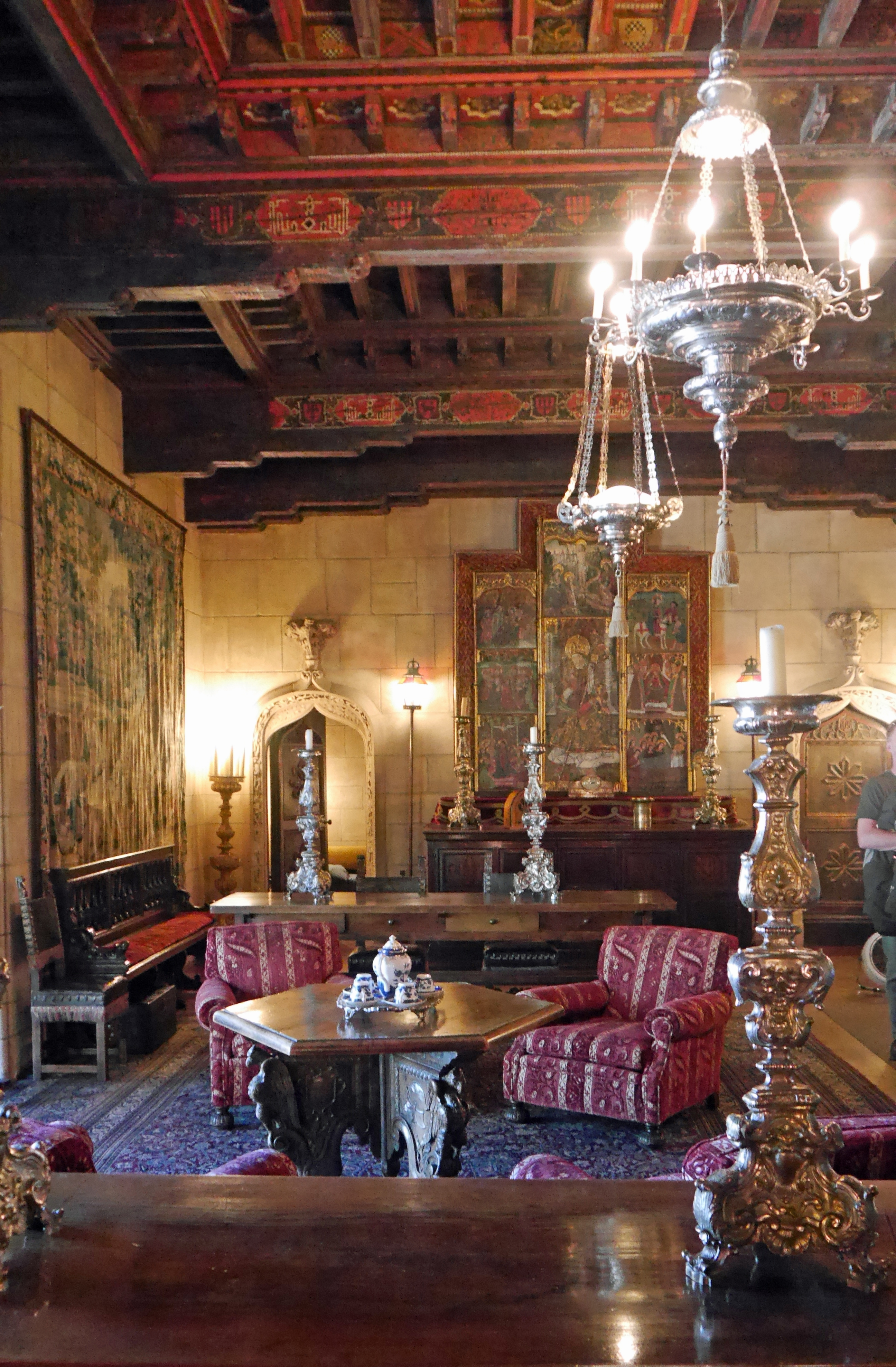
The Morning Room where guests would have a nice cup of tea.
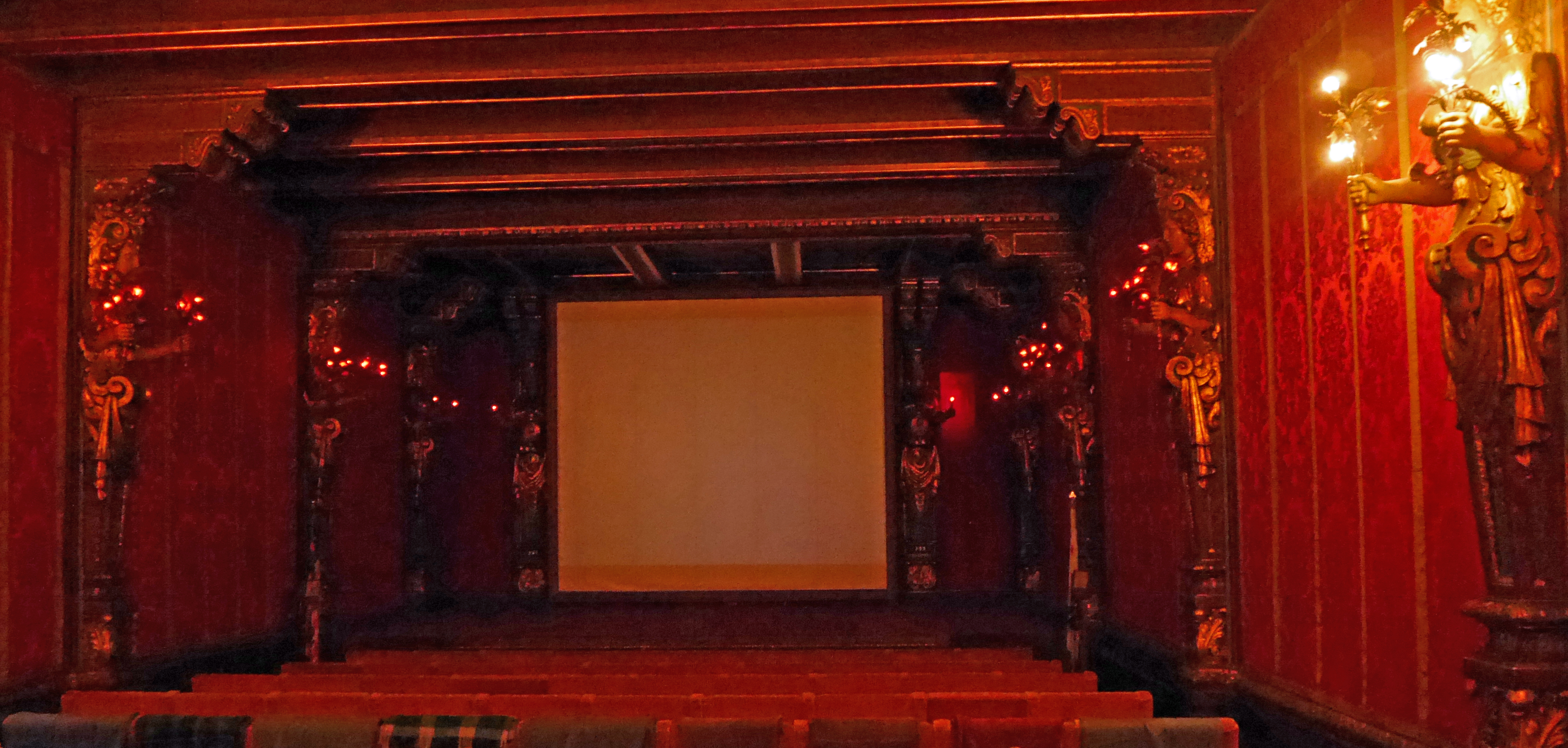
The Hearst movie theatre. It was pretty good but not as grand as I thought it could be, given the decadent picture palaces of the 1920s.

The Doge’s Suite Bedroom. All the guest bedrooms were themed around certain artwork in Hearst’s collection. This one was the stuff he plundered from Venice.
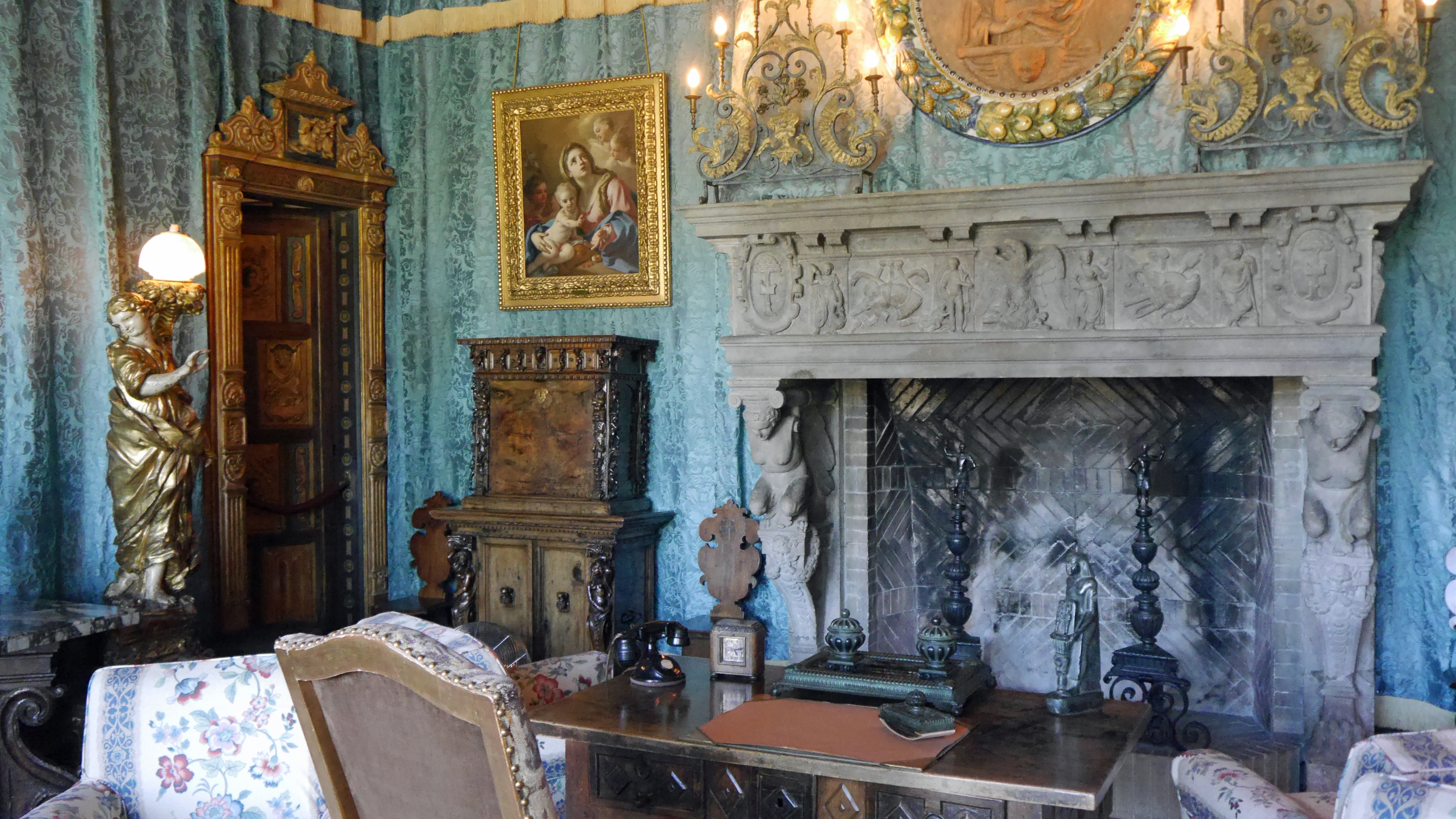
The adjacent sitting room in the Doge’s Suite. These rooms sure were grand.
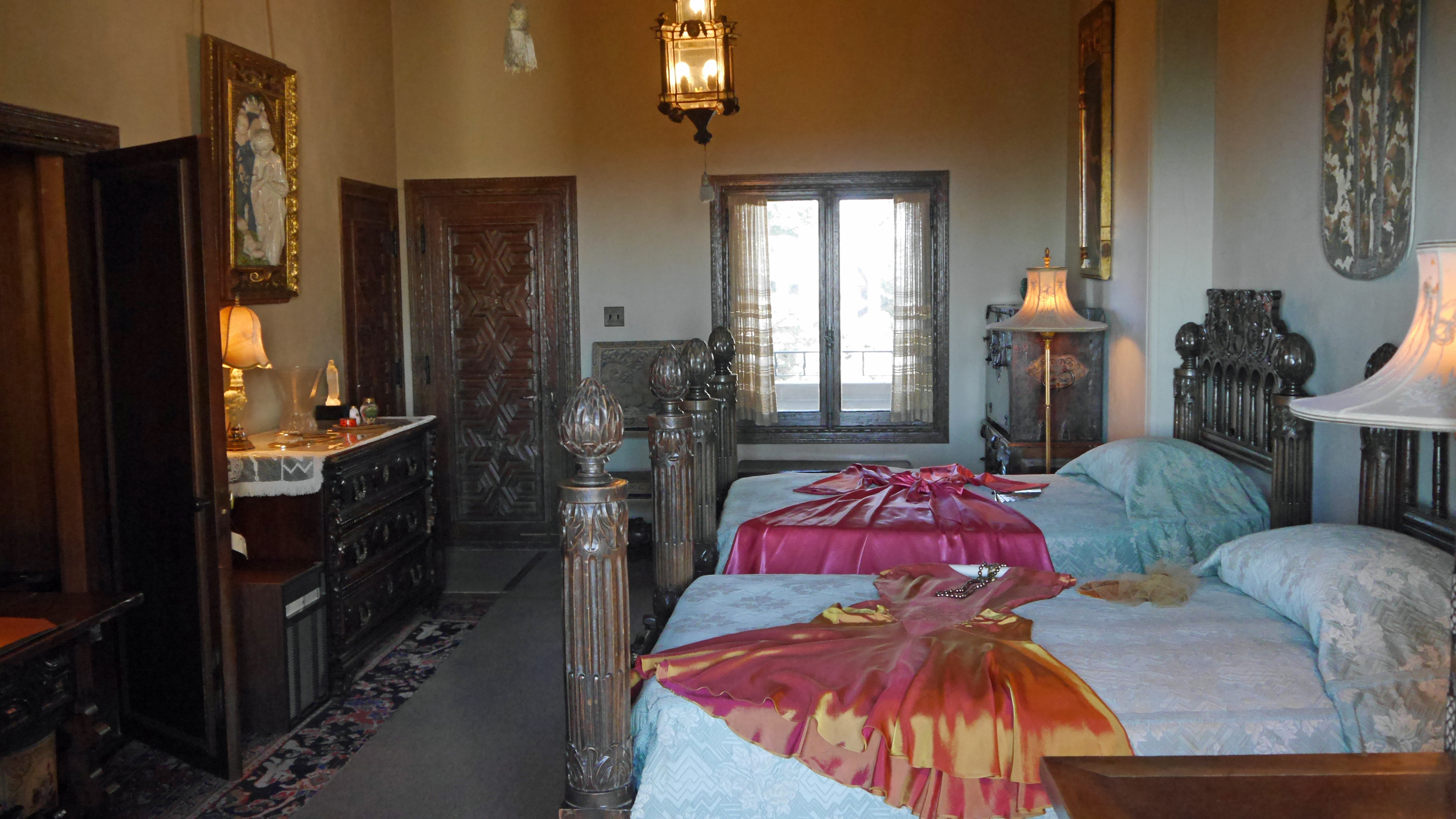
One of the Cloister guest bedrooms.
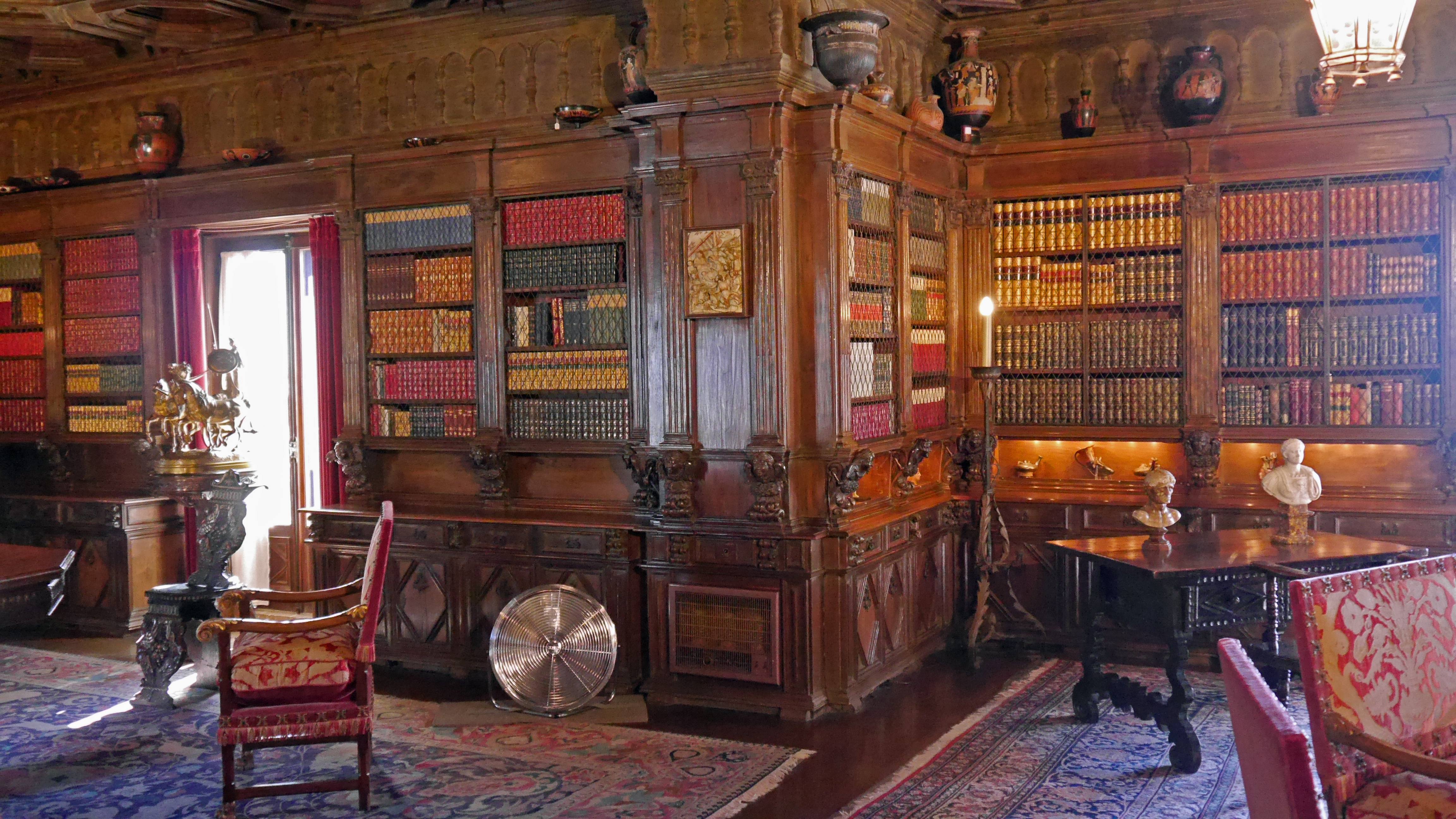
Hearst’s library. The library contains over 4,000 antique books (first editions, rare printings and ancient manuscripts) and over 150 classical Greek vases.
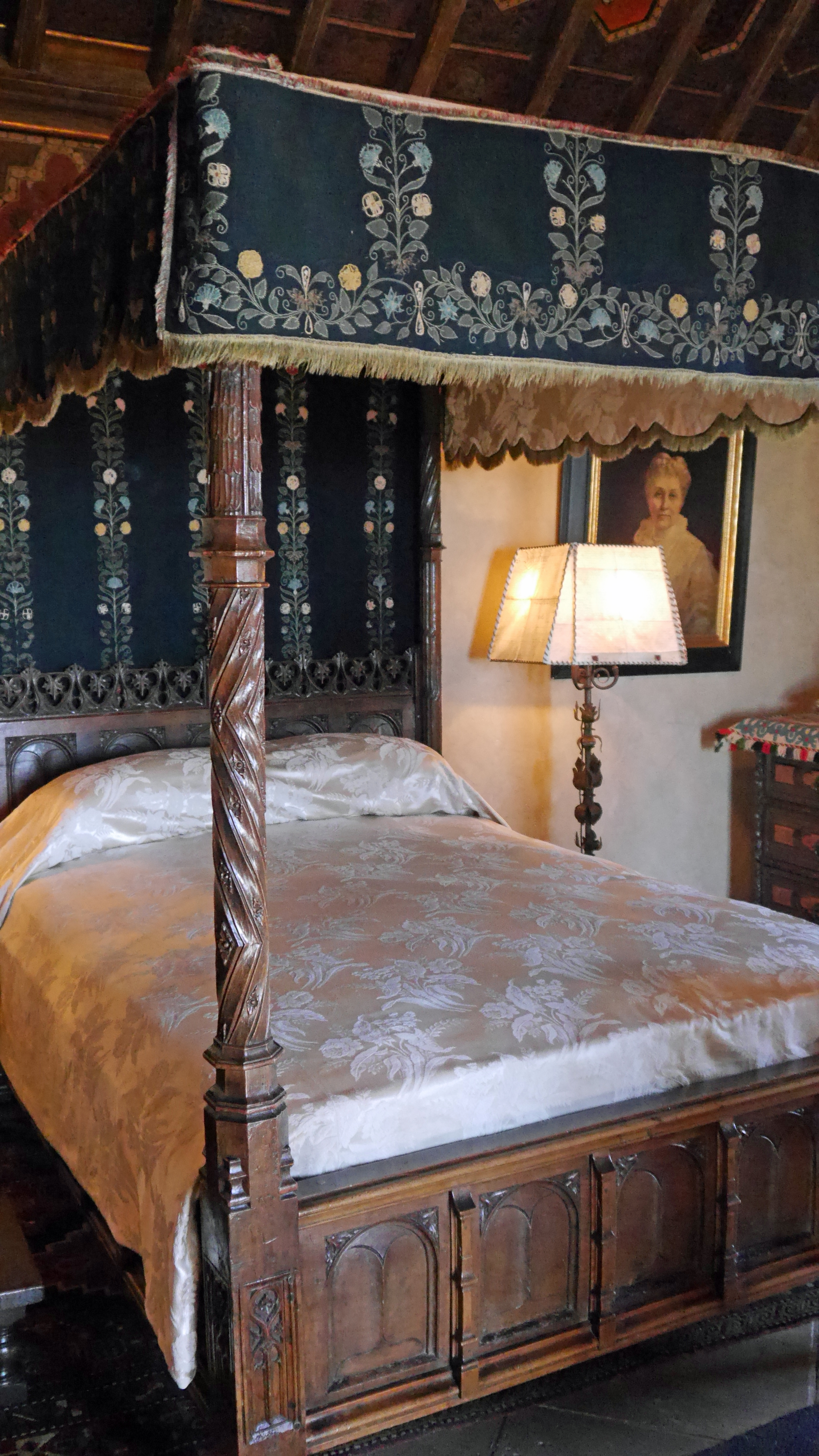
Hearst’s bedroom with a portrait of his mother next to the bed.

Hearst’s walk-in wardrobe.
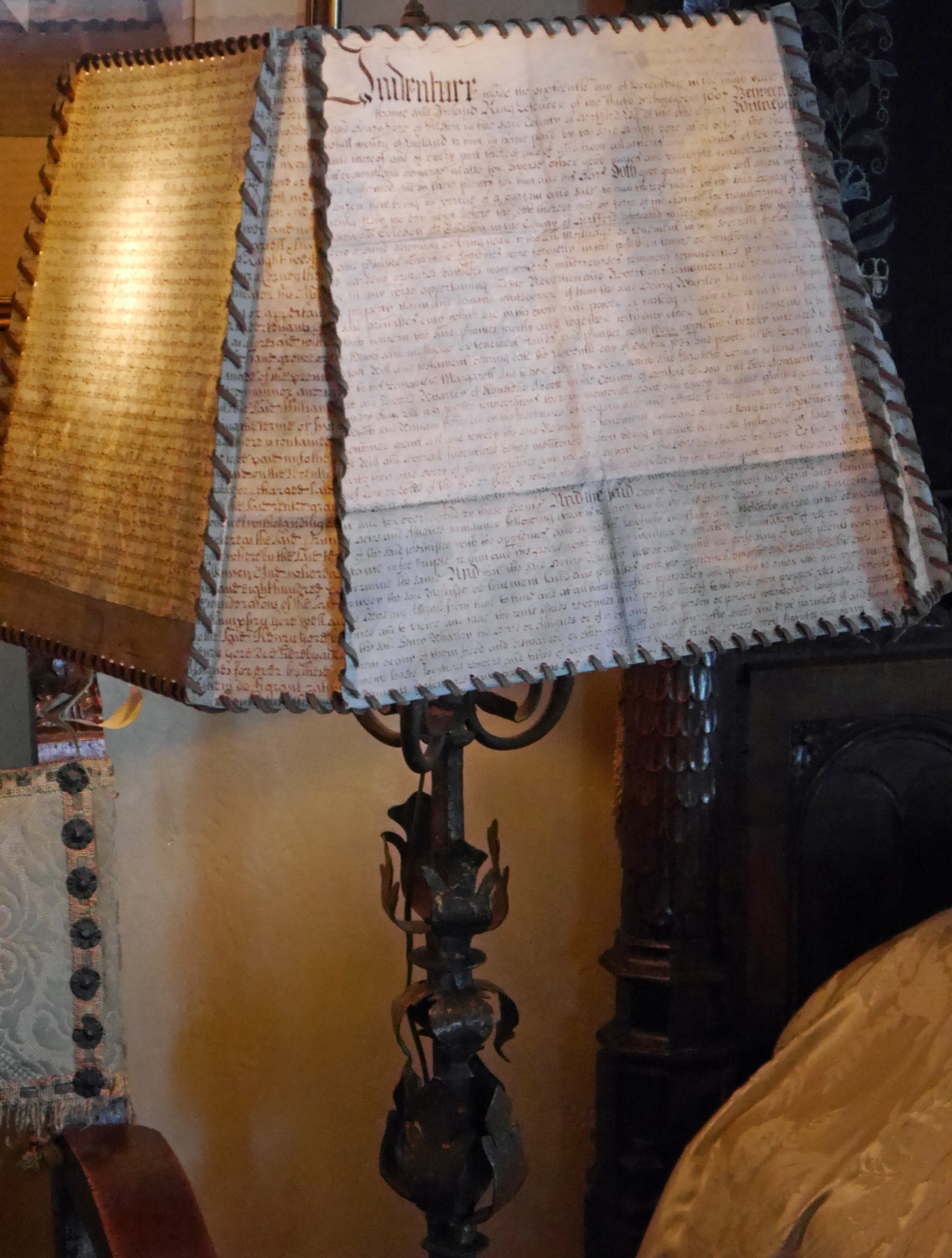
Hearst had 17th Century British land indenture contracts turned into lampshades for his bedroom.
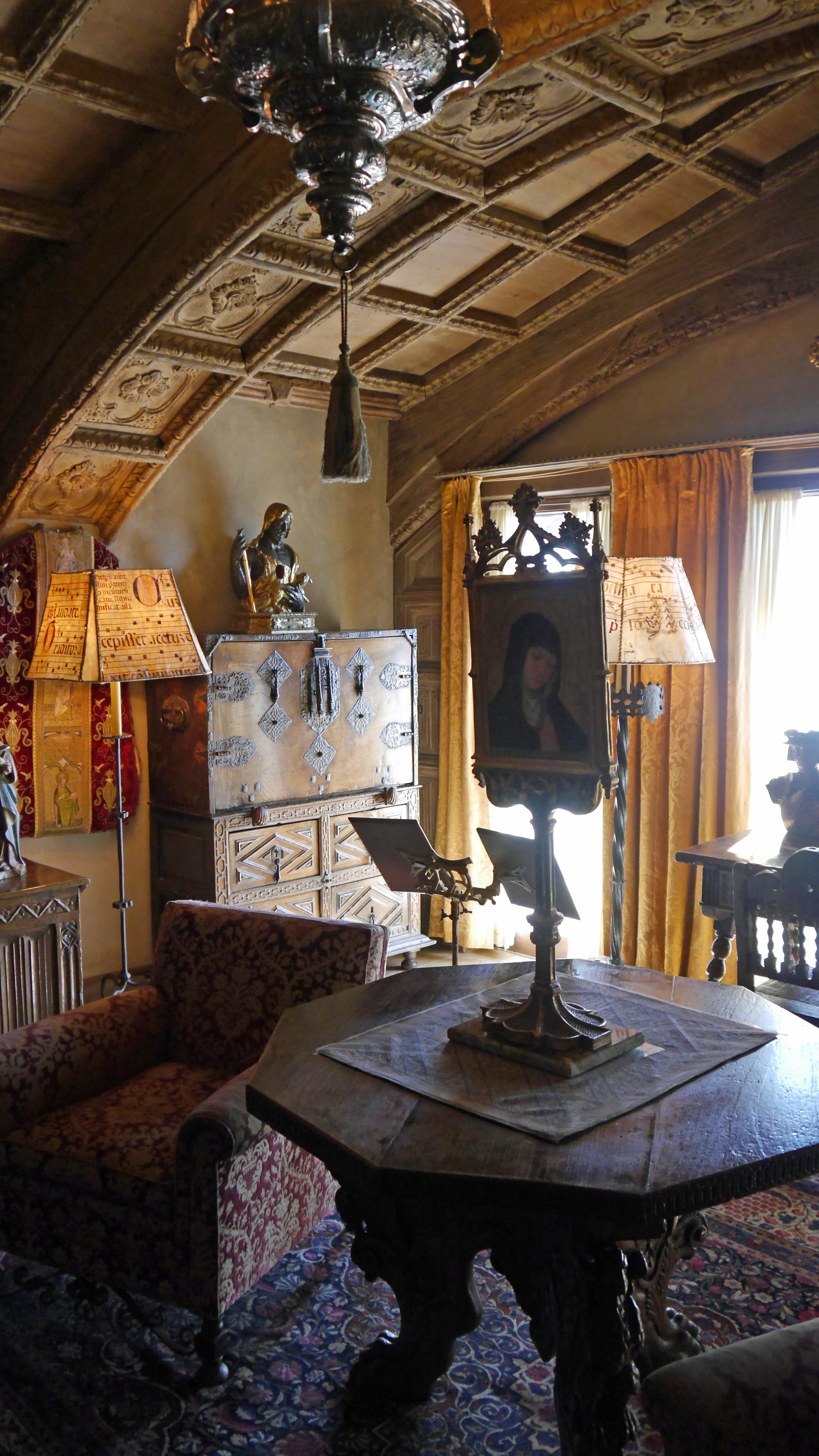
The sitting room in Hearst’s bedroom. Hearst wanted a strong Gothic theme for his bedroom which says much about the man.

Hearst’s mistress Marion Davies bedroom, just down the hall from Hearst’s bedroom.

The Gothic Study.
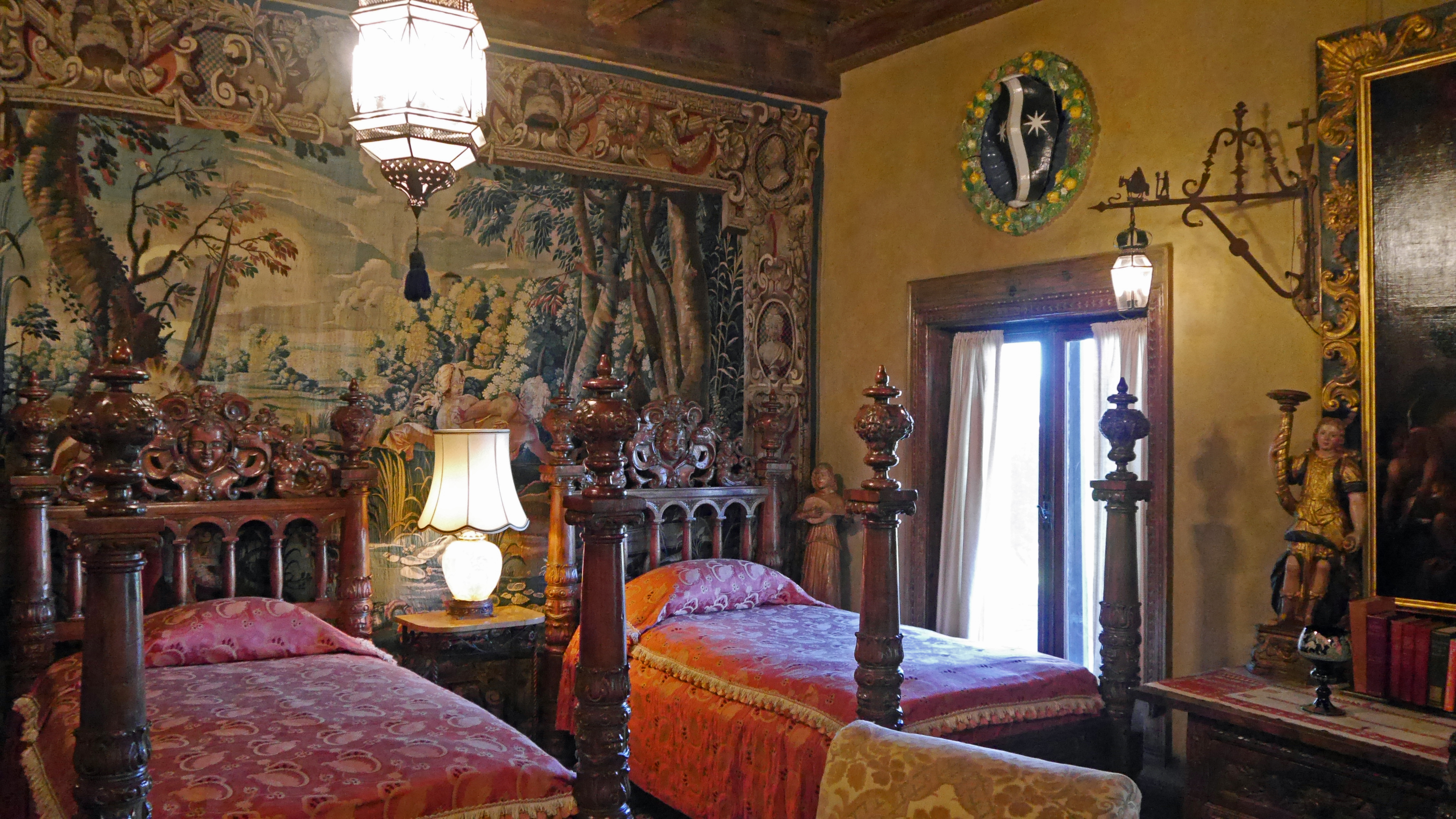
The North Deck guest bedroom.
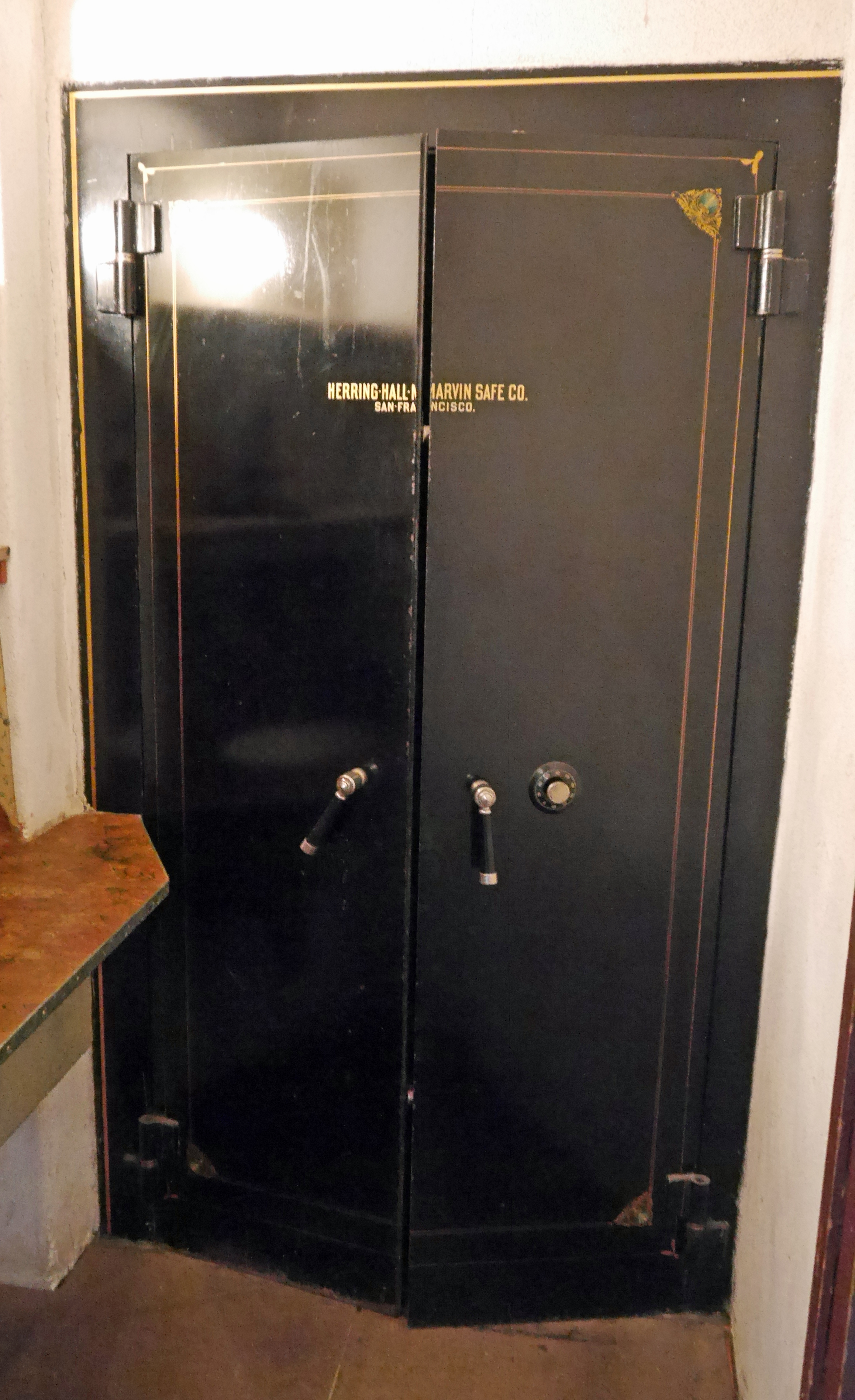
The giant safe where guests could lock their valuables. Weapons were also stored in this safe.
Santa Barbara
We left Hearst Castle in the late afternoon and set off towards Santa Barbara. While we had taken a leisurely drive down The Big Sur in the morning, we were now in a hurry as we wanted to catch a movie at the drive-in in Santa Barbara. Being great drive-in fans, we had hoped to go to a few them on our trip. However, 73 days in, and we hadn’t been to one. This was going to be rectified in Santa Barbara!
Thankfully, we arrived in Santa Barbara in time and after checking in to a cheap hotel, we set off to the drive-in in the nearby suburb of Goleta. Being a week night, there weren’t a lot of people there but this may also be due to the bleakness of the place. We saw Lucy and Let’s Be Cops while we ate the worst food of our journey. Not the best drive-in experience but we take what we can get these days.

The West Wind Drive-In at Goleta. This is taken from the Internet as we didn’t take any pictures. However, I think it properly captures the bleakness of the place.

I was also surprised to find this photo on the West Wind’s site itself. This is exactly what we ate for dinner as we watched the movies. The West Wind called it “Nachos” but really it was just stale tortilla chips and melted plastic cheese. Not a place for foodies. Or indeed, anyone with tastebuds.
Camarillo
The next morning we headed off down the Ventura Highway in the sunshine for some retail therapy at the massive factory outlets at Camarillo. The place was the size of a small suburb with over 160 shops on 63,000 square metres of land. Like most American malls, you needed to drive to get from one end of the mall to the other. So, we made sorties into shops before re-grouping to drive to the next section of the mall. The range of shops was great and we bagged quite a few bargains on some good quality clothes.

This is an aerial shot from Google Maps of the Camarillo Outlets. Everything within the red line are shops and you can get a sense of scale by looking at the tiny dots on the highway that are cars.

We were proud to see Australia wasn’t left behind in the fashion stakes with an upmarket UGG Boot shop. All we could say was “Ugg,”
Having shopped ourselves out, we headed off to brave the traffic in to Los Angeles Airport where we had to drop off our hire car and spend our last seven days in L.A.
 ourtripyall.com